

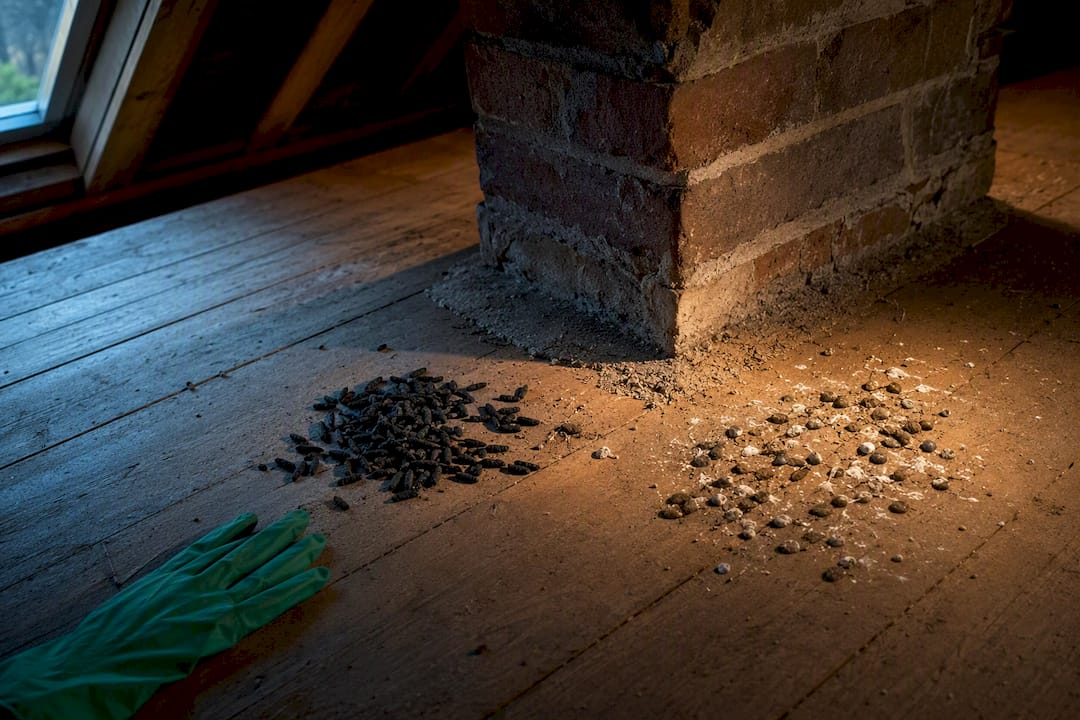
Bat guano forms dark, crumbly, pellet-shaped droppings that often crumble to powder, while bird droppings are two-toned, with a white or cream urate cap over a darker paste. Both can harbour fungal spores that cause histoplasmosis when accumulations are disturbed. If you find a mound or streaking pattern and cannot confirm what left it, avoid stirring the material and treat it as a health hazard until you know more.
TL;DR:
- Bat guano appears as dark, pellet-shaped droppings about 6 to 10 millimeters long, with no white cap, unlike bird droppings which have a white urate cap and a paste-like texture.
- The crumble test reveals guano as powder with a faint glitter of insect exoskeletons, while rodent droppings remain solid and do not contain insect fragments.
- Disturbed accumulations of bat or bird droppings can aerosolize fungal spores that cause histoplasmosis, especially if they have sat undisturbed for months or years.
- Professional removal is advised for large, enclosed, or high-risk areas, since controlled methods with HEPA filtration and lab testing ensure safety.
- Never perform dry sweeping or power washing on droppings, and always use protective gear, wet the material beforehand, and seal waste in heavy plastic bags.
Table of Contents
- How to tell bat guano from bird droppings
- What histoplasmosis risk means for droppings in your home
- How to safely clean up a small guano or dropping accumulation
- When to bring in a hazardous-material removal professional
- Keeping bats and birds from coming back
- Guano as fertilizer: why household droppings are not the same thing
- What years of cleanup calls teach you about droppings
- Professional guano cleanup and testing from MSN Environmental
- Where to find more detail on the health guidance
- Sources
- FAQ
How to tell bat guano from bird droppings
The fastest way to separate the two starts with colour and shape. Bat guano is uniformly dark brown or black, shaped like small pellets, usually between about 6 and 10 millimetres long, and shows no white component anywhere in the dropping. Bird droppings almost always show two tones: a white or cream cap of uric acid sitting over a darker, softer centre, and the overall texture leans toward a paste or a dried splatter rather than a solid pellet.
Texture is the second clue, and it is where the well-known crumble test comes in. Bat guano, when dry, breaks apart into a fine, powdery dust with light pressure, and you may notice a faint glitter inside it. That glitter is undigested insect fragments, mostly the hard exoskeleton material called chitin, left over from a bat’s diet. Bird droppings do not crumble the same way. They tend to flake, smear, or dry into a hardened crust rather than collapsing into dust, and they never contain insect fragments because birds process food differently.
Location and pattern matter as much as the material itself. Bat droppings collect in mounds directly below a roost, often in an attic corner, behind a chimney, or along a wall where bats cluster during the day. Bird droppings show up as streaking below a regular perch, such as a windowsill, ledge, or beam, because birds move around more and do not cluster in one exact spot the way roosting bats do. If you are checking an attic, a mound that keeps growing in the same footprint over weeks is a strong sign of an active bat roost rather than a one-time bird visit.
Rodent droppings are the other common mix-up. Mouse and rat pellets are similar in size to bat guano but are harder, do not crumble easily, and never contain insect fragments. If a sample passes the crumble test and glitters, it is guano. If it stays solid and dense, you are likely looking at rodent droppings instead, which carry their own separate health concerns.
None of this replaces a lab test when the stakes are high, particularly in a daycare, a food-handling space, or a building with vulnerable occupants. Visual identification is a solid first filter, but the Canada makes clear that either dropping type can carry the fungus, so uncertainty should push you toward caution rather than a guess.
A few identifiers to keep in mind before touching anything:
- Colour and cap: bird droppings show a white or cream urate cap, bat guano does not.
- Shape: bat guano forms discrete pellets, bird droppings tend toward smears or streaks.
- Crumble test: guano breaks into powder and may glitter with insect fragments, rodent droppings stay firm.
- Location pattern: mounds under a roost point to bats, streaking under a perch points to birds.
Pro Tip: Never perform the crumble test bare-handed. Use disposable gloves, a mask rated for fine particulates, and work over a surface you can wipe down or discard afterward.
What histoplasmosis risk means for droppings in your home
Histoplasmosis comes from a fungus called Histoplasma capsulatum, which grows in soil enriched by bird or bat droppings over time. The fungus itself does not live in fresh droppings. It develops in accumulations that have sat undisturbed, often for months or years, and its spores become airborne the moment that material is scraped, swept, or blown around. Once inhaled, those spores can settle in the lungs and cause an infection that ranges from no noticeable symptoms to a serious respiratory illness.
According to the Canada.ca pathogen safety data sheet, symptoms typically appear one to three weeks after exposure, and severe disease is more likely in people who are immunocompromised. Most healthy adults who inhale a small number of spores never develop symptoms at all, but the range runs from a mild flu-like illness to a life-threatening infection in people with weakened immune systems, and the outcome depends heavily on how much material was disturbed and how contained the space was.
A single disturbed accumulation of bat or bird droppings can aerosolize enough fungal spores to cause histoplasmosis in anyone who breathes the dust, regardless of the species that left the droppings. That single fact is why identification matters less than caution once you know an accumulation exists.
Geography plays a role too. Case reports gathered through the Canada Communicable Disease Report note that histoplasmosis has turned up in people with no travel history to classic endemic zones, and public-health writers point out that the illness is likely underreported because so many cases are mild or symptomless. That underreporting is part of why conservative handling makes sense even when a case looks minor: you cannot tell from the outside how much fungal material an accumulation is hiding.
If you develop a fever, dry cough, chest pain, or fatigue within a few weeks of clearing droppings, mention that exposure to a doctor directly. Histoplasmosis is often missed because its early symptoms mimic a common cold or flu, and testing depends on the physician knowing to look for it.
How to safely clean up a small guano or dropping accumulation
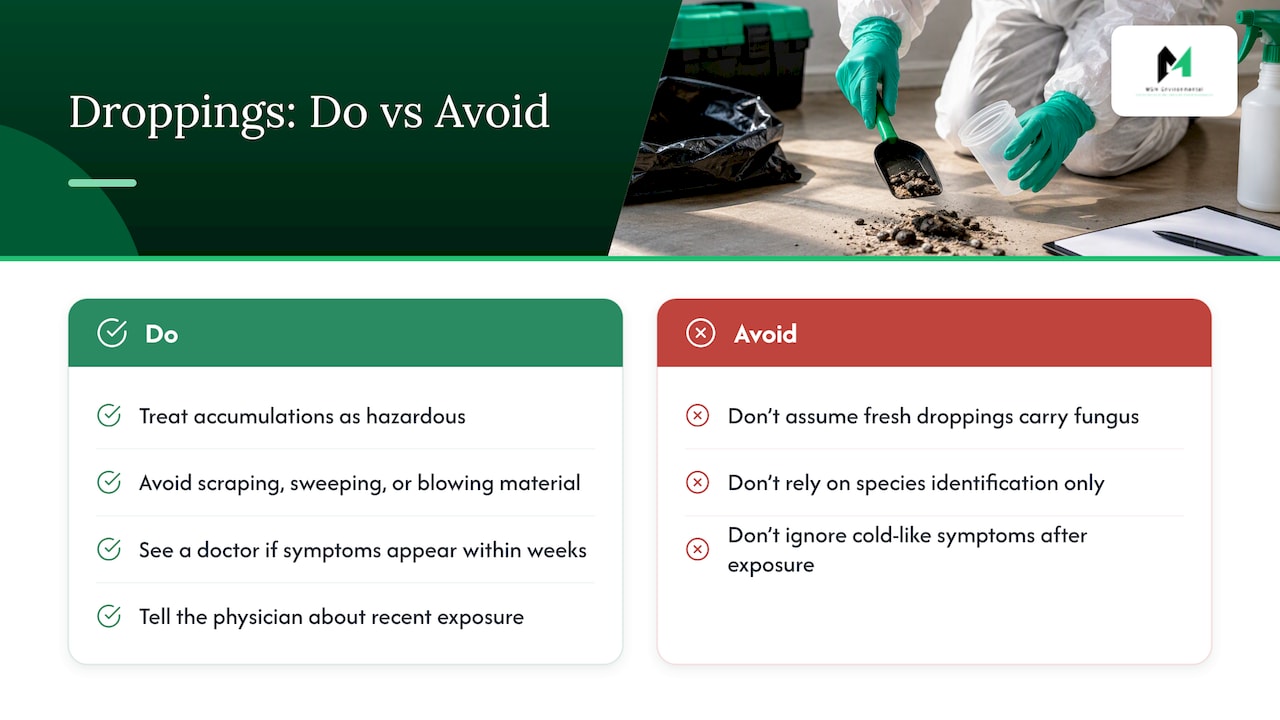
Small accumulations, think a thin layer along an eave, a light dusting on an attic floor, or a scattering under a single perch, can sometimes be handled without a full remediation crew. The CDC and NIOSH guidance on histoplasmosis sets out a hierarchy of controls that starts with avoiding disturbance altogether, then moves to engineering controls like wetting agents and HEPA filtration, and treats personal protective equipment as the last line of defence rather than the first.
If you decide a small area is safe to clean yourself, follow these steps in order:
- Check the space first. Confirm ventilation, occupant risk (pregnant, very young, elderly, or immunocompromised people should not be present or nearby), and how much material you are dealing with.
- Wet the material before touching it. A light mist of water or a diluted disinfectant keeps spores from becoming airborne when disturbed.
- Wear a properly fitted N95 respirator, not a paper dust mask, along with disposable gloves and eye protection.
- Scoop, never sweep. Use a dustpan or a HEPA-filtered vacuum where available; dry sweeping and leaf-blowing throw spores into the air.
- Bag the waste in a sealed plastic bag, double-bagged if the accumulation is more than a light dusting, and dispose of it with regular household waste unless local rules say otherwise.
- Wash exposed skin and change clothes immediately after finishing, and launder those clothes separately.
Avoid power washing droppings off exterior surfaces too. It feels efficient, but it aerosolizes the exact spores you are trying to avoid breathing, and it spreads contaminated water across a wider area. The same caution applies to shop vacuums without HEPA filtration, which can pass fine spores straight through the exhaust.
Pro Tip: If you smell a musty, ammonia-like odour before you even see the droppings, treat the space as a larger accumulation than it looks and stop before scooping anything.
For a closer look at where the line sits between a small job and one that needs a professional, our guide on when a homeowner can safely handle a small guano cleanup walks through the size and location thresholds in more detail, and our attic guano cleanup page covers containment specifics for enclosed roof spaces.
When to bring in a hazardous-material removal professional
Some situations are not homeowner jobs, no matter how careful you are. Call a certified remediation company when any of the following apply:
- The accumulation covers a wide area or has built up over multiple seasons, not just a light dusting.
- The space is enclosed with poor airflow, such as a sealed attic or a crawl space with limited access points.
- Anyone in the home is pregnant, very young, elderly, or immunocompromised.
- You see visible mould or fungal growth mixed into the droppings.
- You cannot confidently tell whether the material is bat guano, bird droppings, or rodent waste.
Professional remediation typically includes containing the work area to stop spores from spreading to the rest of the building, collecting bulk or air samples for lab testing, using HEPA-filtered vacuum systems and wetting agents to suppress dust during removal, and disposing of contaminated material through certified waste channels. That combination of testing and controlled removal is difficult to replicate with household equipment.
Before you call, take a few photos of the accumulation and its location, note roughly how long it has been there if you can, and mention any occupants who fall into a higher-risk category. That information lets a technician scope the job accurately before ever stepping on site, and our testing and inspection services can confirm contamination levels if you want verification before or after cleanup.
Keeping bats and birds from coming back
Cleaning up an accumulation solves today’s problem, not next year’s. Exclusion work closes the gaps that let animals in and stops droppings from building up in the same spot again.
- Seal obvious entry points first, gaps in soffits, vents, and roofline gaps are common access spots for bats.
- Install one-way exclusion devices on active bat entries, but never during maternity season, since trapping flightless pups inside creates a bigger problem than the one you started with.
- Add physical bird deterrents, such as angled ledges or spike strips, on window sills and beams where birds regularly perch.
- Trim overhanging branches that give birds and bats easy access to roof edges and eaves.
Cheap deterrents like reflective tape or plastic owls tend to fail within weeks because the animals adjust. Durable solutions rely on physically blocking access or making a surface unusable for perching, not on scaring animals away temporarily. A quick seasonal check of eaves, vents, and attic corners catches a new roost early, before droppings accumulate into the kind of job that needs a wetting agent and a respirator.
Guano as fertilizer: why household droppings are not the same thing
Bat guano has a real history as fertilizer. Deep cave deposits, harvested commercially, carry high nitrogen and phosphate content, and that value is why guano mining became an industry in the first place, as described in general background on guano’s use in agriculture. Processed, packaged guano fertilizer still shows up in garden centres for that reason, and bird droppings share a broadly similar nutrient profile in smaller concentrations.
What is in your attic is not that product. Household accumulations sit uncontrolled, mixed with dust, insulation fibres, insect remains, and whatever fungal growth has taken hold, and there is no way to know their pathogen load without lab testing. That is a meaningful difference from a bagged product that has been dried, treated, and screened before sale.
- Do not compost or spread attic or roof droppings in a garden bed without testing.
- Commercial guano fertilizer is safe because it has been processed under controlled conditions, unlike raw household accumulations.
- Dispose of small amounts as sealed household waste, and let a professional handle anything large enough to need bulk removal.
What years of cleanup calls teach you about droppings
Homeowners make the same mistake over and over: they see a small pile of droppings and reach for a broom before thinking about what might be in the dust. Dry sweeping is the single most common way a manageable situation turns into a bigger one, because it takes fungal spores that were sitting still and puts them into the air for everyone nearby to breathe.
Containment sounds like overkill for a small job until you have watched a five-minute cleanup turn into a multi-room air-quality problem because nobody sealed off the work area first. Professionals default to plastic sheeting, negative air pressure, and wetting agents not because every job needs a full hazmat setup, but because the cost of skipping those steps only shows up after the spores have already spread. Treat every accumulation as if it might be worse than it looks, and you will rarely regret it.
— Moacyr
Professional guano cleanup and testing from MSN Environmental
If a dropping accumulation in your attic, eaves, or roofline meets any of the red flags covered earlier, wide coverage, an enclosed space, or occupants at higher health risk, it is worth getting a professional opinion rather than guessing. Professional services can include bat guano cleanup and decontamination alongside asbestos, mould, and other hazardous material removal, using containment, wetting agents, and HEPA-filtered equipment to keep spores from spreading during the job.
Contact starts with a site assessment: a technician looks at the extent of the accumulation, checks ventilation and access, and builds a scope of work before anything is removed. If you are unsure whether droppings, visible growth, or air quality in the space need lab confirmation, the same visit can include bulk and air sampling to settle the question.
- Attic and eave guano cleanup with contained removal and certified disposal.
- Air and bulk testing to confirm contamination before or after cleanup.
- HEPA-filtered vacuum systems and wetting agents to limit airborne spores during the job.
| What you get | What it covers |
|---|---|
| Site assessment | On-site inspection, scope of work, containment plan |
| Guano cleanup and decontamination | Contained removal, wetting agents, certified disposal |
| Testing services | Bulk sampling, air quality testing for contamination confirmation |
Reach out through Msnenvironmental to book an assessment if your accumulation matches the conditions described above.
Where to find more detail on the health guidance
For readers who want the primary guidance behind the safety steps in this article, a few sources cover the clinical and occupational side in more depth.
- The Canada covers the organism, exposure routes, and illness severity.
- CDC and NIOSH guidance on elimination and engineering controls explains dust suppression, ventilation, and respirator use during cleanup work.
- A review of occupational histoplasmosis outbreaks ties most cases back to disturbed accumulations and recommends exclusion as the strongest long-term prevention.
- General guidance on cleaning bird droppings safely covers surface cleanup precautions relevant to vehicles and exterior areas.
This article is general information, not a substitute for advice from a qualified doctor. Consult a qualified healthcare professional about your own circumstances before acting on anything here.
Sources
- Canada
- Reducing risk for histoplasmosis (CDC/NIOSH)
- Occupational histoplasmosis: epidemiology and prevention measures (CDC stacks PDF)
FAQ
Is guano bat poop or bird poop?
Guano most commonly refers to bat droppings, particularly the pellet-shaped accumulations found in caves, attics, and roost sites, though the term is sometimes used more broadly for seabird droppings harvested for fertilizer. In everyday use around homes, “guano” almost always means bat droppings specifically.
Why did we stop using guano as fertilizer?
Guano never fully stopped being used. Commercial harvesting declined sharply after synthetic nitrogen fertilizers became widely available and cheaper to produce, but processed bat and bird guano is still sold as fertilizer, just at a much smaller scale than its historical peak as described in general background on guano’s agricultural history.
How long is bat guano toxic to humans?
Bat guano itself is not toxic in the way a poison is, but old accumulations can harbour Histoplasma capsulatum fungus indefinitely as long as the material stays undisturbed and conditions support fungal growth. Disturbing that material, even years after it was deposited, can release spores capable of causing histoplasmosis.
How long does bat guano take to break down?
Breakdown speed depends heavily on moisture, temperature, and airflow, so there is no single fixed timeline, and dry attic conditions can preserve droppings for years rather than weeks. Because decomposition rate varies so widely by environment, treat any accumulation as a potential fungal hazard regardless of how old it looks.
What is the safest way to check if droppings are from bats or birds?
Look for colour and shape first: bat guano is uniformly dark and pellet-shaped, while bird droppings usually show a white or cream cap over a darker base. If you need to confirm further, the crumble test done with gloves and a respirator, checking whether the material breaks into powder with visible insect fragments, is a reliable field indicator, though lab testing remains the only way to confirm fungal contamination.