

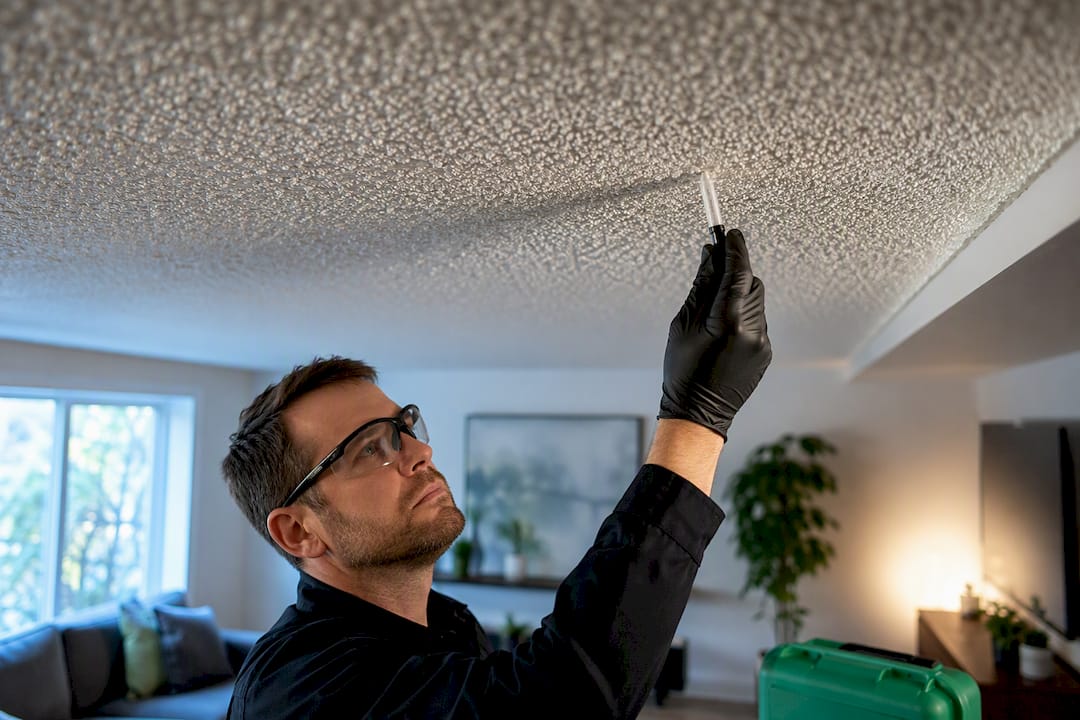
If you suspect your popcorn ceiling contains asbestos, stop scraping, sanding, or drilling and arrange professional testing before you touch anything else. In most cases where testing confirms asbestos, professional abatement or enclosure is the safer route than DIY removal. If renovations are already planned, get a pre-renovation asbestos survey done first so your contractor has a clear scope before demolition starts.
TL;DR:
- Professional asbestos testing with accredited lab analysis is essential, and sample collection must be done carefully by qualified individuals to ensure accurate results.
- Disturbing an asbestos-containing ceiling through scraping or sanding releases hazardous fibres, even if the material appears undisturbed and intact.
- Encapsulation or enclosure over a non-friable, sealed ceiling is temporary, while removal provides a permanent solution and compliance with safety standards.
- Full abatement involves specific procedures, containment, waste tracking, and clearance testing, with costs varying based on room size, condition, and regulatory requirements.
- DIY removal is high risk due to fibre release and improper cleanup, making professional services the safest, most reliable option.
Table of Contents
- How do you confirm a popcorn ceiling contains asbestos?
- Why disturbing asbestos ceiling texture is dangerous
- Should you leave it, encapsulate it, or remove it?
- What a professional removal job actually involves
- Why DIY removal is riskier than it looks
- What removal and disposal actually cost
- What homeowners consistently get wrong about asbestos
- How MSN Environmental supports homeowners through this process
- Sources
- FAQ
How do you confirm a popcorn ceiling contains asbestos?
Visual inspection cannot tell you whether a textured ceiling contains asbestos. Laboratory analysis of a bulk sample is the only way to confirm it, and accredited lab analysis of that sample is what determines the material’s type and concentration. Homeowners can hire a qualified sampler or occupational hygienist rather than attempt a home test kit, since proper chain of custody matters for the result to hold up if you later need documentation for renovation permits or resale.
A trained sampler takes a small piece of the texture, using a light water mist to limit dust, then bags and seals it before it reaches the lab. This is not a job for a shop vacuum or a power sander, both of which spread fibres rather than contain them.
- The sampler wets the area lightly and cuts a small section by hand, avoiding any rotary or powered tool.
- The sample goes into a sealed, labelled bag with chain-of-custody paperwork attached.
- The lab report identifies the asbestos type, its percentage by weight, and whether the material is friable or non-friable.
- A friable result (crumbles easily by hand) generally means higher risk and more caution during any future work; a non-friable, intact result generally means lower urgency.
Our bulk sampling guide walks through what a compliant sampling report should include if you want to check your contractor’s paperwork against it.
Why disturbing asbestos ceiling texture is dangerous
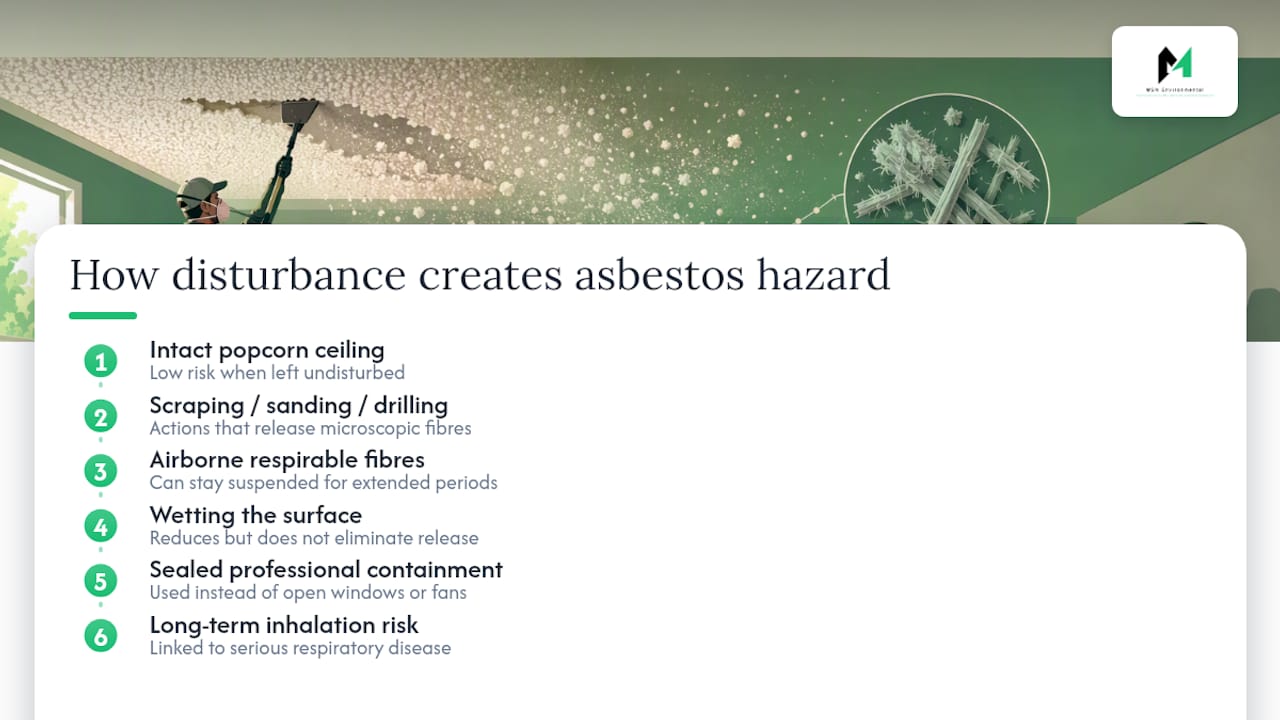
Asbestos in an undisturbed popcorn ceiling is generally low risk. Health Canada guidance states that asbestos-containing material is not dangerous when it is intact and left alone, but disturbance releases microscopic fibres that pose serious health risks once airborne. Scraping, sanding, drilling, or cutting through a textured ceiling are exactly the actions that turn a stable material into a breathing hazard.
Renovation activities like scraping and sanding commonly release respirable fibres, and published research on renovation exposure notes that wetting the surface first reduces but does not eliminate that release. Fibres are small enough to stay suspended in room air for extended periods, which is why professional work relies on sealed containment rather than open windows or fans. Long-term inhalation of asbestos fibres is linked to serious respiratory disease, which is the reason regulators treat disturbance, not mere presence, as the trigger for controls.
Should you leave it, encapsulate it, or remove it?
The right choice depends on the ceiling’s condition and your renovation plans, not on a blanket rule.
- Leave it undisturbed when the texture is intact, painted, and no renovation will touch it: routine dusting with a damp cloth is fine, dry dusting or vacuuming is not.
- Encapsulate or enclose when the material is in good condition but you want a permanent barrier: a sealant coating or a new layer such as drywall installed over the texture without disturbing it, an approach occupational health guidance accepts as a non-removal alternative, though it adds a maintenance layer rather than eliminating the material.
- Remove it when the ceiling is damaged, flaking, or friable, or when your renovation plan requires drilling, cutting, or full demolition of that surface.
Encapsulation is cheaper up front but has a practical lifespan tied to the coating or enclosure material, and any future renovation that breaks through it reopens the same exposure question. Removal costs more initially but closes the issue permanently once clearance testing confirms the air is clean.
Pro Tip: If you’re planning a kitchen or bathroom remodel that touches the ceiling anyway, factor removal into that same project rather than paying for encapsulation now and removal again later.
What a professional removal job actually involves
A compliant abatement job follows a sequence, not a single afternoon of work. CCOHS abatement guidance describes site assessment, a written scope of work, containment, supervised removal, and documented waste handling as the standard framework.
- A designated-substance survey and bulk sampling confirm the material and generate a written scope before any notifications go out.
- The crew seals the room with poly sheeting, isolates the HVAC system, and sets up negative-pressure HEPA units so air only flows in one direction, out through filtration.
- Technicians wet the material and remove it using non-powered tools or glove bags, working in sections rather than all at once.
- Waste goes into sealed, double-bagged containers with a manifest documenting where it goes for disposal.
- Once removal is done, an independent clearance air sample confirms fibre counts are back to an acceptable level before the containment comes down.
Before you sign a contract, ask for proof of technician certification, liability insurance, and a sample of the clearance report format they use. Ontario’s O. Reg. 278/05 sets out Type 1 through Type 3 work classifications and the containment requirements tied to each, so a legitimate contractor should be able to tell you which type applies to your ceiling and why.
- Written scope of work and designated-substance survey results
- Containment plan matched to the regulation’s work classification
- Clearance air sampling report before containment removal
Why DIY removal is riskier than it looks
Scraping, sanding, or running a power sander over textured ceiling material is the single most effective way to fill a room with airborne fibres, and no amount of plastic sheeting from a hardware store replicates sealed negative-pressure containment. There are narrow exceptions for very small, non-destructive repairs, but Ontario’s regulatory guide ties those exceptions to specific area thresholds, and exceeding them without knowing it is a common mistake. If you are unsure whether your situation qualifies, ask a professional before starting.
Improper cleanup, using a household vacuum or dry sweeping, spreads fibres into carpets, HVAC ducts, and adjoining rooms, which turns a contained problem into a whole-house one.
- Never dry sand, scrape, or drill into suspected asbestos texture.
- Never use a shop vacuum or leaf blower to clean debris.
- Restrict access to the room and keep children and pets out until testing is done.
- Seal or cover any vents in the room to limit air movement while you wait for a professional assessment.
Pro Tip: If you’ve already disturbed the ceiling before reading this, close the door, turn off the HVAC fan, and avoid re-entering until a professional has assessed the room.
What removal and disposal actually cost
Costs vary with the scope of work, but the components are consistent: testing, containment setup, labour, disposal fees, and clearance air testing after the work is done. Room access, ceiling condition, and whether other hazardous materials are present alongside the asbestos all push the price up or down, and a room requiring full negative-pressure containment will always cost more than one qualifying for a limited, lower-risk procedure under Ontario’s regulatory thresholds.
Asbestos waste cannot go out with regular curbside trash. It must be double-bagged, labelled, and tracked through a manifest to a licensed disposal facility, the same documentation trail CCOHS abatement standards describe as standard practice.
- Testing and sampling
- Containment setup and teardown
- Labour for removal
- Licensed hazardous waste disposal
- Post-removal clearance air testing
Keep every report and manifest. They matter for your own records and can matter again at resale, when buyers or their inspectors ask for proof the work was done properly.
What homeowners consistently get wrong about asbestos
The most persistent myth is that painting over a popcorn ceiling seals the asbestos in for good. It does not: paint can make the surface harder to wet properly during later removal, which actually complicates the job rather than solving it. The homeowners who avoid trouble are the ones who ask for a written clearance report and get a pre-renovation survey before any demolition begins, not after.
— Moacyr
How MSN Environmental supports homeowners through this process
Testing before touching anything is the safest and cheapest step you can take, and it also starts with testing before touching anything for every homeowner call. Services typically include bulk sampling, air quality testing, and designated substance surveys, then moving into full abatement when a ceiling needs to come down, with clearance testing and written reports at the end so you have documentation on file.
When you’re comparing quotes, ask each contractor for the same things: a written scope of work, the containment plan matched to the applicable work classification, how disposal is documented, and a sample clearance report. Those details tell you more about a quote’s quality than the price alone.
- Request bulk sampling or a pre-renovation survey before any demolition date is set.
- Confirm the quote includes containment, disposal manifests, and post-removal clearance testing.
- Have your ceiling’s age, square footage, and any known damage ready when you call.
Reach out through our asbestos removal services page for an estimate, or start with testing and inspection services if you just need answers before deciding on next steps.
This article is general information, not a substitute for advice from a qualified doctor. Consult a qualified healthcare professional about your own circumstances before acting on anything here.
Sources
- O. Reg. 278/05 — Designated Substance: Asbestos
- Scientific literature on asbestos exposure and renovation risks (NCBI/PMC)
FAQ
What happens if I remove a popcorn ceiling with asbestos myself?
Scraping or sanding releases fibres into the air that can remain suspended and settle into carpets, ductwork, and adjoining rooms, according to research on renovation exposure. Wetting the surface reduces but does not eliminate fibre release, so professional containment is the standard recommendation rather than a home attempt.
How much does it cost to remove asbestos from a popcorn ceiling?
Costs depend on testing, containment setup, labour, disposal fees, and clearance air testing, and MSN Environmental’s asbestos removal services page has pricing available on request based on your ceiling’s size and condition. Friable material and rooms needing full negative-pressure containment typically cost more than smaller, lower-risk jobs.
Is it safe to drywall over an asbestos popcorn ceiling?
Enclosing a popcorn ceiling with a new layer such as drywall, without disturbing the texture underneath, is an accepted alternative to removal according to occupational health guidance, provided the material stays intact and undisturbed during installation. It is not a permanent fix if a later renovation cuts through the enclosure and exposes the material again.
How likely is a popcorn ceiling to contain asbestos?
Homes built before 1990 are likely to contain asbestos in building materials, including textured ceiling finishes, according to Health Canada. The only way to know for certain is laboratory testing of a bulk sample taken by a qualified sampler.