

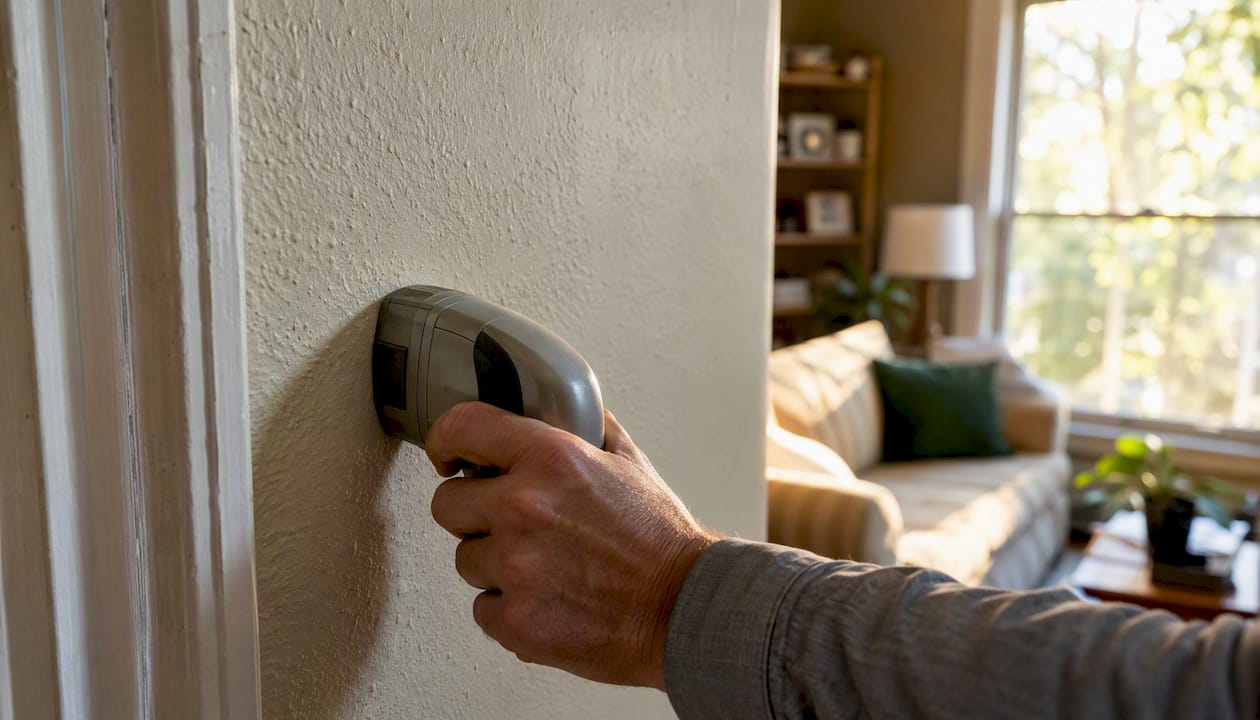
XRF lead testing is the accepted field standard for identifying lead-based paint in residential and commercial buildings. A certified operator can scan a painted surface and get a result in seconds, without removing any paint. That speed and non-destructive approach make it the go-to method for pre-renovation inspections, real-estate disclosures, and routine housing surveys across Canada.
When is XRF alone sufficient? For most residential inspections, real-estate disclosure requirements, and renovation pre-tests, a properly documented XRF inspection by a certified operator is enough. When it is not: OSHA-style construction exposure compliance, deeply layered or textured paint, and any reading that falls in the inconclusive range all call for laboratory confirmation.
Immediate next steps based on your XRF result:
- Positive result: Stop any planned disturbance work. Contact a certified abatement contractor to assess the scope and plan safe removal or encapsulation.
- Negative result: Document the report and keep it on file for renovation permits and real-estate transactions.
- Inconclusive result: Do not proceed as if the surface is lead-free. Arrange paint-chip sampling for laboratory analysis before any work begins.
Pro Tip: Ask your inspector for the instrument’s Performance Characteristic Sheet before work starts. If they cannot produce it, the inspection may not be legally valid.
Key takeaways
XRF lead testing is reliable for residential inspections when performed by a certified operator following the instrument’s PCS, but inconclusive results always require laboratory confirmation before work proceeds.
| Point | Details |
|---|---|
| XRF is the field standard | Handheld XRF reports lead in mg/cm² non-destructively and is accepted for most residential inspections. |
| PCS compliance is mandatory | The instrument’s Performance Characteristic Sheet defines valid thresholds; inspections without it may be legally invalid. |
| Inconclusive means lab confirmation | Any reading in the inconclusive band requires paint-chip sampling via AAS or ICP before work begins. |
| Certified operators matter | Calibration checks, substrate corrections, and documented QA/QC under ASTM E2119 are what make a report defensible. |
| MSN Environmental covers the full scope | Certified XRF testing, PCS-compliant reporting, and abatement services across Ontario from a single provider. |
Table of Contents
- How XRF detects lead in paint
- What XRF can and cannot measure accurately
- How a professional XRF inspection is performed
- When XRF is enough and when you need a lab
- Cost, practicalities and renting vs hiring in Canada
- Interpreting positive or inconclusive results: what to do next
- Why certified inspectors and abatement contractors matter
- What practitioners often get wrong about XRF
- MSN Environmental: certified lead testing and abatement in Ontario
- Sources
- FAQ
How XRF detects lead in paint
X-ray fluorescence works by directing a beam of X-rays at a painted surface. The energy excites lead atoms in the paint, which then emit a characteristic fluorescence signal. The instrument’s detector reads that signal and converts it to a concentration value expressed in milligrams per square centimetre (mg/cm²). A result is typically available in under 10 seconds without removing or disturbing the paint, which is why field XRF is the primary accepted method for housing inspections.
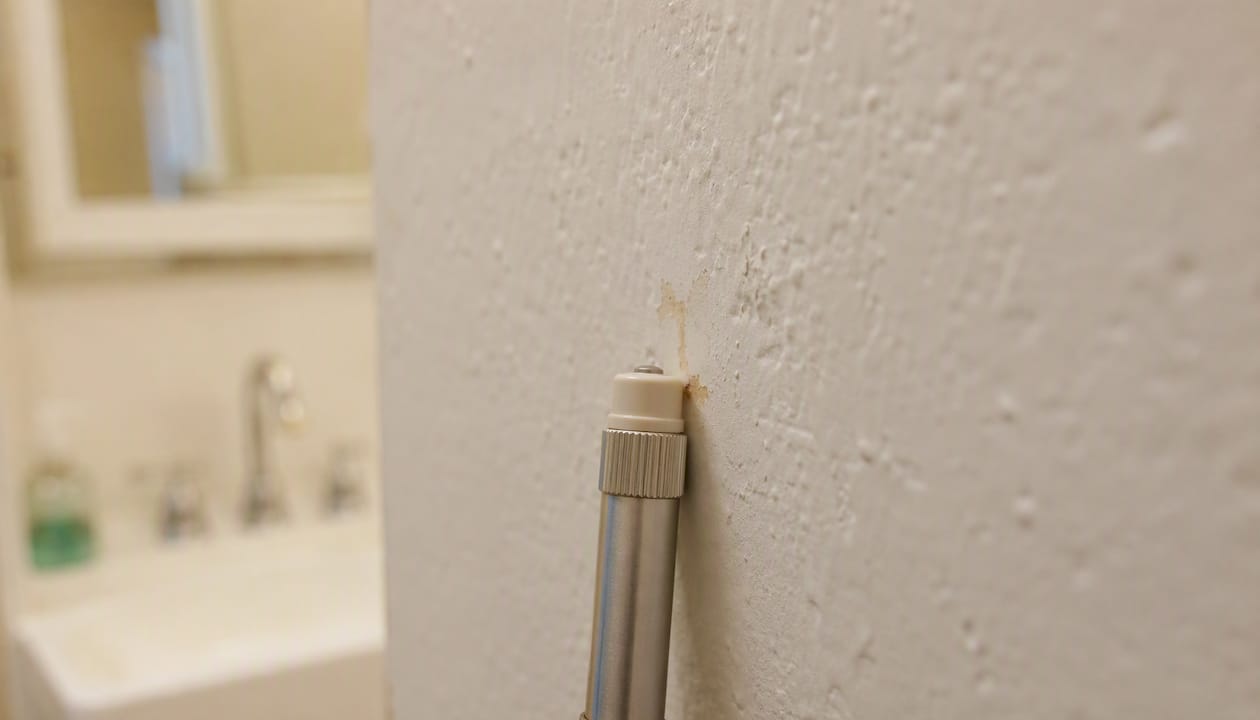
The mg/cm² unit matters. It measures the total mass of lead across all paint layers on a given area, which is more meaningful for hazard assessment than percent by weight when you are dealing with multiple coats of unknown thickness. A surface with thin but heavily leaded paint can read very differently from one with thick, low-lead paint, and mg/cm² captures that distinction directly.
Two device types are in common use. Radioisotope-source XRFs use a radioactive source to generate the excitation beam. They tend to penetrate more deeply through multiple paint layers, which is useful on older buildings with many coats, but they require licensing, transport permits, and regulated disposal. X-ray-tube devices generate their beam electronically, so there is no isotope to license or dispose of, and they are simpler to travel with. The trade-off is that they can struggle with very deeply buried lead under many coats of paint.
Pro Tip: Keep the probe flat and in firm, full contact with the surface during each reading. Even a slight tilt or air gap between the probe face and the paint changes the geometry of the measurement and can shift the result.
What XRF can and cannot measure accurately
XRF is fast and reliable within its limits, but those limits are real and worth understanding before you rely on a report.
Detection limits and what they mean in practice. Modern handheld XRF instruments typically detect lead at concentrations well below the 1.0 mg/cm² threshold used by HUD and EPA as the reference level for lead-based paint. In practice, readings near that threshold require more care. A surface reading 0.7 mg/cm² on a smooth wall is a different situation from the same reading on a rough brick substrate, because the substrate itself affects the measurement.
Common sources of measurement error:
- Substrate bias: The material beneath the paint (wood, drywall, plaster, brick) emits its own fluorescence signal. If the instrument is not corrected for that substrate, the lead reading can be artificially elevated or suppressed.
- Multiple paint layers: Deeply buried lead under many coats of newer paint may be partially shielded, potentially producing a lower reading than the actual lead content.
- Textured or uneven surfaces: Gaps between the probe and a rough surface reduce measurement accuracy. Textured stucco, brick, and ornate trim are the most common problem areas.
- Interfering elements: Barium (common in white paints) and other heavy elements can overlap with lead’s fluorescence signal and inflate readings on some instrument models.
- Calibration failures: An instrument that has not been checked against a known standard before and after a session can drift, making every reading on that day unreliable.
Results are classified as positive, negative, or inconclusive. The specific thresholds depend on the instrument model and its Performance Characteristic Sheet (PCS). The HUD guidelines define an inconclusive band for each instrument where neither a positive nor a negative determination can be made without lab confirmation.
1.0 mg/cm² is the HUD/EPA reference level for lead-based paint. Readings at or above this threshold are classified as positive. Readings in the inconclusive band require paint-chip sampling regardless of how close they are to the threshold.
Early instrument designs showed that geometry and computational corrections could achieve approximately 95% confidence in quantitative lead measurements, which illustrates how much instrument design and correction methodology matter to result quality.
Pro Tip: Never read a single XRF value in isolation. Look at the full set of readings for a component, the substrate correction applied, and the instrument’s stated uncertainty range for that substrate before drawing a conclusion.
How a professional XRF inspection is performed
A certified inspector does not simply walk through a building pointing a device at walls. The protocol is structured, documented, and tied to the specific instrument being used.
The Performance Characteristic Sheet
Every XRF instrument model has a PCS that defines its positive, negative, and inconclusive ranges for each substrate type, its calibration tolerances, and its substrate-correction procedures. Following the PCS is a regulatory requirement in many inspection frameworks. An inspector who uses a device without its current PCS, or who applies the wrong substrate corrections, produces results that may be legally invalid.
Sampling strategy and substrate correction
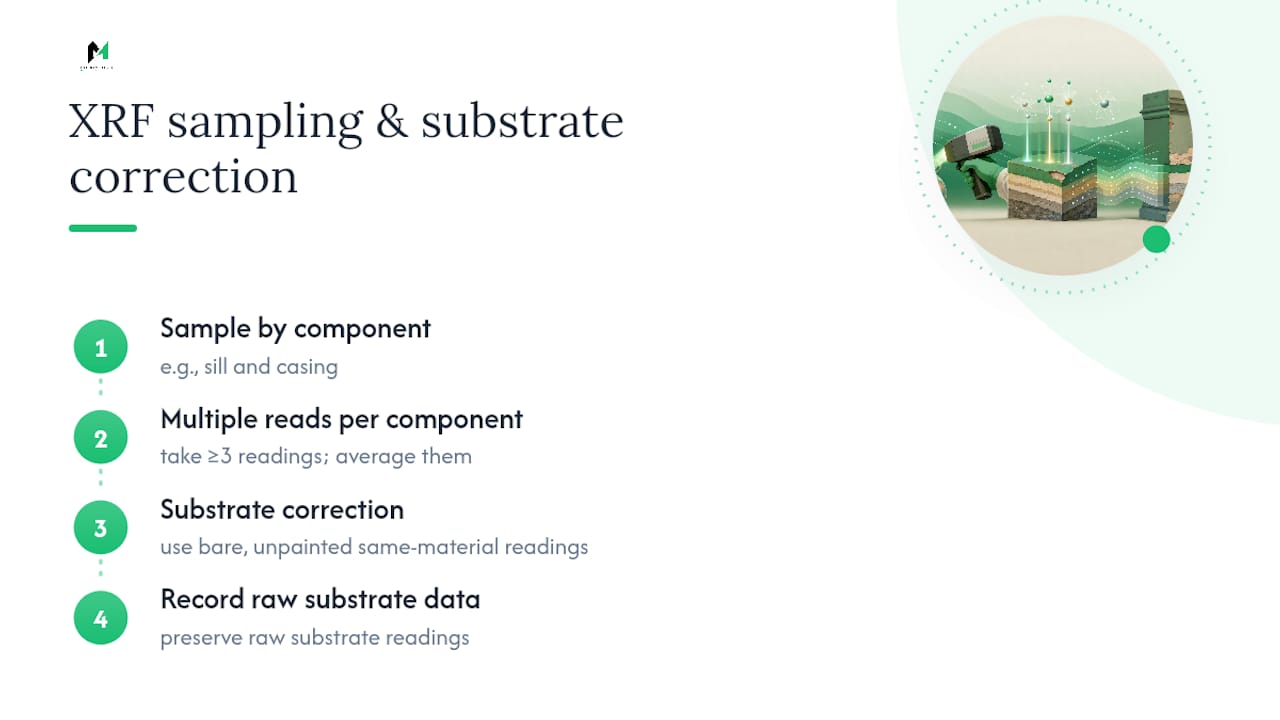
Readings are taken by component, not by room. A window sill is one component; the window casing is another. Taking multiple readings across a single component (typically three or more) and averaging them reduces the effect of surface variation. Substrate correction is computed from readings on bare, unpainted sections of the same material and applied per substrate type. Inspectors should preserve raw substrate readings in the report so a third party can verify the correction.
Quality control documentation
ASTM E2119 sets out QA/QC procedures that supplement the PCS, covering calibration checks, substrate bias checks, and documentation practices. A compliant inspection includes:
- An opening calibration check against a NIST-traceable standard reference material (SRM) film before any field readings.
- Periodic calibration checks during the session (typically every two hours or after a defined number of readings).
- A closing calibration check at the end of the session.
- Documentation of all raw readings, substrate corrections, and calibration results in the final report.
| Inspection step | What to look for on the report |
|---|---|
| Instrument model and serial number | Confirms PCS applicability |
| PCS version and date | Must match the instrument in use |
| Opening calibration check | Reading and pass/fail against SRM |
| Substrate types recorded | Correction applied per substrate |
| Component-by-component readings | Raw values, not just pass/fail |
| Closing calibration check | Confirms instrument stability |
| Photographs of tested components | Ties readings to physical locations |
| Inspector credentials | Certification number and issuing body |
ASTM F2853 also specifies test times for energy-dispersive XRF: typically 1–3 minutes for homogeneous samples and 4–8 minutes for paint, which is longer than the sub-10-second field readings common with modern handheld units. The difference reflects the distinction between a laboratory-grade method and a field screening tool.
When XRF is enough and when you need a lab
XRF is sufficient for most routine residential inspections and renovation pre-tests. Lab confirmation becomes necessary in specific situations.
Send a paint-chip sample to the lab when:
- The XRF reading falls in the inconclusive range defined by the instrument’s PCS.
- The surface is heavily textured (stucco, brick, ornate moulding) and probe contact was inconsistent.
- The result will be used as legal evidence in a property dispute or litigation.
- Consumer product testing requires percent-by-weight results rather than mg/cm².
- Regulatory compliance requires a confirmed positive or negative with no ambiguity.
Lab methods (atomic absorption spectrometry, AAS, or inductively coupled plasma, ICP) report results as percent lead by weight, not mg/cm². Converting between the two units requires knowing the paint film’s density and thickness, which is rarely known precisely in the field. For practical purposes, treat the two units as complementary rather than directly interchangeable: XRF tells you whether lead is present and at what surface concentration; lab analysis confirms the composition of the paint film itself.
| Scenario | XRF sufficient? | Lab confirmation needed? |
|---|---|---|
| Routine residential inspection | Yes | Only if inconclusive |
| Pre-renovation disclosure | Yes | Only if inconclusive |
| Textured or rough surfaces | Caution | Recommended |
| Legal evidence or litigation | No | Yes |
| Consumer product compliance | No | Yes |
| Construction worker exposure monitoring | No | Yes (air monitoring) |
| Inconclusive XRF range | No | Yes |
Cost, practicalities and renting vs hiring in Canada
XRF inspection costs in Canada vary by property size, number of components tested, travel distance, and whether the inspector also prepares a formal risk assessment. A single-family home inspection typically involves a per-component or per-hour fee structure, plus documentation time and any lab fees for paint-chip samples. Costs are not publicly standardised across provinces, so getting a written quote that itemises the scope is the right starting point.
Why renting an XRF rarely makes sense for homeowners:
- Rental units come without the model-specific PCS, or require you to source it separately.
- Calibration SRM films are not always included and must be verified before use.
- Operator training is a prerequisite for valid results; an untrained operator produces data that no regulator or insurer will accept.
- Documentation, substrate correction, and report preparation take time that professionals have already built into their workflow.
A rental might make sense for a large property management company running ongoing surveys with trained in-house staff. For a homeowner or small renovator, the training and compliance overhead makes hiring a certified inspector the more cost-effective path.
Regulatory context in Canada. Lead paint regulations in Canada are governed provincially, with federal guidance under Health Canada and provincial occupational health and safety codes setting the framework for renovation and abatement work. XRF inspection reports are used for renovation permits, real-estate disclosures, and abatement planning. Keeping the original report on file is important: it documents the pre-disturbance condition of the property and can protect you in a future dispute.
Pro Tip: Before booking an inspector, ask specifically whether the report will include raw component readings, substrate corrections, calibration check results, and photographs. A report that only lists pass/fail results without the underlying data is not adequate for regulated renovation work.
Interpreting positive or inconclusive results: what to do next
A positive XRF result does not mean you need to gut the building. It means lead-based paint is present and that any work disturbing that surface requires a controlled approach.
Immediate safety steps after a positive or inconclusive result:
- Stop any planned sanding, scraping, or demolition on the affected surface.
- Isolate the area from children and pregnant individuals.
- If dust is already present, use a HEPA vacuum rather than a standard vacuum or broom.
- Avoid dry scraping or dry sanding under any circumstances until the surface is assessed.
- Wash hands and change clothes before leaving the work area.
When to engage a certified abatement contractor: any renovation that will disturb a confirmed lead-painted surface in a residential building, particularly in rooms used by children, requires certified abatement or at minimum certified work-practice supervision. Interim controls (painting over intact lead paint, for example) are acceptable in some situations, but they require documentation and periodic re-inspection.
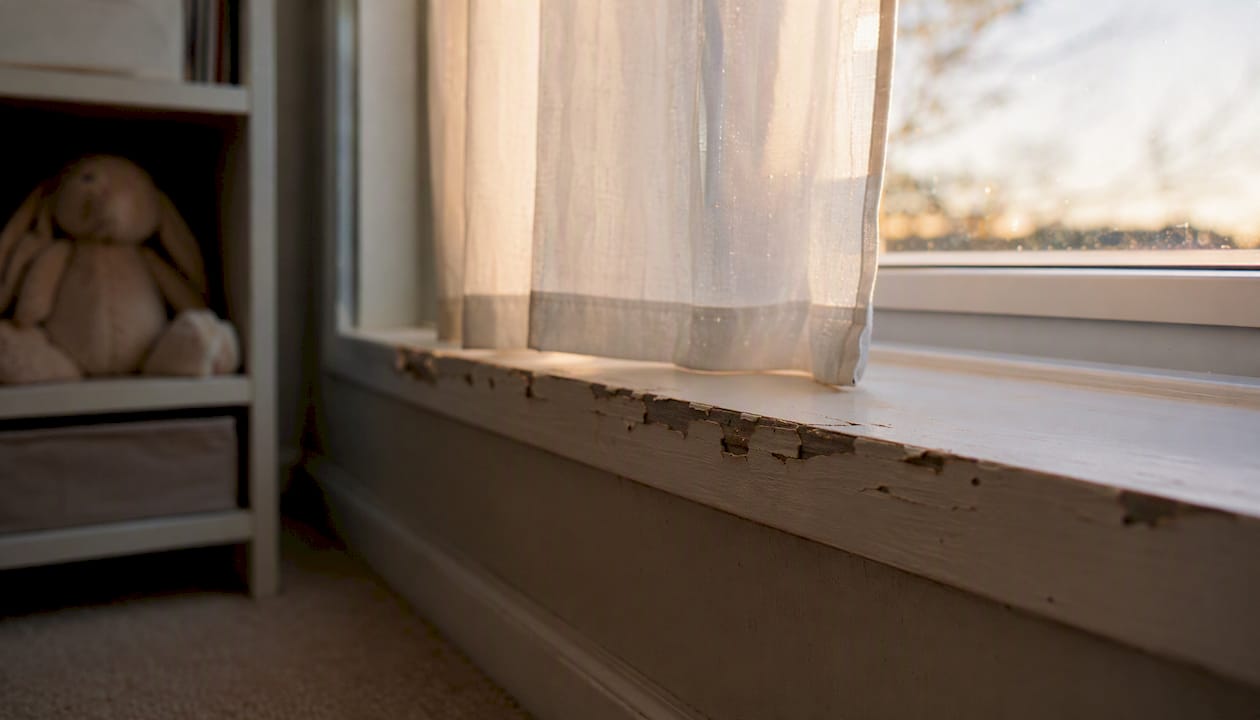
Prioritise surfaces by use. Children’s bedrooms, play areas, and high-contact surfaces like window sills and door frames carry the highest risk because lead dust from friction and impact is the primary exposure pathway. Those surfaces warrant the most urgent attention, regardless of the absolute mg/cm² reading.
Why certified inspectors and abatement contractors matter
The difference between a certified inspector and someone with a rented device is not just credentials. It is the entire chain of documentation that makes a result usable.
What a certified inspector delivers:
- A PCS-compliant inspection with documented calibration checks before and after the session.
- Component-by-component raw readings with substrate corrections preserved for third-party review.
- A formal report that meets the documentation requirements for renovation permits and real-estate disclosure.
- A risk assessment that identifies which surfaces pose the highest hazard and recommends next steps.
What to look for when hiring:
- Certification from a recognised body and a current certification number you can verify.
- Proof of liability insurance and, where applicable, radiation safety credentials for radioisotope-source devices.
- References or documented project experience on similar building types.
- A sample report showing the level of detail they provide.
The report package should include raw readings, calibration check results, substrate correction data, photographs of each tested component, and a clear written recommendation. Certified testing and documented QA/QC are what separate a legally defensible inspection from a field screening exercise. Hiring certified professionals for hazardous material work is not just a regulatory formality; it is the only way to ensure the documentation holds up when it matters.
What practitioners often get wrong about XRF
Most articles on XRF lead testing focus on the technology and skip the part that actually determines whether a result is usable: the documentation chain. An XRF reading without a PCS, without calibration checks, and without substrate corrections is not an inspection. It is a number with no context.
The other thing that gets underestimated is the inconclusive range. Inspectors sometimes treat an inconclusive result as a near-negative and move on. That is a mistake. The inconclusive band exists precisely because the instrument cannot reliably distinguish between lead-based and non-lead-based paint at that concentration on that substrate. Sending a paint-chip sample is not optional in that situation; it is the only way to resolve the ambiguity. Textured surfaces, in particular, produce inconclusive readings at a higher rate than smooth ones, so inspectors working on older homes with plaster or stucco should plan for paint-chip backup sampling from the start rather than treating it as an afterthought.
There is also a tendency to conflate surface concentration with exposure risk. A high mg/cm² reading on intact paint behind a radiator is a very different hazard from the same reading on a window sill that children touch daily. The number alone does not tell you the risk; the condition of the paint, the use of the space, and the likelihood of disturbance all factor in. That is why a risk assessment from a certified professional adds value beyond the raw XRF data.
MSN Environmental: certified lead testing and abatement in Ontario
When a lead inspection needs to hold up for a renovation permit, a real-estate transaction, or a regulated abatement project, the report quality is everything. MSN Environmental provides certified XRF lead paint testing with full PCS-compliant documentation, including component-by-component readings, calibration check records, substrate corrections, and photographs. For properties where testing confirms lead-based paint, the same team handles abatement and removal, so you are not coordinating between separate contractors.

MSN Environmental serves residential, commercial, and industrial clients across Ontario, with trained technicians and documented QA/QC processes that meet provincial and federal regulatory requirements. Whether you need a pre-renovation inspection, a real-estate disclosure report, or a full hazardous material removal plan, the process starts with a straightforward quote. Contact MSN Environmental to book a certified inspection or request a scope of work for your project.
Sources
- Chapter 7: Lead-Based Paint Inspection, Guidelines for the Evaluation and Control of Lead-Based Paint Hazards in Housing
- Quantitative measurement of lead in paint by XRF analysis without manual substrate correction – PubMed
- Using XRF hand-held devices to detect lead-based paint (USDA Forest Service tech tip)
- E2119 Standard Practice for Quality Systems for Conducting In Situ Measurements of Lead Content in Paint or Other Coatings Using Field-Portable XRF Devices
FAQ
How accurate is XRF lead testing?
Modern handheld XRF instruments are accurate enough for most residential inspections when calibrated and operated correctly, with well-designed instruments achieving approximately 95% confidence in quantitative measurements using geometry and computational corrections. Accuracy drops on textured surfaces, deeply layered paint, and substrates with interfering elements, which is why substrate correction and calibration checks are required.
Can an XRF analyser detect lead under multiple layers of paint?
Yes, though depth penetration depends on the device type. Radioisotope-source XRFs generally penetrate more deeply through multiple paint layers than x-ray-tube devices, but very deeply buried lead under many coats can still be partially shielded and produce a lower reading than the actual lead content.
How much does XRF lead testing cost in Canada?
Costs vary by property size, number of components, travel distance, and report complexity; there is no publicly standardised fee schedule across Canadian provinces. Getting an itemised written quote from a certified inspector is the most reliable way to understand the full cost, including any lab fees for paint-chip samples.
What is the most accurate way to test for lead in paint?
For field identification, XRF is the primary accepted method for housing inspections. For regulatory certainty, legal evidence, or inconclusive XRF results, laboratory analysis by AAS or ICP on paint-chip samples provides the highest accuracy and reports results as percent lead by weight.