

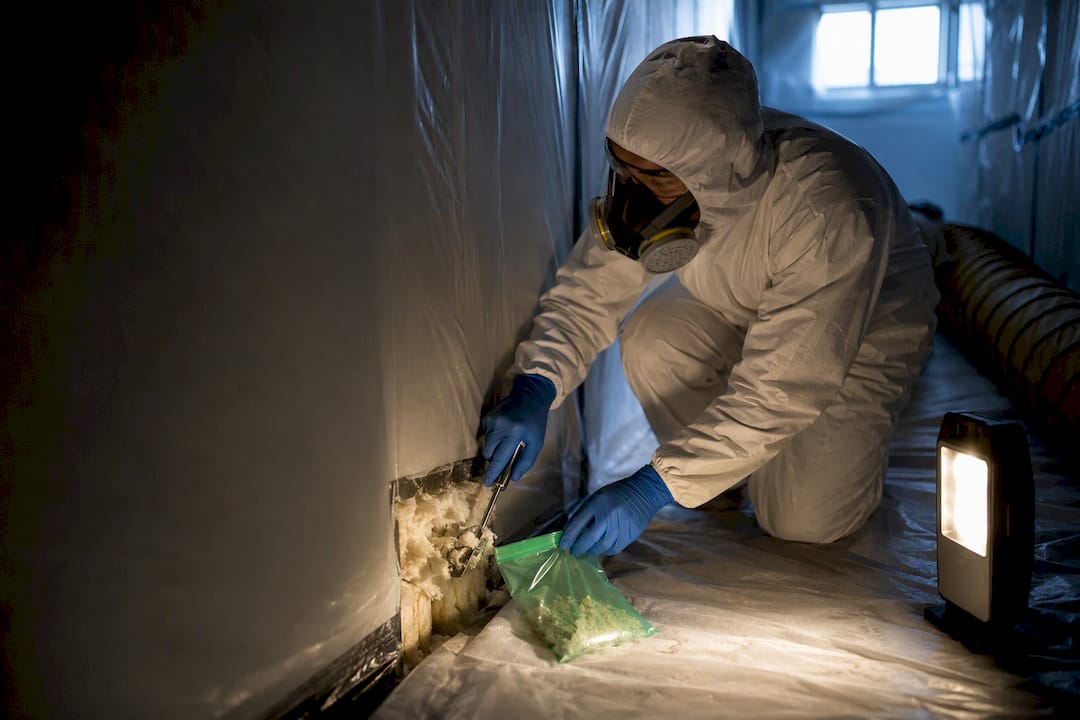
Ontario Regulation 278/05 requires owners to identify and manage asbestos-containing material, classify any work that disturbs it as Type 1, 2 or 3, and follow the prescribed controls for that class. If you suspect a material contains asbestos, treat it as asbestos-containing until bulk sampling confirms otherwise. Stop work that disturbs it, and notify the people the regulation requires before you go further.
TL;DR:
- Most asbestos-containing materials are legally classified once they exceed specific thresholds, regardless of their appearance or age, and require proper sampling to confirm.
- Disturbing more than one square meter of friable asbestos or working in heavily contaminated areas triggers full containment, negative air pressure, and clearance testing before reoccupation.
- Building owners must maintain an updated asbestos management program with detailed records, and conduct regular inspections and sample reviews to avoid outdated or incomplete data.
- All asbestos work classifications—Type 1, 2, or 3—demand different levels of controls, training, and notifications, with Type 3 requiring prior Ministry notice before work begins.
- Immediate action is critical if suspected asbestos is discovered during work: stop, secure, notify relevant parties, arrange proper sampling, and treat the material as asbestos until proven safe.
Table of Contents
- What O. Reg. 278/05 covers: scope, definitions and key thresholds
- Type 1, Type 2 and Type 3 operations: classification and required controls
- Owner responsibilities: asbestos management program, records and inspections
- Before renovation, tendering or contracting: examinations, reports and what to provide contractors
- Sampling, testing and clearance: lab standards, minimum sampling and clearance testing
- Notifications, reporting and training: ministry notice, asbestos work reports and worker training
- What to do if you discover suspected asbestos during work
- Practical compliance checklist for Ontario homeowners, building owners and contractors
- Practitioner perspective: how MSN Environmental approaches compliance
- What the regulation gets right, and where owners still get caught out
- How MSN Environmental supports O. Reg. 278/05 compliance
- Sources
- FAQ
What O. Reg. 278/05 covers: scope, definitions and key thresholds
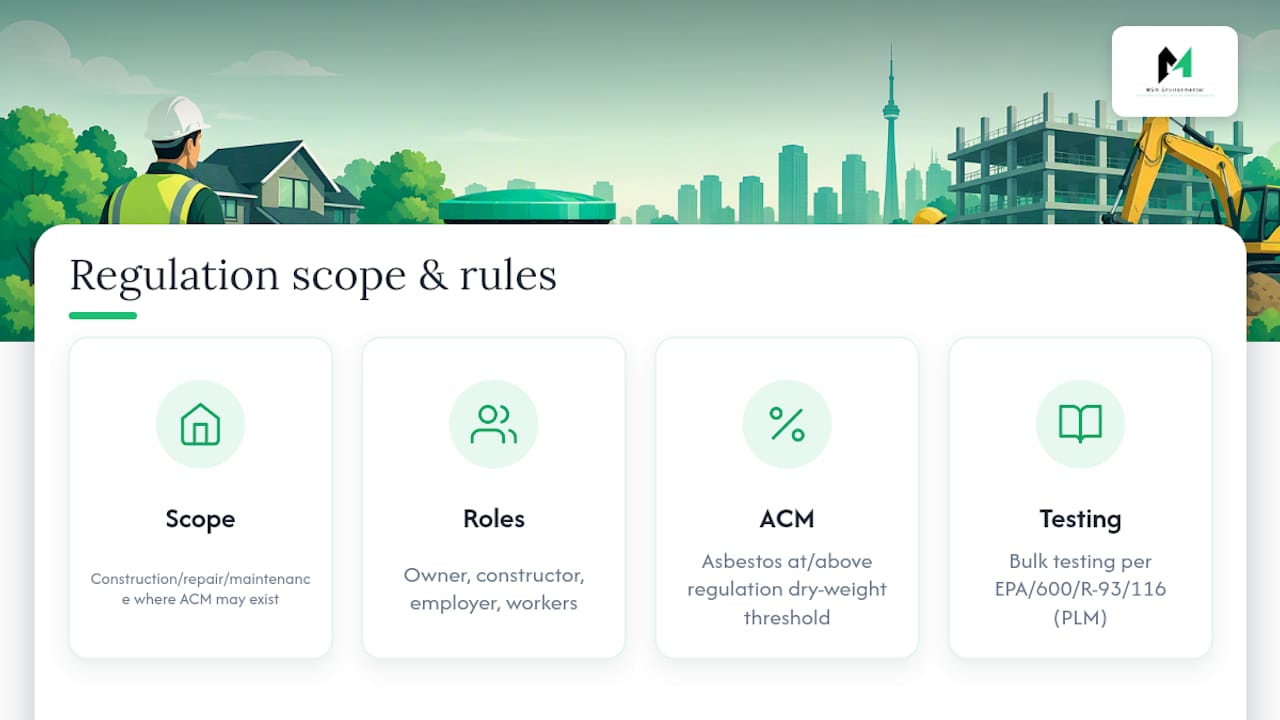
O. Reg. 278/05 applies to construction projects, and to repair, alteration or maintenance work on buildings where asbestos-containing material may be present. It sets out duties for four roles: the owner of the building or project, the constructor who oversees the work, the employer whose workers perform it, and the workers themselves. Each role carries distinct obligations, and a single person or company can hold more than one role on a given job, which is where a lot of confusion starts on smaller residential projects.
The regulation’s definitions decide almost everything that follows. Asbestos-containing material, often shortened to ACM, means any material containing asbestos by dry weight at or above the specified threshold. That threshold is a bright line: cross it and the material is legally ACM regardless of how solid or old it looks. Below that line, a material is not regulated as ACM even if it once contained a trace amount, though most surveyors will still flag it for monitoring.
Friability matters just as much as content. A friable material can be crumbled, pulverized or reduced to powder by hand pressure, which means its fibres release more easily into the air. Non-friable material, such as intact vinyl floor tile or cured cement board, holds its fibres more tightly, so the regulation treats work on it as lower risk. That distinction drives the Type 1, 2 and 3 classification system covered next.
The regulation also carries forward a long-standing prohibition on the use, application or installation of sprayed-on materials such as fireproofing or acoustic insulation containing asbestos at or above a low threshold. That threshold is deliberately lower than the general ACM definition because spray application aerosolizes fibres directly, which is precisely the exposure route Health Canada flags as most dangerous. According to Health Canada, asbestos fibres are linked to asbestosis, mesothelioma and lung cancer, and there is no reliable way to confirm asbestos content by looking at a material. Laboratory testing is the only way to know.
That is why the regulation adopts a specific laboratory standard rather than leaving sampling methodology to individual labs. Bulk material testing under O. Reg. 278/05 must follow U.S. EPA Test Method EPA/600/R-93/116, which uses polarized light microscopy to identify asbestos fibres and estimate their percentage by weight. This matters legally because a lab result that does not follow this method, or a visual assessment that skips lab testing altogether, does not satisfy the regulation’s identification requirement. An owner who relies on an eyeball inspection instead of a proper bulk sample is not in compliance, no matter how experienced the person doing the looking.
Type 1, Type 2 and Type 3 operations: classification and required controls
Every job that disturbs ACM falls into one of three classes, and the class determines the equipment, training and paperwork required before a worker touches the material. Getting the classification wrong is the single most common way small jobs turn into costly compliance failures, because a Type 3 job started under Type 1 assumptions has no containment, no clearance testing and no notice on file.
Type 1 covers minor disturbance of non-friable ACM, such as removing a small section of intact vinyl asbestos tile or drilling a handful of holes through asbestos cement board. These jobs need basic precautions: wetting the material, using hand tools instead of power tools where possible, and cleaning up with a HEPA vacuum rather than a broom. No enclosure or air monitoring is required.
Type 2 sits in the middle and covers larger-scale non-friable work or limited friable work using controlled methods, such as removing an asbestos-containing ceiling tile system across several rooms or removing insulation from short sections of pipe using a glove bag. Respiratory protection, a demarcated work area and worker training become mandatory here, and depending on scope, a Type 2 job can trigger the same notice obligations as Type 3, discussed below.
Type 3 is the high-risk category: removing more than one square metre of friable ACM, working in areas with heavy accumulations of asbestos dust, or any work that generates uncontrolled friable fibre release. According to O. Reg. 278/05, Type 3 operations require full containment, negative air pressure, HEPA filtration, dedicated decontamination facilities and clearance air testing before the enclosure comes down. Our Type 3 abatement guide walks through what that containment looks like on an active Ontario job site.
The controls scale with the risk, and knowing which threshold applies to your job avoids both under-protection and unnecessary expense:
- Wetting and hand tools apply to virtually all ACM disturbance, regardless of type, to limit fibre release at the source.
- Respirators and demarcated zones become mandatory once work moves into Type 2 territory, along with worker training specific to the task.
- Glove bag technique is standard for Type 2 pipe insulation removal, isolating the work from the surrounding air without full enclosure.
- Full enclosure and negative air pressure apply to Type 3 work, sealing the space and drawing air through HEPA filtration to prevent fibre migration.
- Clearance air testing closes out Type 3 jobs in occupied buildings, confirming fibre counts have returned to acceptable levels before reoccupation.
Advance notice to the Ministry of Labour, Training and Skills Development is required before any Type 3 operation begins, and also applies to certain Type 2 work: specifically, glove bag removal of one square metre or more of insulation crosses the notice threshold even though the technique itself is a Type 2 control. That single detail catches out a lot of contractors who assume glove bag work is automatically exempt from notification because it is not full Type 3 containment. It is not exempt once the area removed passes that one square metre mark.
Owner responsibilities: asbestos management program, records and inspections
If you own a building where ACM is known or reasonably suspected to be present, the regulation requires you to establish and maintain an asbestos management program, often shortened to AMP. This is not a one-time survey filed away and forgotten. Ontario’s guidance describes it as a living record that must be updated at least once every twelve months, or sooner if new information comes to light, such as damage discovered during a renovation or a new sample result.
The record itself needs to capture enough detail that anyone reading it, whether a maintenance worker or an incoming contractor, understands exactly what they are dealing with and where. At minimum, it should include:
- Location of each area or material known or suspected to contain asbestos, described specifically enough to find on-site.
- Condition of the material, noting any damage, deterioration or previous disturbance.
- Friability, since friable material carries stricter handling rules than non-friable material in the same building.
- Sample results, including the lab report reference, so the finding can be verified later without re-testing.
- Asbestos type, for sprayed-on friable material, if known, or a documented decision to treat it as non-chrysotile when the type is not established.
Owners also carry a notification duty toward occupants. When the record contains information relevant to the space a tenant or occupier uses, that information must be shared with them in writing, not simply held on file at the property management office.
Pro Tip: Keep a laminated summary of the current AMP posted in the building’s mechanical room or superintendent’s office, with the full record available digitally for any contractor who asks before quoting a job.
The most common failure MSN Environmental sees on Ontario properties is not a missing survey. It is a survey from eight or ten years ago that nobody updated after a boiler replacement, a ceiling repair or a tenant improvement disturbed material the original report never anticipated. A record that predates recent work is worse than no record at all, because it gives everyone false confidence.
Practically, the easiest way to keep an AMP usable is to treat it the way you would treat fire safety documentation: one physical binder or shared digital folder, one person responsible for updates, and a standing instruction that no contractor starts work until they have reviewed it. Share the relevant sections with contractors before they quote, not after they arrive on-site, since pricing a job without knowing whether ACM is present almost guarantees a change order later.
Before renovation, tendering or contracting: examinations, reports and what to provide contractors
Before any construction project or renovation goes to tender, section 10 of the regulation requires an examination of the work area to determine whether ACM is present and, if so, its location, condition and friability. This obligation sits with the owner, and it exists specifically so that contractors are pricing and planning against real information rather than guesswork.
The resulting report needs to give a prospective constructor everything required to plan the work safely and price it accurately:
- ACM status and location, identifying which materials in the work area contain asbestos and where they are found.
- Friability assessment, since friable material changes the equipment, timeline and cost of the job substantially.
- Drawings or specifications, marked up to show ACM locations against the actual floor plan or work scope.
- Sample and lab reference numbers, so any party can verify the finding without commissioning a duplicate survey.
That report must reach every prospective constructor before they submit a tender, and it flows down from there: the constructor must provide it to every contractor and subcontractor whose work could disturb the identified material. A general contractor who receives the report but fails to pass it to the drywall or mechanical subcontractor has not satisfied the requirement, even if the paperwork technically exists somewhere in a project file.
This is where liability risk concentrates. Relying on a report from a previous renovation, a report for a different part of the building, or a report old enough that conditions have changed exposes the owner and the constructor to real risk if a worker is later exposed to fibres the report did not flag. The regulation does not treat “we had a report from years ago” as a defence if that report no longer reflects the actual condition of the work area. Anyone relying on an older survey should treat our pre-renovation testing guide for older Ontario homes as a starting point for deciding whether a fresh sample is warranted, particularly on any home or building constructed before the 1990s.
Beyond the paperwork, the person conducting the section 10 examination is expected to physically inspect the work area rather than rely solely on building plans or a previous inspector’s notes. Plans get out of date the moment someone reroutes a duct or reinsulates a section of pipe, and a document review alone will miss that kind of change.
Sampling, testing and clearance: lab standards, minimum sampling and clearance testing
Sampling under O. Reg. 278/05 is not a matter of grabbing one chunk of material and sending it to whichever lab answers the phone first. The regulation adopts EPA Test Method EPA/600/R-93/116 for bulk sample analysis, and it requires that samples be collected randomly from each homogeneous area, meaning a section of material that appears uniform in age, texture and application method, by a worker competent to take a representative sample.
The practical implications are significant:
- One homogeneous area, multiple samples. A single type of material spread across a building, such as textured ceiling finish, is typically sampled in several locations rather than once, since asbestos content can vary even within what looks like one continuous application.
- One positive sample governs the whole area. If even one sample from a homogeneous area comes back at or above the 0.5% threshold, the entire area is legally deemed ACM, not just the specific spot sampled.
- Competent sampling matters as much as lab accuracy. A poorly chosen sample location, such as one that misses a patched or repaired section, can produce a false negative that puts workers at risk later.
One positive result reclassifies the whole area: under O. Reg. 278/05, a single bulk sample at or above 0.5% asbestos by dry weight is enough to deem the entire homogeneous area asbestos-containing material, which can turn a job planned as Type 1 into a Type 2 or Type 3 project overnight.
Clearance air testing enters the picture once Type 3 work wraps up inside an occupied or soon-to-be-occupied building. Ontario’s guide to the regulation confirms that clearance testing is required for indoor Type 3 enclosures in buildings that will not be demolished, and that negative air pressure must be maintained throughout the containment period. Air samples are taken inside the enclosure after final cleaning, and fibre counts must drop to an acceptable level before the enclosure is dismantled and the space returned to use. Skipping this step, or treating it as optional because the visible cleanup looks thorough, is one of the more expensive mistakes an owner can make, since reoccupying a space without clearance documentation leaves no defence if an occupant later reports symptoms or a subsequent test finds elevated fibres. Our bulk sampling guide covers how a sampling plan is built for a full building survey.
Notifications, reporting and training: ministry notice, asbestos work reports and worker training
Type 3 operations require advance notice to the Ministry of Labour, Training and Skills Development before work begins, and that same notice requirement extends to Type 2 glove bag removal once the insulation being removed reaches one square metre or more. The notice must be given both orally and in writing, and it needs to include the project location, the scope and duration of the work, the contractor’s contact information and the control measures planned for the job.
Beyond the initial notice, the regulation imposes ongoing reporting duties once work is underway:
- Asbestos work reports, required under section 21, document the details of completed work, including the type of operation, the methods used and the results of any air monitoring.
- The Asbestos Workers Register, required under section 22, tracks which workers have performed asbestos-related work, supporting long-term exposure monitoring for anyone who has worked with the material over a career.
- Training records must show that every worker performing Type 2 or Type 3 work has completed a training course appropriate to that type of operation, not a generic safety orientation.
Training requirements scale with risk in the same way controls do. A worker performing Type 1 tasks needs basic awareness training in recognizing ACM and following wetting and cleanup procedures. Type 2 and Type 3 work require a “competent person,” a term the regulation uses specifically to mean someone who has the training, knowledge and experience to organize the work and knows the applicable legal requirements, not simply someone who has done the job before informally. Ministry-approved abatement training programs cover the specific procedures for enclosure construction, respirator fit testing, decontamination protocol and waste handling that generic construction safety training does not.
A recurring compliance gap shows up specifically around discovery scenarios: when unexpected ACM turns up mid-project, the regulation requires oral and written notice to the Ministry inspector, the owner, the contractor and the joint health and safety committee or worker representative, and a common failure is giving only verbal notice or notifying just one of these parties rather than all four.
What to do if you discover suspected asbestos during work
Finding material that looks like it might contain asbestos mid-renovation is common, and how you respond in the first few minutes matters more than almost anything else in the process.
- Stop work immediately and avoid any further disturbance of the material, including sweeping, sanding or vacuuming with a standard vacuum.
- Secure the area by closing doors, taping off the space and keeping people who are not directly involved away from it.
- Do not use power tools or brooms near the material, since both generate and spread airborne fibres far more effectively than hand tools.
- Give oral notice right away to the site owner, the contractor and, on a construction project, the joint health and safety committee or worker representative, followed by written notice as required.
- Arrange bulk sampling through a competent tester who can collect representative samples and send them to a lab using the EPA-adopted method.
- Treat the material as ACM in the meantime. Ministry guidance recommends an assume-and-treat approach: until test results confirm otherwise, proceed as though the material contains asbestos.
- Call a licensed abatement contractor if the suspected quantity or condition suggests Type 2 or Type 3 work, rather than attempting removal with general construction crews.
Pro Tip: Keep a small kit of poly sheeting, tape and warning signage in every work vehicle so a crew can seal off a suspect area within minutes of discovery, before anyone has time to second-guess whether stopping work is really necessary.
The instinct on a lot of job sites is to keep working while waiting for lab results, especially when a deadline is looming. That instinct is exactly backwards: the cost of a few days’ delay is nothing compared to the cost of an exposure incident, a Ministry order to stop work anyway, or the legal exposure of having proceeded on a material that later tests positive.
Practical compliance checklist for Ontario homeowners, building owners and contractors
Pulling the regulation’s requirements into a single working sequence makes it easier to confirm nothing has been missed before a project starts, while it is underway, and once it wraps up.
- Confirm survey and records exist for the property and reflect the current condition of the space, not a renovation from years ago.
- Build a sampling plan for any homogeneous area not already covered by a valid lab report, using a competent tester and the EPA-adopted method.
- Verify contractor credentials before work begins, including training certificates specific to the type of operation planned.
- Submit required notifications to the Ministry for any Type 3 work or qualifying Type 2 glove bag removal, in both oral and written form.
- Confirm training and reporting are in place, including asbestos work reports and register entries where the work requires them.
- Schedule clearance testing for any Type 3 enclosure before the space is reoccupied.
| Step | Who is responsible | When it happens |
|---|---|---|
| Survey and AMP update | Owner | Before tender, and at least annually |
| Bulk sampling | Competent tester or contractor | Before disturbing unconfirmed material |
| Contractor verification | Owner or constructor | Before signing a contract |
| Ministry notification | Constructor or employer | Before Type 3 work or qualifying Type 2 work |
| Clearance air testing | Abatement contractor | After Type 3 enclosure work, before reoccupation |
Retain sampling reports, notifications and clearance certificates for the life of the building, since a future renovation or sale will likely require them again. When testing genuinely is not practicable, such as during an emergency repair, document the decision to treat the material as ACM in writing, including who made the call and why, so the record shows a reasoned judgment rather than a shortcut.
Practitioner perspective: how MSN Environmental approaches compliance
On a typical Ontario project, our process starts before any tool touches the material: a pre-renovation survey identifies suspect areas, followed by representative bulk sampling across each homogeneous area and lab analysis using the EPA-adopted method. Results determine the Type classification, which then drives the containment design, whether that means simple wetting and hand tools for a Type 1 job or full negative-pressure enclosure for Type 3 work. Once removal is complete, clearance air testing confirms the space is safe before anyone dismantles the containment or moves back in, and regulatory notifications go out at each stage the regulation requires.
Owners hiring any contractor for this kind of work, not just MSN Environmental, should ask for specific proof before signing anything: training certificates matched to the type of operation planned, a sample report showing lab results rather than a verbal assurance, a clear disposal manifest showing where the waste actually went, and confirmation of liability insurance covering the scope of work. A contractor who cannot produce these documents on request is not one you want managing a Type 2 or Type 3 job.
Technicians work across multiple regions in Ontario, applying consistent documentation standards on every job regardless of size. The paperwork serves as evidence that removal work complies with regulatory requirements.
What the regulation gets right, and where owners still get caught out
The regulation itself is reasonably clear once you sit down and read it, which is more than can be said for a lot of Ontario’s technical rules. Where owners get caught out is not usually in the text, it is in treating asbestos management as a survey they commission once and then forget, rather than a program that has to be revisited every time a building changes.
The overrated piece of conventional advice is “get a survey done.” A survey is a snapshot. What actually protects an owner, and what the regulation is built around, is the update cycle: the twelve-month review, the fresh examination before every tender, the willingness to resample when a homogeneous area gets disturbed in a way the original report never covered.
If I had to tell an Ontario building owner to prioritize one thing, it would be this: stop treating “no positive results yet” as the same thing as “cleared.” An area that has not been sampled is not a safe area, it is an untested one, and the regulation’s own assume-and-treat logic exists precisely because that distinction gets lost under deadline pressure.
— Moacyr
How MSN Environmental supports O. Reg. 278/05 compliance
Getting a compliant asbestos file together, sampling, lab coordination, Type classification and clearance documentation, takes real time most owners and contractors do not have alongside running a project. Such compliance tasks are often handled by professionals who do this work regularly, relieving property managers of interpreting complex regulations amidst their other duties.
Services relevant to O. Reg. 278/05 compliance include:
- Asbestos and mold testing services, including bulk sampling and air quality testing for Type 3 clearance.
- Asbestos removal services, covering Type 1 through Type 3 abatement with full containment where required.
- Designated Substance Surveys and pre-renovation or demolition surveys, satisfying the section 10 examination requirement before tendering.
- Regulatory-notice support, helping constructors prepare the oral and written notifications Type 3 and qualifying Type 2 work require.
Before booking any hazardous materials contractor, ask to see training certificates for the specific type of operation, a sample lab report from a recent job, a written scope of work and a disposal plan showing where waste goes after removal. If you are planning a renovation on an older Ontario property, or you have already found suspect material and stopped work, reach out through our asbestos removal page to get a survey and sampling plan started.
Sources
The following official references are worth bookmarking if you want to verify anything in this article against the source text.
- O. Reg. 278/05 — Designated Substance — asbestos on construction projects and in buildings and repair operations
- Health Canada — Health risks of asbestos
FAQ
Can you sell a house with asbestos in Ontario?
Yes, there is no law in Ontario preventing the sale of a home containing asbestos-containing material. Sellers are generally expected to disclose known hazards, and any material known or suspected to be ACM should be documented so the buyer understands what they are taking on.
What if I accidentally removed asbestos tiles?
Stop working immediately, wet down the area to limit dust, and avoid sweeping or vacuuming with a standard vacuum, since both spread fibres further. Contact a competent tester to sample the material and, depending on the quantity disturbed, notify the property owner and consider air testing to confirm the space is safe.
How to tell if your drywall has asbestos in it?
You cannot tell by looking. According to Health Canada, visual inspection cannot confirm or rule out asbestos, and laboratory testing using the EPA-adopted bulk sample method is the only reliable way to know.
What year was asbestos banned in Ontario?
There is no blanket ban on asbestos-containing material already present in Ontario buildings, and O. Reg. 278/05 instead regulates how existing ACM must be identified, managed and disturbed.
When does a Type 2 job require Ministry notice in Ontario?
A Type 2 glove bag removal requires advance notice to the Ministry once the insulation being removed reaches one square metre or more, even though glove bag technique itself is classified as Type 2 rather than Type 3. Notice must be given both orally and in writing before the work begins.