

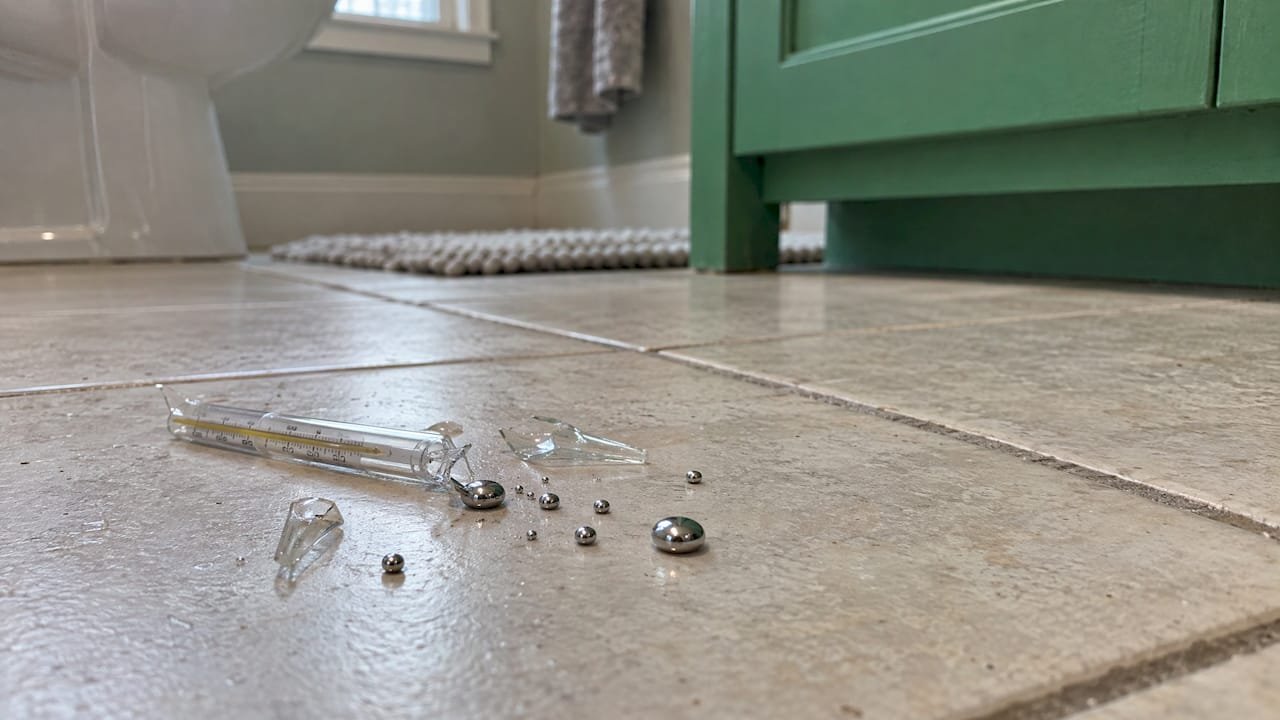
A mercury spill at home is a hazardous materials event, even when it is only a few beads from a broken thermometer. Liquid mercury gives off poisonous, colourless, odourless vapour, so you cannot see or smell the danger. A small, contained spill on a hard floor can be picked up carefully with simple household items. Anything larger, anything that reached carpet, upholstery or cracks, or any spill in a home with a pregnant person, needs a certified hazardous materials crew. In Ontario, that is work we do.
TL;DR
- Leave the room, keep children and pets out, close the doors to other rooms and turn off any ventilation that could spread vapour.
- Never vacuum, sweep with a broom or pour mercury down a drain. Each one spreads the problem.
- DIY cleanup is only for a small, contained spill on tile, linoleum or wood. Above about one tablespoon, or on carpet, upholstery or cracks, bring in professionals.
- Seal beads and tools in an airtight bag or glass jar and take them to a household hazardous waste depot, never the regular garbage.
- For symptoms or exposure questions, call 911 or the Ontario Poison Centre. For technical advice, call CANUTEC.
Table of Contents
- The first minutes after a mercury spill
- Small spill or professional job?
- Mercury spill cleanup procedure for a small hard-surface spill
- What never to do with spilled mercury
- When mercury reaches carpet, clothing or cracks
- Disposal and storage in Canada
- Your health after a mercury spill
- Why we treat mercury differently
- Professional mercury cleanup in Ontario
- FAQ
- Sources
The first minutes after a mercury spill
What you do in the first few minutes matters more than any cleanup product. Mercury is a liquid metal that breaks into tiny beads, rolls into gaps and evaporates at room temperature. The goal at the start is to stop people from breathing vapour and stop the beads from travelling on shoes, socks and paws.
Do these things first:
- Get everyone out of the room. Children are especially at risk because vapour can linger near the floor, right where they crawl and play.
- Keep children and pets away and close the doors to other indoor areas. The National Collaborating Centre for Environmental Health (NCCEH) also says to turn off ventilation that could circulate contaminated air, such as a furnace fan or central air, and to use outdoor ventilation where you can, for example by opening a window to the outside.
- Do not walk through the spill. Anyone who has stepped in it should take their shoes off carefully and check the soles.
- Decide whether this is a do-it-yourself spill at all. The next section helps you do that.
If anyone is coughing, short of breath or has chest pain, or you believe someone has had moderate or serious exposure, call 911 or your local poison control centre right away. Questions about a broken thermometer or a possible exposure can go to the Ontario Poison Centre. For technical advice on the spill itself, CANUTEC, the Canadian emergency centre for dangerous goods, can help. We cover the household version of this moment in more detail in our guide to the first 10 minutes after a broken mercury thermometer.
Small spill or professional job?
This is the decision that matters most. Official guidance draws a clear line, and it is narrower than most people expect.
The NCCEH says household cleanup is limited to a small, contained spill on tile, linoleum or wood, or on a small porous item that can simply be thrown away. It says spills larger than one tablespoon should be reported to the proper authority and need professional help for a thorough cleanup. Transport Canada’s CANUTEC page adds that you should not clean it yourself if the spill is large, happened in a public area, or you are pregnant or expect to be within the year.
| Situation | Who handles it |
|---|---|
| A few beads from a thermometer on a tile, linoleum or wood floor | Careful household cleanup using the steps below |
| More than about one tablespoon of mercury | Professional cleanup |
| Mercury in floor cracks, baseboard gaps or tracked through several rooms | Professional cleanup |
| Mercury on carpet, rugs, upholstery or hard-to-clean items | Professional cleanup |
| Anyone in the home is pregnant or expects to be within the year | Professional cleanup |
| Spill in a shared or public space, such as a rental hallway, office or shop | Professional cleanup |
| Broken lamps in large numbers, or a spill where air monitoring is needed | Professional cleanup with air testing |
The NCCEH recommends a cleanup contractor for mercury in cracks, carpet, upholstery, widespread or tracked areas, or difficult-to-clean items. Environment and Climate Change Canada says large amounts of spilled or broken mercury lamps may require qualified personnel for professional cleanup or air monitoring. If you are unsure, your local public health office can also advise on small spills.
Property managers and business owners should read the table with extra care. A spill in a shared building, a school lab, a clinic or a workplace raises questions about tenants, staff and documentation that a bag and an eyedropper cannot answer.
Mercury spill cleanup procedure for a small hard-surface spill
If your spill fits the small, contained category, the steps below follow Canadian official guidance. Work slowly. Hurrying is how beads get crushed into smaller beads, and smaller beads are harder to find.
Before you start
- Have everyone else, including pets, out of the area.
- Put on disposable gloves if you have them, as the Ontario Poison Centre advises.
- Remove jewellery from your hands and wrists, since mercury can cling to metal.
- Set clean clothes, shoes and a garbage bag just outside the room so you can change without carrying beads out on your feet.
- Leave the room and let it air for at least 15 minutes before you begin, again per the Ontario Poison Centre.
Collecting the beads
- Shine a flashlight low across the floor. Beads show up as tiny bright reflections. Check along baseboards, under furniture edges and in the grout.
- Collect the beads without pushing hard. Transport Canada’s guidance lists cards, an eyedropper or syringe, tape or a squeegee as ways to gather them. Roll small beads together into larger ones so they are easier to lift.
- Handle broken glass separately. Collect small glass fragments with tape or a damp paper towel, or pick up broken pieces with stiff paper or cardboard.
- Wipe the area with a damp paper towel once the visible beads are gone.
- Search again. Run the flashlight over the area a second time from a different angle.
Containing what you collected
Put the beads, the tools you used and the paper towels into an airtight sealable bag or a glass jar. The Ontario Poison Centre describes a tightly lidded glass container for the depot. Put it somewhere outside living space, out of reach of children, until you can drop it off.
If you need a refresher on why sealed containment and compliant disposal matter for hazardous waste in general, this overview of hazardous waste cleanup safety and compliance covers the principles.
Airing out the space
After pickup, ventilate. Transport Canada says that in a room used often, natural ventilation may be enough, while a low-traffic room can be aired with a fan and open windows. Keep doors to the rest of the home closed while you do it, so vapour moves outside rather than through the house.
What never to do with spilled mercury
Most of the harm in household spills comes from well-meant shortcuts. CANUTEC and Transport Canada are specific:
- Do not vacuum. CANUTEC does not recommend it because a vacuum can nebulize droplets, spread vapour and contaminate the machine itself. The vacuum then becomes a source of vapour every time it runs.
- Do not sweep with a broom. Brooms scatter droplets into smaller pieces and push them into cracks.
- Never pour mercury down a drain. It can accumulate in plumbing and release vapour over time.
- Do not put it in the regular garbage. It belongs at a hazardous waste facility.
- Do not wash contaminated clothing in the machine. The NCCEH warns that mercury can contaminate the washing machine and the septic system.
- Do not heat it. Heat makes mercury evaporate faster. The consensus guideline on elemental mercury exposure treats heated mercury, vacuuming or sweeping as situations that call for medical or environmental evaluation.
When mercury reaches carpet, clothing or cracks
This is where the do-it-yourself approach stops working. Mercury beads sink into carpet fibres, lodge in upholstery and slip into the gaps between floorboards, behind baseboards and under tile edges. You cannot reach them, and they keep releasing vapour for as long as they remain.
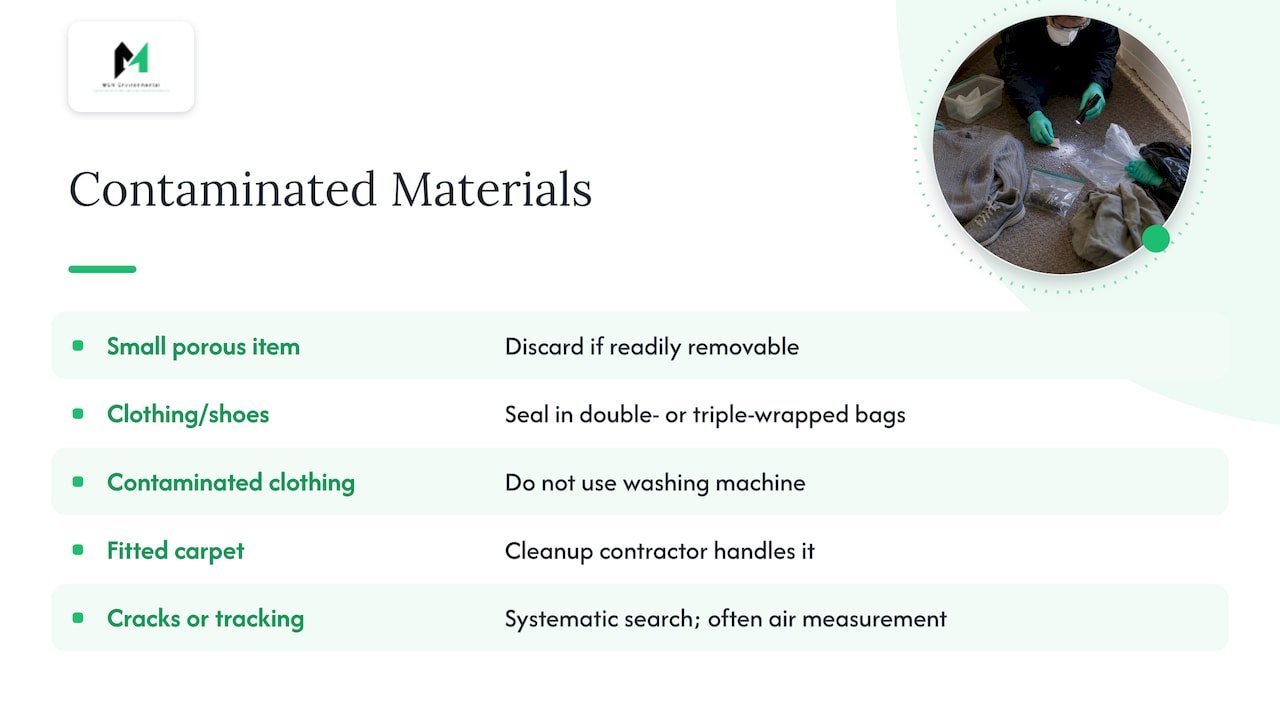
Clothing and shoes. If anything is contaminated, remove it carefully, and seal it in double- or triple-wrapped bags, as the NCCEH instructs. Do not run it through the washing machine.
Carpet and soft furnishings. A small porous item that you can readily discard is one thing. A fitted carpet, a sofa or a mattress is another. These are the cases the NCCEH sends to a cleanup contractor.
Cracks and tracked mercury. If beads rolled under a baseboard or someone walked through the spill and carried it into other rooms, the contamination is no longer one spot on one floor. Finding all of it means systematic searching and, often, air measurement.
This is the kind of job certified hazardous materials technicians do routinely. Our mercury vapour testing page explains how testing fits into spill response in Ontario homes and buildings.
Disposal and storage in Canada
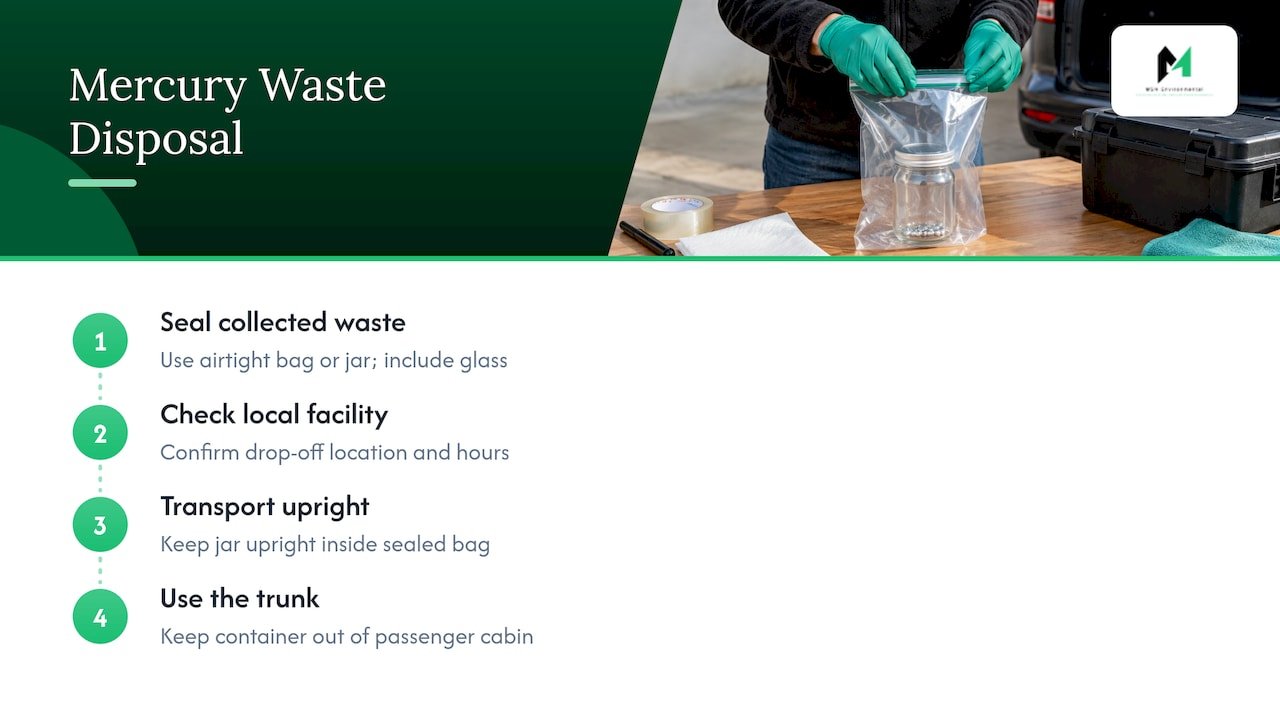
Collected mercury is hazardous waste. Seal beads and tools in an airtight bag or glass jar, then take them, and any small glass pieces, to a local hazardous waste facility. Municipal programs differ on drop-off locations and hours, so check your own municipality’s waste page before you go. Transport the jar upright, in a sealed bag, in the trunk and not the passenger cabin.
Broken mercury lamps, such as fluorescent tubes, follow the same logic. Environment and Climate Change Canada’s code of practice says they should be managed as mercury waste, stored separately from whole lamps in a sealed container in a cool, dry, low-traffic location, and kept out of regular garbage. The sealed container and cool storage exist because mercury persists and vapour must not escape while the waste waits for pickup.
For businesses and property managers, remember that waste from a larger spill is a different matter from a jar of beads. Waste from a professional cleanup is documented and handled by the crew doing the work.
Your health after a mercury spill
Most people who clean up a single broken thermometer promptly and correctly are not harmed, but vapour exposure is the concern, and symptoms deserve attention.
The peer-reviewed consensus guideline on elemental mercury exposure recommends emergency evaluation for acute symptoms such as cough, shortness of breath or chest pain, and healthcare evaluation for signs of longer-term toxicity such as rash, tremor or weight loss. It also allows home observation after a brief, low-dose exposure with no symptoms, but recommends medical or environmental evaluation if there are symptoms, if the mercury was heated, if it was vacuumed or swept, or if the dose may have been higher.
In practical terms:
- Call 911 for breathing difficulty or chest pain.
- Call the Ontario Poison Centre if you have questions about a broken thermometer or an exposure, including children who handled beads.
- See your doctor if symptoms such as tremor, rash or unexplained weight loss appear after a spill.
- Tell your doctor if you or someone in the home is pregnant, since official guidance says pregnant people should not do the cleanup.
Why we treat mercury differently
Most mercury calls start the same way: someone has tried to deal with it, then wonders if they did enough. The honest answer depends on things you cannot see.
At MSN Environmental we remove hazardous materials for a living, and mercury abatement is one of the services we provide. Our technicians are trained and certified, and our work follows Ontario regulations and industry standards. We carry full liability insurance, and we plan each project around the property in front of us, whether that is a family home, a rental building or a commercial space.
The reason to bring in a certified crew is not the beads you found. It is the ones you did not. Floor cracks, carpet and tracked residue are where a spill keeps releasing vapour long after the visible mess is gone. Our environmental testing, including air sampling, is designed to show where a space stands, rather than leaving you to guess.
If the spill is small and on a hard floor, follow the steps above carefully. If it is anything more, call us before you start. A cleanup that spreads the mercury is harder to fix than the original spill.
Moacyr
Professional mercury cleanup in Ontario
When a spill is too large, too spread out or too close to children or a pregnancy for a household cleanup, MSN Environmental provides mercury abatement for residential, commercial and industrial properties across southern Ontario, including Kitchener, Waterloo, Cambridge, Guelph, Hamilton, London, Burlington and Oakville. Our work is compliant with Ontario regulations and industry standards, and we also offer environmental testing, including air sampling.

See our mercury abatement and other hazardous materials removal services, or contact MSN Environmental to describe your spill. If you are weighing who to call for hazardous work generally, our guide to hiring certified hazardous material removal professionals sets out what matters.
FAQ
What should I do first if mercury spills in my home?
Get everyone, including pets, out of the room, close the doors to other areas and turn off ventilation that could circulate air through the house. Open outside windows if you can. For moderate or serious exposure, call 911 or poison control, and call CANUTEC for technical advice.
How much mercury can I clean up myself?
Only a small, contained spill on tile, linoleum or wood, such as one broken thermometer. The NCCEH says spills larger than one tablespoon need professional help. Carpet, upholstery, cracks and any home with a pregnant person also call for professionals.
Can I vacuum up mercury beads?
No. A vacuum can break droplets into finer pieces, push vapour into the air and contaminate the machine. Use cards, an eyedropper or syringe, tape or a squeegee, then seal everything in an airtight bag or glass jar.
Where do I take the mercury once I have collected it?
Take the sealed bag or glass jar to a local household hazardous waste facility. Do not put it in the garbage or pour it down a drain. Check your municipality’s waste page for depot locations and hours.
How long should I ventilate the room?
Ontario Poison Centre guidance says to leave and ventilate the area for at least 15 minutes before cleanup, and Transport Canada advises ventilating again after pickup. In a low-traffic room, a fan and open windows work. Keep doors to other rooms closed.
Sources
- Mercury thermometer spills: What to do (Transport Canada, CANUTEC)
- Mercury and Human Health (Health Canada)
- Cleanup Instructions for Small Mercury Spills (NCCEH, 2012)
- Thermometers (Ontario Poison Centre)
- Code of practice for the environmentally sound management of lamps containing mercury (Environment and Climate Change Canada, 2017)
- Elemental mercury exposure: an evidence-based consensus guideline (PubMed, 2008)