

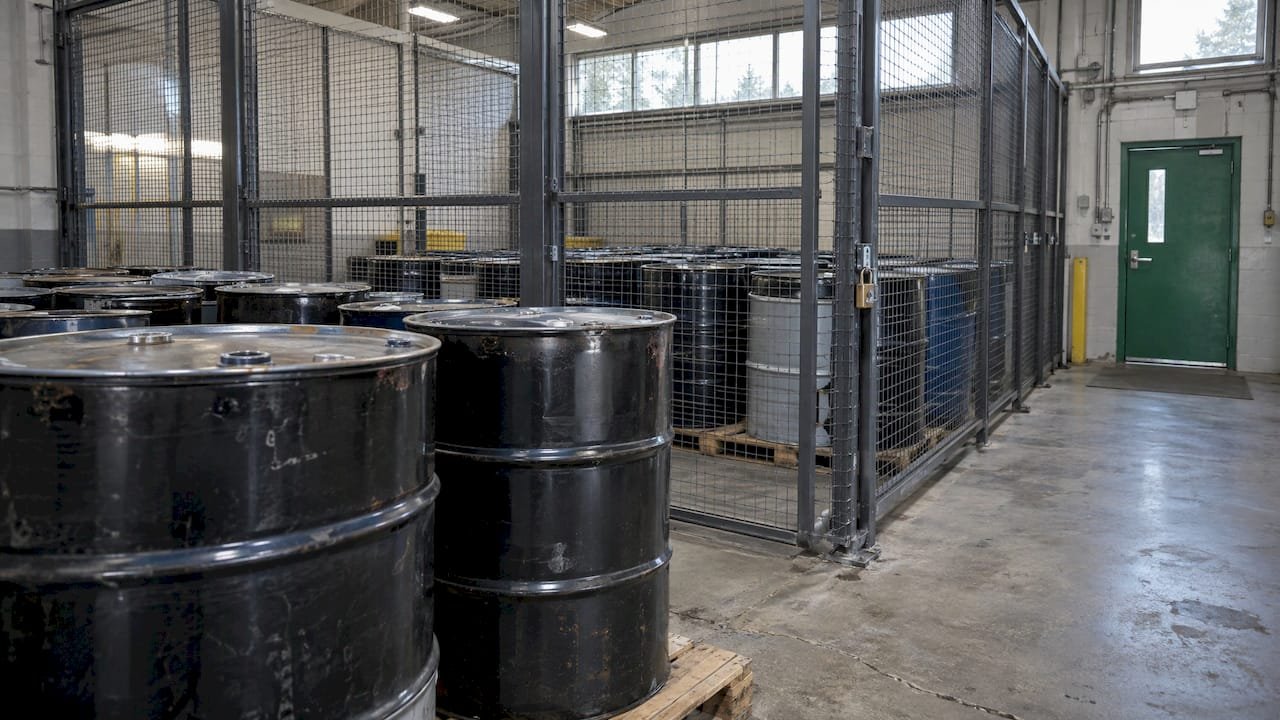
PCB waste in Ontario cannot go in the trash, down a drain or to a scrapyard. It has to be stored securely and then sent to an approved facility or destroyed under the provincial and federal rules. The owner of the equipment is legally responsible for that outcome. The practical route is to confirm what you have, keep it contained, and hand identification, removal and paperwork to a certified hazardous materials contractor. We do this work for homeowners, property managers, renovators and commercial owners across southwestern and central Ontario.
TL;DR
- PCBs (polychlorinated biphenyls) are toxic chemicals found in older transformers, capacitors, light ballasts and some oils. Equipment made before the 1980s is the main suspect.
- Under federal rules, the owner is responsible for proper handling and disposal, including reporting. Ontario Regulation 362 allows PCB waste to go only into an approved waste management system.
- Do not move, cut, drain or mix suspected PCB material with other waste. Contain it and get it identified.
- Several federal end-of-use deadlines fall on December 31, 2026, so older electrical equipment in service needs attention now.
- MSN Environmental offers PCB abatement and environmental testing, compliant with Ontario regulations.
Table of Contents
- What PCBs are and where they turn up in Ontario buildings
- How to tell whether equipment contains PCBs
- The rules that govern PCB disposal in Ontario
- Storing PCB waste safely until it leaves your site
- Moving PCB waste off site
- Step-by-step: how a PCB disposal project runs
- What affects the cost of PCB disposal
- Who should handle it
- How MSN Environmental helps
- Our perspective
- FAQ
- Sources
What PCBs are and where they turn up in Ontario buildings
PCBs are synthetic chemicals that were used for decades as insulating and cooling fluids because they resist heat and do not burn easily. They persist in the environment and are regulated for that reason. You are most likely to meet them in:
- Transformers and capacitors in older commercial, industrial and institutional buildings.
- Fluorescent light ballasts, the small boxes inside old tube fixtures.
- Pole-top and grid electrical equipment owned by property owners or industrial sites.
- Oils and fluids drained from, or spilled by, any of the above.
For a homeowner, the realistic cases are an old fluorescent fixture in a basement or garage, or a retired appliance with an electrical capacitor. For a property manager, renovator or construction manager, the realistic cases are electrical rooms, mechanical rooms and ceiling fixtures in buildings from before the 1980s, which tend to turn up during renovation or demolition.
How to tell whether equipment contains PCBs
You cannot tell by looking at the fluid, and you should never open equipment to check. Environment and Climate Change Canada (ECCC) lists the clues that point to PCBs: equipment manufactured before the 1980s, nameplate information, liquid type numbers beginning with “L” (usually Askarel), and old “Attention PCB” labels. If the nameplate is unclear, the manufacturer can confirm what was used.
Two rules of thumb from ECCC’s guidance for metal recyclers and hazardous waste providers help with common equipment:
- Transformers: wet transformers may contain PCB liquid or mineral oil contaminated with PCBs, while dry-type air-cooled transformers typically do not. When you are unsure, sampling and analysis settles it.
- Capacitors: assume those made from the 1930s up to 1982 contain Askarel unless the date or a clear non-PCB marking shows otherwise. PCB capacitors are normally sent for destruction, not recycled.
Where equipment is suspected but not confirmed PCB-free, institutional guidance such as the University of Toronto’s PCB procedures calls for verification by an accredited laboratory. That is the same logic any owner should follow: a lab result, not a guess, decides how the item is classed.
What to do before anyone touches it
- Leave the item where it is if it is intact and not leaking. Do not drain, cut or dismantle it.
- Keep suspected PCB material separate. Ontario Tech’s 2023 hazardous waste guidance says it should not be mixed with other wastes.
- Keep people and pets away from any leaking or stained equipment, and keep children out of the room.
- Photograph the nameplate and note the location, quantity and condition.
- Arrange sampling and identification before any renovation, demolition or electrical work begins.
If PCB liquid has spilled or soaked into materials, treat the area as a cleanup job, not a household chore. Contact a certified hazardous materials contractor, and if you have skin contact or any health concern, speak to your doctor or call Telehealth Ontario.
The rules that govern PCB disposal in Ontario
Two layers of law apply at once: the federal PCB Regulations and Ontario’s Regulation 362.
Ontario Regulation 362
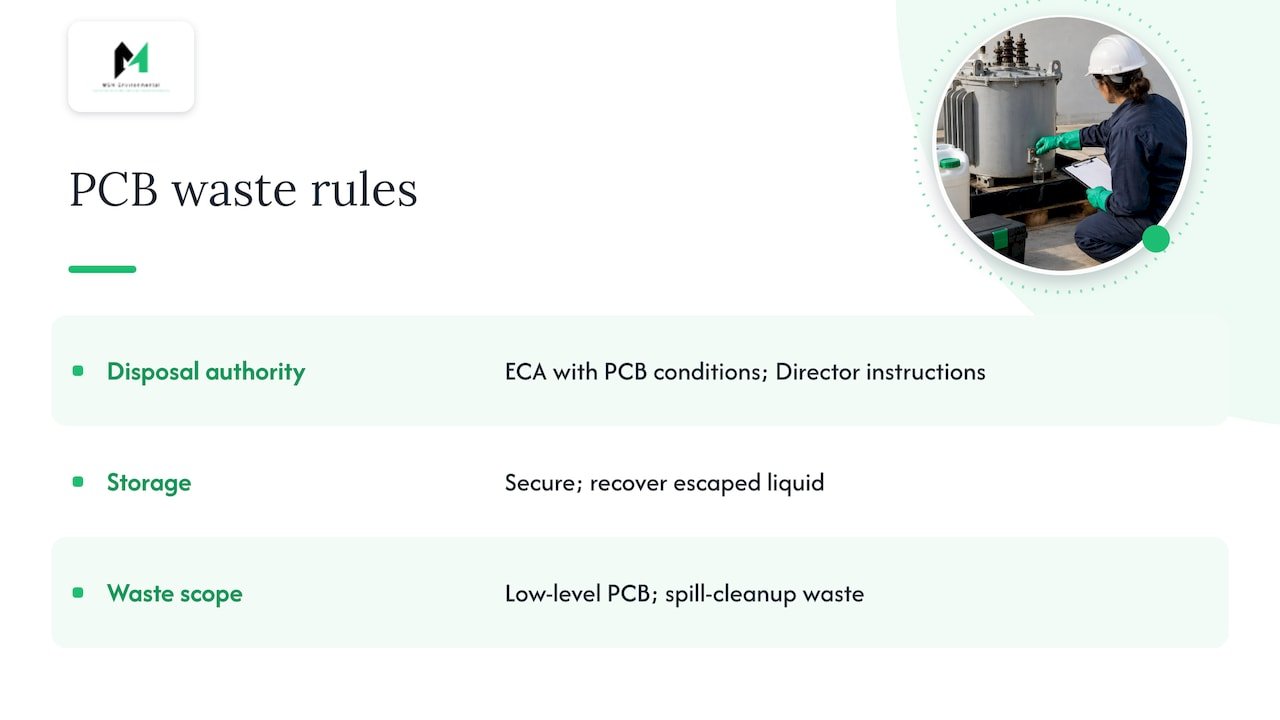
Under Section 6 of Ontario Regulation 362, managing PCB waste, including disposal and decontamination, is allowed only in or to a waste management system holding an environmental compliance approval with specified PCB conditions, or under written instructions from the Director. In plain terms: a waste hauler or facility without the right approval cannot lawfully take it.
The same regulation sets the storage standard. PCB waste must be kept in a safe, secure location that prevents contact with people and lets any escaped PCB liquid be recovered without reaching watercourses or groundwater.
The regulation also reaches beyond the equipment itself. Its definition of PCB related waste includes low-level PCB waste and waste from the cleanup of a PCB spill. Rags, absorbents, soil and debris from a cleanup are therefore regulated too.
The federal PCB Regulations
The federal PCB Regulations (SOR/2008-273), current to October 19, 2026, add three things that matter to an owner.
- A release limit. Environmental releases at or above 2 mg/kg for PCB liquids and 50 mg/kg for PCB solids are prohibited, subject to the regulation’s exceptions.
- A 30-day clock. Under section 19, the owner or person in control generally must, within 30 days after PCBs or PCB products stop being used day to day, send them for destruction at an authorized facility or store them at a PCB storage site.
- End-of-use dates. ECCC lists December 31, 2026 for specified equipment with 50 to under 500 mg/kg PCBs outside prescribed locations, for light ballasts and pole-top electrical equipment at or above 50 mg/kg, and for certain grid equipment at or above 500 mg/kg. If you still run any of these, plan removal now rather than after the deadline.
Reporting
Owners carry the paperwork too. ECCC states that owners are legally responsible for proper handling and disposal, including reporting on use, storage, shipment and destruction. Annual reports are filed through ECCC’s ePCB system, and the deadline for the 2026 annual report is March 31, 2027. Check that page for the schedule in later years.
Storing PCB waste safely until it leaves your site
Removal is rarely same-day, so storage matters. ECCC’s storage guide sets out what a compliant setup looks like:
- Access is controlled and the storage is enclosed or fenced. Where a woven-mesh fence or comparable wall is used, the guide specifies at least 1.83 m in height.
- Equipment and containers holding PCB liquids sit on a curbed or sided surface. For a single item or container, the sides must be able to hold 125% of its PCB liquid volume.
- Containers stay in their original packaging unless leaking or likely to spill. A 2024 Ontario Environmental Compliance Approval for a waste site sets that condition and requires PCB waste to move through an approved waste management system.
For a homeowner with a single old ballast, this does not mean building a fenced compound. It means keeping the item intact, contained and out of reach until it is collected. For a property with several items, the storage design is part of the job plan.
Moving PCB waste off site
This is where well-meaning owners get into trouble. Waste above 50 ppm requires special handling. The University of Toronto’s guidance notes that the Ministry must be notified before such waste leaves the generating site, and that transport along public streets needs prior approval. It also describes disposal options as limited. That is institutional guidance, but it shows why PCB waste is not something to load into a pickup.
Regulatory steps such as notices, approvals and manifests belong to the authority and the approved carrier and facility. They are part of the process, not a choice. A certified contractor who handles PCB abatement works through that chain with you, so the waste ends up at a facility that is allowed to receive it.
Facility operators must keep records of what they receive: receipts, deliveries, transport, quantity and nature of the waste, site location and storage methods. Keep your own copies of the paperwork from every step. They are your proof that the waste went where the law says it should.
Step-by-step: how a PCB disposal project runs
| Step | What happens | Where it goes wrong |
|---|---|---|
| 1. Identify | Nameplate review, age check, sampling and lab analysis where uncertain | Assuming equipment is clean because it looks fine, or opening it to look |
| 2. Assess the scope | Count items, check for leaks, stains, and affected materials such as floors or insulation | Missing a second location, such as a ceiling full of old ballasts |
| 3. Contain | Isolate the area, keep the item intact, set up compliant temporary storage | Mixing PCB waste with ordinary construction debris |
| 4. Remove | Trained technicians remove and package equipment and any contaminated materials | Cutting or draining equipment, which can spread contamination |
| 5. Transport and destroy | Carriage by an approved system to an authorized facility | Using a hauler or site without the right approval |
| 6. Document | Keep records and meet reporting duties | No paperwork to prove where the waste went |
Steps 1 to 4 are where the risk to people sits, and step 6 is where owners most often fall short. Doing it in one coordinated job keeps those pieces from falling apart.
What affects the cost of PCB disposal
No credible figure applies to every job, so be wary of a flat number. The factors that move the price are:
- Quantity and type. A handful of ballasts and a large transformer are very different jobs.
- Contamination. Leaked fluid that has soaked into floors, insulation or soil adds removal and waste volume.
- Access. Basements, rooftops, tight electrical rooms and occupied buildings change labour and containment needs.
- Testing. Sampling and lab analysis may be needed to classify the material.
- Facility handling. Authorized destruction facilities charge for the waste they receive.
- Timing. Work scheduled ahead of a deadline or inside a renovation timeline is easier to plan than an emergency cleanup.
The efficient way to get an accurate number is a site assessment, which turns these factors into a defined scope.
Who should handle it
The owner is responsible in law, but that does not mean the owner should do the work. Residential owners, property managers, renovators and construction managers each face the same issue: a mistake in identification, storage or transport is the owner’s liability.
For most readers, the right answer is a certified hazardous materials contractor that can test, remove and document in one job. Where PCBs surface during a renovation, the same team can coordinate with pre-renovation and demolition surveys and the broader designated substances survey requirements in Ontario, so the building is checked for asbestos, lead and other materials in the same visit rather than discovered one at a time.
For older buildings generally, our guide to hazardous materials in older Ontario homes shows how often several materials sit in the same walls and ceilings.
How MSN Environmental helps
MSN Environmental removes hazardous materials including PCBs, alongside asbestos, mould, lead paint, mercury, UFFI and bat guano. We also offer environmental testing, including bulk and air sampling, designated substance surveys and pre-renovation or demolition inspections, and interior demolition. All of it is delivered in line with Ontario regulations and industry standards, by trained technicians, with full liability insurance.
If you have suspected PCB equipment in a home, rental building, commercial space or construction project, start with our hazardous materials removal page, which covers PCB abatement, or contact us through the main site.

We serve Kitchener, Waterloo, Cambridge, Guelph, Hamilton, London, Brantford, Oakville, Burlington, Milton and communities across the surrounding region.
Our perspective
PCB jobs rarely arrive as a PCB job. They show up inside another project: a basement clear-out, a tenant fit-out, a demolition scope where someone finds a row of old ballasts. By then the schedule is already running, and the temptation is to bag it and move on.
Our view is that identification comes first and the paperwork comes with it. When an owner knows what the material is, where it sits and how it leaves the site, the rest of the project stops being a gamble. That is why we pair removal with environmental testing and surveys, and why our technicians are trained and certified to work to Ontario regulations.
Because older buildings seldom hold only one regulated material, we would rather look at the whole picture once. An owner who deals with PCBs, asbestos and lead in a single coordinated scope has a cleaner site, a clearer record and fewer surprises.
Moacyr
FAQ
Can I put an old fluorescent light ballast in my household garbage?
Not if it may contain PCBs. Older ballasts are one of the items federal rules single out, with end-of-use dates of December 31, 2026 for those at or above 50 mg/kg. Keep it intact, separate it from other waste and have it identified before disposal.
Who is legally responsible for PCB waste?
The owner of the equipment or product. ECCC states that owners must handle and dispose of PCBs properly and meet reporting requirements. Hiring a contractor helps you carry out the work correctly, but keep your records.
How long can I keep PCB equipment after I stop using it?
Under the federal PCB Regulations, owners generally must send PCBs for destruction at an authorized facility, or store them at a PCB storage site, within 30 days after they stop being used day to day. Storage must meet the containment and access rules.
Do I need testing before disposal?
When the nameplate or age does not make the answer clear, yes. Sampling and laboratory analysis show whether liquids or materials contain PCBs and at what level, which decides how they must be handled. Testing is also useful before renovation or demolition of older buildings.
What should I do if PCB oil has leaked?
Keep people and pets away, do not wipe it up with household cleaning materials and do not wash it down a drain. Contact a certified hazardous materials contractor. Cleanup waste counts as PCB related waste under Ontario Regulation 362. See your doctor if anyone has had skin contact or symptoms.
Sources
- About PCBs, Canada.ca
- PCB regulations: metal recyclers and hazardous waste providers, Canada.ca
- PCB storage, Canada.ca
- PCB reporting and record keeping, Canada.ca
- PCB Regulations (SOR/2008-273)
- Ontario Regulation 362, Waste Management PCBs
- Ontario Regulation 362, earlier version
- Environmental Compliance Approval, 2024
- PCB Disposal, University of Toronto Environmental Health & Safety
- Hazardous Waste Management, Ontario Tech University (2023)