

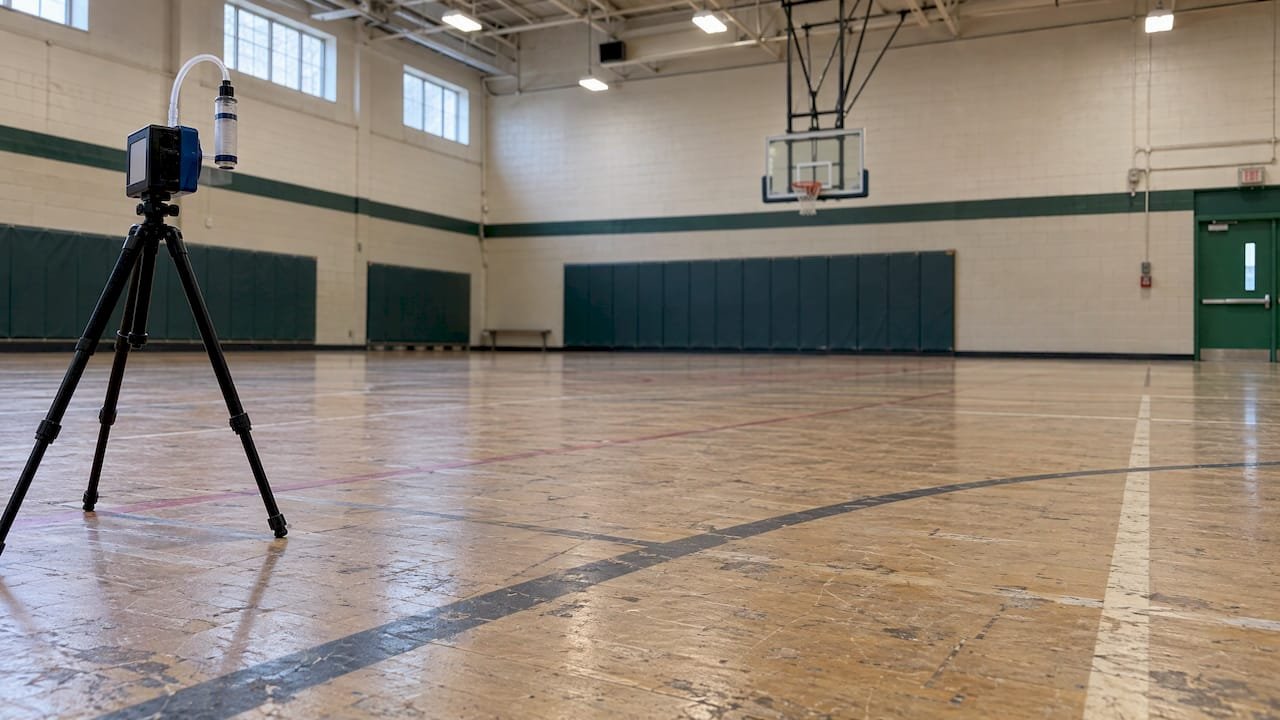
If a gym floor or rubber mat may contain mercury, the right order is test first, then plan the removal, then dispose of the waste under the rules of your province. Do not scrape, sand or cut the surface to “see what is underneath”. Confirming the material and the air quality comes before any removal, and the work is done by a contractor trained in hazardous materials. At MSN Environmental, mercury abatement and environmental testing are part of what we do for Ontario homes, businesses and institutions.
This guide is for property managers, business owners, construction managers and renovators who own or manage a space with an older seamless gym floor, a rubberized sports surface or mats of unknown origin. It explains what the concern is, how it is confirmed, how removal is run, and what you need to keep on file.
TL;DR
- Mercury in a floor is confirmed by two different tests: sampling the material itself, and sampling the air above it. One does not replace the other.
- Testing and a written scope come before abatement. Canada’s occupational safety body, CCOHS, advises assessing and testing the area first and building a project-specific safe-work plan.
- Removal needs isolation of the work area, restricted access, trained workers and protective equipment, so the floor should never be a DIY or general-demolition job.
- Removed material is hazardous waste. Disposal follows local, provincial and federal rules, and your contractor should document where it went.
- In Ontario, employers must assess and document worker exposure to designated substances, and mercury is one of them.
Table of Contents
- Why a gym floor can be a mercury problem
- Step 1: Confirm what the floor is made of
- Step 2: Build the scope and the safe-work plan
- Step 3: The Ontario rules that sit behind the work
- Step 4: Packaging, transport and disposal
- What to do while you wait for results
- Planning around worker safety
- Perspective
- How MSN Environmental helps
- FAQ
- Sources
Why a gym floor can be a mercury problem
Mercury is a metal that gives off vapour at room temperature. Some older seamless sports floors were made with polymer-modified asphalt, and mercury-based compounds were used in certain polyurethane floor systems. Over time such a floor can release mercury vapour into the room. The best-documented cases are American school gyms, which is where most of the published testing guidance comes from, but the issue is a building-materials one: any older resilient floor or mat of unknown composition deserves a proper look before it is sanded, cut or ripped out.
The New Jersey Department of Health’s 2020 guidance explains that mercury may be present in the flooring material and may be released as vapour. That is why the question is never only “is there mercury in the floor?” but also “is any of it in the air people breathe?”
What the health picture looks like
Mercury vapour is a long-term inhalation concern, especially in small, confined and poorly ventilated spaces, according to Transport Canada’s CANUTEC guidance. That is a thermometer-spill page, but the point about vapour in enclosed rooms holds for any mercury source.
A 2019 clinician fact sheet from the Icahn School of Medicine notes that mercury can affect the nervous system and kidneys. The same document says that low-level, intermittent exposure from this type of gym flooring is thought unlikely to cause health effects, and it does not recommend routine urine, blood or hair mercury tests for children simply because they attend a school with this flooring.
What that means in practice: you do not need to panic, and you should not guess. Measure the air, confirm the material, and act on numbers. If you or an occupant has symptoms or a specific concern, speak to your family doctor or your local public health unit.
Step 1: Confirm what the floor is made of
Looking at a floor does not tell you whether it contains mercury. Two kinds of testing answer two different questions, and the 2016 Arizona School Facilities Board sampling plan lays out the split clearly: bulk sampling confirms mercury in the material, while air sampling helps judge whether exposure levels are a health concern. That plan is a U.S. document and not a Canadian protocol, but the logic of separating the two is sound.
| Test | Question it answers | What it involves |
|---|---|---|
| Bulk (material) sampling | Is there mercury in the flooring itself? | Small samples of the floor are taken and analysed in a laboratory |
| Indoor air sampling | Is mercury vapour in the room at a level that matters? | Air is measured in the occupied space, ideally under normal conditions |
The New Jersey guidance recommends that a licensed environmental consultant develop the sampling plan, and CCOHS says that occupational-hygienist expertise is generally needed to test and establish the extent of the hazard. Where a hazard is suspected, the sampling plan should be written before anyone takes a sample, so that locations, conditions and number of samples are defensible.
We do environmental testing in Ontario, including bulk and air sampling, designated substance surveys and pre-renovation or demolition inspections. You can read more on our testing, inspections and assessments page and on mercury vapour testing in Ontario homes and buildings.
Read the results before you decide
The New Jersey guidance recommends measuring indoor air and considering ventilation, temperature management and re-testing before deciding whether removal is needed. Warm rooms can drive more vapour off a floor, so test conditions matter. Ask for the lab report, the sampling locations, the conditions on the day and a written recommendation. These documents become part of your file if a tenant, a user group, an insurer or an inspector asks later.
Step 2: Build the scope and the safe-work plan
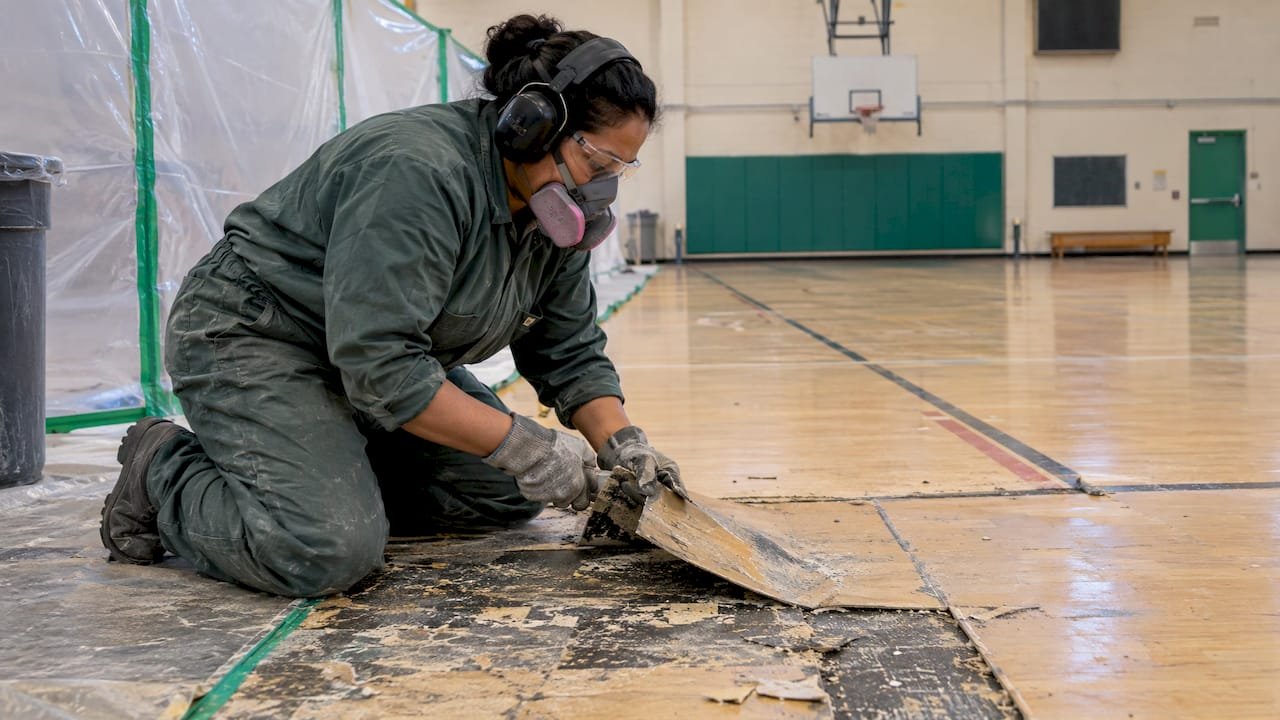
CCOHS’s guidance on hazardous-material abatement lays out the structure of a sound job: assessment and testing first, a defined scope and sequence of removal, a project-specific risk assessment and safe-work plan, and controls such as isolation barriers, restricted access, training and protective equipment. It also says jurisdictional requirements should be verified and built into the safe-work process, which is the point where Ontario’s rules come in.
A workable scope for a mercury floor typically answers these questions in writing:
- What is being removed? The full floor system, or only the top layer? Where do the edges, thresholds, wall bases and drains sit?
- What is being protected? Adjacent rooms, ventilation paths, equipment, finishes and occupants.
- How will the work area be isolated? Barriers, restricted access and controlled entry and exit.
- How will workers be protected? Training, protective equipment and decontamination routines.
- How will waste be handled? Packaging, labelling, storage on site, transport and the receiving facility.
- How will you know the job is done? Post-removal checks and documentation.
This is where a single accountable contractor pays off. When testing, containment, removal and paperwork are planned as one project, there are fewer hand-offs where something can be missed. Our approach combines highly trained and certified technicians with specialized equipment and personalized oversight, and we carry full liability insurance. Our mercury abatement service is built around that kind of defined scope.
Why a general demolition crew is the wrong fit
A gym floor is often glued or bonded to the slab. Removing it means grinding, cutting or scraping, and each of those actions can disturb the material. On an ordinary job that is routine. On a floor that may hold mercury, it is exactly what needs containment and trained workers. If your project combines a floor strip-out with other interior work, the hazardous-material removal comes first and the interior demolition follows once the area is cleared. Having both under one contractor keeps the sequence clean.
Step 3: The Ontario rules that sit behind the work
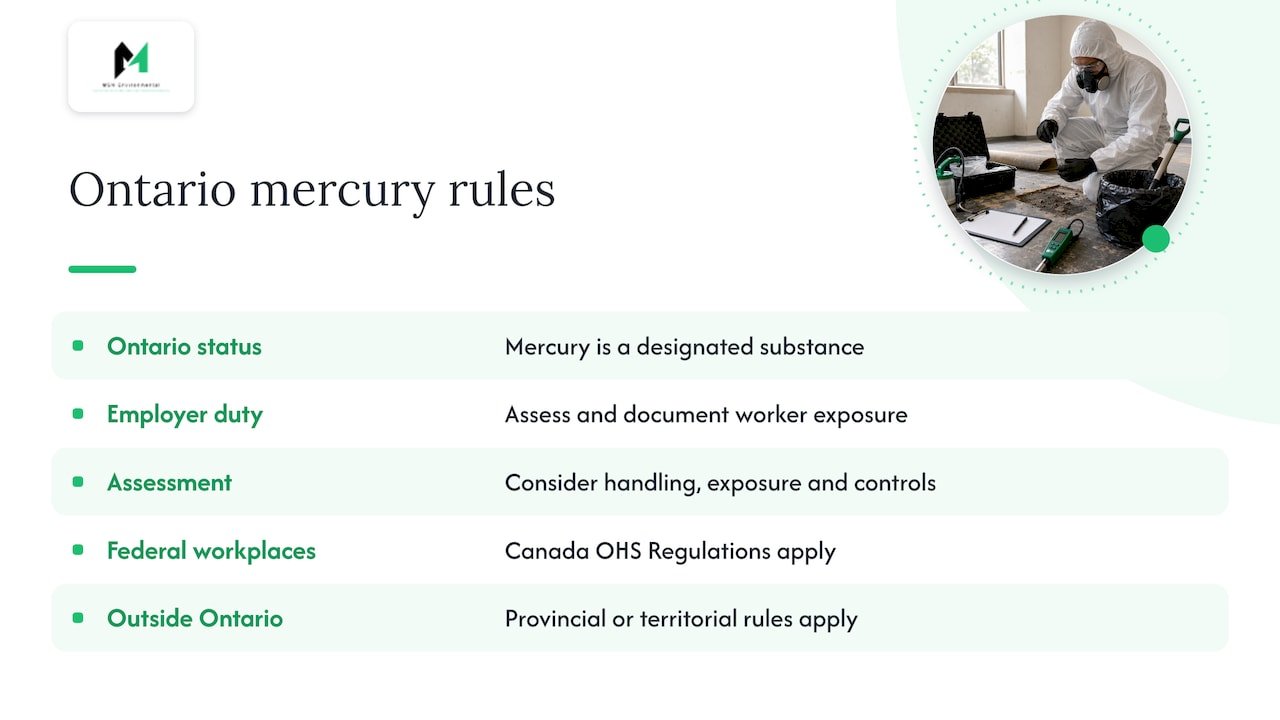
In Ontario, mercury is a designated substance. Under section 19 of O. Reg. 490/09, an employer must assess and document workers’ exposure, or likelihood of exposure, to designated substances, including mercury. The assessment has to consider handling methods, the extent of exposure and the controls in place. In plain terms: before workers touch a floor that may contain mercury, someone responsible must have looked at the risk and written it down.
For property managers and owners, that is the practical reason to commission a survey before a renovation, not during it. Our guides on designated substances survey requirements in Ontario and the 11 designated substances and how employers comply walk through the documentation in more detail.
Federally regulated workplaces fall under the Canada Occupational Health and Safety Regulations, which are current to October 19, 2026 and were last amended on March 26, 2025. Mercury management more broadly is shared across governments: Canada implements its Minamata Convention obligations through legislative and voluntary measures, and in many cases mercury is managed through provincial or territorial agencies. Outside Ontario, the province or territory’s own rules apply, so the contractor must work to the rules of the jurisdiction where the building stands.
Step 4: Packaging, transport and disposal
Removed flooring and the waste from the work area, such as protective clothing, filters and cleaning materials, cannot go into ordinary construction bins. CCOHS says removed hazardous materials must be disposed of under applicable local, provincial and federal rules, and it advises checking with the municipality or the environment ministry.
One point of caution on what you read online. Environment and Climate Change Canada’s code of practice on mercury-containing lamps says mercury from lamp waste should be recovered or stabilized before disposal in a hazardous-waste landfill. That code covers lamps, so it gives useful general context on how mercury waste is treated, but the classification of removed flooring is a separate determination made under the rules of the province where the waste is generated and where it is going.
For a deeper look at why mercury waste is handled so carefully once it leaves a building, see this overview of mercury risks and safe management in recycling.
What you should expect from your contractor:
- Waste packaged and labelled on site before it leaves the contained area.
- Transport and receiving facilities that are appropriate for the waste classification.
- Copies of the paperwork that follow the waste from your building to its destination.
- A closing report that links the testing, the removal and the final checks.
What to do while you wait for results
If you already suspect a mercury floor, these steps are low-risk and keep the situation stable:
- Leave the surface intact. No sanding, grinding, drilling or cutting.
- Keep the room ventilated and avoid overheating it, since temperature can influence vapour release.
- Limit access if testing is pending, especially to small or poorly ventilated rooms.
- Gather what you know: when the floor was installed, who installed it, any product data and past renovation records.
- Book testing before any renovation, resurfacing or demolition is scheduled.
If a mercury item has actually broken or spilled, such as a thermometer or a device, that is a different job. Our mercury spill cleanup guide and the broken thermometer first-10-minutes guide cover it.
Planning around worker safety
On any hazardous-material job, the people doing the work are the first group at risk. Training, personal protective equipment, controlled entry and clear sequencing are not extras. They are the core of the safe-work plan CCOHS describes, and a useful general read on the workplace side is this piece on the biggest safety risks to employees. If you are a construction manager, make sure every trade on site knows which areas are restricted and why.
Perspective
We approach a suspected mercury floor the way we approach any hazardous material: prove it first, then plan, then remove. A floor that only looks old can be harmless, and a floor that looks fine can need work, so the answer comes from sampling the material and the air, not from appearance.
What we see as the most valuable thing a client can do is keep testing, removal and documentation under one scope. Our technicians are highly trained and certified, we work with specialized equipment, and we carry full liability insurance. Each project gets personalized oversight, because a school gym, a fitness studio and a warehouse floor do not carry the same constraints.
If you are a property manager, a business owner or a construction manager, the paper trail matters as much as the removal. Ontario’s designated substance rules ask for an assessment that is documented, and we build our work around producing exactly that.
Moacyr
How MSN Environmental helps
We handle hazardous materials removal and environmental testing for residential, commercial and industrial properties across Ontario, including Kitchener, Waterloo, Cambridge, Guelph, Hamilton, London and surrounding communities. For a floor that may contain mercury, that means sampling to confirm what is there, a written scope, mercury abatement by trained technicians, and documentation you can keep.
Start with our mercury abatement and other hazardous materials removal services, or tell us about your floor and your timeline so we can plan the testing.

FAQ
Can I just rip out a gym floor I think has mercury?
No. Tearing, grinding or cutting an unconfirmed floor can disturb the material before anyone knows what it is. Test the material and the air first, then remove it under a written scope and safe-work plan, as CCOHS advises for hazardous-material abatement.
How do I know if mercury vapour is in the air?
Only air sampling answers that. Bulk sampling tells you whether the floor contains mercury, while indoor air sampling shows whether vapour is present in the occupied space. Both are usually planned together by a qualified consultant or hygienist.
Is mercury a regulated substance in Ontario workplaces?
Yes. Mercury is one of the designated substances under O. Reg. 490/09, and employers must assess and document the likelihood of worker exposure before work begins, including the controls to be used.
Do children or occupants need mercury blood or urine tests?
A 2019 clinician fact sheet from the Icahn School of Medicine does not recommend routine testing for children who merely attend a school with this kind of flooring. If someone has symptoms or a specific worry, they should speak to their doctor or local public health unit.
Where does removed flooring go?
It is managed as hazardous waste under local, provincial and federal rules. Your contractor should package it on site, use appropriate transport and give you the paperwork showing where it was delivered.
Sources
- Evaluation and Management of Mercury-Containing Floors, New Jersey Department of Health (2020)
- Mercury sampling plan, Arizona School Facilities Board (2016)
- Mercury thermometer spills: what to do, Transport Canada CANUTEC
- Mercury in Gym Flooring: Guidance for Clinicians, Icahn School of Medicine (2019)
- Abatement of Hazardous Materials, CCOHS
- O. Reg. 490/09 Designated Substances, Ontario e-Laws
- Canada Occupational Health and Safety Regulations
- Mercury: Minamata Convention, Government of Canada
- Code of practice: environmentally sound management of lamps containing mercury, Environment and Climate Change Canada
- Mercury in Electronics Recycling: Risks and Safe Management
- The Biggest Safety Risks to Employees at Your Business