

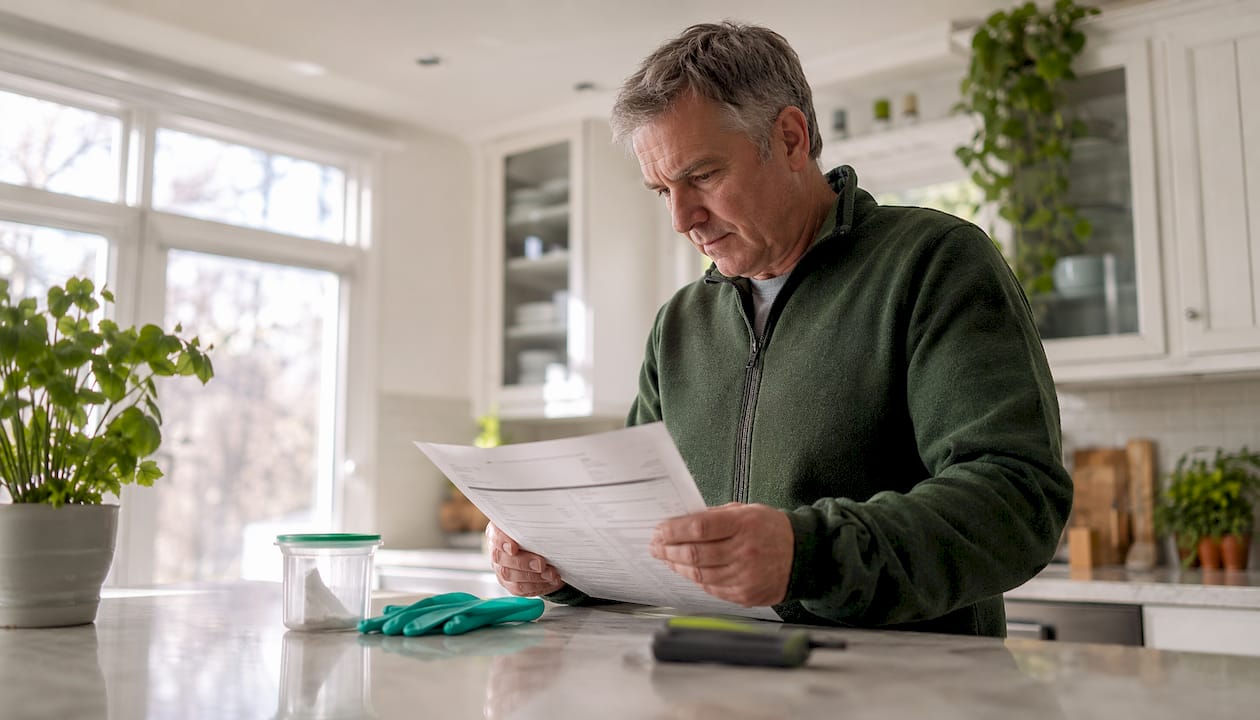
Hire a certified asbestos abatement contractor. That is the short answer for any homeowner facing drywall or joint compound installed before the early 1980s. The only exception is a very small, intact, non-friable patch where disturbance is genuinely unavoidable — even then, the precautions are strict and the risk is real.
When to stop work immediately and call a pro:
-
The home was built or last renovated before 1985, and you are planning to sand, cut, or demo any wall or ceiling surface.
-
You have found textured finishes, popcorn ceilings, or extensive patching work that has not been tested.
-
Drywall or joint compound has been water-damaged, crumbling, or is already releasing dust.
-
You are unsure of the renovation history of the building.
Immediate safety steps:
-
Stop all sanding, cutting, and power-tool work on suspect surfaces right now.
-
Limit access to the area; keep children and pets out.
-
Do not use a regular household vacuum — it will spread fibres, not capture them.
-
Arrange professional testing or a site assessment before any further work proceeds.
Pro Tip: If the drywall or ceiling finish was installed before 1990 and you cannot confirm it has been replaced, treat it as suspect. Testing costs far less than remediation after a contamination event.
Table of Contents
-
Does your drywall or joint compound actually contain asbestos?
-
How to confirm asbestos in drywall: testing and accredited labs
-
What a certified abatement contractor actually does, step by step
-
How to legally dispose of asbestos-containing drywall in Canada
-
What asbestos drywall abatement typically costs and how long it takes
-
How to choose a certified asbestos abatement contractor in Canada
-
How Msnenvironmental handles a residential drywall abatement project
-
Msnenvironmental can handle your asbestos drywall removal safely
Does your drywall or joint compound actually contain asbestos?
Age is the most reliable first indicator. Drywall systems installed in North America from the late 1920s through the early 1980s may contain asbestos, primarily in the joint compound rather than the gypsum core itself. In Canada, the practical cut-off is roughly 1982, though some regional guidance extends caution to 1990 for certain finishes.
The risk is almost never in the gypsum board itself. It lives in the mud: taping compound, skim coats, texture sprays, and patching compounds applied over joints and penetrations. Asbestos content in joint compound of that era typically ranged between 3–6% by weight, which is well above the 0.5% regulatory threshold that triggers abatement requirements.
Physical and renovation-history clues to watch for:
-
Original finishes that have never been replaced or skim-coated over
-
Popcorn or textured ceilings applied before the mid-1980s
-
Extensive patching, multiple layers of compound, or repairs around fixtures and penetrations
-
Water staining or damage that has softened the finish layer
-
A renovation history you cannot verify from permits or previous owners
The good news: intact, undisturbed wall finishes are low risk. Asbestos-containing joint compound that has never been sanded or damaged is not releasing fibres into your air. The hazard begins the moment you disturb it.
Pro Tip: When the build date or material history is ambiguous, presume risk and pause all intrusive work. A qualified inspector can often assess the situation in a single site visit.
How to confirm asbestos in drywall: testing and accredited labs
Testing is the only way to know for certain. Visual inspection alone cannot identify asbestos fibres. Here is the correct sequence:
-
Stop all work on the suspect surface. Do not sand, scrape, or cut anything further.
-
Contact a qualified inspector or environmental consultant to collect samples. In Canada, look for consultants with training through the Canadian Registration Board of Occupational Hygienists (CRBOH) or equivalent provincial credentials.
-
Wet-method bulk sampling is the standard approach. The sampler wets the material before collection to suppress fibre release, then takes a small chip of the joint compound layer specifically, not just the gypsum board. Polarised light microscopy (PLM) is the standard analytical method for confirming asbestos in joint compound.
-
Chain-of-custody to an accredited laboratory. In Canada, labs accredited under the Standards Council of Canada (SCC) or the Canadian Association for Laboratory Accreditation (CALA) are appropriate choices. The sample travels with documented paperwork from collection to analysis.
-
Receive and retain the lab report. The report will state the percentage of asbestos and the fibre type. Keep this with your renovation records permanently.
Trust signals to request from any sampler or inspector:
-
Written credentials and proof of asbestos-specific training
-
Chain-of-custody documentation for every sample
-
The name and accreditation number of the laboratory being used
-
Estimated turnaround time for lab analysis typically ranges from a few days to about two weeks depending on the lab and service level
-
Copies of all test reports for your own files
Understanding what asbestos testing involves before you book a sampler helps you ask the right questions and avoid paying for incomplete work. Metro Vancouver’s municipal guidance specifically recommends testing drywall tape and joint compound installed before 1990 before any removal or renovation proceeds.
Why DIY asbestos drywall removal is a serious mistake
The problem with amateur removal is not attitude or effort. It is physics. Sanding asbestos-containing joint compound can produce fibre concentrations 50–100 times the occupational exposure limit in a matter of minutes. Without a sealed containment zone and negative-pressure HEPA filtration, those fibres migrate through HVAC ducts, door gaps, and return air pathways into every room in the house.
The core risks of DIY removal:
-
Fibre aerosolisation: Cutting, sanding, or prying joint compound without wetting releases microscopic fibres that remain airborne for hours.
-
Cross-contamination: Fibres carried on clothing, tools, and skin spread to unaffected rooms, vehicles, and other occupants.
-
Inadequate PPE: A standard dust mask does not filter asbestos fibres. Only P100 or NIOSH-equivalent respirators with proper fit-testing provide meaningful protection.
-
No clearance verification: Without independent air testing after cleanup, there is no way to confirm the space is safe to re-occupy.
-
Disposal violations: Asbestos-containing waste requires labelled, sealed packaging, licensed transport, and acceptance at a designated facility. DIYers typically lack access to waste manifests and approved landfill contacts.
Asbestos-related diseases, including mesothelioma and asbestosis, have latency periods of 20–50 years. That gap between exposure and diagnosis is precisely why exposure prevention is the only practical protection available today. There is no treatment that reverses fibre accumulation in lung tissue. The case for hiring certified professionals is not about liability paperwork. It is about the fact that amateur disturbance commonly fails to control fibre release in ways that cannot be undone.
DIY removal of asbestos-containing drywall is strongly discouraged across Canadian municipal and provincial guidance, and for good reason.
What a certified abatement contractor actually does, step by step
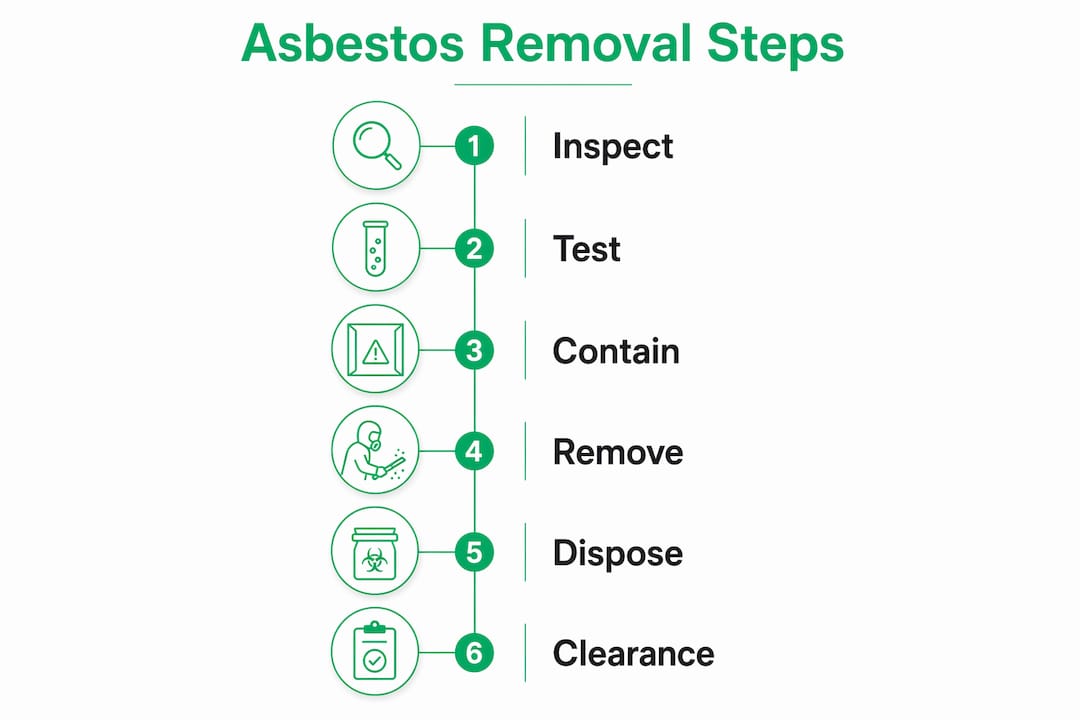
Professional asbestos abatement is a controlled, documented process. Here is what a licensed contractor does from start to finish:
-
Site inspection and scope of work. The contractor reviews lab results, inspects the affected areas, and produces a written scope of work. For larger removals, provincial regulations may require notification to the relevant occupational health authority before work begins.
-
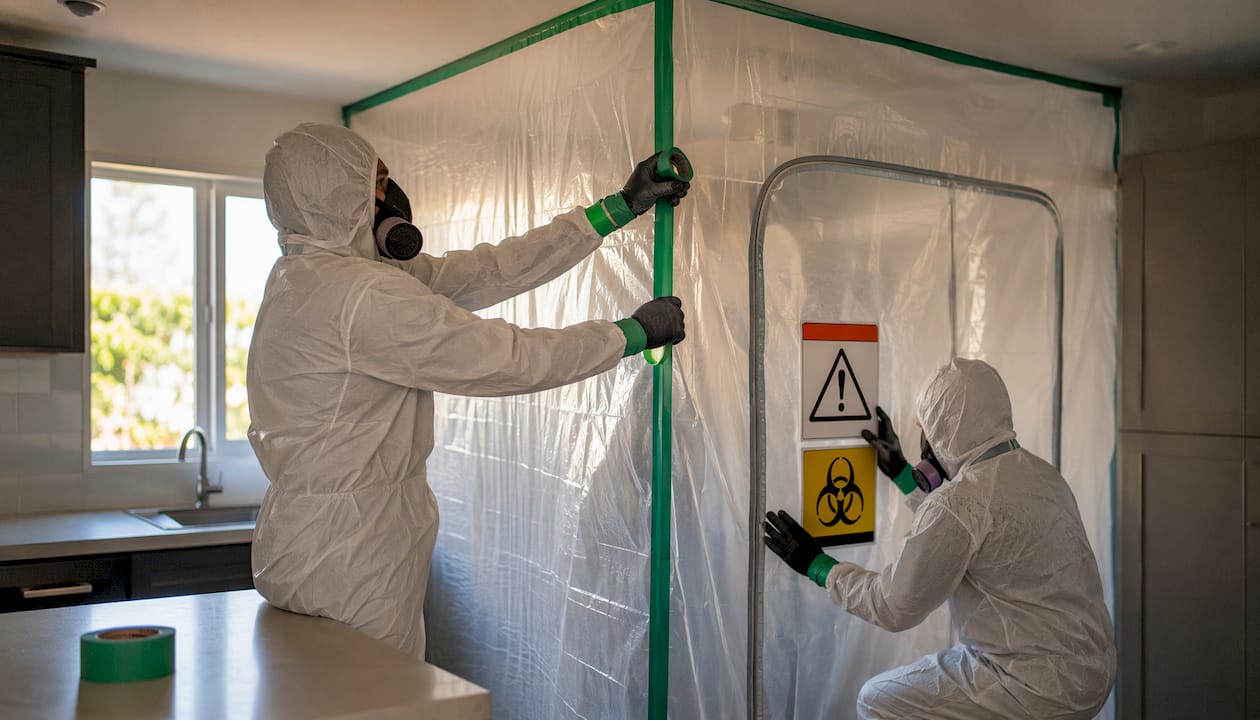
Containment setup. The work area is sealed with polyethylene sheeting on floors, walls, and all openings. Negative-pressure enclosures with HEPA-filtered air machines are established so that air flows into the work zone rather than out of it, preventing fibre migration.
-
Decontamination unit. Workers enter and exit through a decontamination airlock, removing and bagging disposable coveralls before leaving the enclosure.
-
Wet removal. Joint compound and finishes are thoroughly wetted with amended water (water with a wetting agent added) before and continuously during removal. Power tools are prohibited; hand tools only. Wetting is the single most effective control for suppressing airborne fibre creation.
-
Waste handling. Removed material is double-bagged in labelled 6-mil polyethylene bags, sealed, and staged in the decontamination zone before transport.
-
HEPA cleanup. After material removal, all surfaces are HEPA-vacuumed and damp-wiped. Polyethylene barriers are wetted and bagged as waste before removal.
-
Independent air clearance testing. A third-party hygienist or the contractor’s own air monitoring team collects air samples after cleanup and compares results to clearance criteria. This is the only objective confirmation that the space is safe.
-
Documentation and handover. The homeowner receives waste manifests, landfill disposal receipts, the clearance certificate, and a copy of the scope of work. Keep all of these permanently.
Equipment and PPE used by certified crews:
-
P100 or powered air-purifying respirators (PAPR) with fit-testing
-
Disposable Tyvek coveralls, gloves, and boot covers
-
HEPA-filtered negative air machines are typically used at a rate adequate to maintain negative pressure for the containment area
-
HEPA vacuums rated for asbestos work
-
Air monitoring pumps and calibrated sampling cassettes
Pro Tip: Ask the contractor whether air clearance testing is included in the quoted price or billed separately. Some contractors quote removal only and add clearance as an extra. You need both.
When encapsulation or over-boarding is a viable alternative to full removal, a good contractor will say so. Installing new drywall over an intact existing finish avoids the highest-risk mechanical disturbance entirely and is an accepted approach when the surface is stable and no further work will disturb it.
If you must handle a very small, intact patch yourself
This section covers a narrow scenario: a single, localised, non-friable patch that is intact and undamaged, where professional abatement is genuinely not accessible in time. DIY is still discouraged. If the patch is larger than a dinner plate, crumbling, or requires any cutting or sanding, stop and call a contractor.
Minimum precautions for a very small, intact repair:
-
Wet the surface thoroughly with water and a wetting agent before touching it. Keep it wet throughout.
-
Use hand tools only. No sanders, grinders, oscillating tools, or rotary cutters.
-
Seal off the immediate work area with polyethylene sheeting. Close HVAC vents in the room.
-
Wear a properly fitted P100 respirator (not a dust mask), disposable coveralls, gloves, and eye protection.
-
Double-bag all waste in sealed, labelled polyethylene bags immediately.
-
HEPA-vacuum the work area, then damp-wipe all surfaces. Do not use a regular vacuum.
-
Shower and change clothes before moving through the rest of the home.
-
Contact your municipality for disposal instructions before transporting the waste.
When to stop immediately and call a professional:
-
The patch is larger than expected once you begin.
-
Visible dust appears despite wetting.
-
The material is crumbling or separating from the substrate.
-
You need to cut along a seam or sand any surface.
Pro Tip: If you are unsure whether the patch qualifies as “very small and intact,” it almost certainly does not. The cost of a professional assessment is a fraction of the cost of decontaminating a room after an uncontrolled release.
How to legally dispose of asbestos-containing drywall in Canada
Disposal is not optional and not flexible. Asbestos-containing material (ACM) is regulated hazardous waste in every Canadian province and territory. Here is the required pathway:
-
Confirm the material is ACM. You need a lab report identifying the material as asbestos-containing before most landfills will accept it.
-
Contact your local municipality or provincial waste authority to identify which landfills accept ACM and what their specific packaging and documentation requirements are.
-
Arrange transport with a licensed hauler or your abatement contractor. In most provinces, transporting ACM requires a licensed carrier and a completed waste manifest.
-
Deliver with documentation. The landfill will require the waste manifest, the lab report, and properly packaged, labelled bags. Retain the landfill receipt permanently.
Packaging and transport requirements:
-
Double-bag in 6-mil polyethylene, sealed and labelled as asbestos-containing waste
-
Do not overfill bags; keep them manageable and intact
-
Avoid contaminating vehicle interiors; line the cargo area with polyethylene if transporting yourself
-
Never mix ACM with regular construction debris
Provincial variation is real. Disposal rules, permitted facilities, and transport licensing requirements differ across provinces and territories. What is accepted at a Metro Vancouver landfill may not match the requirements in Ontario or Nova Scotia. Always confirm with your local authority before moving the material.
| Province/Territory | Regulatory body to contact | Key requirement |
|---|---|---|
| British Columbia | Metro Vancouver / Regional Districts | Confirm ACM acceptance; manifest required |
| Ontario | Ministry of the Environment | Licensed hauler; waste manifest; approved facility |
| Alberta | Alberta Environment | Manifest and approved disposal site |
| Quebec | Ministère de l’Environnement | Characterisation report and licensed transport |
| Other provinces | Provincial environment ministry | Contact locally before transport |
What asbestos drywall abatement typically costs and how long it takes
Cost varies significantly based on project scope, and any figure you read online is a starting point, not a quote. That said, here are the main drivers and representative ranges to help you budget.
Key cost factors:
-
Total square footage of affected surface area
-
Whether the work involves ceilings (more complex containment and scaffolding)
-
Number of rooms requiring containment
-
Whether air monitoring and clearance testing are included
-
Distance to an approved disposal facility and landfill tipping fees
-
Contractor mobilisation costs for small jobs
Representative cost ranges (Canadian dollars, residential):
| Scope | Typical range | Notes |
|---|---|---|
| Small patch or single wall section | — | Includes containment, removal, disposal |
| Single room (walls and ceiling) | — | Varies with ceiling height and access |
| Multi-room or full-floor abatement | — | Larger containment, more disposal volume |
| Air clearance testing (standalone) | — | Per clearance event; may be included in contract |
These ranges are illustrative. Get at least three itemised quotes from certified contractors before committing.
Typical timeline for a residential project:
| Phase | Duration |
|---|---|
| Site inspection and sampling | 1–3 days (plus lab turnaround) |
| Contractor mobilisation and containment setup | Half day to 1 day |
| Removal and cleanup | 1–3 days depending on scope |
| Air clearance testing and results | 1–2 days |
| Final documentation and handover | Same day as clearance |
Getting accurate pricing: Request itemised bids that separately list containment, removal labour, disposal fees, air monitoring, and clearance testing. A bid that bundles everything into one line without breakdown makes it impossible to compare contractors fairly or identify what is missing.
How to choose a certified asbestos abatement contractor in Canada
The certification landscape in Canada is provincial. Ontario, British Columbia, Alberta, and Quebec each have their own licensing or training requirements for asbestos abatement workers and supervisors. Here is how to evaluate any contractor you are considering.
Questions to ask every contractor:
-
What provincial licence or certification do your workers and supervisors hold?
-
Can you provide proof of asbestos-specific training for the crew assigned to this job?
-
What are your insurance limits (general liability and workers’ compensation)?
-
Will you provide a written scope of work and method statement before starting?
-
What negative-air and HEPA equipment will you use, and what is the air exchange rate for the containment zone?
-
Is independent air clearance testing included in your quote, or is it extra?
-
Can you provide references from similar residential abatement projects?
-
Who handles waste transport and disposal, and will I receive manifests and landfill receipts?
Red flags that should end the conversation:
-
No written scope of work offered before you sign anything.
-
Vague or verbal disposal plan with no mention of manifests or licensed haulers.
-
Refusal to show certifications, insurance certificates, or training records.
-
A bid significantly lower than all others, with no itemisation to explain why.
-
No mention of air clearance testing after removal.
-
Suggesting you can skip testing because “it probably doesn’t have asbestos.”
Documents to require in the contract:
-
Written scope of work with specific removal methods described
-
Project timeline with start and completion dates
-
Itemised pricing (containment, removal, disposal, air monitoring, clearance)
-
Proof of worker training and supervisor certification
-
Confirmation that waste manifests and clearance certificates will be provided at project close
Msnenvironmental’s asbestos abatement services in Kitchener and the surrounding region cover all of these requirements as standard, including written scopes, certified crews, and post-project documentation.
How Msnenvironmental handles a residential drywall abatement project
A typical Msnenvironmental project begins with a site inspection and a review of any existing lab results. If testing has not been done, the team coordinates bulk sampling and accredited lab analysis before any removal work is scoped or priced. That sequence matters: removal without confirmed testing is guesswork, and guesswork with asbestos is not a risk worth taking.
What the service covers from intake to handover:
-
Initial site inspection and testing coordination (bulk sampling, chain-of-custody, accredited lab)
-
Written scope of work tailored to the specific materials and room configuration
-
Full containment setup with polyethylene barriers and HEPA-filtered negative-air machines
-
Wet hand-removal of joint compound and affected finishes, no power tools
-
HEPA vacuuming and damp-wipe cleanup of all surfaces within the containment zone
-
Hazardous waste packaging, labelling, transport, and licensed disposal
-
Independent air clearance testing and provision of the clearance certificate
-
Final documentation package: scope, manifests, disposal receipts, clearance certificate
Trust signals Msnenvironmental provides to homeowners:
-
Staff hold provincial asbestos abatement certifications and receive ongoing training
-
Air monitoring is conducted during and after removal, not just at clearance
-
HEPA-filtered negative-air equipment is standard on every abatement project
-
Full general liability insurance and WSIB coverage
-
Every project closes with a written clearance certificate and disposal receipts for the homeowner’s records
Pro Tip: Before your first call with any abatement contractor, have the following ready: the approximate build date of the home, photos of the affected surfaces, the room dimensions, and any existing lab reports. That information lets the contractor give you a meaningful preliminary scope rather than a vague estimate.
Msnenvironmental serves residential and commercial clients across Ontario, including Toronto, Hamilton, Kitchener, Waterloo, Cambridge, and surrounding communities.
Key takeaways
Asbestos-containing drywall and joint compound installed before the early 1980s must be tested before any sanding, cutting, or demolition, and removed only by a certified abatement contractor using containment, wet methods, HEPA filtration, and independent air clearance testing.
| Point | Details |
|---|---|
| Test before you touch | Any finish installed before 1990 should be bulk-sampled by a qualified inspector before renovation work begins. |
| The risk is in the mud | Asbestos in drywall systems lives in joint compound and texture sprays, not the gypsum core; test the mud layer specifically. |
| DIY is strongly discouraged | Amateur disturbance can produce fibre concentrations far above safe limits and spread contamination through the whole home. |
| Encapsulation is a valid option | Intact surfaces can often be over-boarded rather than removed, avoiding the highest-risk disturbance entirely. |
| Msnenvironmental | Provides certified asbestos abatement across Ontario, including testing coordination, wet removal, HEPA clearance, and full disposal documentation. |
A word on safety and choosing the right contractor
The part of asbestos abatement that most guides underplay is documentation. Homeowners focus on the removal itself, which is understandable, but the clearance certificate and disposal receipts are what protect you when you sell the property, pull a permit for future renovations, or need to demonstrate to an insurer that the work was done properly. A contractor who cannot or will not provide those documents at project close is not a contractor worth hiring, regardless of how low the bid is.
The other thing worth saying plainly: the decision to encapsulate rather than remove is not a shortcut or a compromise. When a surface is intact and stable, leaving it undisturbed or over-boarding it is often the technically correct choice, not a second-best option. The goal is to prevent fibre release, and sometimes the safest way to do that is to not disturb the material at all. A good abatement contractor will tell you this honestly, even when removal would mean more billable work for them.
MSN Environmental can handle your asbestos drywall removal safely
When testing confirms asbestos in your drywall or joint compound, the next call should be to a contractor who can manage the entire process, not just the removal itself.
MSN Environmental provides certified asbestos abatement services for homeowners and property managers across Ontario, including Kitchener, Waterloo, Cambridge, Hamilton, Toronto, and surrounding areas. The team handles testing coordination, full containment and wet removal, hazardous waste transport and disposal manifests, HEPA air clearance testing, and the complete documentation package you need at project close. Before you call, have your home’s build date, photos of the affected surfaces, and approximate room dimensions ready. That information lets the team provide a meaningful scope and quote on the first conversation. Contact Msnenvironmental to request an inspection or get a project quote.
Useful Canadian sources and further reading
These authoritative sources cover testing, disposal, provincial rules, and sampling methods for Canadian homeowners:
-
Metro Vancouver: Asbestos and Gypsum Drywall Removal and Disposal — Municipal guidance on testing joint compound installed before 1990, confirming asbestos, and arranging compliant disposal. Directly applicable to BC homeowners; the testing and disposal logic applies broadly across Canada.
-
InspectAPedia: Asbestos Content in Drywall and Joint Compound — Detailed reference on which drywall-era products contained asbestos, where the risk lives in the wall system, and what the Canadian classification framework looks like for drywall removal hazard levels.
-
InspectAPedia: Asbestos Drywall Remediation and Removal — Covers encapsulation versus removal decisions, regulatory thresholds that trigger licensed abatement, and practical guidance on when to leave materials in place.
-
Queen’s University: Type 1 Asbestos Removal Procedures — Canadian institutional procedures for low-risk (Type 1) asbestos work, including wetting requirements, HEPA vacuuming protocols, and waste handling steps. Useful for understanding what minimum-precaution work actually requires.
-
CDC/NIOSH Asbestos Resources — Occupational health guidance on asbestos exposure limits, respirator selection, and health effects. Relevant for understanding the science behind exposure controls.
-
AsbestosHQ: Asbestos Drywall Guide — Practical overview of PLM testing, encapsulation options, and why power tools are prohibited in asbestos abatement work.
-
Standards Council of Canada (SCC) / Canadian Association for Laboratory Accreditation (CALA) — Use these bodies’ directories to find accredited laboratories in your province for bulk PLM analysis of joint compound samples.
-
Your provincial Ministry of the Environment or Labour — The authoritative source for province-specific disposal rules, licensed hauler requirements, and abatement contractor licensing in your jurisdiction. Search “[your province] asbestos abatement regulations” to reach the current guidance page.