

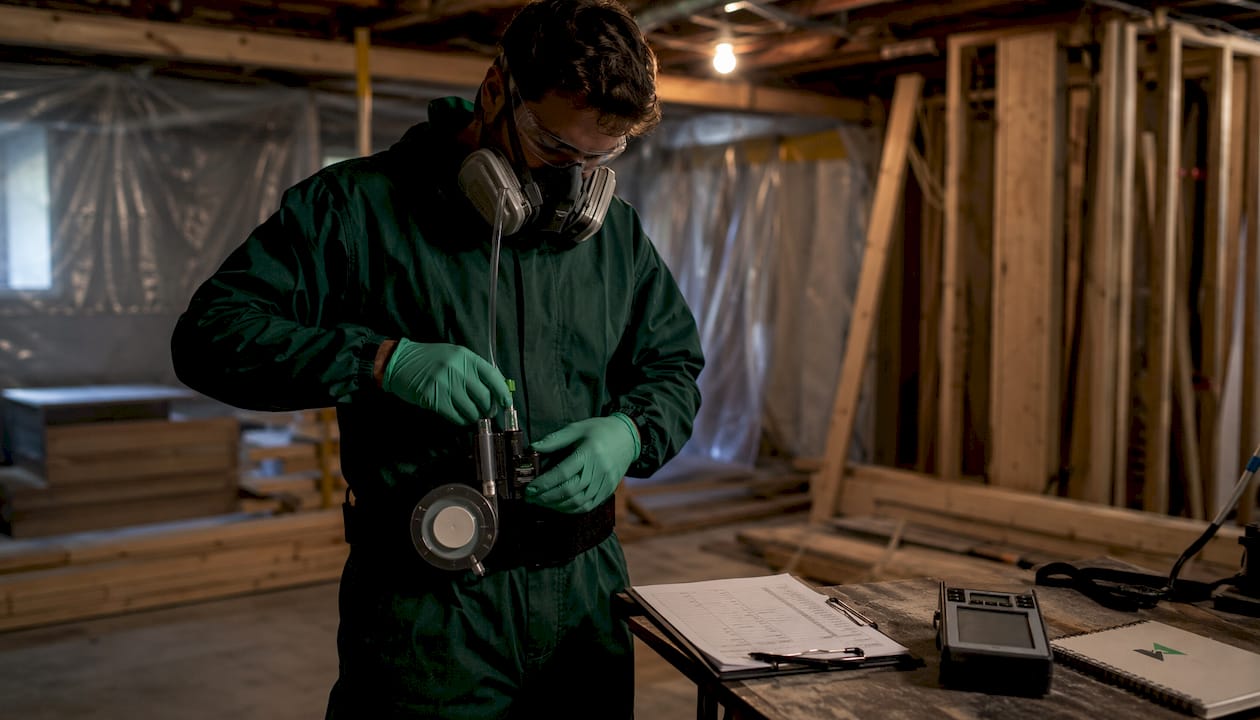
Sample air for asbestos when suspect materials have been disturbed, during or after abatement work (clearance testing), or when you need to measure a worker’s actual exposure during a specific activity. If the asbestos-containing material (ACM) is intact and undisturbed, air sampling is rarely the right first move. A visual inspection and bulk material testing are more informative and less likely to generate misleading results.
When sampling is warranted, two analytical routes are available:
- PCM (Phase Contrast Microscopy, NIOSH Method 7400): counts all fibres meeting length and aspect-ratio criteria at roughly 400× magnification. Fast and well-established for occupational exposure monitoring, but cannot confirm fibre type.
- TEM (Transmission Electron Microscopy, NIOSH Method 7402 / ISO equivalent): identifies mineral type, detects finer fibres, and reaches lower detection limits. Required for certain clearance scenarios and whenever PCM results are disputed or inconclusive.
Both methods depend on a properly collected sample: a 25-mm mixed-cellulose ester (MCE) filter, a calibrated pump, correct flow rates, and documented chain-of-custody submitted to an ISO/IEC 17025-accredited laboratory.
The bottom line: if materials were disturbed, if you need legal or occupational clearance, or if a renovation is planned, hire a qualified, independent sampler and an accredited lab. Consumer PM2.5 monitors and DIY kits cannot detect asbestos fibres. Full stop.
Table of Contents
- When is asbestos air sampling actually appropriate in Canada?
- Types of asbestos air sampling and what each is used for
- How asbestos air sampling is actually done: pumps, filters, and chain-of-custody
- PCM versus TEM: which laboratory method do you actually need?
- How to read an asbestos air report and find Canadian regulatory guidance
- How to choose a qualified Canadian lab and certified sampler
- What to expect during clearance sampling in Canada
- Safety, legal, and best-practice essentials for asbestos work in Canada
- Key takeaways
- Why the “just test it” instinct often leads people astray
- MSN Environmental: certified sampling and abatement across Ontario
- Authoritative Canadian and technical references
When is asbestos air sampling actually appropriate in Canada?
Undisturbed asbestos-containing materials generally do not require routine air testing. Canadian and Ontario provincial guidance is consistent on this point: the risk comes from disturbed, friable ACM releasing fibres into the air, not from intact materials sitting behind a wall or under a floor. Visual inspection and bulk sampling (polarised light microscopy on a physical sample) are the standard tools for identifying whether ACM is present.
Clear triggers for air sampling:
- Visible damage or disturbance to suspected ACM (ceiling tiles, pipe insulation, floor tiles, textured coatings)
- Post-abatement clearance testing to confirm a work area is safe to re-occupy
- Occupational exposure monitoring for workers who may contact ACM during renovation, demolition, or maintenance
- Activity-based sampling (ABS) during soil disturbance or construction near naturally occurring asbestos
- Owner- or regulator-requested testing under building management programmes or school rules
Situations where air sampling is not the right tool:
- Intact, well-maintained ACM with no evidence of disturbance — leave it alone and manage it in place
- Initial identification of whether a material contains asbestos (bulk PLM analysis is the correct method)
- General indoor air quality checks where no ACM disturbance has occurred
Ontario Regulation 278/05 and federal guidance from Canada.ca both frame clearance sampling as a validation step after abatement, not a routine monitoring activity. A clearance result does not certify a building as permanently “asbestos-free”; it confirms that fibre concentrations in the work area met the applicable threshold at the time of testing.
Quick decision checklist:
- Has suspect material been cut, sanded, drilled, or otherwise disturbed? → Air sampling is warranted.
- Is abatement work complete and the area ready for re-occupancy? → Clearance sampling required.
- Are workers regularly in contact with ACM during maintenance? → Occupational exposure assessment needed.
- Is the material intact, labelled, and undisturbed? → Inspect, document, and manage in place; no air sampling needed.
Types of asbestos air sampling and what each is used for
Not all sampling serves the same purpose, and choosing the wrong type produces results that cannot answer the question you are actually asking.
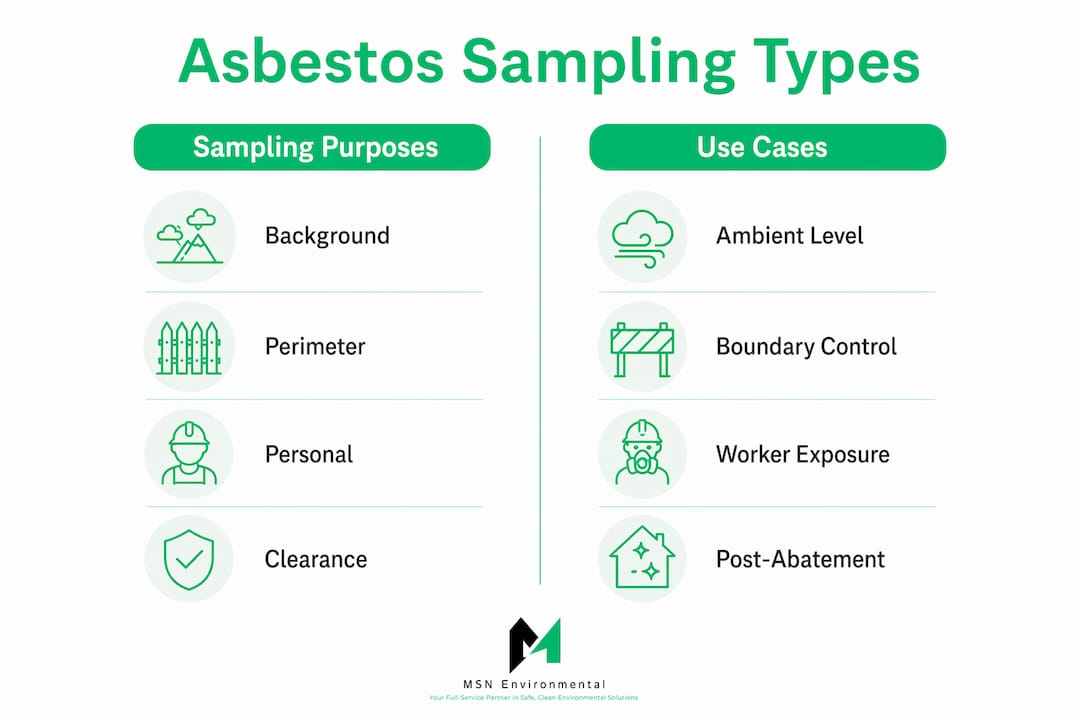
Background (reference) samples establish the ambient fibre concentration before any work begins or in areas unaffected by abatement. They give you a baseline against which post-abatement or perimeter results can be compared. Without a background sample, it is difficult to argue that elevated post-work concentrations came from the abatement itself rather than pre-existing conditions.
Perimeter samples are collected at the boundary of a regulated work area, outside the containment. Their purpose is to confirm that the containment is not leaking fibres into adjacent occupied spaces. Clearance sampling protects areas adjacent to regulated zones by proving containment integrity — a point that matters enormously in commercial buildings where only part of a floor is under abatement.
Personal (breathing-zone) samples are clipped to a worker’s lapel within 30 cm of the nose and mouth. These are the samples used for occupational exposure assessment and TWA (time-weighted average) compliance checks. They represent what the worker actually inhales during a task.
Clearance (post-abatement) samples are collected after the abatement contractor has completed cleaning and the area has dried. They are the final gate before re-occupancy. Critically, they must be collected by an independent party, not the abatement contractor.
Activity-based sampling (ABS) is used during specific disturbance events — soil excavation near naturally occurring asbestos, demolition of ACM-containing structures, or maintenance tasks on known ACM. ABS samples are often collected at higher volumes to reach the sensitivity needed for low-concentration environments.
Short use-case examples:
- School abatement clearance: perimeter and indoor clearance samples collected by an independent hygienist after floor-tile removal, with TEM confirmation if initial PCM results are near the threshold.
- Home renovation disturbance: personal breathing-zone sample on the worker plus area samples in adjacent rooms to check containment.
- Construction soil disturbance: ABS with high-volume sampling to detect concentrations at or below 0.001 structures/cc.
- Worker respirator fit verification: personal samples during a specific task to confirm that existing PPE controls are adequate.
How asbestos air sampling is actually done: pumps, filters, and chain-of-custody
The field kit for a standard asbestos air sample is straightforward, but every component matters. A mistake in cassette assembly or pump calibration can invalidate the entire sample.
Standard equipment
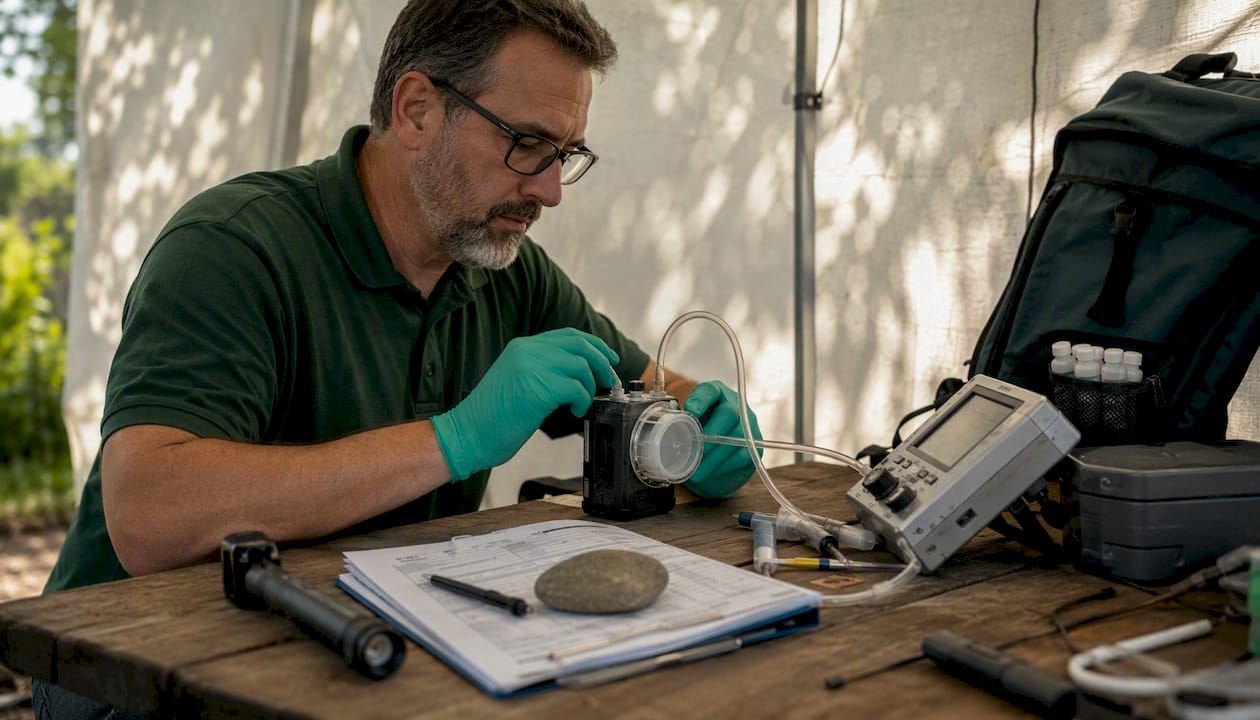
The standard sampling assembly uses a battery-operated personal sampling pump connected by tubing to a 25-mm, three-piece conductive cassette. The cassette holds a 25-mm MCE filter and is fitted with a 50-mm electrically conductive extension cowl, open-face, to prevent electrostatic fibre loss and ensure representative collection. Cassettes are single-use. Never reload a used cassette; electrostatic effects and filter repositioning alter fibre retention in ways that cannot be corrected at the lab.
Flow rates and sample volumes
Standard flow rates for 25-mm cassettes run from 0.5 to 5.0 L/min. In practice, most samplers operate at 1–2 L/min to reduce the risk of filter overloading, particularly in dusty environments. The NIOSH/OSHA ID-160 method sets a minimum sample volume of 25 L for TWA compliance samples and approximately 48 L for 30-minute excursion checks. Sample volumes may be increased according to environmental conditions and detection requirements. For activity-based or background sampling targeting very low concentrations, volumes greater than 500 L are often used, and background sensitivity targets can require thousands of litres.
| Parameter | Typical value | Notes |
|---|---|---|
| Filter type | 25-mm MCE | 25-mm pore size standard |
| Cassette | 3-piece conductive, open-face | 50-mm extension cowl required |
| Flow rate | 0.5–5.0 L/min | Operational target: 1–2 L/min |
| Min. volume (TWA) | 25 L | Per OSHA/NIOSH guidance |
| Min. volume (30-min excursion) | ~48 L | Per OSHA/NIOSH guidance |
| Max. volume (varies by environment) | Up to thousands of litres | Avoid filter overloading, especially in dusty settings |
| ABS / background sensitivity | >500 L, often thousands | Based on target detection limit |
| Field blank frequency | 10% of samples or minimum 2 | Submitted with each batch |
Calibration and chain-of-custody
Pumps must be calibrated with the actual cassette assembly in place, both before and after sampling. Post-sampling calibration confirms the flow rate did not drift. Record both readings on the chain-of-custody form.
Field blanks travel with the sample batch, are handled identically to real samples (opened and closed in the field), but no air is drawn through them. NIOSH/OSHA guidance recommends at least 10% blanks or a minimum of two per batch. If a blank comes back above the detection limit, the entire batch is suspect.
Chain-of-custody documentation records every hand-off from field to lab: sampler name, sample ID, collection time, pump flow rate, total volume, temperature and humidity notes, and the signature of each person who handled the samples. Labs will not accept samples without it.
Pro Tip: Pack cassettes in rigid containers with minimal movement and avoid electrostatic packing materials (foam peanuts, certain bubble wrap). Electrostatic charge can pull fibres off the filter during shipping, producing a false-low result.
PCM versus TEM: which laboratory method do you actually need?
The choice of analytical method is not a formality. It determines what the result can and cannot tell you, and choosing the wrong one can leave you with a report that is technically valid but practically useless.
Phase contrast microscopy (PCM)
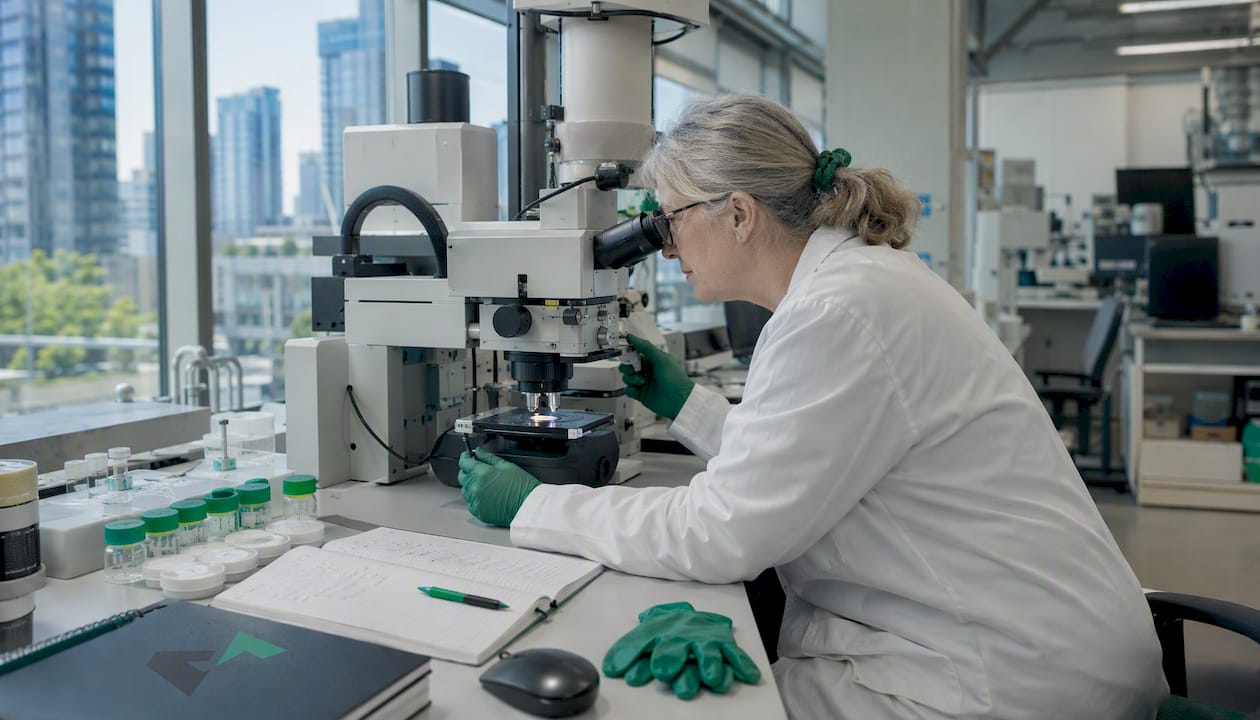
PCM, standardised as NIOSH Method 7400 and referenced in OSHA ID-160, counts all fibres longer than 5 µm with an aspect ratio of at least 3:1, visible at roughly 400× magnification. It is fast, well-established, and the standard method for occupational exposure monitoring and routine clearance sampling where regulations permit it. The ideal counting range is 100–1,300 fibres/mm² of filter area.
The critical limitation: PCM cannot distinguish asbestos fibres from other elongated mineral particles or synthetic fibres. A high PCM count in a building with no known ACM may be non-asbestos fibres entirely. Conversely, very fine asbestos fibres below roughly 0.2 µm in diameter are invisible to PCM.
Transmission electron microscopy (TEM)
TEM, referenced in NIOSH Method 7402 and equivalent ISO methods, identifies the mineral structure of individual fibres. It detects fibres too fine for PCM, reaches lower detection limits, and can confirm whether a counted fibre is actually asbestos. This matters in three situations: when PCM results are near a regulatory threshold and the fibre type is uncertain; when clearance is required after a failed abatement; and when ABS or background work targets concentrations at or below 0.001 structures/cc, where the sensitivity of PCM is simply inadequate.
| Feature | PCM (NIOSH 7400) | TEM (NIOSH 7402 / ISO) |
|---|---|---|
| What it counts | All fibres meeting size criteria | Asbestos structures specifically |
| Mineral identification | No | Yes |
| Detection limit (sample volume varies) | near 0.001 f/cc | Significantly lower |
| Typical turnaround | 1–3 business days | 3–7 business days |
| Cost | Lower | Higher |
| Best use | Occupational monitoring, routine clearance | Confirmation, low-concentration ABS, disputes, school clearance |
| Limitation | Cannot confirm asbestos type | Slower, more expensive |
AHERA-style guidance (used as process reference in Canadian school abatement contexts) specifies TEM for re-clearance after a failed initial clearance, recognising that PCM alone cannot resolve ambiguous results near the threshold.
How to read an asbestos air report and find Canadian regulatory guidance
A lab report for asbestos air sampling contains more information than the fibre count on the front page. Knowing what to look for separates a reliable result from one you should question.
What a credible report includes
- Sample identification: unique ID, collection date, location, sampler name
- Pump data: flow rate (L/min), start and end times, total volume (L)
- Method stated: PCM (NIOSH 7400 / OSHA ID-160) or TEM (NIOSH 7402 / ISO equivalent)
- Field blank results: blank fibre counts and whether they are below the detection limit
- Fibre or structure count: raw count, filter area analysed, calculated concentration (f/cc or s/cc)
- Detection limit: expressed per sample volume
- Lab QA/QC notes: blind recount results, proficiency scheme participation (AIHA/PAT, NVLAP or equivalent)
- Chain-of-custody stamps: signed at each transfer point
Evaluating report reliability
A credible report comes from an ISO/IEC 17025-accredited laboratory. That accreditation means the lab’s methods, equipment, and personnel have been independently assessed. Check that the report states the method used, shows blank results below detection, includes calibration data, and documents participation in an interlaboratory proficiency scheme. If any of these are missing, ask the lab directly before relying on the result.
Canadian regulatory context
For occupational exposure, the primary Canadian reference is the Canadian Centre for Occupational Health and Safety (CCOHS) and provincial occupational health and safety regulations. Ontario Regulation 278/05 governs asbestos on construction projects and in buildings, setting out requirements for Type 1, 2, and 3 operations and the conditions under which clearance sampling is required. Health Canada provides guidance on residential exposures. Canada.ca’s technical guideline on asbestos exposure management programmes is the federal reference document for building owners and programme managers.
Interpreting a “non-detect” result
A non-detect result means fibre concentrations were below the method’s detection limit at the time and location of sampling. It is not proof that no asbestos fibres are present in the building. Air sampling captures a moment and a location; fibre release is intermittent and depends on activity, airflow, and disturbance. Treat a non-detect clearance result as confirmation that the abatement work met the threshold on the day of testing, not as a permanent certificate.
How to choose a qualified Canadian lab and certified sampler
The two most common mistakes in asbestos air sampling are using an unaccredited lab and allowing the abatement contractor to collect their own clearance samples. Both undermine the entire purpose of the exercise.
Minimum credentials to require
- ISO/IEC 17025 accreditation for the specific asbestos air method (PCM and/or TEM) — ask for the accreditation scope document, not just a certificate number
- Recognised analytical methods: NIOSH 7400 (PCM), NIOSH 7402 (TEM), or equivalent ISO methods
- Proficiency testing participation: AIHA Proficiency Analytical Testing (PAT) programme, NVLAP, or a recognised Canadian equivalent
- Experienced microscopists: ask how many analysts perform asbestos counts and whether they participate in regular blind recounts
- Qualified sampler: a Certified Industrial Hygienist (CIH), Registered Occupational Hygienist (ROH), or a technician working under the supervision of a qualified hygienist
The conflict-of-interest problem
Clearance sampling must be independent. An abatement contractor who collects their own clearance samples has a financial interest in a passing result. This is not a theoretical concern. Independent third-party sampling is the standard expected by regulators and building owners alike. If a contractor insists on performing their own clearance, treat that as a red flag.
Questions to ask before hiring
- What method will you use for analysis, and why PCM rather than TEM (or vice versa) for this project?
- Is your lab ISO/IEC 17025 accredited for asbestos air analysis? Can you provide the accreditation scope?
- What is your chain-of-custody procedure from field to lab?
- What is the standard turnaround time, and what does rush service cost?
- How long do you retain samples after analysis?
- Do you participate in AIHA/PAT or an equivalent proficiency scheme?
TEM costs more and takes longer than PCM, but for school abatements, litigation support, or low-concentration ABS work, the extra cost is justified. For routine occupational clearance where PCM is permitted by regulation, PCM is the standard choice.
What to expect during clearance sampling in Canada
The clearance process follows a fixed sequence. Skipping or reordering steps produces results that regulators and building owners will not accept.
Step-by-step workflow:
- Inspection and bulk testing — confirm ACM presence and extent before any work begins
- Scope and control setup — establish containment, negative pressure, and access controls per Ontario Regulation 278/05 or applicable provincial rules
- Abatement or repair — licensed contractor completes removal or encapsulation
- Cleaning and drying — thorough HEPA vacuuming and wet wiping; the area must be visually clean and fully dry before sampling begins
- Independent clearance sampling — qualified third-party sampler collects area samples, perimeter samples, and field blanks; photographs and documentation completed on site
- Lab analysis — samples shipped under chain-of-custody to an ISO/IEC 17025 lab
- Final decision and report — lab results compared to applicable threshold; clearance issued or re-abatement required
Realistic timelines
Site inspection typically takes the same day to a few days depending on building size. Abatement ranges from a few hours for a small residential job to several days for a large commercial project. Cleaning and drying generally takes one to three days. Lab turnaround for PCM runs one to three business days under normal conditions; TEM takes three to seven business days. Rush PCM analysis is available from most accredited labs, often within 24 hours at a premium.
On the day of clearance sampling
The independent sampler will need unobstructed access to the work area. Expect photographs of the containment, documentation of pump serial numbers and calibration records, field blanks collected and labelled in the field, and co-located samples where the project scope requires them. The sampler should not be accompanied by the abatement contractor during sample collection.
When re-sampling is required
A failed clearance — results above the applicable threshold — means the area must be re-cleaned and re-sampled. Re-sampling is also required if visible debris remains after abatement, if field blanks come back above detection, or if procedural errors (pump failure, cassette damage, chain-of-custody gaps) compromise the original batch.
Safety, legal, and best-practice essentials for asbestos work in Canada
The single most important safety rule is also the simplest: do not intentionally disturb suspect ACM. Elevated airborne asbestos concentrations occur when ACM is cut, sanded, drilled, or otherwise disturbed. Containment, negative pressure, and appropriate PPE are not optional extras for Type 2 and Type 3 operations under Ontario Regulation 278/05 — they are legal requirements.
Legal best practices
Obtain a qualified inspection and designated substance survey before any renovation or demolition that may disturb ACM. Insist on independent clearance sampling with documented chain-of-custody. Keep all inspection reports, bulk sample results, abatement records, and clearance reports indefinitely — they are part of the building’s permanent record and may be required for future sales, permits, or insurance claims. For asbestos removal in Ontario, the contractor must be licensed and the work must follow the notification and procedural requirements set out in provincial regulation.
Common DIY errors to avoid
- Improper pump calibration (calibrating without the cassette attached, or not calibrating at all)
- Re-using cassettes or handling open-face cassettes without gloves
- Shipping samples in electrostatically charged packaging materials, which can strip fibres from the filter
- Misinterpreting a non-detect result as proof that no asbestos is present
- Relying on consumer air quality monitors: PM2.5 and AQI devices report particulate mass, not fibre morphology or mineral type, and cannot detect asbestos under any conditions
The health consequences of asbestos exposure are well-documented, including the link between asbestos and certain cancers. That risk is precisely why sampling protocols exist and why cutting corners on equipment, calibration, or lab accreditation produces results that are worse than useless — they create false confidence.
When in doubt about the regulatory requirements for your jurisdiction, retain a qualified occupational hygienist or a licensed abatement contractor before proceeding.
Key takeaways
Asbestos air sampling requires a calibrated pump, an accredited lab, and an independent sampler — any shortcut in that chain produces results you cannot rely on.
| Point | Details |
|---|---|
| Sample only when warranted | Air sampling is appropriate for disturbed ACM, post-abatement clearance, occupational exposure checks, and ABS; leave intact materials undisturbed. |
| Match the method to the question | PCM (NIOSH 7400) is the routine choice; use TEM (NIOSH 7402) when mineral identification, lower detection limits, or failed-clearance re-testing is required. |
| Accreditation is non-negotiable | Use only ISO/IEC 17025-accredited labs stating the method, blank results, and proficiency scheme participation on the report. |
| Independence protects everyone | Abatement contractors must not collect their own clearance samples; independent third-party sampling is the standard expected by Canadian regulators. |
| MSN Environmental | Provides certified air sampling, ISO/IEC 17025 lab coordination, and full abatement with independent clearance across Ontario. |
Why the “just test it” instinct often leads people astray
There is a persistent belief that ordering an air test is always the safe, responsible first step when asbestos is suspected. In practice, it is often the wrong one.
Air sampling answers a specific question: what was the fibre concentration at this location during this period? It does not tell you whether a material contains asbestos, whether it will release fibres next month, or whether the building is safe in any general sense. When someone calls asking for an air test because they noticed a damaged ceiling tile, the more useful first step is a bulk sample of the tile itself, analysed by polarised light microscopy. That tells you whether asbestos is present. An air test on an undisturbed tile may well come back non-detect — and then the material gets left in place, still containing asbestos, with the owner now falsely reassured.
The other pattern that concerns me is contractor-led clearance. A contractor who abates and then samples their own work is not providing independent verification — they are providing a receipt. The value of clearance sampling comes entirely from its independence. A passing result from the same company that did the abatement is not meaningless, but it is not the same as a third-party sign-off, and regulators and insurers increasingly treat them differently.
The technical standards (NIOSH 7400, ISO/IEC 17025, Ontario Regulation 278/05) exist precisely because asbestos risk is not visible, not intuitive, and not something a consumer monitor can quantify. The protocol is the protection.
MSN Environmental: certified sampling and abatement across Ontario
When you need more than guidance, MSN Environmental delivers certified asbestos air sampling, ISO/IEC 17025 lab coordination, and full abatement with independent clearance verification across Ontario, including the Kitchener-Waterloo region, Toronto, Hamilton, Cambridge, and surrounding areas. The difference from a general contractor is straightforward: every project follows a documented chain-of-custody, every clearance sample goes to an accredited lab, and abatement and sampling are kept independent by design.
Services include site inspection and designated substance surveys, personal and area air sampling, clearance sampling after Type 2 and Type 3 abatement, TEM confirmation when required, and complete hazardous material removal for residential, commercial, and industrial properties. If you are planning a renovation, have discovered damaged ACM, or need post-abatement clearance, the right move is a fast site assessment before any work begins. There are seven concrete reasons why certified professionals outperform unlicensed alternatives on projects like these — cost and liability chief among them.
Contact MSN Environmental to schedule a site assessment or certified clearance sampling. Most initial assessments are booked within a few business days, and rush PCM lab turnaround is available when timelines are tight. Reach the team directly through msnenvironmental.com/asbestos-removal or the testing and assessments page.
Authoritative Canadian and technical references
The sources below are the primary references for asbestos air sampling standards, Canadian regulatory requirements, and laboratory methods. Provincial requirements vary, so always confirm the rules that apply in your jurisdiction.
- Canada.ca — Technical guideline on asbestos exposure management: federal reference for building owners and programme managers; sets out inspection, assessment, and management requirements.
- Ontario Regulation 278/05: governs asbestos on construction projects and in buildings in Ontario; defines Type 1, 2, and 3 operations and clearance requirements.
- CCOHS — Canadian Centre for Occupational Health and Safety: occupational exposure limits, worker rights, and guidance on asbestos handling in Canadian workplaces.
- Health Canada: residential exposure guidance and health risk information for homeowners.
- NIOSH Method 7400 (PCM): standard analytical procedure for counting airborne fibres by phase contrast microscopy; the baseline method for occupational monitoring.
- OSHA ID-160: detailed sampling and analysis procedures including flow rates, volumes, and QC requirements.
- OSHA 1915.1001 Appendix A and Appendix B: mandatory and non-mandatory sampling and analysis procedures, including cassette configuration and lab QA.
- EPA OSWER Activity-Based Sampling guidance: standard operating procedures for ABS in soil disturbance scenarios; used as process reference for high-volume sampling design.
- EPA AHERA guidance: school abatement clearance requirements including sample counts and TEM use conditions; applied in Canadian school contexts as process guidance.
- ISO/IEC 17025: the international standard for laboratory competence; confirm your lab’s accreditation scope covers asbestos air analysis by PCM and/or TEM before submitting samples.