

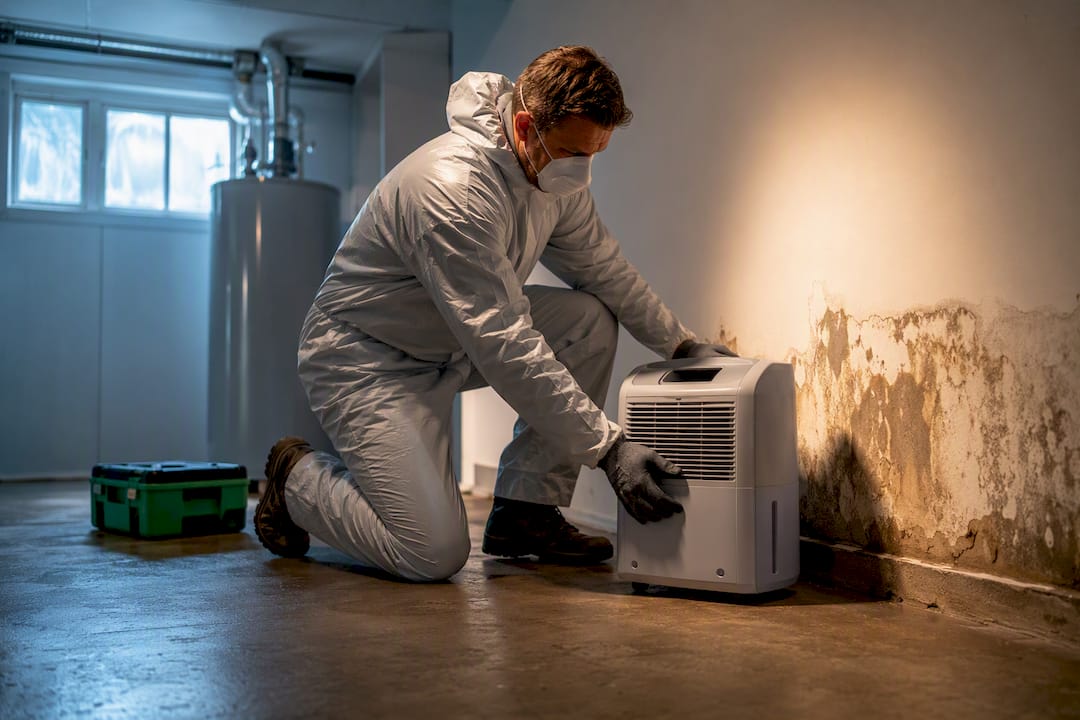
Mould remediation gets covered when it results from a sudden, accidental event your policy insures against, such as a burst pipe or a failed appliance. Slow leaks, chronic humidity, and deferred maintenance almost always get denied. Most policies also cap mould payouts through a sublimit, often well below the actual cost of remediation. Document everything and start drying immediately, before you call your adjuster.
TL;DR:
- Mould remediation is only covered when caused by a sudden, accidental water event like a burst pipe or storm, not slow leaks or ongoing humidity.
- The typical mould payout is capped between $5,000 and $25,000, which may be insufficient for extensive remediation costs or whole-structure repairs.
- Proper documentation, including photos, failure parts, moisture maps, and fast drying, is crucial to secure a claim payment and link it to the covered event.
- Insurers often deny claims from gradual leaks, deferred maintenance, or pre-existing mould, relying heavily on timing, physical evidence, and specific policy language.
- Prompt action within 24 hours of discovering water damage is essential to prevent mould growth and avoid being reclassified as a failure to mitigate, which risks claim denial.
Table of Contents
- Understanding mould remediation insurance coverage: the covered-peril rule
- Common mould exclusions and why claims get denied
- What a mould claim payout actually covers
- Documenting a mould claim: what insurers actually want to see
- When a certified remediation team makes the difference
- Why timing matters more than most homeowners realize
- The claims process step by step
- Disputing a denied mould claim
- Homeowner’s coverage versus commercial policies for mould
- What insurers are legally required to do
- Balancing health, cost, and insurance rules
- How a certified team handles remediation and the paperwork insurers expect
- Sources
- FAQ
Understanding mould remediation insurance coverage: the covered-peril rule
A “covered peril” is the specific cause of loss your policy agrees to pay for: fire, a burst pipe, a windstorm-driven roof breach, a washing machine hose that fails overnight. Mould coverage rides on that definition. Insurers don’t ask “is there mould?” They ask “what caused the water that caused the mould?” If the answer traces back to a sudden, accidental event named in your policy, the mould remediation tied to that event is usually covered. If the answer is “it’s been damp down there for years,” coverage disappears fast.
This is the causation chain that decides almost every mould remediation insurance coverage dispute: water event → moisture contact → fungal growth → remediation claim. Break that chain anywhere, and the insurer has grounds to deny.
Examples that typically clear the bar for a covered claim:
- A supply line to your dishwasher splits and floods the kitchen overnight.
- A storm tears shingles loose and rain gets into the attic before you can tarp it.
- A washing machine hose bursts while you’re at work.
- A pipe freezes and cracks during a cold snap, soaking a finished basement.
None of these clear the bar on their own:
- A slow drip under the sink that’s been staining the cabinet for six months.
- Condensation building up in a poorly ventilated bathroom.
- Grading around the foundation that lets groundwater seep in every spring.
Your dwelling coverage generally pays to repair the structure (drywall, subfloor, framing) and, in the same claim, the remediation needed to remove mould that grew because of that damage. Personal property coverage handles ruined belongings, furniture, flooring, sometimes electronics, under the same causation logic. Adjusters treat mould remediation as an extension of the water damage claim, not a separate line item, which is exactly why proving the “sudden” part matters so much.
Common mould exclusions and why claims get denied
Standard homeowners policies list several situations where mould coverage doesn’t apply, and knowing them before you file saves you a frustrating denial letter.
- Flood exclusion. Overland flooding, rising groundwater, and sewer backup often need separate endorsements or standalone flood coverage. A basement flooded by a river overflow is not the same claim as a basement flooded by a burst pipe, even though the water looks identical once it’s on your floor.
- Gradual or slow leaks. A pipe that’s been seeping for months, rather than bursting suddenly, usually gets classified as a maintenance failure rather than a covered event.
- Chronic humidity and condensation. Bathrooms without proper ventilation, basements that sweat every summer, these read as ongoing environmental conditions, not accidents.
- Deferred maintenance. Roof leaks from shingles you knew needed replacing, or window seals that failed years ago, put the responsibility back on the homeowner.
- Pre-existing mould. If an inspection or prior claim already flagged mould before the current incident, insurers will argue the new claim is really the old problem resurfacing.
Adjusters lean heavily on timing and physical evidence to decide which bucket a claim falls into. Staining patterns, the age of water marks, and how quickly you reported the damage all factor in. Report a leak six weeks after you noticed it, and even a genuinely sudden event can get reclassified as “failure to mitigate,” which is grounds to reduce or deny payment. Before you assume you’re exempt from any of this, pull your declarations page and read the fungi or mould endorsement language directly. Many Canadian policies use variations of the ISO HO 04 26 fungi endorsement, and the wording differences between insurers are larger than most homeowners expect.
What a mould claim payout actually covers
Even when your claim clears the covered-peril test, most policies cap what they’ll pay for mould specifically through a mould sublimit, a separate ceiling that applies on top of your regular dwelling limit.
Mould sublimits commonly range from $5,000 to $25,000, though some insurers offer endorsements that raise this ceiling for an added premium.
That sublimit exists regardless of how much your overall dwelling coverage is worth. A homeowner with a $500,000 dwelling limit can still find their mould payout capped at $10,000 if that’s what the endorsement specifies. Compare that ceiling against realistic remediation costs before you assume you’re covered:
- Surface-level cleaning in a single small area: roughly $500 to $1,500
- A single room requiring containment and drywall removal: several thousand dollars
- HVAC contamination requiring duct cleaning and possible replacement: can run into the low tens of thousands
- Whole-structure remediation after prolonged exposure: $10,000 to $30,000 or more
Run the math before you file. If your deductible is $1,000 and the job costs $1,200, filing a claim to net $200 rarely makes sense, especially once you weigh the premium impact discussed further down. If the job is $8,000 and your sublimit is $5,000, you’re still on the hook for $3,000 out of pocket, but that’s still meaningfully better than paying the full amount yourself.
Documenting a mould claim: what insurers actually want to see
Documentation quality is often the single biggest factor separating a paid claim from a denied one, according to restoration industry guidance on mould claims. Insurers aren’t being difficult for the sake of it. They need a clear evidentiary trail linking the mould back to a specific, covered, sudden event, and it’s your job to help build that trail before an adjuster shows up.
- Photograph everything immediately. Wide shots of the affected area, close-ups of the source (the burst fitting, the failed hose, the water stain), and timestamped images if your phone supports it.
- Save the failed part. Don’t throw out the burst hose or cracked fitting. Physical evidence of the mechanical failure is often more persuasive than a written description.
- Start drying right away and log every step. Note when you turned on fans or dehumidifiers, when you pulled up wet carpet, and when you called a restoration contractor.
- Keep every receipt. Rental equipment, professional drying services, hotel stays if you were displaced, all of it supports your claim’s value.
- Get moisture mapping done. A restoration contractor or industrial hygienist uses pin and pinless moisture meters to map how far water travelled through walls and subfloor, creating a record that shows the extent of damage tied to the original event.
- Request a formal mitigation report. This should include drying logs, equipment used, and dates, ideally matching the timeline of your covered event.
If the infestation is large enough to warrant one, an independent industrial hygienist (IH) report carries particular weight with insurers. A credible IH report documents inspection conditions on the day of assessment, includes detailed moisture mapping of affected surfaces, describes the sampling protocol used (air samples, surface swabs, or both), maintains lab chain of custody for any samples sent for analysis, and explicitly ties the timeline of fungal growth back to the covered water event rather than leaving that connection implied.
Once the IH report is in hand, a remediation contractor converts its findings into a formal scope of work, usually broken into line items using systems like Xactimate, the same estimating software most insurers use internally. That shared language is what lets your contractor’s $14,000 estimate and your adjuster’s assessment land in the same range instead of miles apart.
Pro Tip: Ask your contractor for pin and pinless moisture readings at the start and end of the drying process, not just once. A single reading tells the insurer what happened; two readings, days apart, prove the drying process worked and support your claim that mitigation was timely.
When a certified remediation team makes the difference
Small, surface-level mould, a coin-sized patch on a windowsill, is something Health Canada’s own guidance says homeowners can often clean themselves. Anything larger, or anything tied to a structural water event, moves quickly into territory where professional mould remediation services aren’t optional, they’re what your insurer expects to see.
Professional remediation teams use containment barriers to stop spores from spreading, HEPA filtration and negative air pressure during removal, careful demolition of contaminated materials, and post-work clearance testing to ensure the space is safe to reoccupy. Insurers accept this documentation because it follows a recognized methodology, not guesswork.
When you’re vetting a contractor, ask for:
- Certifications in mould remediation (not just general contracting)
- Proof of liability insurance
- Experience working directly with insurance claims and adjusters
- A sample scope of work and daily log from a past job
Pro Tip: Get an itemized written estimate before any demolition starts. Adjusters move faster on claims that arrive with a clear scope of work than on claims where the damage was already torn out with no paper trail.
Why timing matters more than most homeowners realize
Health Canada’s guidance is blunt on this point: reduce moisture and act on it quickly, because mould colonies can establish themselves within days of sustained dampness. The commonly cited window is 24 to 48 hours from the moment materials get wet to the moment mould growth becomes likely.
That window matters for two separate reasons. The health reason is obvious: faster drying means less exposure for anyone living in the home. The insurance reason is less obvious but arguably more consequential for your wallet. Insurers read delayed response as a red flag. If you wait a week to call a restoration company after a pipe bursts, an adjuster can reasonably argue that the extensive mould growth resulted from your inaction, not the original covered event. That reframing shifts responsibility from “insured peril” to “failure to mitigate,” and it’s one of the fastest ways a legitimate claim turns into a denial.
Practically, this means renting a dehumidifier the same day, pulling up soaked carpet before you’ve even spoken to your insurer, and documenting that you did so. You are not waiting for permission to start drying your home. Most policies actually require you to mitigate damage promptly as a condition of coverage, so acting fast protects both your health and your claim simultaneously. Contact your insurer within 24 hours of discovering the damage if at all possible, even if it’s just a phone call to open a file while you start drying.
The claims process step by step
Filing a mould remediation claim follows a fairly predictable sequence, and knowing the order helps you avoid the mistakes that slow payouts down.
First, stop the source of water if you safely can, shutting off a valve or unplugging a failed appliance. Second, begin drying and document as you go, following the steps outlined above. Third, contact your insurer to open a claim file, giving them the basic facts: what happened, when, and what you’re doing about it. Fourth, an adjuster is typically assigned within a few business days and may visit in person or request photos and contractor estimates remotely, depending on the claim’s size.

From there, your contractor or industrial hygienist submits a formal scope of work, often with the IH report attached if the infestation was significant. The adjuster reviews that scope against your policy’s mould sublimit and deductible, then issues a decision, approval, partial approval, or denial, along with a payment amount if applicable. Remediation work generally shouldn’t start on the insurer’s dime until this scope is agreed upon, though emergency mitigation (drying, tarping, boarding up) is usually fine to begin immediately since delaying it only makes the eventual damage, and cost, worse.
Keep a single point of contact with your insurer throughout, and get every approval in writing. Verbal assurances from a claims adjuster carry far less weight than an email confirming the approved scope and dollar amount, especially if a dispute comes up later.
Disputing a denied mould claim
A denial letter isn’t necessarily the end of the road. Insurers deny mould claims for a range of reasons, some legitimate, some worth challenging, and you have a formal right to push back.
Start by requesting the specific policy language the insurer used to justify the denial. Vague denials (“mould is excluded”) should be met with a request for the exact clause and endorsement number cited. Compare that language against your own declarations page; sometimes adjusters cite the wrong endorsement version, or apply a general exclusion that doesn’t actually match your policy’s specific wording.
If you believe the denial misread the cause of loss, gather additional evidence: a second contractor opinion, a more detailed IH report if you didn’t already have one, or repair records proving the originating event was sudden rather than gradual. Submit this as a formal written appeal to the insurer’s internal review process, most Canadian insurers have one, and most require a response within a defined timeframe.
If internal appeal doesn’t resolve things, you can escalate to your provincial insurance ombudsman or regulator, or consult a public adjuster or lawyer who specializes in property claims, particularly for larger losses where the dollar amount justifies the cost. Keep every piece of correspondence, every date, and every version of the scope of work throughout this process. Disputes are won on paper trails, not phone calls.
Homeowner’s coverage versus commercial policies for mould
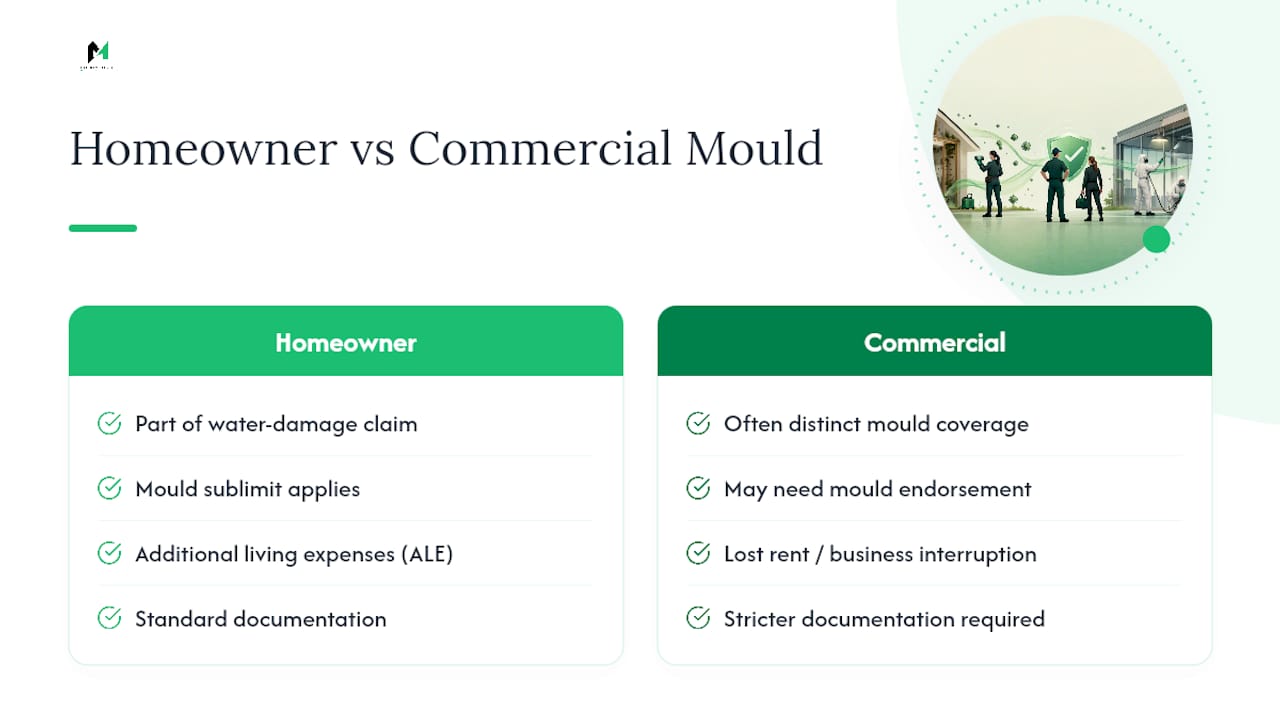
Homeowners insurance and commercial property insurance handle mould through the same basic logic, coverage follows a sudden, covered peril, but the details diverge in ways that matter if you own rental property or run a business out of part of your home.
Homeowners policies typically bundle mould remediation into the broader water damage claim, capped by a mould sublimit that applies regardless of the size of your overall dwelling coverage. Commercial policies more often treat mould as a distinct coverage category with its own terms, and commercial landlords frequently need to add a specific mould or fungi endorsement rather than relying on baseline coverage at all.
Business interruption coverage is the other major difference. A homeowner displaced by mould remediation might get additional living expenses covered under their policy. A commercial property owner facing the same infestation may also be able to claim lost rental income or business interruption costs while the space is unusable, assuming that coverage was purchased separately. Landlords managing multi-unit properties should also expect stricter documentation requirements from commercial insurers, since the potential payout and liability exposure are usually larger than a single-family home claim.
If you rent out part of your property, even informally, it’s worth checking whether your policy still classifies as pure homeowners coverage or whether it’s shifted into a landlord or commercial classification that changes your mould terms entirely.
What insurers are legally required to do
Insurance companies operate under provincial regulation across Canada, and while the specifics vary by province, some obligations are broadly consistent. Insurers must handle claims in good faith, meaning they can’t deny a legitimate claim arbitrarily or drag out a decision without justification. Most provinces require insurers to acknowledge a claim within a set number of business days and to provide written reasons for any denial.
Provincial insurance regulators, and in some cases ombudsman services, exist specifically to handle disputes between homeowners and insurers when internal appeals fail. These bodies can review whether an insurer applied policy language correctly and whether the claims process followed fair-practice standards. What they generally can’t do is force an insurer to pay a claim that’s genuinely excluded by valid policy language. If your policy’s fungi endorsement clearly excludes gradual leaks and your claim is a gradual leak, no regulator is going to override that contract term.
The practical takeaway: insurers have real obligations around fairness and timeliness, but the legal obligation to pay still comes down to what your specific policy says. Read your declarations page and endorsements before you assume a legal right exists that your contract doesn’t actually grant.
Balancing health, cost, and insurance rules
If mould is affecting your health or the structure of your home, remediate and document immediately. Don’t wait for a claim decision to start drying and containing the problem; delay only makes both the health risk and the eventual bill worse.
For small jobs hovering near your deductible, paying out of pocket is often smarter than filing. A minor claim can affect your renewal terms without netting you meaningful money after the deductible. Where prevention is possible, ventilation upgrades, cleared gutters, and prompt leak repairs, it’s cheaper than any claim you’d ever file.
— Moacyr
How a certified team handles remediation and the paperwork insurers expect
Coordinating a water event, a mould infestation, and an insurance claim at the same time is a lot to manage on your own, particularly while you’re also trying to keep your household running. MSN Environmental handles the technical side so you’re not translating adjuster language while also renting dehumidifiers.

Services start with an on-site assessment to determine the scope of contamination, followed by coordination with an independent industrial hygienist when a formal report is warranted. From there, mitigation and remediation proceed with containment, HEPA filtration, and proper material removal, finishing with clearance testing that confirms the space is safe. Every step generates documentation, moisture maps, daily logs, and a clearance report, built in the format adjusters actually want to see, whether the issue is confined to a basement or has spread through an entire structure.
Before work begins, clients typically receive an itemized estimate which they can share with their adjuster to help align the scope of work with policy coverage and avoid discrepancies between billed and approved amounts.
Sources
- Health Canada – Addressing moisture and mould in your home
- RestoreAdvisor – Does Homeowners Insurance Cover Mold? Coverage & Claims
- Restoration Intel – Mold insurance claims: coverage, documentation and scope
- Gladewick – Mold remediation insurance coverage
This article is general information, not a substitute for advice from a qualified doctor. Consult a qualified healthcare professional about your own circumstances before acting on anything here.
FAQ
Will insurance cover mould damage?
Only when the mould results from a sudden, accidental covered event like a burst pipe or storm damage. Mould from gradual leaks, humidity, or deferred maintenance is typically excluded, and most payouts are further limited by a mould sublimit.
Is mould covered by insurance in Canada?
Yes, under the same covered-peril logic used across most Canadian home insurance policies: coverage depends on whether a sudden insured event caused the moisture. Check your policy’s fungi or mould endorsement for your specific sublimit and exclusions.
What are common mould insurance exclusions?
The most frequent exclusions are overland flooding, slow or gradual leaks, chronic condensation and humidity, deferred maintenance, and pre-existing mould identified before the current claim.
Can mould grow back after remediation?
Yes, if the underlying moisture source wasn’t fully resolved or if humidity levels in the space remain high. Clearance testing after professional remediation, along with fixing the root cause of moisture, is what prevents recurrence.
How long do I have to report mould damage to my insurer?
There’s no single national deadline, but most policies require prompt notice, often within days of discovering the damage. Reporting late can get your claim reclassified as a failure to mitigate, even if the original cause was genuinely sudden.