

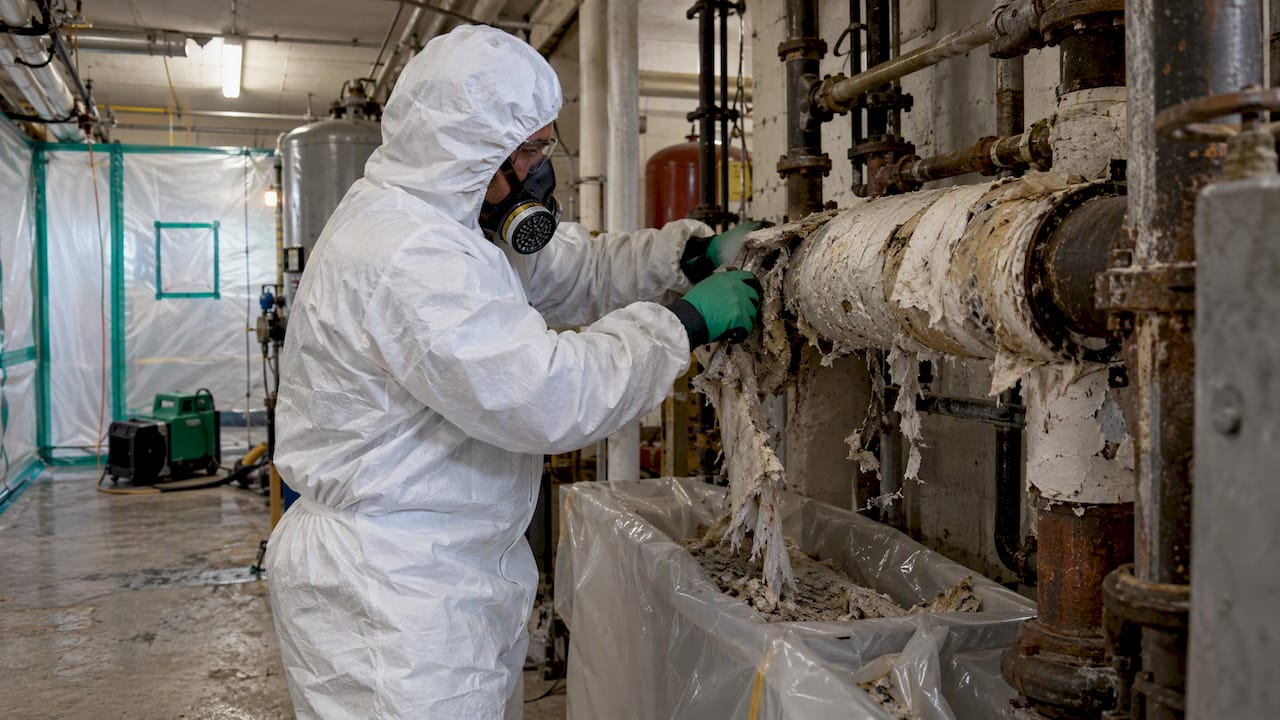
If you have found or suspect asbestos in a Hamilton home or building, the safest route is to have the material tested first, then hire a specialist abatement contractor if it is going to be disturbed. Leaving intact material alone is often fine. Drilling, sanding, cutting or demolishing it is not. This guide compares the options you actually have, explains which rules apply to you, and shows what to ask before you sign anything.
TL;DR
- Intact asbestos is usually not an immediate hazard. It becomes one when it is disturbed during renovation or demolition.
- Test before you touch anything. A lab result, not a guess, decides whether you need removal.
- Your realistic choices are DIY, a general renovator, a demolition crew, or a specialist abatement firm. Only the last is built for containment, air control and compliant waste handling.
- Ontario Regulation 278/05 governs construction and commercial work, and it does not apply to an owner-occupied private home, but the health risk is the same.
- Hamilton demolition permits expect your hazardous materials to have been addressed, so keep your survey on hand.
Table of Contents
- Why Hamilton homes and buildings so often have asbestos
- Step one: identify it before you choose anyone
- What the rules say, and what they don’t
- Your real options, compared
- What to ask any asbestos contractor in Hamilton
- What does asbestos removal cost in Hamilton?
- After the work: cleaning and clearance
- Our perspective
- Working with MSN Environmental in Hamilton
- FAQ
- Sources
Why Hamilton homes and buildings so often have asbestos
Hamilton grew as a major industrial and commercial centre, and much of that growth happened before the health impacts of many materials were understood. Older houses, rental buildings and former industrial properties can contain asbestos in places you would not think to check: vinyl floor tiles, textured or popcorn ceilings, plaster, pipe and duct wrap, attic insulation and roofing products.
Asbestos is not dangerous because it is in your house. It is dangerous because of what happens when fibres go airborne. The Government of Canada links inhaling asbestos fibres to asbestosis, lung cancer and mesothelioma and notes there is no known safe level of exposure. Health Canada also distinguishes inhalation from ingestion: its drinking water guidance concerns water treatment, and the main concern on a renovation project is airborne fibre.
That is why the first question is never “who removes it?” It is “is it asbestos, and will anyone disturb it?”
Step one: identify it before you choose anyone
You cannot identify asbestos by looking. Two materials that look identical can differ completely. A qualified person should assess the building and, where needed, take samples for laboratory analysis. The federal guidance says a proper hazardous substance assessment by a qualified person should determine whether asbestos is present and whether it can be disturbed, which is the difference between friable and non-friable material.
In practice that means one of three things:
- Bulk sampling. A small piece of the suspect material is taken under controlled conditions and sent to a lab.
- Air sampling. Used during or after work to confirm fibres are not escaping containment or lingering afterward.
- A pre-renovation or designated substance survey. A project-specific inspection of every area that will be opened up, which is what contractors, insurers and municipalities tend to ask for.
We offer all three through our asbestos and mould testing services. If you are weighing a DIY test kit against a professional, our guide on DIY versus professional asbestos testing explains when each makes sense. For a Hamilton-specific overview, see our page on asbestos and mould testing in Hamilton.
What the rules say, and what they don’t
Ontario Regulation 278/05 is the provincial rule for asbestos on construction projects and in buildings and repair operations. It sets out how work is classified and carried out, including for demolition. It is written for employers, contractors and building owners handling construction work.
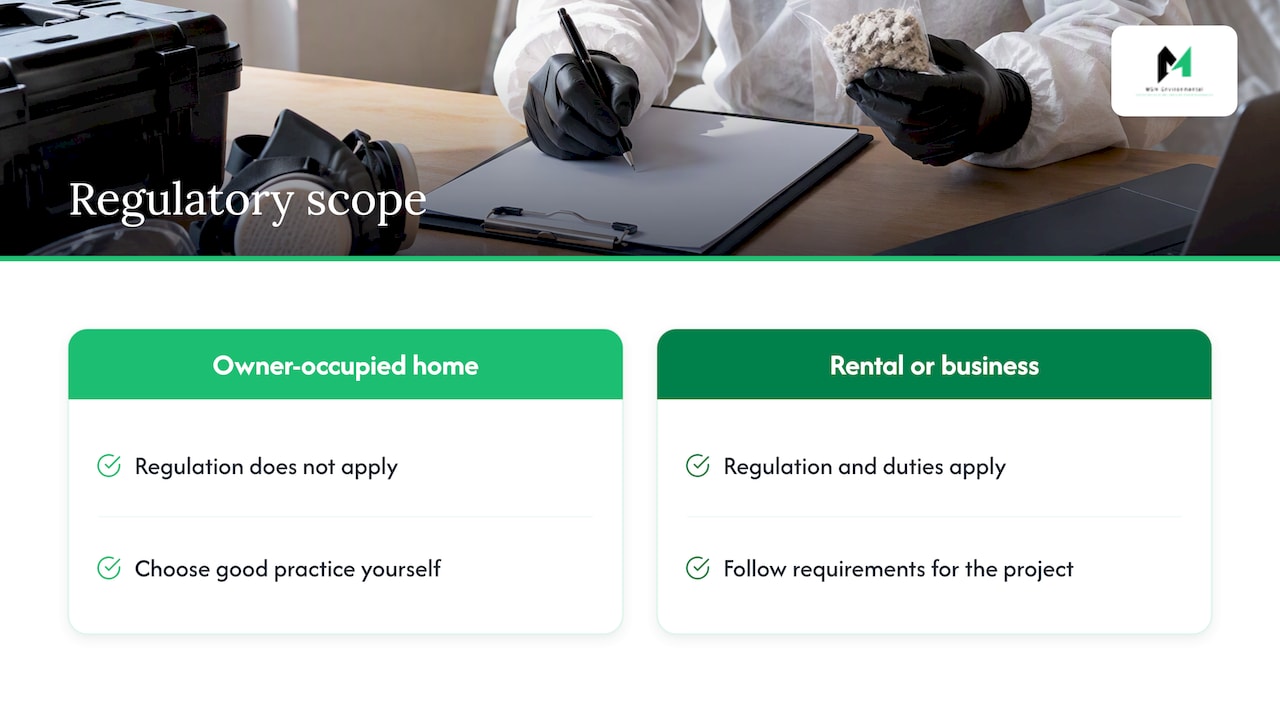
Here is the point many homeowners miss. The regulation does not apply to private homes occupied by the owner or their family. That does not make it safe to do the work casually. Fibres harm a family the same way regardless of which law applies. It does mean that, as an owner-occupier, nobody will force good practice on you, so you have to choose it.
The situation flips if you are a landlord, property manager, renovator or business owner. Then the regulation and the duties around it apply to your project. Our Ontario asbestos regulations roadmap walks through the owner and contractor obligations, and our explainer on O. Reg. 278/05 and its 0.5% threshold covers the details.
Hamilton demolition permits
If your project involves demolition, the City of Hamilton requires a Demolition Application Checklist and a Commitment to Disconnect Services form before a permit is issued, and utilities must be capped. The city also expects documentation that hazardous materials have been addressed, so have the survey ready. Partial demolitions of buildings are covered by the same permit page, which matters for gutting a kitchen or basement.
Your real options, compared
Here is how the four common routes stack up when asbestos is involved.
| Option | Testing | Containment and air control | Compliant waste handling | Best for |
|---|---|---|---|---|
| DIY by the homeowner | Kit or none | Improvised | Owner’s responsibility, easy to get wrong | Very small, intact, non-friable jobs after professional advice |
| General renovator or handyman | Usually not included | Rarely built for it | Often unclear | Work on materials already tested negative |
| Demolition crew | Sometimes subcontracted | Varies | Varies | Demolition once abatement is finished |
| Specialist abatement contractor | Included or coordinated | Planned containment, negative air, decontamination | Part of the scope | Any disturbance of confirmed asbestos |
DIY
It is tempting, especially on a small ceiling or a few floor tiles. The trouble is that the failure is invisible. Dry scraping, sanding, drilling or breaking tiles can release fibres into the whole house, and they travel through ductwork. If you are still considering it, read our guide on the asbestos removal process in Canada first to see what proper containment involves, and you will probably decide against it.
Renovators and general contractors
A good renovator will stop work and call for testing when they see old plaster or tile. A poor one will not. Ask directly: will you test before demolition, and who handles the waste? If the answer is vague, hire the abatement first. Renovators are often our clients for exactly this reason: they need the area cleared and documented so their own crews can proceed safely. Our interior demolition services cover the strip-out afterward, and we explain the difference in interior demolition versus abatement.
Demolition-only crews
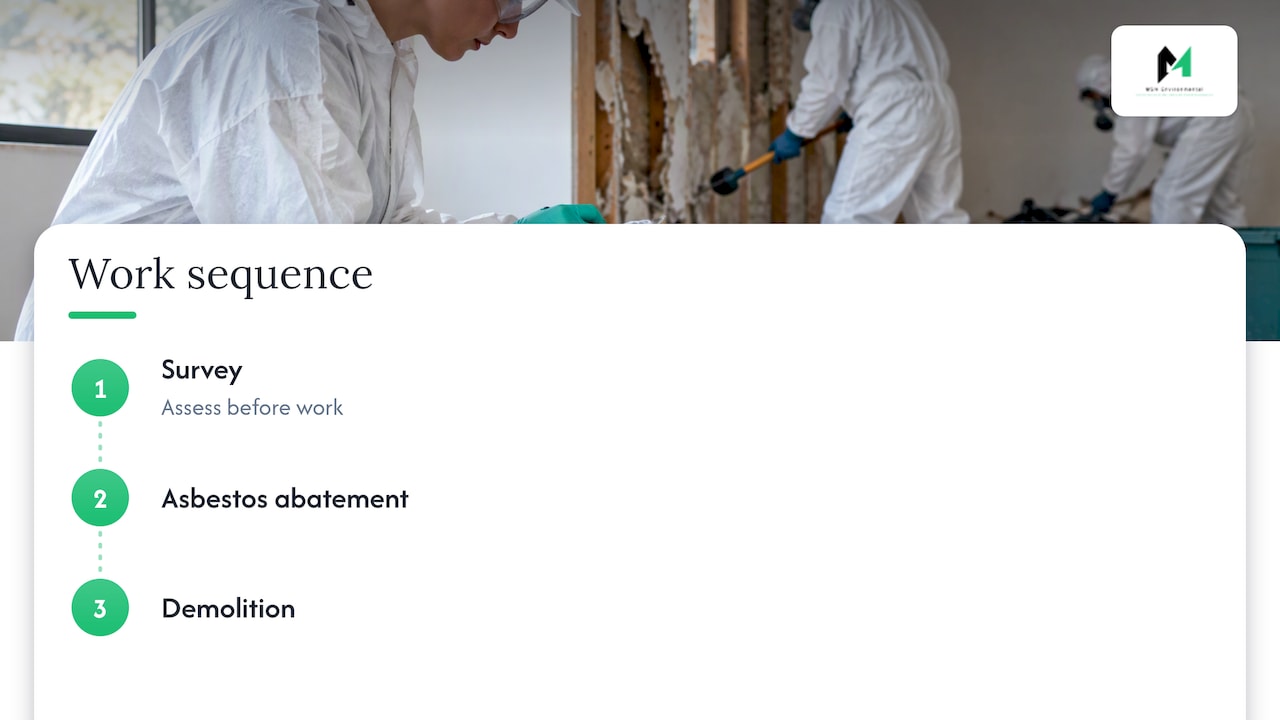
Demolition firms are skilled at tearing things down, not necessarily at containing hazardous dust. Demolishing before abatement spreads contamination into everything that is then thrown out, and into the rooms around it. Sequence matters: survey, abate, then demolish.
Specialist abatement contractors
This is the category we work in. A specialist sets up sealed work areas, controls air pressure, uses protective equipment, decontaminates people and tools, and handles the waste as part of the job. It is the only one of the four options designed around the actual hazard.
What to ask any asbestos contractor in Hamilton
Whoever you call, a short list of questions separates serious firms from the rest:
- Will you test or review a survey first? No responsible firm quotes blind on an unknown material.
- Which type of work is this? Ontario classifies asbestos work into Type 1, 2 and 3 operations, with Type 3 being the most controlled. Our Type 3 compliance guide explains it.
- Are your technicians trained and certified, and are you fully insured? Ask for proof of both, not a verbal yes.
- How will you contain the work area and verify it is clean? Look for a clear plan, and for air sampling afterward where appropriate.
- Who handles the waste, and what paperwork will I receive? You want a written record, particularly if you are a landlord or selling.
- Is the quote itemized? Scope, containment, waste, testing and restoration should be separate lines, so you can compare quotes fairly.
What does asbestos removal cost in Hamilton?
No honest number exists without seeing the material. Price depends on what the material is, how much of it there is, whether it is friable, how hard it is to reach, and how much containment the work needs. Disposing of the waste and any air testing are part of the picture too. Cheap quotes are usually cheap because something is missing, often the testing, the containment or the paperwork.
We do not publish fixed prices, because each project differs. We give written quotes after an assessment. For a general breakdown of what drives costs, see our asbestos removal cost guide for Ontario.
One cost note for commercial and institutional owners: Hamilton’s ERASE Community Improvement Plan has provided financial assistance for abatement of designated substances such as asbestos in institutional and designated heritage buildings. Eligibility is specific, so check the city’s programme details before you plan around it. It is not aimed at ordinary single-family homes.
After the work: cleaning and clearance
Once abatement and any rebuild are finished, dust left by construction is its own issue. Fine construction dust is best removed with HEPA filtration, and one post-construction cleaning checklist built around HEPA vacuuming is a useful reference for the final clean once the hazardous work is signed off. Asbestos-contaminated areas, though, are cleaned as part of the abatement itself, by the abatement crew, and verified before anyone moves back in.
Our perspective
Most calls we get begin with “how fast can you remove it?” and the better answer is usually “what is it, and does it need to go?” We would rather test and tell you a material can stay, intact and labelled, than sell a removal that is not needed. When removal is the right call, we want it done once and done properly.
Three things we see repeatedly in Hamilton and across southwestern Ontario. First, owners start a renovation, find suspect material halfway through, and then have to stop work while the house is already contaminated. A pre-renovation survey costs far less than that. Second, people assume that because the regulation does not apply to their own home, there is no standard to meet. The fibres do not read the regulation. Third, quotes that skip air testing look cheaper and leave you without proof the job was clean.
Our approach combines trained, certified technicians, modern equipment, full liability insurance and personal oversight of each project, so the person you spoke to is accountable for the result. Residential and commercial clients get the same discipline, scaled to the job.
— Moacyr
Working with MSN Environmental in Hamilton
We handle the whole sequence in one place: testing and surveys, asbestos abatement, and interior demolition if the space is being stripped out. We also deal with other hazardous materials you may find in the same older building, including lead-based paint, PCBs, mercury and bat guano, and UFFI.
If you are ready to move, start with our asbestos removal services page or the one for asbestos removal and remediation in Hamilton. Tell us what you found, where, and what you plan to do next, and we will advise on testing and give you a written quote.
FAQ
Do I have to remove asbestos from my Hamilton home?
Not always. Intact, undisturbed material is generally considered much lower risk, and the problem arises when it is disturbed. If you are renovating or the material is damaged and friable, removal or encapsulation under professional advice is the safer choice. Test first so you know what you have.
Can I remove asbestos myself in Ontario?
O. Reg. 278/05 does not apply to owner-occupied private homes, so the law does not stop you. The health risk is the same as anywhere, though, and without containment and proper protective equipment you can spread fibres through your home. We recommend a professional for any material that will be disturbed.
How do I know if my house has asbestos?
You cannot tell by sight. A sample must be analysed in a laboratory, and a pre-renovation survey will cover every area your project will open up. Do not break or scrape the material to check it yourself.
Do I need a survey before demolition in Hamilton?
Yes, in practice. The City of Hamilton expects hazardous materials to be addressed as part of the demolition permit process, and Ontario’s regulation treats demolition as work needing prior attention to asbestos. Keep your survey with your permit documents.
Sources
- Asbestos, Government of Canada
- Guidance on asbestos in drinking water, Health Canada
- O. Reg. 278/05, Ontario e-Laws
- Building Permit Application Requirements, City of Hamilton
- City of Hamilton document on the city’s industrial history
- ERASE Community Improvement Plan FAQs, Engage Hamilton
- Post-construction cleaning checklist