

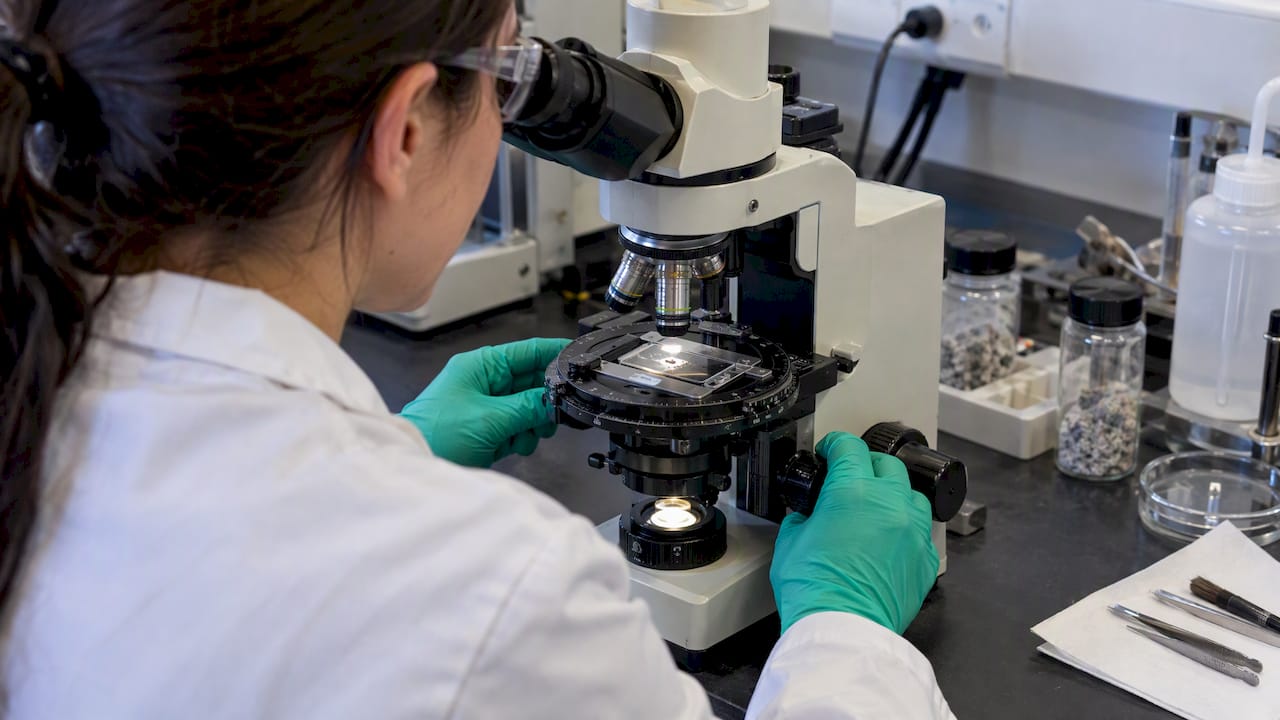
A point count is a second, more exact way for a lab to measure how much asbestos is in a bulk sample. Instead of estimating the percentage by eye, the analyst counts points under a microscope and works out the share that lands on asbestos fibres. In Ontario you order it when a result sits close to the regulatory line and the answer decides whether you need regulated abatement or not.
This guide explains how the method works, how it connects to Ontario’s 0.5% definition, when it pays off and when it is a waste of money, and how to read the report.
TL;DR
- Point counting is an optional add-on to standard polarized light microscopy (PLM) that turns a visual estimate into a counted, defensible percentage.
- Ontario treats a material as asbestos-containing at 0.5% or more by dry weight under O. Reg. 278/05, so results near that line are where a point count earns its fee.
- A 400-point count is typically quoted at about 0.25% and a 1,000-point count at about 0.1%, so the count you choose sets how low the lab can reliably report.
- It does not replace the minimum number of samples, and it says nothing about airborne fibres. Clearance air testing is a separate step.
- If you are planning renovation or demolition, have a certified team sample first, then decide on a point count only for borderline materials.
Table of Contents
- What a point count actually measures
- How it connects to Ontario’s 0.5% line
- When a point count is worth ordering
- Sampling comes first
- Perspective: use the count to make a decision, not to chase a number
- After removal: the air test is a different measurement
- How to read a point count report
- Planning around results in older Ontario homes
- Testing, then removal, from one team
- FAQ
- Sources
What a point count actually measures
Standard bulk analysis uses PLM. A trained analyst looks at the sample under magnification, identifies the fibre type by its optical properties and estimates the percentage by comparing what they see with calibrated visual references. Bureau Veritas describes point counting as an optional technique for samples with low concentrations of asbestos.
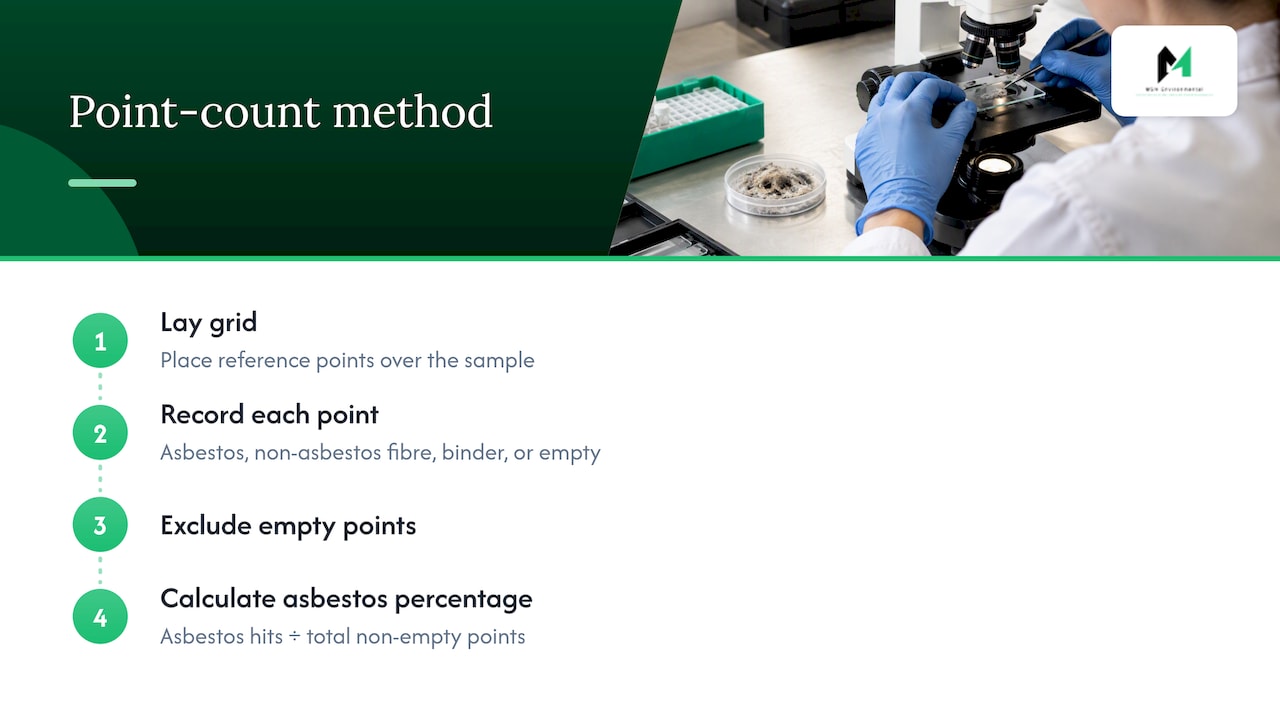
The point count method replaces the estimate with a tally. The analyst lays a grid or set of reference points over the prepared sample and, field by field, records what sits under each point: asbestos, non-asbestos fibre, binder, or empty space. Empty points are not counted. The asbestos percentage is the number of asbestos hits divided by the total non-empty points.
The method most Ontario labs follow is the US EPA bulk method, EPA/600/R-93/116. The published method description for the 400-point count shows it as one of several techniques within that document, not a separate test.
Why counting beats estimating at low levels
A skilled microscopist can spot asbestos at well under 1%. Putting an exact number on it is harder. A peer-reviewed paper on point counting is not needed to see the logic: at a fraction of a percent, a few stray fibres across a slide can swing a visual estimate up or down. Counting forces the analyst to commit to observed points, and the result can be reproduced and checked.
The same logic applies in review. US EPA data validation guidance for PLM, the PLM validation guidelines, has a dedicated section on point counting that checks the bench sheets and raw data for it. In other words, a point count leaves a paper trail that a reviewer can audit. A visual estimate is far harder to audit.
How it connects to Ontario’s 0.5% line
Under O. Reg. 278/05, asbestos-containing material means material with 0.5% or more asbestos by dry weight. That is stricter than the federal definition used in some other contexts: the Canada Labour Code guidance refers to 1% or more. Ontario construction and renovation work follows the provincial figure, so a result of 0.7% matters here even though it would sit below 1%.
That is where the confusion starts. Many reports and many search results talk about the 1% threshold because that is the US and federal figure. If your lab report says “less than 1%” and nothing more, you do not yet know whether the material is above or below Ontario’s 0.5%. Our guide to the 0.5% rule and traps for Ontario owners and contractors goes through that gap in detail.
What each count can report
The number of points counted sets the lowest percentage a lab can report with confidence. Bureau Veritas notes that reporting limits depend on the number of points counted. Typical figures labs quote look like this:
| Analysis | What the analyst does | Typical reporting limit | Best use |
|---|---|---|---|
| Standard PLM, visual estimate | Identifies fibres and estimates the area percentage | Trace to a stated percentage, subjective | First pass on most materials |
| PLM 400-point count | Counts at least 400 non-empty points | About 0.25% | Materials near the 0.5% line |
| PLM 1,000-point count | Counts at least 1,000 non-empty points | About 0.1% | Close calls, disputes, high-value decisions |
| Gravimetric preparation plus count | Ashes off organics and dissolves carbonates first | Better detection in difficult matrices | Floor tile, plasters, cementitious products |
A 400-point count comfortably resolves a result against a 0.5% line. A 1,000-point count is for cases where even 0.25% is not precise enough, or where someone may challenge the result later.
Gravimetric preparation
Some materials hide asbestos in a matrix of organics or carbonates. One Ontario lab explains that its gravimetric preparation burns off organic matter and removes carbonates, leaving mineral residue to examine. That makes the sample more uniform and the fibres easier to detect. If your material is a vinyl floor tile with mastic, a textured ceiling, or a plaster with lots of filler, ask whether the lab offers this preparation along with the count.
When a point count is worth ordering
A point count is a targeted tool. It is not required for every sample, and ordering it routinely just adds cost.
Order one when:
- The visual estimate lands close to 0.5%. A result of 0.5% to 2% by estimate is the classic case. The count may confirm the material is below the line, or it may confirm it is above, and either answer is better than guessing.
- The financial stakes are high. If a classification as asbestos-containing material means containment, Type 3 procedures and disposal across a large area, a few extra lab fees can be a sensible check. Our Type 3 abatement compliance guide shows what that classification triggers.
- The result may be disputed. Property sales, tenant complaints, insurance claims and contractor disagreements all benefit from a counted figure.
- A prior report is ambiguous. A “trace” or “<1%” with no number is not much use when you must decide.
Skip it when:
- The estimate is clearly well above 0.5%. A count will not change what you do.
- The result is non-detected and the sample was representative.
- You have already decided to treat the material as asbestos-containing regardless of the number. That is a legitimate choice, and some owners prefer it for simplicity.
What a count cannot do
A point count only improves the analysis of the sample you sent in. It cannot fix a poor sample. If the sample missed the part of a material that holds the fibres, a perfect count of that sample is still wrong. That is why the number and location of samples matter more than the analytical method.
Sampling comes first
O. Reg. 278/05 sets the minimum number of bulk samples by material type and by the size of the homogeneous area. Ontario’s sampling table for surfacing material is often summarized as the 3-5-7 rule: fewer samples for small areas, more for large ones. The text of the regulation carries the actual table. Note that this is a rule of thumb for one category, not a universal rule for all asbestos testing. Thermal insulation and miscellaneous materials follow their own entries.
Two practical points:
- The minimum is per homogeneous area, not per building. A renovation may involve a dozen distinct materials.
- A point count on three samples does not satisfy a requirement for five. The count improves each result; it does not reduce the number of samples.
If you want to see how sampling and analysis fit in a project, read our Ontario asbestos regulations roadmap.
Perspective: use the count to make a decision, not to chase a number
We see the same pattern on many jobs. A homeowner or property manager gets a lab report with a figure just above or below the line and does not know what to do. Our view is simple.
First, the sample plan decides whether the answer is trustworthy. We would rather take the right number of samples from every distinct material than pay for a 1,000-point count on one.
Second, the count is a decision tool. If a borderline material is a small area in a closet, treating it as asbestos-containing may cost less than another round of lab work. If it is a whole floor of ceiling texture across a commercial unit, the count can change the budget a lot, and it is worth running.
Third, we tell clients plainly when no abatement is needed. Our testing and inspection work covers bulk sampling, air testing, designated substance surveys and pre-renovation surveys, and a clean result is a good outcome. When removal is needed, our technicians are certified and the company carries full liability insurance, and we oversee each project personally.
— Moacyr
After removal: the air test is a different measurement
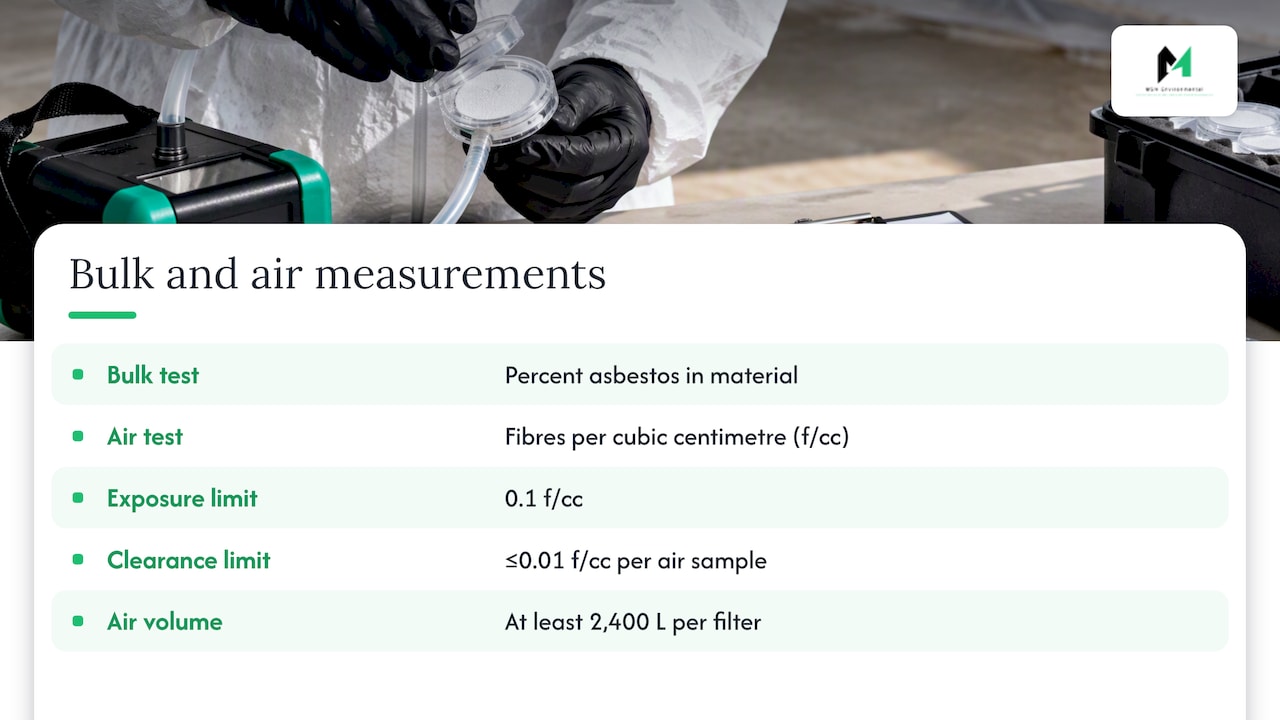
People sometimes assume a bulk result and a clearance result are linked. They are not. Bulk analysis measures percent asbestos in a material. Air testing measures fibres per cubic centimetre (f/cc).
Ontario’s occupational exposure limit is 0.1 f/cc. For clearance after enclosure-based work, O. Reg. 278/05 requires that every air sample not exceed 0.01 f/cc, typically confirmed by phase contrast microscopy using NIOSH Method 7400, with at least 2,400 litres of air drawn through each filter.
That is why a point count can tell you the material is not regulated, but cannot tell you the room is safe to reoccupy after work on a different material. Our explainers on asbestos air sampling and PCM versus TEM for clearance cover the air side.
When a space has been cleaned after abatement, the quality of final dust control also matters. For a sense of what high-efficiency filtration specifications look like in a facility setting, see these HEPA dust control specifications for facility managers. They are written for general commercial cleaning, not as a substitute for a clearance test.
How to read a point count report
A good report gives you more than a percentage. Check for these items:
- Sample ID and location. It should match your sampling log.
- Method named. For example PLM with a 400-point count, referencing EPA/600/R-93/116.
- Number of points counted and number of asbestos points. If the report gives only a percentage, ask for the bench data.
- Fibre type. Chrysotile, amosite and crocidolite are the common ones.
- Reporting limit. It tells you what “none detected” really means.
- Lab accreditation and analyst details. Ontario’s regulation expects results from an accredited laboratory.
- Preparation noted. Gravimetric or other prep should be stated.
Then compare to Ontario’s 0.5% by dry weight, not to the 1% in US or federal wording. If the lab reports area percent and your decision depends on dry weight, ask how the lab treats that difference. A good analyst will explain it.
Worked example
Say a plaster sample from a 1960s home shows an estimated 1% chrysotile by visual estimate. You plan a renovation of the whole room. A 400-point count returns 3 asbestos points out of 412 non-empty points, which is about 0.7%. That is still above 0.5%, so the plaster is treated as asbestos-containing material and you plan Type 2 or Type 3 work as the scope requires. Had it returned 1 point out of 412 (about 0.24%), the material would fall below the line and the project plan would change. The numbers here are illustrative, not from a real job.
Planning around results in older Ontario homes
Homes built before the 1990s often include asbestos in plaster, textured ceilings, vinyl flooring, joint compound and insulation. Our guide on testing older Ontario homes before renovation lists where to look. If you are budgeting, the asbestos removal cost guide for Ontario shows what drives price, and a clear lab result can change that picture.
Do not disturb suspect material to take a sample yourself. Our comparison of DIY and professional asbestos testing explains when each makes sense.
Testing, then removal, from one team
If you have a borderline result or are about to renovate, we can sample, send to an accredited lab and advise whether a point count is worth it. Our testing, inspections and assessments cover bulk sampling, air quality testing, designated substance surveys and project-specific pre-renovation or demolition surveys. If the material proves to be regulated, our asbestos removal service handles the work under Ontario regulations. We serve homeowners, property managers, renovators and construction managers across southwestern and central Ontario, from Kitchener-Waterloo and Guelph to Hamilton, London and Orangeville.
FAQ
Is a point count required in Ontario?
No. The regulation sets the 0.5% definition and requires an approved analytical method, but it does not require a point count on every sample. It is an optional technique you add when a visual estimate is close to the line or when you need a result that stands up to challenge.
What is the difference between a 400-point and a 1,000-point count?
The number of points counted sets how low the lab can reliably report. Labs typically quote about 0.25% for 400 points and about 0.1% for 1,000. For a decision against 0.5%, 400 points is usually enough.
Does the 3-5-7 rule apply to all asbestos testing?
No. It is shorthand for the minimum bulk samples for surfacing material by area size. Other materials have their own requirements in the regulation, and a qualified person should confirm the count for each homogeneous area.
Can a point count prove my room is safe to reoccupy?
No. It measures percent asbestos in a material. Safe reoccupation after abatement is confirmed by air clearance sampling, where each sample must not exceed 0.01 f/cc under Ontario’s rules.
Sources
- O. Reg. 278/05, Designated Substance: Asbestos on Construction Projects and in Buildings and Repair Operations
- O. Reg. 422/10, Designated Substance: Asbestos on Construction Projects and in Buildings and Repair Operations
- Technical guideline to asbestos exposure management programs, Canada.ca
- Asbestos Sources, Exposure Risks and Analytical Methods, Bureau Veritas
- PLM EPA/600/R-93/116 (400 Point Count), EMSL
- PLM Validation Process Guidelines for Asbestos Data Review, US EPA
- Services, Epoch Analytical