

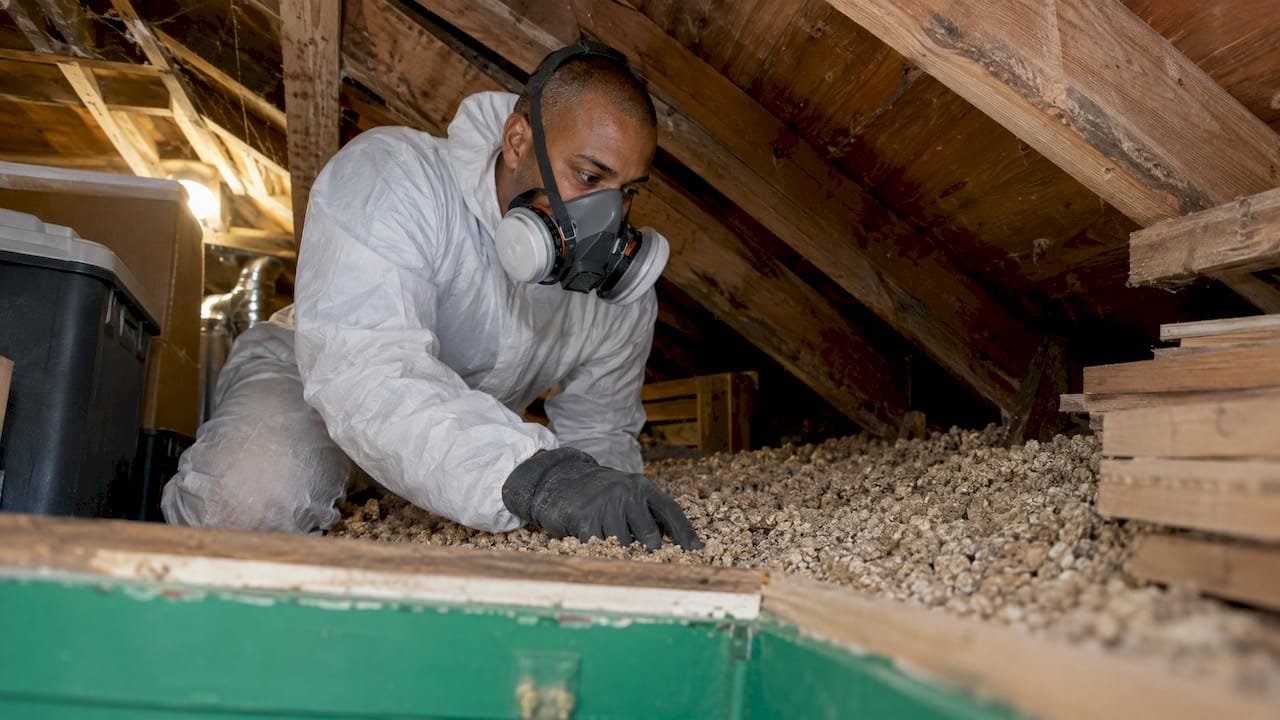
If your building in Ontario is about to be opened up, a qualified person needs to inspect it for hazardous materials first, and the owner is the one who has to arrange it. For asbestos, the province’s rules require an examination and a written report before tenders are requested or any demolition, alteration or repair is contracted. Lead, mercury, silica and other regulated substances follow the same logic: find them on paper before a crew finds them with a hammer.
This guide explains what the inspection covers, who has to order it, how sampling works, what the report should say and what happens when something turns up.
TL;DR
- Before you request tenders or hire anyone for demolition, alteration or repair, Ontario’s asbestos rules put the duty on the owner to have the materials likely to be disturbed examined and reported on.
- The inspection looks at what the planned work will touch: asbestos first, then lead, mercury, silica, PCBs, UFFI, mould and other substances depending on the building’s age and use.
- Samples are taken by a professional and analysed in a laboratory. Visual guesses do not count.
- The written report goes to every contractor bidding, so the price and the safety plan reflect what is really in the walls.
- If something is found, stop, leave it undisturbed and bring in a qualified abatement contractor before any renovation work continues.
Table of Contents
- Why the inspection comes before the first quote
- Who is responsible for arranging it
- What a survey should cover
- How the inspection and sampling work
- Who is qualified to do it
- What a good report contains
- How Ontario classes the asbestos work
- If the survey finds something
- Sequencing the project around the survey
- Our perspective
- Planning a renovation? Start with the survey
- FAQ
- Sources
Why the inspection comes before the first quote
Renovation is the moment hazardous materials stop being dormant. Plaster, drywall joint compound, floor tile, pipe wrap, vermiculite insulation and old paint are harmless when intact and a problem when sanded, cut or smashed. A survey tells you which of those materials are in your project’s path before anyone starts.
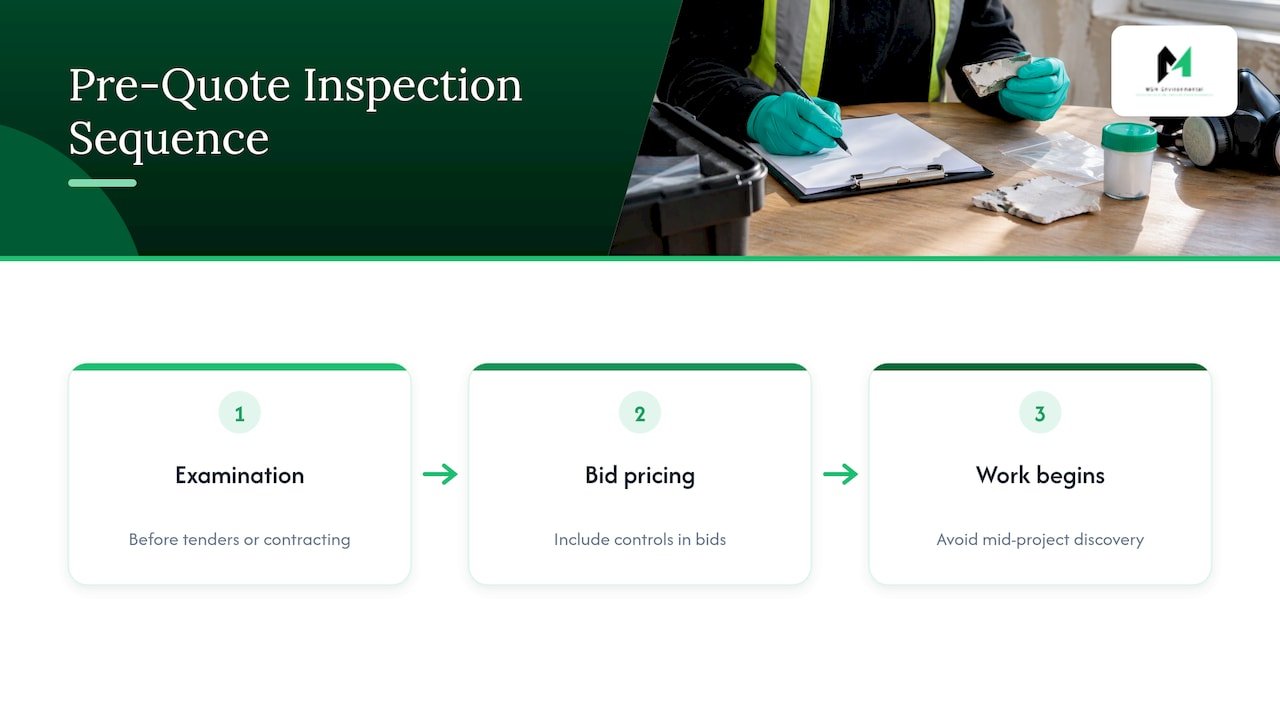
Ontario builds this into the sequence of a project. The province’s guide to the asbestos regulation says the owner must have an examination carried out before requesting tenders or arranging or contracting for demolition, alteration or repair. The reason is practical: contractors can then price the controls into their bids, instead of finding a surprise halfway through and stopping the job.
There is a money argument too. A discovery mid-project means stopped work, an emergency abatement, a schedule that collapses and trades that have to be rebooked. A survey done at the planning stage costs far less than any of that.
Who is responsible for arranging it
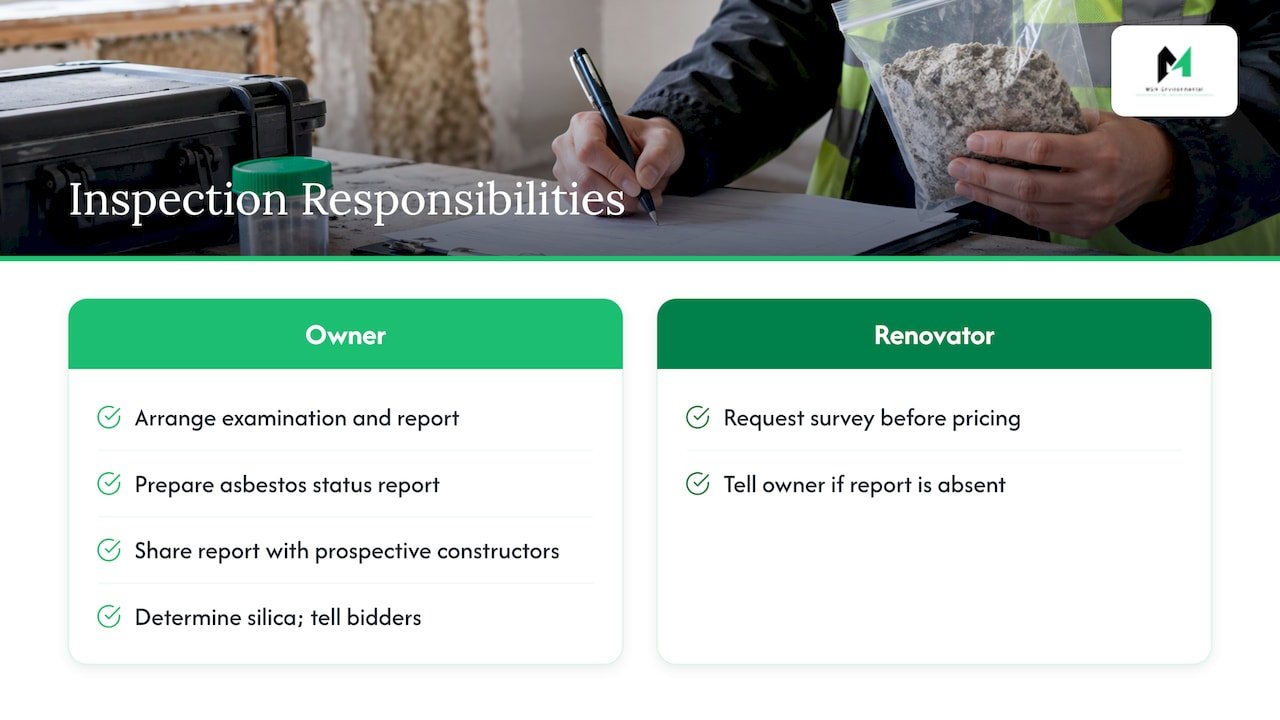
In Ontario, the owner. That is the homeowner for a house, the landlord or property manager for a rental building and the business owner or landlord for a commercial unit. Hiring a general contractor does not move the duty away on its own; it is the owner who has to make sure the examination happens and the report exists.
For asbestos, the owner must also prepare a report stating whether the material is asbestos-containing material (ACM), or whether the work will be done as though it were. The report describes the condition of the material, whether it is friable or non-friable, and where it is.
The owner then passes the report to prospective constructors when the work is being arranged. If a material turns up that was not in the report, the regulation restricts work likely to involve it unless it has been tested or is treated as ACM.
Silica works the same way. Ontario’s guidance says section 30 of the OHSA requires the project owner to determine whether silica is present and tell all potential contractors during bidding. It also notes that an owner who fails to do so can be liable for losses and damages when a contractor discovers silica.
If you are a renovator or construction manager rather than the owner, ask for the survey report before you price. If there is none, tell the owner it needs to be commissioned. Our Ontario asbestos regulations roadmap walks through how the duties split between owners, renovators and contractors.
What a survey should cover
The survey is scoped to the work. A kitchen gut in a 1960s bungalow touches different materials than a tenant fit-out in an industrial unit. Still, the list of substances to think about is fairly stable.
| Substance | Where it commonly hides | Why it matters for renovation |
|---|---|---|
| Asbestos | Insulation, plaster, joint compound, flooring and adhesives, pipe wrap, ceiling texture, vermiculite | Disturbance releases fibres; work is classed by Type 1, 2 or 3 |
| Lead | Older paint, solder, some plumbing and flashing | Sanding, scraping and demolition create lead dust |
| Mercury | Thermostats, switches, fluorescent lamps, some industrial equipment | Breakage releases vapour and contaminates surfaces |
| Silica | Concrete, masonry, brick, mortar | Cutting, grinding and drilling produce respirable dust |
| PCBs | Older lighting ballasts, some sealants and electrical equipment | Needs proper handling and disposal |
| UFFI | Wall cavities in homes insulated in the 1970s and early 1980s | Opening walls exposes it |
| Mould | Basements, crawl spaces, behind finishes after water damage | Demolition spreads spores through the building |
| Bat guano | Attics, roof voids and wall cavities | Needs decontamination before work in the area |
Ontario’s regulation on designated substances, O. Reg. 490/09, lists 11: acrylonitrile, arsenic, asbestos, benzene, coke oven emissions, ethylene oxide, isocyanates, lead, mercury, silica and vinyl chloride. A building-wide study that checks the ones relevant to a site is commonly called a designated substance survey. We break down the full list in our guide to the 11 designated substances in Ontario.
Not every item on the table applies to every job. A competent surveyor reads the building’s age, history and your plans, then scopes the survey to the materials your work will actually disturb.
How the inspection and sampling work
The process is more methodical than a walk-through with a clipboard.
- Scope the work. You describe what will be demolished, drilled, sanded or moved. The inspector uses that to decide which materials are in play.
- Visual assessment. The inspector reviews the building, its age and any previous renovations, and identifies suspect materials room by room.
- Sampling. Samples of suspect materials are taken carefully, to avoid releasing fibres or dust. Ontario’s asbestos regulation sets out how many bulk samples must be collected from an area of homogeneous material, and the analysis method is specified in the regulation.
- Laboratory analysis. Samples go to a lab. Under the regulation, ACM is material that contains 0.5 per cent or more asbestos by dry weight, which is why we wrote a separate piece on the 0.5% rule for older Ontario homes.
- Report. The results are written up with locations, condition and recommendations for the work.
The same sequence is recommended by Canada’s occupational health authority for homes. For vermiculite insulation, CCOHS advises that if you plan renovations that will disturb it, you should hire a professional to take samples and have them tested in a laboratory before work begins.
Air testing is a separate tool. Bulk sampling tells you what a material is made of; air sampling tells you what is floating around the space, which matters for mould concerns and for clearance after abatement. Our testing, inspections and assessments service covers bulk sampling, air quality testing for asbestos and mould, designated substance surveys and project-specific pre-renovation or demolition surveys.
Who is qualified to do it
Ontario’s OHSA uses the idea of a “competent person”: someone qualified by knowledge, training and experience to organize the work and its performance, familiar with the Act and regulations that apply, and aware of any potential or actual danger to health or safety in the workplace.
In plain terms, you want an inspector who knows Ontario’s rules, not only how to collect a sample. Ask who will be on site, what they know about the regulations that apply to your building type, and whether the same firm can carry on to removal if something is found. Having one team that understands both the survey and the abatement avoids hand-off gaps.
What a good report contains
A report you can hand to contractors should answer these questions without a phone call:
- What was examined and which areas were inaccessible or not sampled.
- Which materials are asbestos-containing, with locations, condition and whether they are friable or non-friable. Ontario’s guide lists these as required report content.
- Lab results tied to each sample location.
- Other designated substances found or presumed, such as lead paint, mercury devices or silica-bearing materials.
- Recommendations for abatement, controls or handling before the planned work begins.
- Limits of the survey. Concealed spaces behind finished walls may only be reached once demolition starts, which is why the report should say what to do if unexpected material appears.
That last point matters. If material not in the report is found, Ontario’s rules restrict further work likely to involve it until it has been tested or is treated as ACM. A good report tells your crew what that stop-and-test procedure looks like before they need it.
How Ontario classes the asbestos work
Once you know what is present, the type of work determines the controls. Ontario’s O. Reg. 278/05 sorts operations that may expose workers to asbestos into Type 1, Type 2 and Type 3. Type 3 is the most demanding: it includes removing or disturbing more than one square metre of friable asbestos-containing material during repair, alteration, maintenance or demolition.
That threshold is why the survey’s condition and quantity details matter. A small patch and a whole ceiling can fall into different categories, with different containment and different cost. Our guides to O. Reg. 278/05 and Type 3 asbestos abatement explain the practical consequences for owners and contractors.
If the survey finds something
Finding a hazardous material before you start is the good outcome. It means you can plan around it.
- Leave it alone. CCOHS advises that if asbestos is suspected or found, homeowners should hire a qualified asbestos removal specialist before renovations and should not disturb the material themselves.
- Get the scope in writing. The abatement plan should say what is being removed, by what method, with what containment and how clearance is confirmed.
- Hold the renovation trades. Demolition, drilling and sanding in the affected area wait until abatement is done and the area is cleared.
- Share the report with contractors. Every bidder prices from the same information.
- Keep the paperwork. The survey, lab results and clearance records protect you at resale, at insurance renewal and in any future project.
If the survey flags asbestos, our asbestos removal services and the step-by-step removal process show what to expect. Lead paint, mercury, PCBs and bat guano are handled under other hazardous materials removal, and UFFI has its own removal service. If mould is behind the walls, we deal with that through our mould remediation work.
Sequencing the project around the survey
A workable order for most renovations looks like this:
- Define the scope of work.
- Commission the survey and get lab results.
- Abate anything in the work area, then confirm it is clear.
- Request tenders with the report attached.
- Start demolition, then framing, services and finishes.
Building trades that need access to open walls, such as low-voltage and audio wiring, belong after the abatement and before drywall. A practical audio rough-in checklist shows how much needs to be settled at that stage, which is one more reason not to let a hazardous materials surprise reopen the walls later.
Where your renovation involves taking out interior finishes, our interior demolition services are designed to follow the survey findings, and our piece on interior demolition versus abatement explains where one stops and the other starts.
Our perspective
Most of the costly renovation stories we hear start the same way: a crew opens a wall, finds something nobody tested for and everything stops. The survey is the cheapest step in the project and the one that decides how smoothly the rest goes.
We approach every pre-renovation job from the owner’s side of the table. We want you to hand contractors a report that is clear enough to price from, so the bids you receive compare like with like. That means testing what your specific work will disturb, writing down where it is and how it is behaving, and saying plainly what has to happen before demolition starts.
Because we do the testing, the abatement and the interior demolition, the findings do not get lost between companies. The person who sampled your plaster understands the containment plan for removing it. Our technicians are trained and certified, our work follows Ontario regulations and industry standards, and we carry full liability insurance. That is the standard we think every Ontario owner should expect before a single wall comes down.
Moacyr
Planning a renovation? Start with the survey
MSN Environmental provides environmental testing for Ontario homes, businesses and construction projects: bulk and air sampling, designated substance surveys and project-specific pre-renovation or demolition surveys, with removal and interior demolition available if the results call for it.
To talk through your project, visit our testing, inspections and assessments page or reach us through msnenvironmental.com. We serve Kitchener, Waterloo, Cambridge, Guelph, Hamilton, London, Brantford, Oakville, Burlington and many other communities across southwestern and central Ontario.
FAQ
Do I need an inspection for a small renovation?
The duty to examine applies to the materials likely to be disturbed, not to the size of the budget. A bathroom update can disturb tile adhesive, plaster or old paint just as a larger job does. Describe your scope to a qualified inspector and they will tell you which materials need sampling.
Can I just assume a material contains asbestos?
Ontario’s rules allow work to proceed as though a material were ACM instead of testing it, in which case the work is done under the regulation’s controls. Testing can show a material is below the threshold and may reduce the controls needed. Either way, the decision belongs in the written report.
How old does a building have to be to need testing?
There is no simple cut-off to rely on. Older buildings are more likely to contain asbestos, lead paint and UFFI, but the safe approach is to have the materials your work will disturb assessed by a competent person. Our guide to testing older Ontario homes before renovation covers common materials by era.
Is the inspection the same as a designated substance survey?
They overlap but are not identical. A pre-renovation survey is scoped to the work you plan, while a designated substance survey looks across a building for the substances prescribed in Ontario’s regulation. Many commercial and industrial projects use the broader survey to support the narrower one.
What if the contractor finds something after work starts?
Stop work in that area and do not disturb the material. Ontario’s asbestos rules restrict work likely to involve material that was not in the report until it has been tested or is treated as ACM. Have a qualified specialist test it and set out the next steps before work resumes.
Sources
- Demolition, alterations and repairs: guide to the asbestos regulation, Ontario.ca
- Legal requirements: Silica on construction projects, Ontario.ca
- O. Reg. 490/09 Designated Substances, Ontario.ca
- O. Reg. 278/05 Designated Substance: Asbestos, Ontario.ca
- O. Reg. 278/05, CanLII
- Occupational Health and Safety Act, R.S.O. 1990, c. O.1, Ontario.ca
- CCOHS: Vermiculite Insulation Containing Asbestos
- CCOHS: Asbestos in the Home
- Audio rough-in checklist