

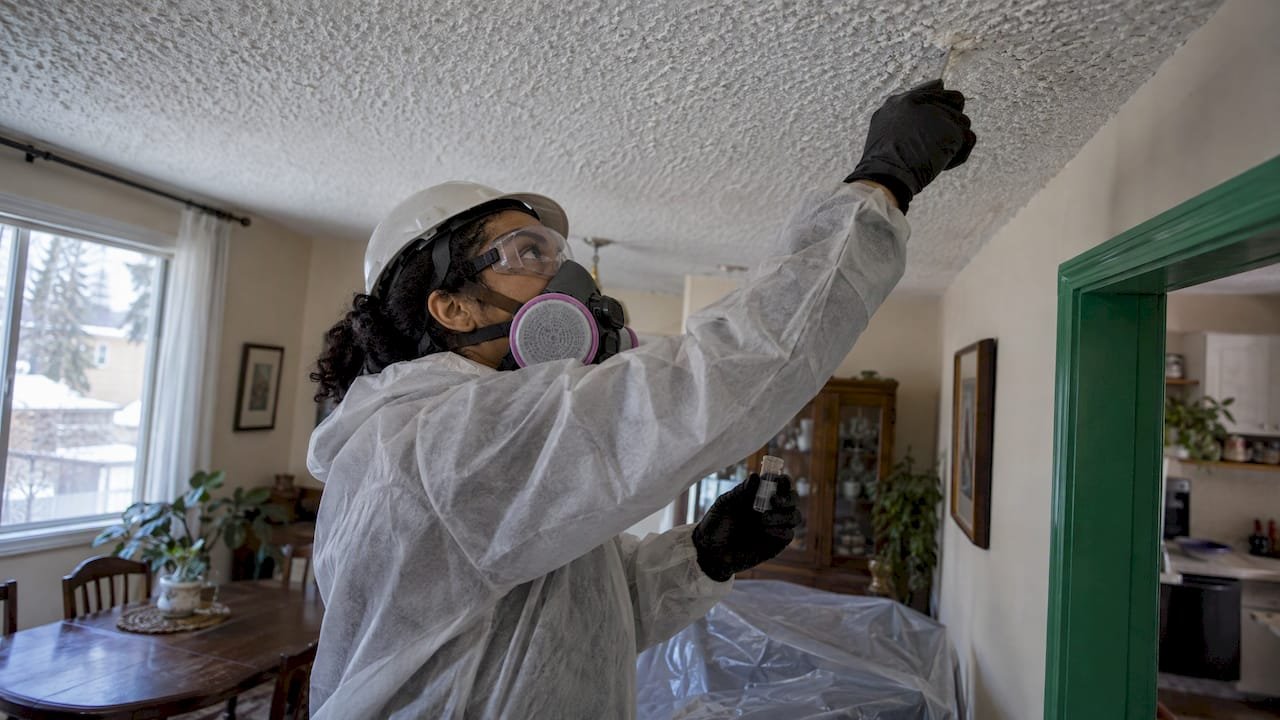
You cannot confirm asbestos by looking at a material, and the only way to know is a laboratory analysis of a sample. The safest “test at home” is therefore one where the sample is taken carefully by a qualified person, without the material being broken up in your living space. This guide explains what you can safely do yourself, what to leave alone, and how testing works for Ontario homes.
TL;DR
- Looks, age and texture cannot tell you whether a material contains asbestos. CCOHS says only laboratory testing can.
- Intact, undisturbed asbestos materials are a much smaller concern than damaged or crumbling ones. Cutting, sanding or scraping a sample is how fibres get into the air.
- The safe at-home steps are visual checks, keeping the area closed off, and not starting any renovation until the material has been tested.
- Before renovating an older Ontario home, have suspect materials sampled by a qualified professional and analysed by a lab.
- If you already disturbed something, stop work, keep people and pets out, and call a specialist.
Table of Contents
- Can you test for asbestos at home?
- Where asbestos can hide in a home
- What you can safely do yourself
- How asbestos testing works
- What about DIY test kits sold online?
- Symptoms are not a test
- The rules that frame all this in Canada
- What to do if you already disturbed something
- Perspective
- Getting your home tested in Ontario
- Material-specific notes
- FAQ
- Sources
Can you test for asbestos at home?
In a literal sense, you can take a piece of material and send it to a lab. But the word “test” hides the risky part. The lab does the testing. What happens at home is sampling, and sampling means breaking off a piece of the material.
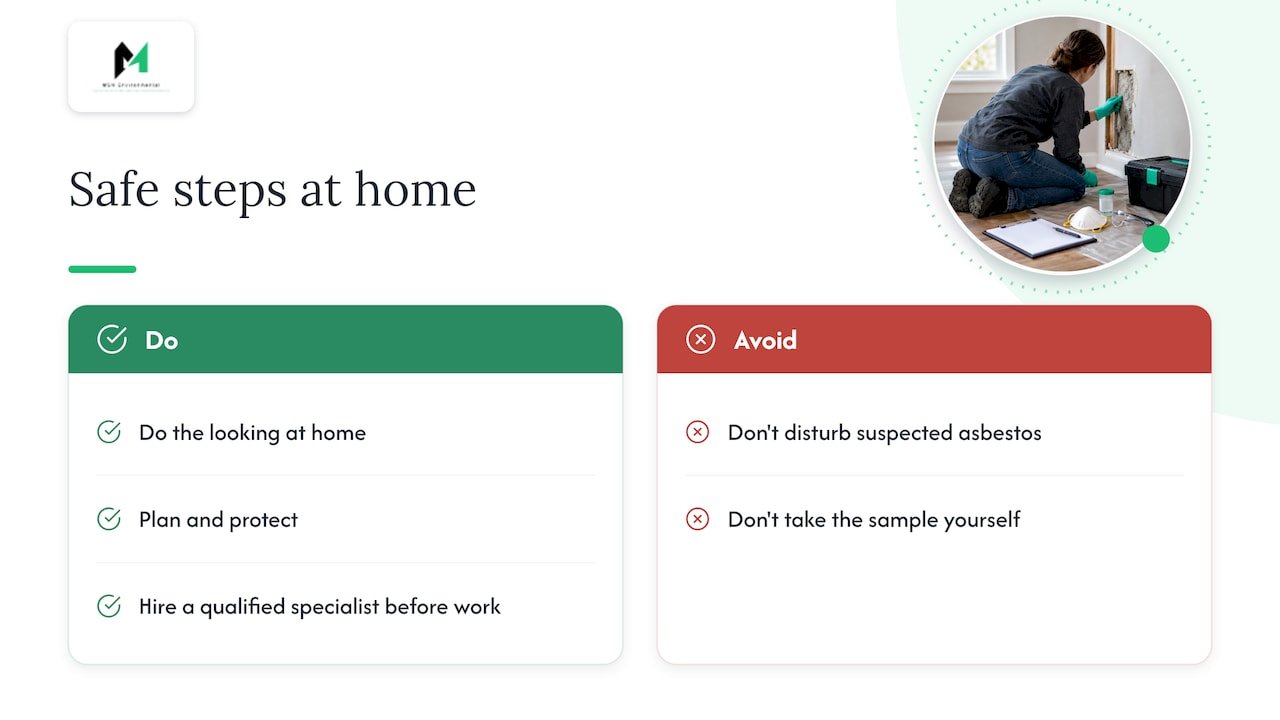
That matters because asbestos is a health risk when its fibres become airborne. CCOHS advises that you should not disturb suspected asbestos materials yourself, because handling them raises the risk to your health and your family’s. If asbestos is suspected or found, it recommends hiring a qualified asbestos removal specialist before any renovation or work begins.
So the practical answer is this: you can do the looking, the planning and the protecting at home. Taking the sample is best left to someone trained, equipped and set up to contain the dust.
Why a visual check is never enough
Asbestos was mixed into many building products, and it is not visible as a separate ingredient. CCOHS states plainly that you cannot tell if a product contains asbestos just by looking at it. Two floor tiles that look identical can differ in what they contain. The same goes for ceiling texture, plaster and pipe wrap.
That is why the age of your house is a prompt to test, not an answer. A home built before the 1990s deserves a closer look before any work that disturbs walls, ceilings, floors or insulation.
Where asbestos can hide in a home
Health Canada, as summarised by CCOHS, lists older building materials where asbestos may still be found:
- house siding
- cement and plaster
- floor and ceiling tiles
- roofing products such as tar paper, shingles and felt
- surface treatments such as paint, putty, drywall, caulking, sealants and spackling
- industrial furnaces and heating systems
- insulation, including around hot water pipes and tanks
The full list is on the CCOHS page on asbestos in the home.
Ceilings
A frequent question is how to test a ceiling. Ceiling tiles, plaster and textured or spray-applied finishes all appear on the list above. Scraping a ceiling to take a sample puts the debris directly above your head and into the room’s air, which is the opposite of what you want. If you plan to remove, patch, drill or scrape a ceiling in an older home, have it sampled first.
Vermiculite attic insulation
Loose, pebbly insulation in an attic deserves special care. CCOHS notes that not all vermiculite sold in Canada before 1990 contains asbestos fibres, but if you think your home has it, it recommends testing the insulation before doing any work. The same document says testing should be done by a competent person, such as an occupational hygienist or a consultant specializing in asbestos abatement, with samples sent to an accredited laboratory.
Until you know, HealthLink BC advises keeping children out of the attic and not using it for storage.
Pipe and duct insulation
HealthLink BC suggests a visual check of hot water pipes and furnace air ducts in an older home. If insulation that could contain asbestos is breaking or coming apart, do not disturb it. It also notes that some insulation looks like asbestos but is actually mineral or fibreglass, and is unlikely to pose a health risk. You cannot sort one from the other by eye, which is exactly why sampling exists.
What you can safely do yourself
There is plenty of useful work to do without touching a single suspect material.
- Note the age of the house and any additions. Older sections are more likely to contain the materials listed above.
- Walk through and photograph suspect materials. Ceilings, floor tiles, pipe wrap, attic insulation, siding, textured finishes. Photos help a surveyor plan a visit.
- Mark which materials your renovation would disturb. A kitchen gut, basement finish or flooring swap each touches different materials.
- Leave damaged materials alone. Do not sweep, vacuum or wipe up crumbling debris you suspect is asbestos. Keep people and pets away, as HealthLink BC recommends.
- Book testing before you book trades. Contractors, demolition crews and flooring installers all need to know what is in the building before they start.
If you want to see how the work of finding and dealing with hidden material unfolds, our guide on what to do before renovating with asbestos walks through the order of operations.
How asbestos testing works
Whether the sample is taken by a homeowner or a professional, the analysis is the same kind of thing: a small piece of material goes to a laboratory, and the lab reports whether asbestos is present, which type, and in what percentage.
That is the content of a proper report. According to the WorkSafeBC homeowner FAQ, a report should name the lab, state the analytical method used (for example NIOSH 9002 or EPA 600), and include the original lab results showing whether asbestos is present, its type and the percentage. That guidance is from British Columbia, but it is a useful picture of what a complete report contains anywhere in Canada.
How many samples does a house need?
One sample rarely tells you about a whole house. The same WorkSafeBC document says a typical survey of a home should include 18 to 25 bulk samples. A single mail-in sample answers a question about one material in one spot. It says nothing about the plaster in the next room, the flooring layers underneath, or the insulation in the attic.
This is the main reason a survey tied to your actual renovation plan is more useful than a single sample. Each product used in a different place or built at a different time may have a different recipe.
Bulk samples and air samples
There are two kinds of testing homeowners usually meet:
| Bulk sampling | Air sampling | |
|---|---|---|
| What is collected | A small piece of the material itself | Air drawn through a filter |
| Question it answers | Does this material contain asbestos? | Are fibres in the air right now? |
| Typical use | Before renovation or demolition | During or after abatement, or after a disturbance |
We cover each in more detail in our guides to asbestos bulk sampling in Ontario and asbestos air sampling.
Independent air monitoring during removal
If asbestos is found and removed, the air should be checked by someone independent. The WorkSafeBC FAQ explains that air sampling during an abatement project should be done by a qualified third party who is not an employee of the abatement contractor, such as someone from an asbestos laboratory or consulting agency. It is a good habit to expect everywhere, and a good question to ask any contractor.
What about DIY test kits sold online?
Mail-in kits are advertised in search results, usually with a lab analysis included. The lab side of those services is what produces the answer. The home side is where the risk sits: the person holding the tool is also the person breathing near it.
If you are considering one, the points that matter are:
- The kit only tells you about the single piece you send in.
- Taking that piece disturbs the material. Friable materials, those that crumble easily, such as pipe wrap, sprayed textures or loose insulation, release more fibres when disturbed.
- A result from a mail-in kit is not the same thing as a survey report that a contractor, insurer or buyer can work from.
For most Ontario homeowners planning real work, it is simpler and safer to have a professional take the samples and handle the chain of custody with the lab. If the material is in good condition and you are only deciding whether to renovate, you can leave it alone while you plan.
Symptoms are not a test
Many people searching this topic want to know whether they have already been exposed. Symptoms cannot tell you whether a material in your house contains asbestos, and they cannot confirm past exposure from a particular room. Asbestos-related illnesses develop over long periods, so a lack of symptoms today also tells you nothing about your house. If you are worried about your own health or past exposure, speak to your family doctor. For the house itself, the question is answered by sampling the material.
The rules that frame all this in Canada
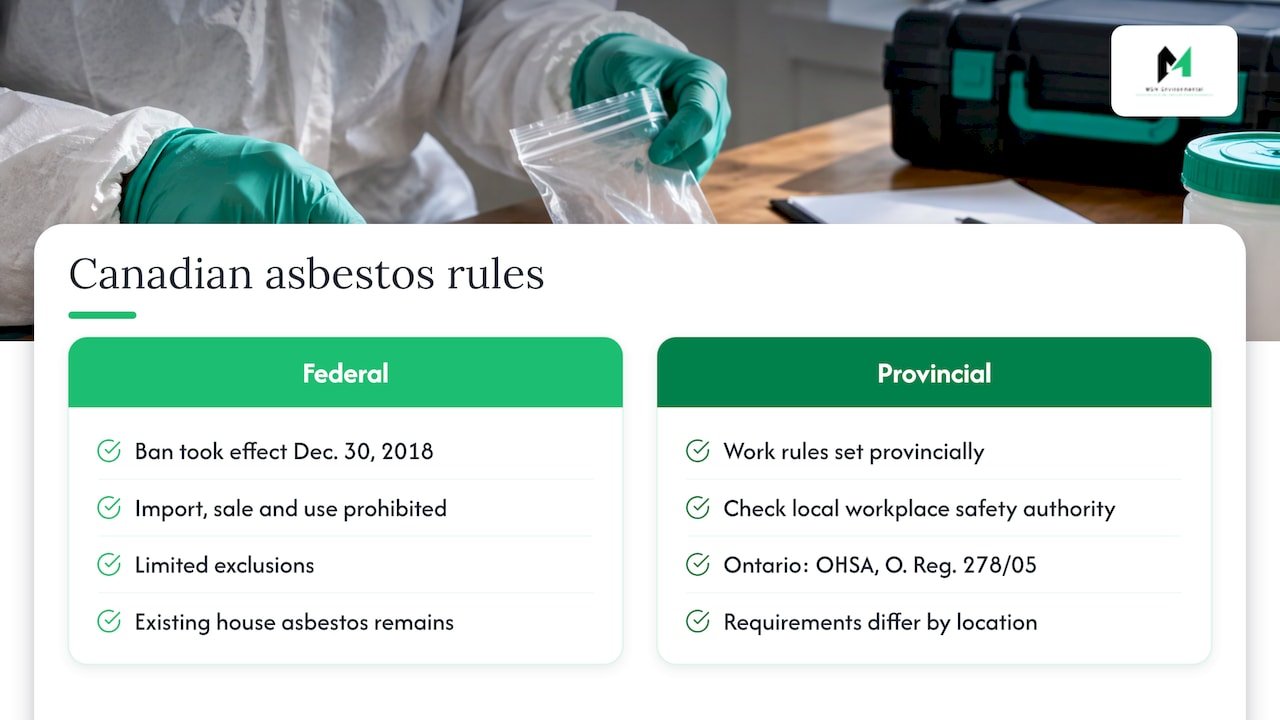
Asbestos is no longer sold in Canada as it once was. The federal government announced that the Prohibition of Asbestos and Products Containing Asbestos Regulations came into force on December 30, 2018, prohibiting the import, sale and use of asbestos and of products containing it, with a limited number of exclusions. That ban does not remove asbestos already built into houses, which is why older homes are the concern.
The rules for working around it are provincial. CCOHS advises checking with your province or territory’s workplace safety authority about the qualifications or certifications required in your area. In Ontario, the starting point is the Occupational Health and Safety Act and its asbestos regulation, O. Reg. 278/05. Our guide to the 0.5% asbestos rule and testing older Ontario homes before renovation explains what that means in practice, and our piece on four situations where testing and a written scope are needed covers when testing becomes a practical must.
Rules differ across the country, and a method accepted in one province should not be assumed to be acceptable in another. Always check the current requirements where you live.
What to do if you already disturbed something
If you have already drilled, scraped, sanded or broken material you now suspect contains asbestos:
- Stop the work immediately.
- Keep people and pets out of the area, and close the door.
- Do not sweep or vacuum the debris.
- Switch off any forced-air system that might move dust through the house, if you can do so without entering the area.
- Contact a qualified asbestos specialist to sample the material and assess the area.
HealthLink BC points out that tests show removing asbestos from older buildings can raise the number of fibres in the air if precautions are not followed. That is the reason to avoid improvising clean-up. Our article on what to do first when asbestos is found during a renovation goes through the steps in more detail.
Perspective
Most of the calls we get start the same way: a homeowner has already opened a wall or lifted a floor and is worried about what they found. The pattern is that the worry could have been avoided with a sample taken before the work began.
Our view is that “testing at home” should mean testing for your home, planned around what you intend to change. We approach it with trained technicians and the equipment to take samples while containing dust, and we match the sampling to the renovation, the rooms and the materials involved. A survey that follows your project gives you something your contractor and your family can both rely on.
If the lab result is positive, you are already talking to the team that can scope and carry out the removal, with full liability insurance and compliance with Ontario regulations as part of the job.
Moacyr
Getting your home tested in Ontario
We handle asbestos sampling and inspection for homes and businesses across southwestern and central Ontario, including Kitchener, Waterloo, Cambridge, Guelph, Hamilton, London and Brantford. Our testing services include bulk sampling, air quality testing for asbestos and mould, designated substance surveys, and pre-renovation or demolition surveys that are specific to your project.
If you are planning a renovation in an older house, start with our asbestos and mould testing services. If a sample comes back positive, our asbestos removal services pick up from there, and our step-by-step removal process guide shows what to expect. Pricing depends on the project, so contact us for a quote.
Material-specific notes
Some materials come up again and again.
- Floor tiles and adhesive: common in basements and kitchens of older homes. See our asbestos floor tile removal safety guide.
- Drywall and joint compound: these appear on Health Canada’s list of surface treatments. See our asbestos drywall removal guide.
- Attic insulation: test before touching, as described above.
- Spray-applied foam insulation in older walls: a different hazard, urea formaldehyde foam insulation. We also offer UFFI removal.
- Old paint: lead is the usual concern. Our lead paint testing guide explains how it is checked.
If an older house has more than one issue, it can make sense to do one survey for all of them rather than separate visits.
FAQ
Does a hardware store sell an asbestos test kit?
Availability varies by store and changes over time, so check with your local retailer. Whatever kit you use, the sample still has to be taken from a material in your home and analysed by a lab. That sampling step is the one that carries the risk, which is why we recommend having it done by a qualified professional.
How can I test my ceiling for asbestos?
A ceiling sample means breaking off part of the material overhead, which can release fibres into the room. Have a qualified professional sample it, with the area protected, and have the sample analysed by a laboratory. Do not scrape, sand or drill a suspect ceiling before you have the result.
Can I tell if something has asbestos by looking at it?
No. CCOHS states that you cannot tell by looking, and that laboratory testing is the only way to know. Age and appearance only tell you whether a material is worth sampling.
Is asbestos in my house dangerous if I leave it alone?
Materials that are intact and undisturbed are generally left in place until work is planned, but damaged or crumbling material should not be touched. Keep people and pets away from it and ask a specialist to assess it, as HealthLink BC advises.
How many samples will my house need?
It depends on the size of the house and the work planned. WorkSafeBC says a typical home survey includes 18 to 25 bulk samples. A surveyor can tailor the number to the rooms and materials your project will touch.
Sources
- CCOHS: Asbestos in the home
- CCOHS: Vermiculite insulation containing asbestos
- HealthLink BC: Asbestos, when should I worry?
- WorkSafeBC: Asbestos frequently asked questions for homeowners
- Government of Canada: measures to ban asbestos and asbestos-containing products