

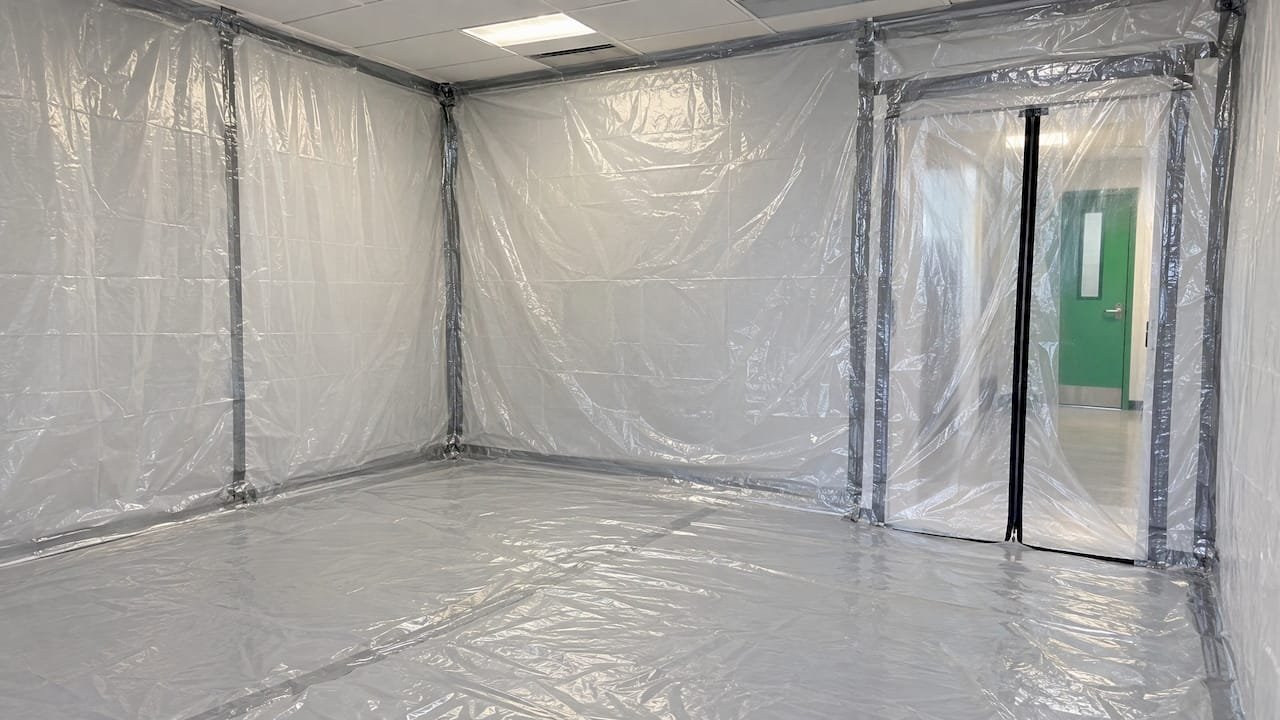
An asbestos containment is a sealed, ventilated work area that keeps fibres from leaving the space where asbestos-containing material is removed. In Ontario, a compliant setup for Type 3 work means polyethylene enclosure, sealed ducts and openings, a HEPA-filtered negative air system, a decontamination facility and clearance air testing before anything comes down. Here is how that setup works, in order, and what you should expect to see on your property.
TL;DR
- Containment is an isolation system built around the work area. Canada’s federal technical guideline defines it as a system designed to hold asbestos fibre within a designated area, and it includes glove bags.
- In Ontario, O. Reg. 278/05 sorts work into Type 1, 2 and 3. Type 3, which includes removing more than one square metre of friable material, calls for the full enclosure.
- The core elements are sealed poly sheeting, disabled and sealed ventilation, negative air through a HEPA exhaust, a shower-based decontamination facility, and sealed, labelled waste.
- The enclosure stays up until clearance air testing passes. Ontario’s regulation specifies TEM analysis for that test.
- Each province has its own wording, so the numbers below are labelled by jurisdiction.
Table of Contents
- What containment is and when it is needed
- Step 1: Survey, plan and mark the boundary
- Step 2: Clean up loose debris and shut down the air
- Step 3: Build the enclosure
- Step 4: Negative air and HEPA filtration
- Step 5: The decontamination facility
- Step 6: Work practices, protective equipment and waste
- Step 7: Clean, test and take down
- Perspective
- Our containment and removal services
- FAQ
- Sources
What containment is and when it is needed
Containment exists for one reason: asbestos fibres are invisible, light and easily carried by air movement. Any work that cuts, scrapes, breaks or pulls friable asbestos-containing material releases them. The enclosure holds them in one room while the people and materials leaving that room are cleaned.
In Ontario, the level of containment follows the type of operation. O. Reg. 278/05 classifies asbestos operations as Type 1, Type 2 or Type 3. Type 3 covers removing or disturbing more than one square metre of friable asbestos-containing material during repair, alteration, maintenance or demolition of a building or equipment. That is the category where a full enclosure, negative air and decontamination facility come into play.
Typical triggers for homeowners and property managers include:
- Sprayed-on ceiling textures or insulation that must be removed before a renovation
- Pipe or boiler insulation disturbed during a mechanical upgrade
- Wall and ceiling strip-outs in older buildings before interior demolition
- Water or fire damage that has broken friable material
If you are unsure which type your project falls into, our guide to Type 3 asbestos abatement in Ontario walks through the classification, and the Ontario asbestos regulations roadmap shows where owners, renovators and contractors each have duties.
Step 1: Survey, plan and mark the boundary
Good containment starts before any plastic goes up. A survey identifies what material is present, where it is and how much of it will be disturbed. That determines the operation type, the size of the enclosure and the number of negative air units. If your building has not been sampled yet, bulk sampling is the usual first step, and our testing and inspection services cover sampling, designated substance surveys and pre-renovation inspections.
The next job is defining the work area. Provincial rules agree on the principle and differ in wording:
- Ontario: the work area must be separated from the rest of the workplace by walls, barricades, fencing or other suitable means.
- British Columbia: section 6.13 of the OHS Regulation requires the boundary to be marked with barricades, fences or similar means, the immediate area cleared of unneeded objects and equipment, and windows, doorways and other openings secured.
On an active site, it also helps to control who can reach the area. Larger commercial and construction projects often add construction site security services so that only trained, authorized people can approach the boundary of a Type 3 work area. For a single-family renovation, the equivalent is simply locked access, posted signs and a clear agreement with the household about which rooms are off limits.
Step 2: Clean up loose debris and shut down the air
Before enclosing the space, the crew deals with any friable material already crumbled onto surfaces. Under Ontario’s regulation, that material is cleaned up with a HEPA vacuum or by damp wiping. Dry sweeping is not part of a compliant setup.
Then the air pathways are closed:
- The mechanical ventilation system serving the work area is disabled.
- All openings and voids, including ventilation ducts, are sealed with tape or other appropriate means.
This step matters for a practical reason. A furnace or air handler running during removal can pull fibres through ductwork into rooms nobody expected. Nova Scotia’s guide describes the same logic: duct openings are sealed with poly sheeting and air handling is turned off where practicable. For homeowners, that means your heating and cooling are typically off in the affected zone for the duration of the work, so plan for it in cold months.
Step 3: Build the enclosure
For indoor Type 3 operations, Ontario requires the work area to be enclosed in polyethylene or other material impervious to asbestos. In practice, technicians frame and line the room so walls, ceiling and floor are covered and the seams are taped airtight.
A few specifics from official sources:
- Poly thickness: the federal technical guideline calls for at least one layer of polyethylene 0.15 mm (6 mil) thick or greater, and drop sheets must not be reused.
- Signs and access: Nova Scotia’s guide requires signs to restrict entry, and an observation window of transparent material so the enclosure can be checked without entering.
- Floors and fixtures: anything that cannot be removed from the room is covered and sealed in the same way.
A well-built enclosure looks plain from the outside: clean taped seams, no wrinkled gaps near corners, and a clearly separated entrance. Poor ones show sagging sheets, untaped edges and unsealed vents, and those are the details we look at before work starts.
Step 4: Negative air and HEPA filtration
The enclosure alone is not enough. What keeps fibres inside is air movement: a fan with a HEPA filter draws air out of the room, so any small leak pulls clean air in rather than letting contaminated air out.
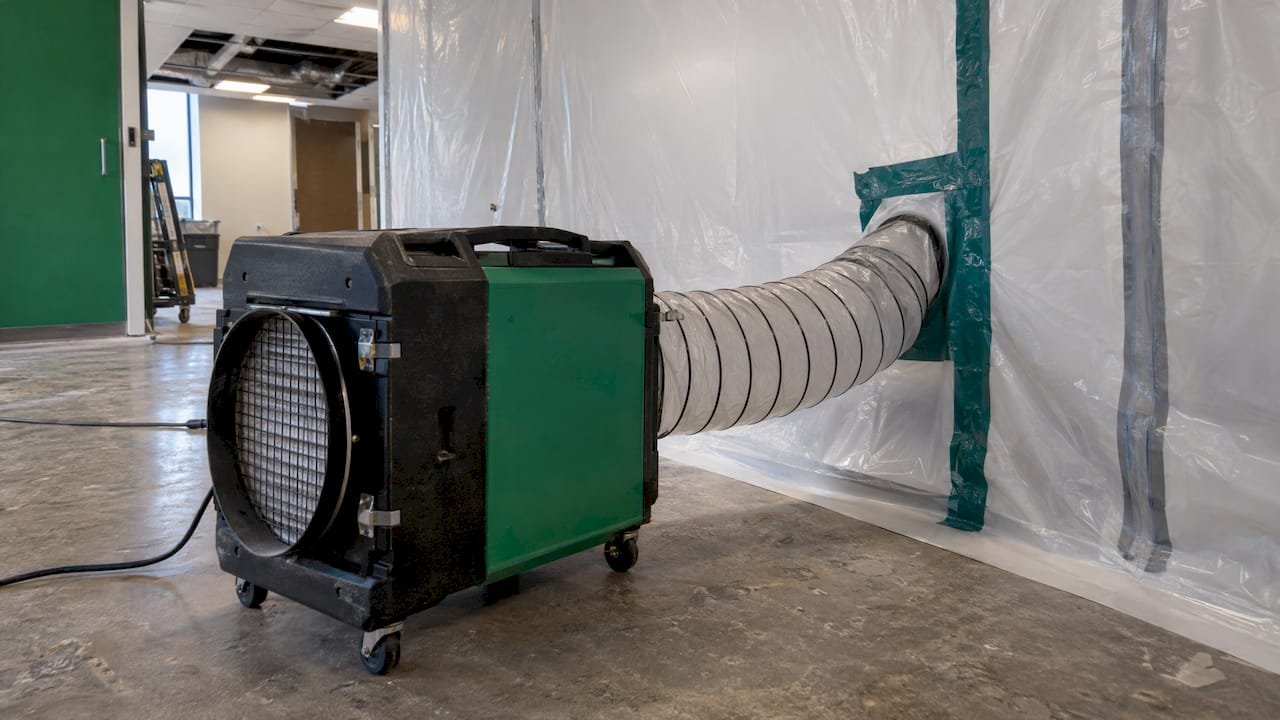
Ontario’s rule is specific. Section 18(4) of O. Reg. 278/05 requires a negative air pressure of 0.02 inches of water relative to the area outside, maintained by a ventilation system with a HEPA-filtered exhaust unit, with replacement air taken from outside the enclosed area and free from contamination. The federal guideline uses the same figure, expressed as 5.0 pascals, and requires the employer to inspect the containment and decontamination facility at least daily.
Other provinces add their own details:
| Jurisdiction | Airflow and pressure requirement | Source |
|---|---|---|
| Ontario | 0.02 inches of water negative pressure, HEPA exhaust | O. Reg. 278/05 |
| Nova Scotia | At least 4 air changes per hour or -5 Pa, with units running around the clock until clearance | Nova Scotia guide |
| New Brunswick | At least 4 air changes per hour, 24-hour operation, exhaust outdoors where practicable | WorkSafeNB code of practice |
| British Columbia | Air flows only from clean areas into the contaminated area, exhaust to outdoors through HEPA filter | OHS Regulation s. 6.17 |
The machines themselves need to be in good shape. Nova Scotia requires HEPA units to pass a test after every filter change and at least every 12 months, with an on-site test right before use if the unit exhausts indoors. New Brunswick adds that once the enclosure is up, a competent person verifies containment integrity and the negative air system’s effectiveness, and keeps a record of that inspection. For property managers who need to document this, our page on proving negative air containment explains what the records should show.
Step 5: The decontamination facility
Every person and every item leaving the enclosure passes through a decontamination facility attached to it. The design is the same across provinces: a sequence of rooms so nobody can walk from contaminated space to clean space without passing through each stage.
The usual layout, drawn from the Ontario regulation, has:
- A contaminated room next to the work area, where protective clothing is removed and stored.
- A shower room in the middle, with water at 40 to 50°C in Ontario.
- A clean room where workers change into street clothes.
New Brunswick describes the doors between rooms as layered polyethylene air locks with at least a three-foot (1 m) overlap, weighted at the bottom. British Columbia requires, for high risk work, a physical connection to the containment, a shower and safe entry and exit, except where the containment is a glove bag. The BC regulation also requires inward airflow through the decontamination facility into the containment, so the air path runs from the clean room, through the shower, to the work area.
The cleaning routine follows a set order. Under Ontario’s regulation, a worker leaving the work area:
- Decontaminates protective clothing with a HEPA vacuum or damp wiping before removing it
- Places non-reusable clothing in a container
- Showers with the respirator still on
- Removes and cleans the respirator
Keeping the respirator on in the shower is the detail people miss. Fibres can still be on the face and hair until the water has rinsed them off. Handling wet, dust-free surfaces in the changing rooms follows the same thinking as other fine-dust jobs; a general explainer on dust cleanup methods and equipment shows why wet methods and HEPA vacuums beat sweeping.
Step 6: Work practices, protective equipment and waste
Inside the enclosure, technicians wear full body coveralls with head covering, suitable footwear, gloves and respirators selected through a risk assessment. Material is kept wet during removal, since damp material releases far fewer fibres.
Waste leaves in a controlled way:
- Ontario: waste goes into sealed containers labelled as containing asbestos, and the outside of each container is cleaned with a damp cloth or HEPA vacuum before it leaves the work area.
- British Columbia: section 6.25 requires everything contaminated, including disposable clothing and cleanup equipment, to be sealed and labelled the same way.
- Alberta: waste guidelines call for rigid impermeable sealed containers or two 6-mil polyethylene bags.
Alberta also asks for notice before work. Its OHS Code requires the employer to notify a Director at least 72 hours before activities that may release fibres. That requirement is Alberta’s, and Ontario has its own notification and training rules that your contractor should confirm for your job.
Step 7: Clean, test and take down
The enclosure is not dismantled when the removal is finished. First the room is cleaned, then tested.
Under Ontario’s section 18(4), the inner surface of the enclosure and the work area are cleaned by thorough washing or HEPA vacuuming, tools and equipment are cleaned, and a competent worker visually inspects for dust, debris or residue. Once the area is dry, clearance air testing using TEM is conducted, and the barriers, enclosure and decontamination facility stay in place until the area passes.
Thresholds vary by jurisdiction:
- Federal guideline: clearance succeeds only at 0.01 f/cc or less, sampled after surfaces dry, with forced air used to dislodge fibres.
- Federal standard for federal properties: under 0.01 fibres/cm³, with 2, 3 or 5 samples depending on enclosure size.
- British Columbia: airborne fibres must not exceed 0.02 f/ml before a high risk containment is dismantled.
Why TEM? The federal guideline explains that TEM is a more powerful analysis method than phase contrast microscopy, because it can see finer fibres. Our article on TEM versus PCM for clearance explains what this means for Ontario owners. The practical takeaway: ask for the clearance report before the plastic comes down, and keep it with your property records.
Perspective
In our experience, most containment problems are visible long before a test shows them. A room that was walked through quickly, ducts left half sealed, a decontamination area squeezed into a hallway: these are the setups that cause trouble later.
We build containment the way the regulation reads, as a system. Enclosure, negative air, decontamination and waste handling each depend on the others. Our technicians are trained and certified, we use professional-grade equipment, and we carry full liability insurance, because owners should not have to take the risk of the work on themselves.
We also think owners are best served by personalized oversight. Every property is different, so the plan for a 1950s bungalow with sprayed ceilings is not the plan for a commercial strip-out. We would rather explain the layout, the air path and the clearance plan before work starts, so you know what each piece of plastic is doing.
Moacyr
Our containment and removal services
MSN Environmental handles asbestos removal for residential and commercial properties across Ontario, including the containment setup, removal and clearance steps described above, all under Ontario regulations. If you want to see how the project flows from first call to sign-off, read the asbestos removal process in Canada. When you are ready to talk about your property, start with our asbestos removal services.
We also offer testing, interior demolition and removal of other hazardous materials such as lead paint, PCBs, mercury, UFFI and bat guano, so one team can cover the full scope of a renovation. Interior demolition after abatement is covered on our interior demolition page.
FAQ
How long does an asbestos containment stay up?
It stays until the work is complete, the area is cleaned and inspected, and clearance air testing passes. Ontario’s regulation says the barriers, enclosure and decontamination facility are not removed before that. Negative air units typically run continuously in the meantime, as Nova Scotia and New Brunswick require in their guidance.
Do I need containment for every asbestos job?
Not always. Ontario classifies operations as Type 1, 2 or 3, and the full enclosure with negative air applies to Type 3 work such as removing more than one square metre of friable material. Smaller operations have lighter requirements. A survey and your contractor’s written scope will tell you which type applies.
Can I stay in my home during containment?
That depends on where the work area is, how it connects to the rest of the house and whether the ventilation system can be fully isolated. Ask your contractor for a plan that shows the boundary, the air path and the route workers use. We walk owners through this before work begins.
What negative pressure is required in Ontario?
Ontario’s O. Reg. 278/05 requires 0.02 inches of water relative to the area outside the enclosure, maintained by a HEPA-filtered exhaust unit. The federal guideline gives the same value as 5.0 pascals. Other provinces use different formulations, such as air changes per hour in Nova Scotia and New Brunswick.
Who checks that containment is working?
A competent person inspects it. The federal guideline calls for at least daily inspection of the containment and decontamination facility, and New Brunswick requires a record of the integrity and negative air checks. Final proof comes from the clearance air test.
Sources
- O. Reg. 278/05 Designated Substance, Asbestos on Construction Projects and in Buildings and Repair Operations
- O. Reg. 278/05, consolidated version
- Technical guideline to asbestos exposure management programs, Government of Canada
- Occupational Health and Safety Regulation, British Columbia
- A Guide to Removal of Friable Asbestos Containing Material, Nova Scotia
- A Code of Practice for Working with Materials Containing Asbestos, WorkSafeNB
- Alta Reg 191/2021, Occupational Health and Safety Code
- Guidelines for Managing Asbestos Waste in Alberta
- Standard on Asbestos Management, Public Services and Procurement Canada