

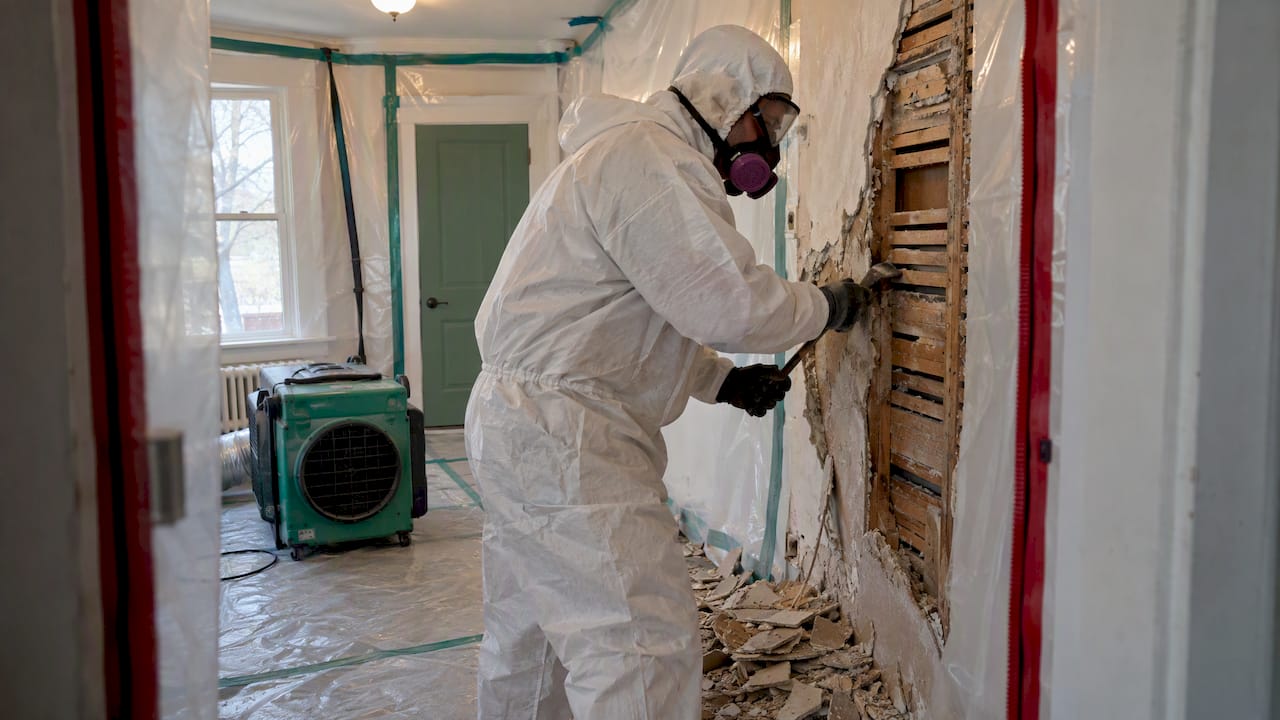
Asbestos remediation is the planned, regulated work of testing, controlling and removing (or safely sealing) asbestos-containing materials so a building is safe to occupy again. In Ontario it starts with a lab-confirmed test, moves through containment, wet removal and licensed disposal, and ends with a clearance check. You should not do it yourself, and you should not start renovating before you know what is in your walls, floors and attic.
TL;DR
- You cannot identify asbestos by looking at it. Only laboratory analysis of a sample confirms it, so test before you renovate.
- Remediation does not always mean removal. Material that is intact, enclosed and undisturbed can sometimes be managed in place.
- In Ontario, work is classified as Type 1, 2 or 3, with stricter controls as the risk of releasing fibres rises.
- Good remediation means containment, negative air pressure, wet methods, double-bagged waste and a licensed carrier.
- Price depends on material, access and project size, so insist on a written scope after testing.
Table of Contents
- What asbestos remediation actually means
- Step one: confirm what you have
- Remove it, enclose it or leave it?
- What Ontario’s rules require
- How a remediation job runs on site
- Perspective: what we see most often
- What affects the cost
- How to choose a contractor
- Working with MSN Environmental
- FAQ
- Sources
What asbestos remediation actually means
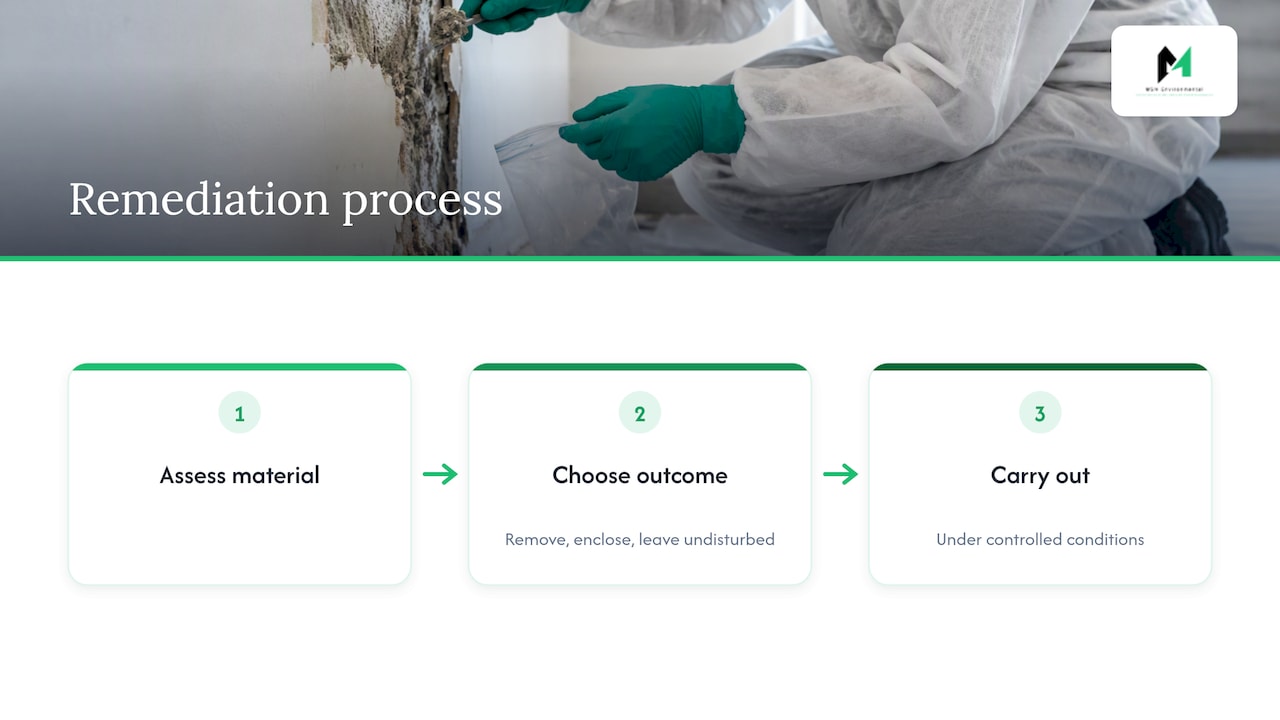
People use “remediation”, “abatement” and “removal” interchangeably, and contractors do too. In practice, remediation is the umbrella: assess the material, decide whether to remove, enclose or leave it, then carry out that decision under controlled conditions. Removal is one possible outcome. Our own step-by-step asbestos removal process guide walks through the removal stage in detail.
The reason for the caution is simple. Asbestos is only dangerous when fibres become airborne. Canada’s government notes that there are no significant health risks when fibres are enclosed or tightly bound, in good condition and left undisturbed. Sanding, drilling, breaking or tearing out the material is what turns a stable product into a hazard.
Why so many Ontario buildings still have it
Asbestos mining in Canada stopped in 2011, and in 2018 the federal government moved to prohibit the import, sale and use of asbestos and asbestos-containing products, with limited exclusions. A ban on new products does nothing about what was installed decades ago. That is why older houses, apartment buildings, schools and commercial properties across Kitchener, Hamilton, London and the rest of southwestern Ontario can still contain it.
According to the Canadian Centre for Occupational Health and Safety, asbestos turned up in roofing shingles, ceiling and floor tiles, siding, cement and plaster products, and many kinds of insulation and wrapping. Vermiculite attic insulation may also contain it.
Step one: confirm what you have
CCOHS is blunt on this point: you cannot tell whether a product contains asbestos by looking at it, and the only way to know is laboratory testing. Building records and visual inspection are not enough either. A New Brunswick code of practice makes the same point, saying that suspected materials should be bulk-sampled and analyzed by a laboratory.
There are three testing routes you will meet:
- Bulk sampling. A trained technician takes small samples of suspect material (tile, plaster, insulation, mastic) for lab analysis.
- Air sampling. Used to check fibre levels in the air, usually during or after work, or where material has already been disturbed. See our practical guide to asbestos air sampling.
- Designated substance and pre-renovation surveys. A building-wide inventory of hazardous materials before renovation or demolition, which is what most contractors and many insurers expect.
Our asbestos and mould testing services cover all three. If you want to know why an inventory matters before you open a wall, read about the 0.5% asbestos rule and testing older Ontario homes before renovation.
How many samples is enough?
You may have heard of a “3-5-7 rule”. It is not a single national rule. New Brunswick’s code of practice, for example, sets a minimum of one sample up to 100 square feet, three for 101 to 1,000, five for 1,001 to 5,000 and seven above 5,000. In Ontario, the practical test is whether the sampling is enough to call each distinct material positive or negative. A competent assessor samples every different material, not just one per room.
Do not disturb it while you wait
If you suspect asbestos, CCOHS advises you not to touch, move or disturb it, and to hire a qualified specialist before renovations or other work begin. That means no scraping popcorn ceilings, no pulling up old floor tile, no cutting into vermiculite insulation. If something has already been broken, close off the room, turn off forced-air systems that could spread dust, and read our guide on what to do in the first 90 seconds of an asbestos emergency.
Remove it, enclose it or leave it?
A good assessor does not default to tearing everything out. Federal guidance on workplace exposure management notes that asbestos that is enclosed and inaccessible, and does not expose people to fibres, may not need further removal, enclosure or encapsulation. The decision usually turns on four questions:
| Question | Leans toward leaving or managing in place | Leans toward removal |
|---|---|---|
| Condition | Intact, bound, sealed | Crumbling, water-damaged, friable |
| Location | Enclosed, out of reach | Exposed, in traffic areas |
| Planned work | None nearby | Renovation, demolition or repair will disturb it |
| Occupancy | Low use | Daily contact, tenants, staff |
The third row decides most residential jobs. If you are opening a wall, replacing a floor or gutting a basement, the material is going to be disturbed, and removal beforehand is the safer path. Our article on interior demolition versus abatement explains how the two jobs fit together and why the order matters.
What Ontario’s rules require
Asbestos work on construction projects in Ontario falls under Ontario Regulation 278/05. It sorts operations into Type 1, Type 2 and Type 3 operations, and the protective measures climb with the risk. As a rough guide, Type 1 covers low-risk, small-scale tasks, while Type 3 covers work that creates the most dust, such as removing large amounts of friable material. The regulation sets out the exact definitions, so any contractor you hire should be able to tell you which type your job is and why.
Two other requirements shape the timeline:
- Notice of Project. Before work that may release fibres, employers and contractors must file a notice with provincial workplace safety authorities, often at least 48 to 72 hours in advance. Your contractor handles this, but ask when it was or will be filed.
- Waste handling. Federal guidance describes asbestos waste as double-bagged in 6-mil polyethylene, labelled, and moved by a licensed hazardous waste carrier to an approved landfill. Ask for the disposal paperwork at the end of the job.
Homeowners share responsibility here. WorkSafeBC has stressed that homeowners have a role in protecting workers from asbestos exposure, and the same logic applies in Ontario: if you hire a renovator, tell them what testing found, and if testing has not been done, do it first.
How a remediation job runs on site
The details change with the material, but a properly run job follows a recognizable sequence.
- Scope and plan. Test results define exactly what is removed, where and how. You should receive this in writing.
- Notification and setup. The notice is filed, the area is isolated and signage goes up. Poly sheeting seals off the work zone, and HVAC is shut down and sealed.
- Negative air pressure. For high-risk work, professionals use negative air pressure and HEPA-filtered exhaust, so air flows into the work area rather than out of it.
- Wet removal. Material is wetted to keep fibres down, unless wetting would create a hazard or cause damage, such as near live electrical equipment.
- Bagging and decontamination. Waste goes into labelled double bags. Workers pass through a decontamination area before leaving the zone.
- Cleaning and clearance. Surfaces are HEPA-vacuumed and wet-wiped, and air sampling confirms the area is clean before the containment comes down.
- Disposal and paperwork. A licensed carrier takes the waste to an approved site, and you receive documentation.
Common materials, different methods
Not every job looks the same. Asbestos floor tile removal is often a controlled, lower-dust job, but the black adhesive underneath can be a separate problem: see our guide to asbestos mastic removal. Asbestos drywall and joint compound removal tends to be messier, because sanding and demolition produce fine dust. Vermiculite attic insulation and sprayed coatings usually call for the heaviest containment.
Perspective: what we see most often
Most of the damage we see is not from asbestos itself but from timing. A homeowner finds out about asbestos after the contractor has already opened a wall, and now a $-sized renovation question has become a contained-work-zone question with a delay attached. The cheapest moment to deal with asbestos is before demolition starts, because testing is quick and a written scope lets you compare quotes fairly.
We also push back on the idea that removal is always the answer. Our approach is to test first, explain what each result means and recommend the least invasive option that actually protects you and the people working in the building. Where a project involves several hazards, such as asbestos plus mould or lead paint in the same older house, we plan them as one job so you are not paying for containment twice.
Our technicians are trained and certified, we carry full liability insurance, and someone senior oversees each project. That is the standard we think you should demand from anyone you hire for this work, ours or not.
— Moacyr
What affects the cost
We do not publish fixed prices because asbestos jobs vary too much for a number to be honest. Costs in Canada are commonly reported as a few hundred to a few thousand dollars for testing, and a per-square-foot range for removal that widens with risk, but treat any such range as a rough orientation, not a quote. What moves the price on a real job:
- Material type and friability. Intact floor tile is not the same job as sprayed insulation.
- Quantity and area. More material means more labour, bags and disposal.
- Access. Tight crawl spaces, finished ceilings and multi-storey stairs add time.
- Containment level. Type 3 work needs more equipment and monitoring than Type 1.
- Disposal fees and location. Local landfill and transport costs differ.
- Rebuild work. Removal leaves a bare surface. Replacement flooring, drywall and insulation are separate items.
The quickest way to a reliable number is a test result plus a site visit. Cost also has a flip side: WorkSafeBC points out that while professional abatement has real costs, the human cost of exposure, which can include cancer and respiratory impairment, far outweighs the savings from skipping safety procedures.
How to choose a contractor
Ask these before you sign:
- Which Type (1, 2 or 3) is this job, and how do you know?
- Can I see the lab results and the written scope of work?
- Who files the Notice of Project, and when?
- What containment and air filtration will you use?
- Will air sampling confirm the area is clear before containment comes down?
- Where does the waste go, and will I get the disposal records?
- Do you carry liability insurance, and can you show proof?
A contractor who cannot answer these plainly is a risk to your property and your insurance. Our piece on why to hire certified hazardous material professionals goes deeper, and four situations where testing and a written scope are essential is a useful checklist before you request quotes. If you are planning a renovation, what to do before renovating with asbestos in your home covers the order of operations.
Working with MSN Environmental
We handle the full sequence for residential, commercial and industrial properties across southwestern and central Ontario: testing and surveys, asbestos removal, and interior demolition once the hazards are cleared. We also deal with mould, lead paint, UFFI, PCBs, mercury and bat guano, so a mixed-hazard property gets one plan rather than several contractors. If you are in the Greater Toronto Area, see our page on asbestos remediation and removal in Toronto, and for the southwest, asbestos removal in London.
Tell us what you have found, or what you plan to renovate, and we will tell you what needs testing first.
Start at our asbestos removal services page to request an assessment.
FAQ
Is asbestos still mined in Canada?
No. Asbestos mining in Canada ceased in 2011, and in 2018 the government took final steps to prohibit the import, sale and use of asbestos and its products. Material installed before the ban is still in many buildings and is managed under existing rules.
How do I tell if vermiculite insulation has asbestos?
You cannot tell by looking. CCOHS says vermiculite-based attic insulation may contain asbestos and should not be disturbed or removed by the homeowner. Have a qualified professional sample it and send it to a laboratory.
Can I remove asbestos myself?
We strongly advise against it. Disturbing the material releases fibres, and in Ontario construction work involving asbestos is governed by a regulation with defined controls. If you suspect asbestos, leave it alone and call a qualified specialist before any work begins.
Does asbestos always have to be removed?
No. Intact, enclosed material that is not disturbed and does not expose anyone to fibres may not need removal, enclosure or encapsulation. Removal becomes the better choice when renovation, demolition or damage will disturb it.
How do I find out how much asbestos removal will cost?
Start with testing, then get a written scope based on the results. Cost depends on material, quantity, access, containment level and disposal, so two quotes are only comparable if they cover the same scope.
Sources
- CCOHS: Asbestos in the home
- Technical guideline to asbestos exposure management programs, Government of Canada
- The Government of Canada takes measures to ban asbestos, 2018
- WorkSafeNB: Code of practice for working with materials containing asbestos
- WorkSafeBC: Homeowners share responsibility in protecting workers from asbestos exposure
- Ontario Regulation 278/05, asbestos on construction projects
- Asbestos removal safety guide for contractors, Safety Evolution