


Most Ontario homeowners pay a moderate to high amount for a residential asbestos removal project; small patch jobs can be relatively low cost, while full whole-home gut renovations are significantly more expensive. The range is wide because asbestos removal cost in Ontario depends on what material you have, where it is, how much of it there is, and which operation type the work falls under. Before you call a contractor, get testing done. A single-sample lab analysis incurs a modest cost, and a professional sampling visit adds further expense. That small upfront cost tells you exactly what you are dealing with and prevents expensive surprises mid-renovation.
Three fastest actions:
-
Test first. Book a professional sampling visit or a Designated Substance Survey (DSS) before any demolition or renovation work begins.
-
Get an itemised quote. Ask for a written breakdown that includes containment, disposal, air monitoring, and clearance testing.
-
Budget for clearance. Air clearance testing after abatement involves a substantial cost per event and is legally required for Type 2 and Type 3 work.
Table of Contents
What does asbestos removal cost in Ontario per material?
Professional asbestos removal in Ontario commonly ranges from $8 to $20 per square foot, depending on the material and scope of work. That spread exists because popcorn ceilings are not the same job as vermiculite attic insulation, and vinyl floor tiles are not the same risk level as pipe wrap.
| Material / Location | Typical Range (per sq. ft.) | Notes |
|---|---|---|
| Popcorn ceilings | $8–$12 | Full containment; common in older homes. |
| Vinyl floor tiles / Mastic | $5–$10 | Often non-friable and require lower containment measures. |
| Drywall joint compound | $8–$12 | Friable when sanded; may require Type 2 or 3 protocols. |
| Vermiculite attic insulation | $10–$15 | Confined access; requires more labour and negative-air setup. |
| Pipe and HVAC wrap | $12–$20 | Friable materials; typically classified as Type 2 glovebag or type 3 for abatement. |
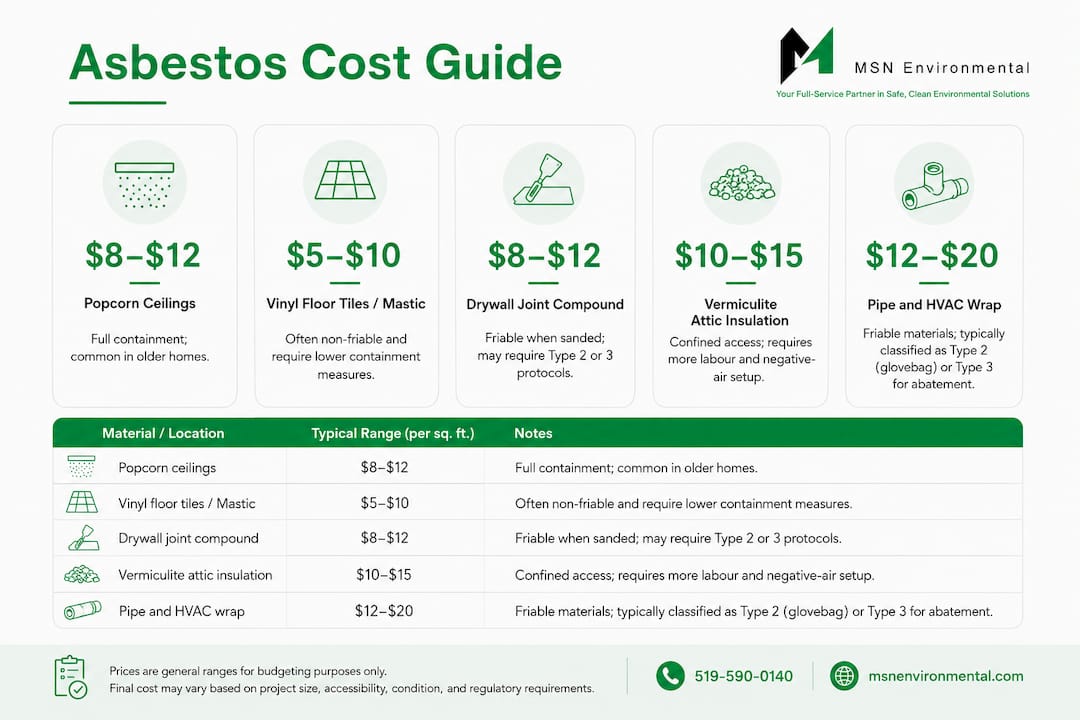
Larger jobs tend to cost less per square foot because the fixed costs (mobilization, containment setup, disposal paperwork) get spread across more material. Larger popcorn ceiling removal jobs generally cost less per square foot than smaller patch jobs due to fixed cost distribution.
Urban projects in Toronto trend toward the upper end of these ranges. Urban logistics such as parking permits for waste bins, constrained site access, and higher local labour rates all push quotes higher in the GTA compared to smaller Ontario cities.
Pro Tip: Per-square-foot estimates are a useful starting point, but they can mislead you on small jobs. Always check whether the quote includes a minimum mobilization charge, because a $10/sq. ft. rate on a 50 sq. ft. patch may still carry a $1,500 minimum call-out fee.
Sample project totals: what real jobs actually cost
Converting per-square-foot ranges into actual project budgets is where most homeowners get stuck. Here are four realistic scenarios with typical scope items included.
-
Single bathroom tile patch (approx. 40 sq. ft.): Expect $1,200–$2,000 total. The material cost is low, but mobilization, containment, and disposal fees dominate. Most contractors apply a minimum charge in this range regardless of square footage.
-
12 ft. × 12 ft. room with vinyl tile (144 sq. ft.): Budget $1,500–$2,500. Vinyl tile is typically non-friable (Type 1 or 2 work), so containment requirements are lighter. Disposal and clearance testing still add to the total.
-
1,000 sq. ft. attic vermiculite removal: Plan for $10,000–$15,000. Attic work is the most labour-intensive residential job. Difficult access, low-pitch roofs, and knee walls mean containment and negative-air systems must be adapted to confined spaces, adding 20–40% to labour costs compared to open-floor work.
-
Whole-bungalow popcorn ceiling removal (1,200 sq. ft.): Typical range is $8,000–$12,000, including testing, containment, disposal, and a post-clearance air test. Urban logistics such as permits and constrained access tend to increase costs for projects in Toronto.
A whole-home project that looks straightforward on paper can grow quickly once a contractor opens walls and finds pipe wrap or drywall compound that was not in the original scope. A full DSS before work begins is the single best way to avoid that situation.
Pro Tip: Ask your contractor to break out the mobilization fee, containment cost, disposal fee, and clearance testing as separate line items. A quote that bundles everything into one number makes it nearly impossible to compare bids fairly.
What factors push your asbestos quote up or down?
Cost is highly sensitive to operation classification under Reg. 278/05: contractors price differently based on containment, worker training, and equipment required rather than a single fixed per-square-foot rate.
-
Type 1 operations involve non-friable materials with minimal disturbance. These are the lowest-cost jobs: limited containment, no air monitoring required.
-
Type 2 operations involve non-friable materials that will be significantly disturbed. Containment, worker respiratory protection, and air clearance testing are required.
-
Type 3 operations cover all friable asbestos-containing materials. Full containment, negative-air pressure systems, trained workers, Ministry of Labour notification, and post-clearance air testing are mandatory. This is the costliest category.
Beyond classification, the following variables move the number:
-
Material friability. Friable materials (pipe insulation, vermiculite, deteriorated drywall compound) require more protective measures than intact vinyl tile.
-
Quantity and accessibility. Attics, crawl spaces, and mechanical rooms all add labour time.
-
Containment and negative-air needs. Full poly barriers and HEPA-filtered negative-air machines are significant equipment costs on Type 3 jobs.
-
Disposal and manifesting. Transport to a Ministry-approved Class II landfill plus paperwork is a fixed cost on every job.
-
Mobilization fees. Setup, travel, and crew time before a single square foot is touched.
Air clearance cost callout: Post-abatement air clearance sampling for Type 2 and Type 3 work involves significant per-event costs; multi-zone clearances for whole homes are more expensive.
Pro Tip: Targeted sampling (3–6 samples) is cheaper upfront, but it can leave you exposed to scope creep if additional asbestos-containing materials turn up once walls open. For any renovation touching multiple rooms or systems, a full DSS is the more defensible choice.
What does asbestos testing and a DSS actually cost?
Testing is not optional before renovation or demolition in Ontario. Ontario Regulation 278/05 requires a DSS before any work that may disturb asbestos-containing materials in a building constructed before 1990.
| Service | Typical Cost |
|---|---|
| Lab analysis per sample | $30–$50 |
| Professional sampling visit | $100–$200 |
| Targeted sampling (3–6 samples) | $400–$800 |
| DSS (single-family home) | $400–$1,300 |
| Whole-home gut renovation DSS | $1,200–$3,000+ |
| Air monitoring during abatement | Varies (confirm with contractor) |
| Post-clearance air testing | $400–$900 per event |
A DSS for a single-family home commonly runs $400–$1,300; whole-home surveys for gut renovations can exceed $3,000 depending on sample counts. That cost is not wasted money. Contractors use DSS results to price comprehensively and avoid emergency stoppages from asbestos-containing materials discovered mid-project.
-
Targeted sampling suits small, well-defined projects where you know exactly which material is suspect. It is cheaper but carries the risk of missing adjacent materials.
-
A full DSS is required for demolition permits and strongly advisable for any renovation touching multiple systems. It documents every suspect material in the building.
-
Air monitoring during abatement is a separate cost from clearance testing. Some contractors include it; others quote it separately. Confirm which applies to your project.
-
Post-clearance testing is the final step before re-occupancy on Type 2 and Type 3 jobs. Never skip it.
For asbestos testing and DSS services, the report you receive becomes the foundational document for contractor quotes, permit applications, and any grant applications you pursue later. Keep every copy.
Disposal, permits, and how long the project takes
Asbestos waste cannot go in a regular bin. Ontario law requires transport to a Ministry-approved Class II landfill, with a completed manifest for every load. Transport and tipping fees vary significantly depending on the volume of asbestos waste. Manifests and paperwork are normally included in the contractor’s price, but confirm this in writing.
Typical project timeline:
-
Sampling and lab analysis: 3–7 business days from sample collection to results.
-
DSS report: 5–10 business days after sampling is complete.
-
Contractor quotes: Allow 3–5 business days to receive and compare written bids.
-
Ministry of Labour notification (Type 3): Contractors must notify the Ministry before Type 3 work begins; this is built into the project schedule.
-
Abatement work: 1–5 working days for most residential jobs, depending on scope.
-
Post-clearance air testing: Conducted after containment is removed; results typically within 24–48 hours.
-
Final clearance and re-occupancy: Once the clearance report is issued, the space is safe to re-enter.
Disposal warning: Illegal dumping of asbestos waste carries serious penalties under Ontario environmental law and creates long-term liability for the property owner. If a contractor suggests you handle disposal yourself or skip the manifest, walk away.
Contractors must include WSIB Form 2156 notifications and Ministry of Labour Type 3 notifications in Type 3 quotes. Confirm these line items are present before signing anything.
Pro Tip: Build at least two weeks of buffer between your DSS report and your planned renovation start date. Clearance testing results and contractor scheduling rarely align perfectly, and a delayed clearance can push your entire renovation timeline back.

Can you legally remove asbestos yourself in Ontario?
The short answer: technically yes, in very limited circumstances, but almost never advisable.
Ontario Regulation 278/05 includes a homeowner exemption that allows owner-occupiers of single-family dwellings to perform Type 1 and some Type 2 work on their own homes. The exemption does not apply to Type 3 (friable) materials, rental properties, or any commercial building.
Asbestos fibres are classified as a known human carcinogen by health authorities. Mesothelioma and lung cancer can develop decades after a single significant exposure. There is no safe level of airborne asbestos fibre.
Even where the homeowner exemption technically applies, the disposal rules do not change. You must still transport waste to a Ministry-approved Class II landfill with a completed manifest. You cannot bag it and leave it at the curb.
Industry experts strongly advise against DIY removal in Ontario: although homeowner exemptions exist for single-family dwellings in limited circumstances, the health risks and legal disposal requirements make professional abatement the prudent choice for virtually every homeowner.
Can I remove asbestos myself in Ontario? Only for Type 1 or limited Type 2 work in your own single-family home, and only if you follow all disposal and containment rules under Reg. 278/05. Friable materials and rental properties require a licensed contractor.
Health risk callout: The U.S. Environmental Protection Agency identifies asbestos as a significant health hazard with no safe exposure threshold. Canadian health authorities hold the same position.
Where to look for grants and financial help in Ontario
Asbestos abatement is expensive, and several funding routes are worth checking before you pay entirely out of pocket.
-
Municipal hardship and home repair funds. Many Ontario municipalities operate low-income home repair programmes that can cover hazardous-material remediation. Contact your local municipality directly, as eligibility and funding amounts vary widely.
-
Ontario Renovates programme. This provincial programme provides forgivable loans and grants to low-to-moderate-income homeowners for essential repairs, which can include health and safety hazards. Eligibility is income-tested and administered through local Service Managers.
-
Canada Greener Homes Grant and retrofit programmes. While primarily focused on energy efficiency, some retrofit programmes have covered hazardous-material removal when it is part of a qualifying renovation. Check the current programme details at the Canada Mortgage and Housing Corporation (CMHC) website, as programme availability changes.
-
CMHC Residential Rehabilitation Assistance Programme (RRAP). Historically funded repairs to address health and safety issues in homes occupied by low-income households. Confirm current availability with CMHC directly, as programme funding is periodic.
-
Local non-profit housing organizations. Some community organizations in Ontario administer emergency repair funds that cover abatement costs for vulnerable homeowners.
Documentation you will need for any application: a completed DSS report, at least two written contractor quotes, proof of property ownership, and (after the work) a post-clearance air testing report. Gather these before you apply.
Pro Tip: Apply for grants before the work begins, not after. Most programmes require pre-approval and will not reimburse completed work. Include your DSS and two quotes with the application to demonstrate scope and cost.
How to choose a qualified asbestos contractor in Ontario
A low quote is not a good quote if the contractor skips clearance testing or cannot produce WSIB documentation. Here is what to verify before you sign.
-
WSIB coverage. Ask for a current WSIB clearance certificate. A contractor without WSIB coverage exposes you to liability if a worker is injured on your property.
-
Proof of worker training. Workers performing Type 2 and Type 3 abatement must be trained under Reg. 278/05. Ask for documentation.
-
Type 2 and Type 3 experience. Not every contractor is equipped for friable-material removal. Confirm they have done comparable work.
-
Liability insurance. Minimum $2 million general liability is standard for abatement contractors in Ontario.
-
Written, itemised quote. The quote must break out mobilization, containment, labour, disposal (with landfill name), air monitoring, and clearance testing as separate line items.
-
Clearance testing arrangements. Ask who performs the post-abatement air test. It should be an independent third party, not the same crew that did the removal.
Questions to ask every contractor:
-
What is included in your disposal fee, and which Class II landfill do you use?
-
Who performs the post-clearance air test, and is that cost included in this quote?
-
Can you provide WSIB documentation and proof of worker training before work begins?
-
Will you provide Ministry of Labour notification for Type 3 work, and is that included?
Red flags to walk away from:
-
Verbal quotes only, with no written breakdown.
-
No mention of clearance testing or air monitoring.
-
Suggestion that you handle disposal yourself.
-
Inability to produce WSIB or insurance documentation.
Contractor hourly rates in Ontario vary widely; final quotes are typically task-based including fixed fees for mobilization and disposal. A suspiciously low total bid usually means something is missing from the scope.
Pro Tip: Get at least three written quotes. If one bid is significantly lower than the others, ask specifically what it excludes. Missing clearance testing or disposal manifesting is the most common reason a quote looks cheap on paper.

A quick budget worksheet to estimate your project cost
You do not need a contractor to form a rough budget. Work through these steps with the numbers from earlier sections.
-
Estimate your square footage. Measure the area of suspect material as accurately as you can.
-
Apply the per-square-foot range. Use $8–$12 for vinyl tile or popcorn ceilings, $12–$20 for attic vermiculite or pipe wrap.
-
Add testing costs. Budget $400–$800 for targeted sampling or $400–$1,300 for a DSS on a typical home.
-
Add disposal. Budget $300–$1,500 depending on volume.
-
Add clearance testing. Budget $400–$900 per clearance event.
-
Add mobilization. Budget $500–$1,500 for a typical residential job.
-
Add a 15–20% contingency. Scope surprises are common once walls open.
Worked example: 500 sq. ft. popcorn ceiling removal in Hamilton
| Line item | Estimated cost |
|---|---|
| Abatement labour (500 sq. ft. × $10) | $5,000 |
| DSS / targeted sampling | $400–$1,300 |
| Disposal and manifesting | $300–$1,500 |
| Clearance air testing | $400–$900 |
| Mobilization | $800 |
| Subtotal | $6,900–$9,500 |
| 15% contingency | $1,035–$1,425 |
| Total estimate | $7,935–$10,925 |
Pro Tip: The contingency is not optional padding. On roughly half of residential abatement projects, additional asbestos-containing materials are found once work begins. A 15–20% buffer keeps your renovation on track without emergency budget decisions.
Key takeaways
Ontario residential asbestos removal typically costs $3,000–$11,000, but testing first, understanding the Type classification, and budgeting for clearance testing are the three decisions that determine whether your project stays on budget and on the right side of Ontario law.
| Point | Details |
|---|---|
| Typical cost range | Most Ontario residential projects fall between $3,000 and $11,000; attic vermiculite can push higher. |
| Test before you renovate | A DSS ($400–$1,300) is required before demolition and prevents costly mid-project surprises. |
| Type classification drives price | Type 3 (friable) work requires full containment, negative air, and clearance testing, making it the most expensive category. |
| Budget for clearance testing | Post-abatement air clearance costs $400–$900 per event and is legally required for Type 2 and Type 3 work. |
| MSN Environmental | Provides Type 1/2/3 abatement, DSS, air monitoring, and clearance testing across Ontario with full WSIB compliance. |
The cost conversation most contractors avoid
The single most underestimated part of asbestos abatement is not the removal itself. It is the clearance testing, and the reason so many homeowners are blindsided by it is that some contractors bury it in fine print or leave it out of the initial quote entirely.
Here is the thing: a clearance test is not a formality. It is the only way to confirm that the air in your home is safe to breathe after abatement. Skipping it, defeats the purpose entirely. Clearance testing is what gives you a defensible record that the work was done properly, and it is what protects you if you ever sell the property or face a future liability question.
The other conversation that rarely happens upfront is about scope creep. Targeted sampling is cheaper than a full DSS, and many contractors will suggest it to keep the initial quote attractive. But if you are renovating a 1960s bungalow and you only test the popcorn ceiling, you may find pipe wrap or drywall compound the moment the walls open. That discovery mid-project means a work stoppage, emergency re-quoting, and a delay that costs more than the DSS would have. A full survey is not an upsell. It is insurance against the renovation grinding to a halt.
Prioritise licensed abatement not because the law requires it (though it does, for most scenarios), but because the documentation trail a certified contractor produces, from the DSS through the clearance report, is the only thing standing between you and an unresolvable dispute with a future buyer, an insurer, or a municipal inspector.
MSN Environmental: certified asbestos abatement across Ontario
When the testing is done and the scope is clear, the next decision is who does the work.
MSN Environmental handles the full abatement process for residential and commercial properties across Ontario, from initial asbestos testing and DSS through Type 1, 2, and 3 removal, air monitoring, disposal manifesting, and post-clearance testing. Every quote is itemised: mobilization, containment, labour, disposal (with named Class II landfill), air monitoring, and clearance testing are listed separately so you can compare bids accurately. WSIB documentation and Ministry of Labour notifications for Type 3 work are included as standard.
The team serves homeowners and property managers across the Greater Toronto Area, Hamilton, London, Cambridge, Kitchener-Waterloo, Guelph, Brantford, and surrounding communities. If you are ready to move from budgeting to booking, request a quote or site inspection and get a written, itemised estimate for your specific project. For Toronto-area homeowners, the Toronto asbestos removal page covers local logistics, permits, and what to expect on a GTA job.
Useful sources and where to verify the rules
The figures and regulatory references in this article draw from the following authoritative sources. Keep your DSS, clearance report, and contractor quotes on file; grant applications and future property disclosures will require them.
Regulatory note: The cost ranges in this article reflect typical Ontario market pricing. Always obtain written quotes from licensed contractors for your specific project. This article is general information, not professional legal or health advice. Confirm current regulations with the Ministry of Labour or a qualified abatement professional for your situation.
-
Ontario Regulation 278/05 (Designated Substance — Asbestos on Construction Projects and in Buildings and Repair Operations): the governing regulation for all asbestos work in Ontario buildings. Available through the Ontario e-Laws portal.
-
Ministry of Labour, Immigration, Training and Skills Development: publishes guidance on Type 1/2/3 classifications, worker training requirements, and notification procedures.
-
U.S. Environmental Protection Agency — Asbestos health guidance: background on health risks and exposure thresholds, consistent with Canadian health authority positions.
-
American Lung Association — Asbestos overview: plain-language health risk summary.
-
Canada Mortgage and Housing Corporation (CMHC): current information on residential rehabilitation and retrofit programmes that may cover abatement costs.
-
MSN Environmental — Asbestos removal services: itemised service descriptions, regional coverage, and quote request for Ontario homeowners.
Documents to keep for grant applications: completed DSS report, minimum two written contractor quotes with itemised scope, post-clearance air testing report, and proof of property ownership.