

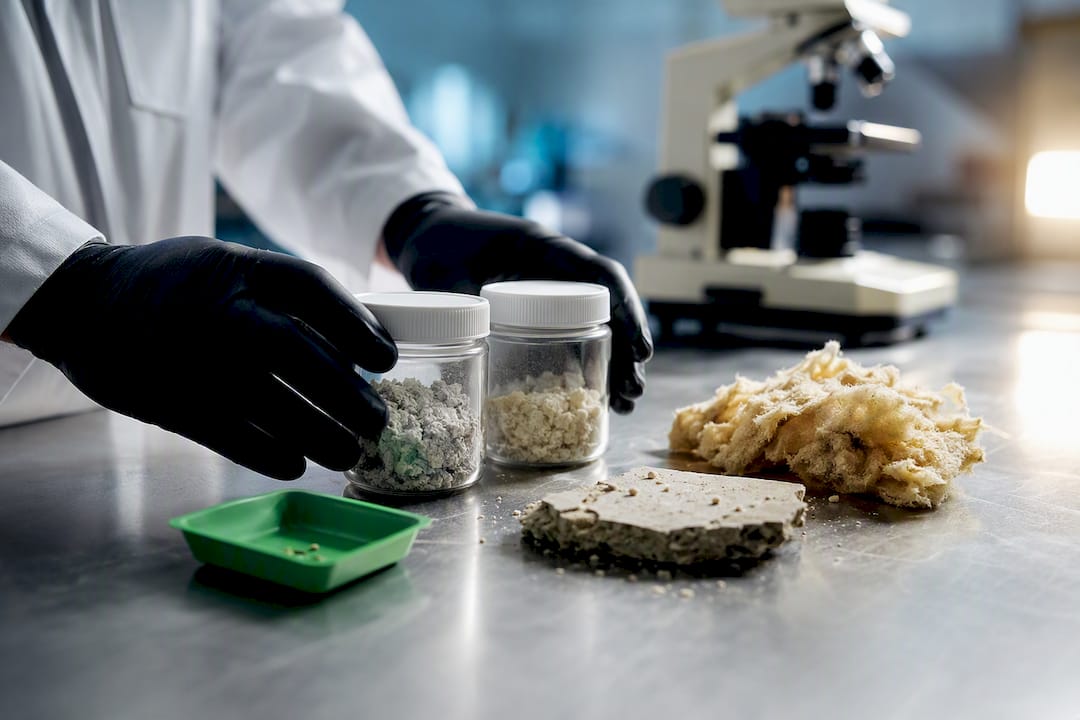
Friable asbestos crumbles to dust under hand pressure and releases hazardous fibres into the air; non-friable asbestos has fibres locked into a solid matrix like cement or vinyl and stays safe as long as it’s undisturbed. Friable material is the higher-risk category by definition. If you suspect either type in your home, the correct move is simple: leave it alone and call a licensed asbestos assessor before you touch, sand, or move anything.
TL;DR:
If asbestos-containing material appears crumbling or damaged, contact a licensed assessor and avoid disturbing it to prevent fibre release.
Asbestos is classified as friable if it can be crumbled by hand and as non-friable if it remains solid; both require professional testing for safe handling.
Disturbing non-friable materials like cement or vinyl during renovation can turn them into regulated friable asbestos, demanding strict containment and disposal protocols.
Asbestos-related diseases can take decades to manifest, with even minimal or one-time exposure increasing the risk of serious health conditions.
Proper disposal involves double-bagging and licensed transport to approved waste facilities, with clearance testing to confirm fiber levels are safe before re-entry.
Table of Contents
-
Friable vs non-friable asbestos: the formal definitions and the 0.5% rule
-
How professionals identify friable vs non-friable asbestos safely
-
MSN Environmental’s perspective on managing both material types
Friable vs non-friable asbestos: the formal definitions and the 0.5% rule
Regulators and labs draw the line using a specific technical test. Material is classified as friable when it can be crumbled, pulverized, or reduced to powder by hand pressure once dry, according to the Canadian Centre for Occupational Health and Safety. Non-friable material can’t be broken down that way, because its fibres are bonded into cement, vinyl, or a similar matrix.
Either category only counts as asbestos-containing material if it exceeds a 0.5% asbestos threshold, a benchmark confirmed in CCOHS’s technical definition. Labs confirm that percentage using polarized light microscopy, or PLM, the standard analytical method for identifying and quantifying asbestos fibres in a bulk sample.
Here’s the part people misread: the hand-pressure description is a laboratory classification standard, not an instruction. It explains how a lab technician categorizes a sample they’ve already collected safely. It was never meant to tell a homeowner to squeeze a pipe wrap and see what happens.
Where you’ll actually find friable and non-friable asbestos
Friable materials tend to show up in older mechanical systems and insulation work, including:
-
Loose-fill vermiculite or other loose insulation in attics and wall cavities
-
Pipe lagging and boiler wrap on older heating systems
-
Sprayed-on fireproofing and acoustic coatings on ceilings and structural steel
-
Deteriorated pipe or duct insulation
Non-friable materials are far more common in ordinary building products:
-
Asbestos cement sheeting, siding, and eavestroughs
-
Vinyl floor tile and the backing on some sheet flooring
-
Roofing shingles and felt
-
Mastics and adhesives used under flooring or tile
Age and renovation change the picture fast. A cement panel that’s been solid for 40 years can shed fibres the moment it’s drilled, cut, or cracked during a reno.
The health risks behind every asbestos warning
Inhaled asbestos fibres cause three well-documented diseases: asbestosis (scarring of lung tissue), mesothelioma (a cancer of the lung and abdominal lining), and asbestos-related lung cancer. All three share a brutal trait: latency. Symptoms often don’t appear for 20 to 40 years after exposure, so the damage is done long before anyone notices.
Risk builds cumulatively. Every exposure adds to a lifetime total, which is why even a single renovation weekend around damaged material matters more than it seems to at the time.
The real hazard isn’t visible dust. It’s the microscopic, respirable fibres too small to see that lodge deep in lung tissue and never fully clear. A surface can look clean and still be shedding fibres well below what your eye can detect.
How professionals identify friable vs non-friable asbestos safely
You will not find a reliable way to test asbestos yourself, and that’s by design, not an inconvenience. Trying to crumble suspect material to see whether it’s friable is genuinely dangerous. It’s the exact action that releases the fibres you’re trying to avoid, a warning echoed by CUPE’s asbestos fact sheet.
What you can do is watch for warning signs and act on them:
-
Look for crumbling, flaking, or powdery residue on insulation, pipe wrap, or ceiling coatings.
-
Check for visible dust accumulation near older mechanical systems or damaged panels.
-
Note any recent impact, water damage, or renovation activity near suspect material.
-
If any of these are present, restrict access to the area immediately.
-
Book a licensed assessor for bulk sampling and, where needed, air testing rather than attempting to identify the material yourself.
Look for a lab or assessor accredited for asbestos analysis and familiar with PLM testing protocols.
Pro Tip: If a material looks intact and nothing has disturbed it recently, it’s usually safer to leave it exactly where it is and schedule an assessment than to move, bag, or “clean” it yourself.
What testing and licensed abatement actually involve
A proper assessment starts with a survey and bulk sampling, followed by PLM analysis in an accredited lab to confirm asbestos content and classification, following essential fumigation safety checks your provider must do before a job to ensure safe handling. If removal is needed, licensed contractors follow a defined containment process: sealed enclosures, negative-pressure units, HEPA filtration, and full PPE for anyone inside the work zone.
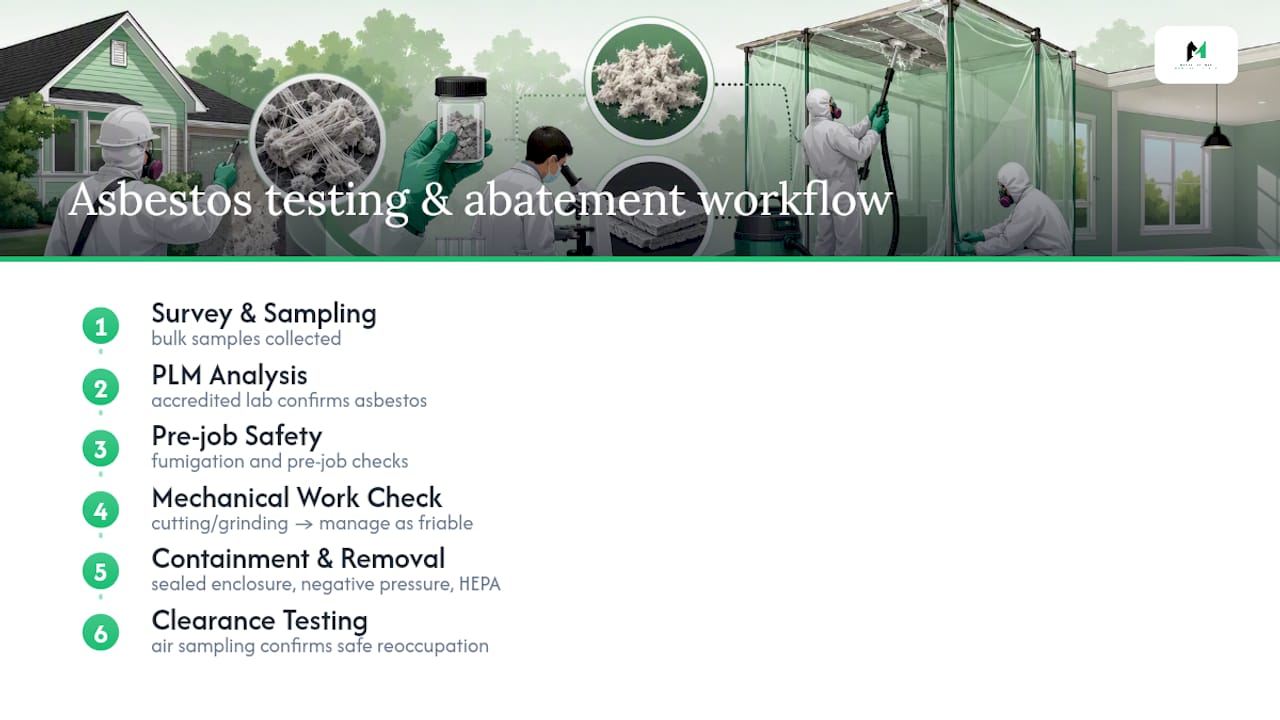
Once work is done, air sampling for clearance confirms fibre counts have dropped to acceptable levels before anyone reoccupies the space, a step outlined in federal regulatory provisions on removal and handling.
One detail catches a lot of renovators off guard: non-friable material doesn’t stay non-friable once you start cutting, grinding, or demolishing it. The moment mechanical work breaks up that matrix, it gets managed as friable, regulated-asbestos-containing material, with the same containment rules that apply to loose-fill insulation.
Regulatory and disposal rules you need to know
Two federal sources carry the weight here. Canada’s asbestos prevention guidance sets out occupational exposure controls, and the SOR/86-304 regulations define how materials get classified and handled once work begins. Provincial and municipal bylaws layer on top of both, especially around demolition permits and waste transport.
The reclassification rule matters most in practice: any activity likely to break up a non-friable matrix, sanding, cutting, demolition, triggers the same controls as handling friable material outright.
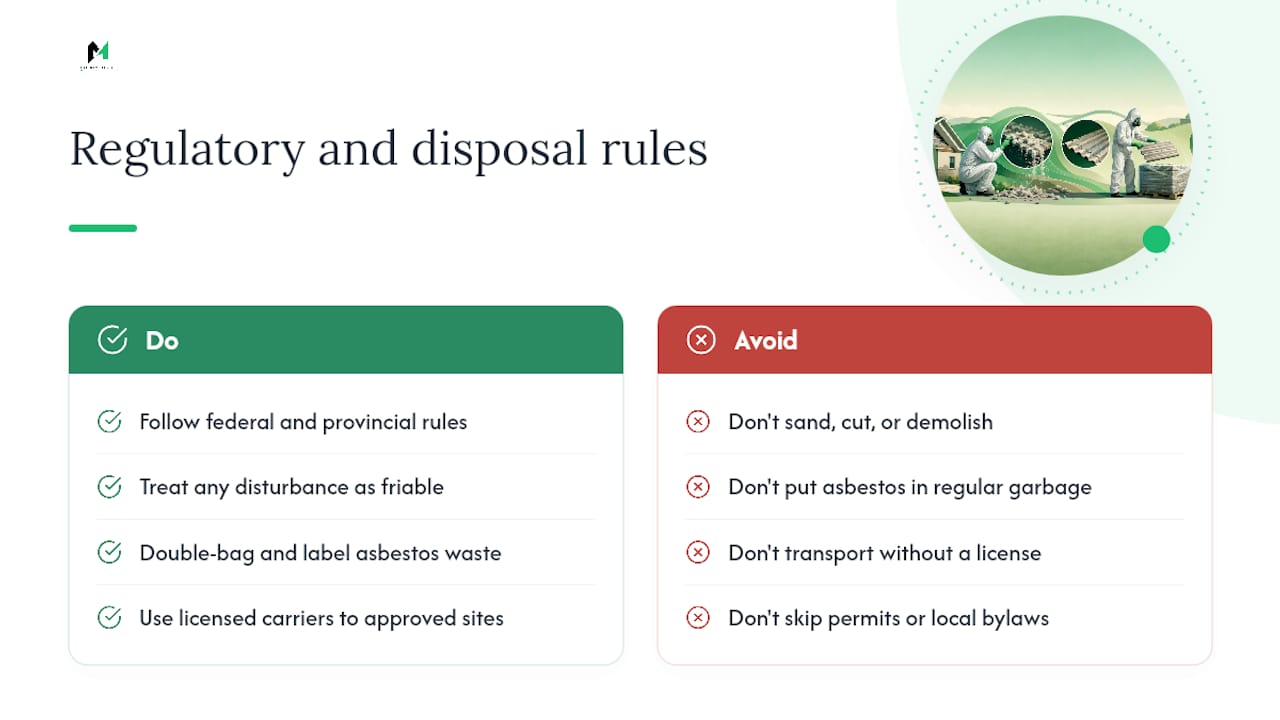
Disposal isn’t a garbage-day problem. Asbestos waste has to be double bagged or wrapped, clearly labelled, and transported by licensed carriers to approved disposal facilities. Provincial environment ministries and municipal bylaw offices are the enforcement bodies most homeowners will actually deal with, alongside occupational health authorities for workplace exposure.
If you find suspected asbestos, follow this sequence
-
Stop whatever work you’re doing immediately and leave the material undisturbed.
-
Restrict access to the room or area, close doors, and avoid sweeping or vacuuming dust.
-
Contact a licensed assessor and ask specifically about PLM sampling, air testing capability, and containment procedures for your material type.
-
Get a written scope and quote before any work starts, and confirm clearance air testing is included.
-
Expect the full timeline, survey, lab results, containment setup, removal, and clearance testing, to run anywhere from a few days to a couple of weeks, depending on the amount of material and site complexity.
Cost and duration both scale with the size of the affected area and whether the material is friable (which demands stricter containment) versus non-friable (often faster to manage if it’s still intact).
MSN Environmental’s perspective on managing both material types
Most of the fear around asbestos comes from not knowing which category you’re dealing with. In practice, the friable/non-friable distinction changes everything about how a job gets scoped, contained, and cleared. MSN Environmental treats every suspected sample the same way at intake: assume it’s regulated until a lab says otherwise, then build containment and clearance testing around whatever that result comes back as.
— Moacyr
Get a professional assessment before you touch anything
If you’ve read this far because you’re staring at cracked pipe wrap or a damaged ceiling tile, the next move isn’t a bigger to-do list, it’s one phone call. MSN Environmental’s asbestos abatement services cover the full path: bulk and air sampling, PLM-confirmed lab results, and licensed removal for both friable and non-friable situations, including Type 3 abatement for higher-risk jobs.
When you contact MSN Environmental, expect a straightforward process: a site survey, sample collection, a written quote once lab results confirm what you’re dealing with, and full containment controls during any removal work. If you’re mid-renovation and just found something suspect, this guide on what to do first covers the immediate steps while you wait for a technician. Book an assessment through the asbestos removal service page and get a straight answer instead of a guess.
This article is general information, not a substitute for advice from a qualified doctor. Consult a qualified healthcare professional about your own circumstances before acting on anything here.
Sources
-
Asbestos — Canadian Centre for Occupational Health and Safety (CCOHS)
-
Asbestos prevention — Government of Canada (Employment and Social Development Canada)
-
Regulatory provisions on removal and handling — Government of Canada
FAQ
What is the difference between friable and non-friable asbestos?
Friable asbestos crumbles to powder under hand pressure when dry and releases fibres easily, while non-friable asbestos has fibres bonded into a solid matrix like cement or vinyl and stays low-risk unless disturbed.
How do professionals determine if asbestos is friable?
Assessors collect a bulk sample without disturbing the material and send it to an accredited lab for PLM analysis, which confirms both asbestos content and whether the material meets the friable classification. Homeowners should never test this by hand.
Is drywall considered friable asbestos?
Drywall compound can contain asbestos, and once it’s damaged, sanded, or crumbled, it behaves as friable material and releases fibres readily. Intact, undamaged drywall poses far less risk until it’s disturbed.
Where is friable asbestos most commonly found?
Friable asbestos typically turns up in loose-fill insulation, pipe lagging on older heating systems, and sprayed-on fireproofing or acoustic coatings, especially in older buildings.
Can non-friable asbestos become dangerous over time?
Yes. Non-friable material becomes hazardous once it’s sanded, cut, mechanically worked, or degraded by age and weather, at which point it’s managed under the same rules as friable asbestos.