

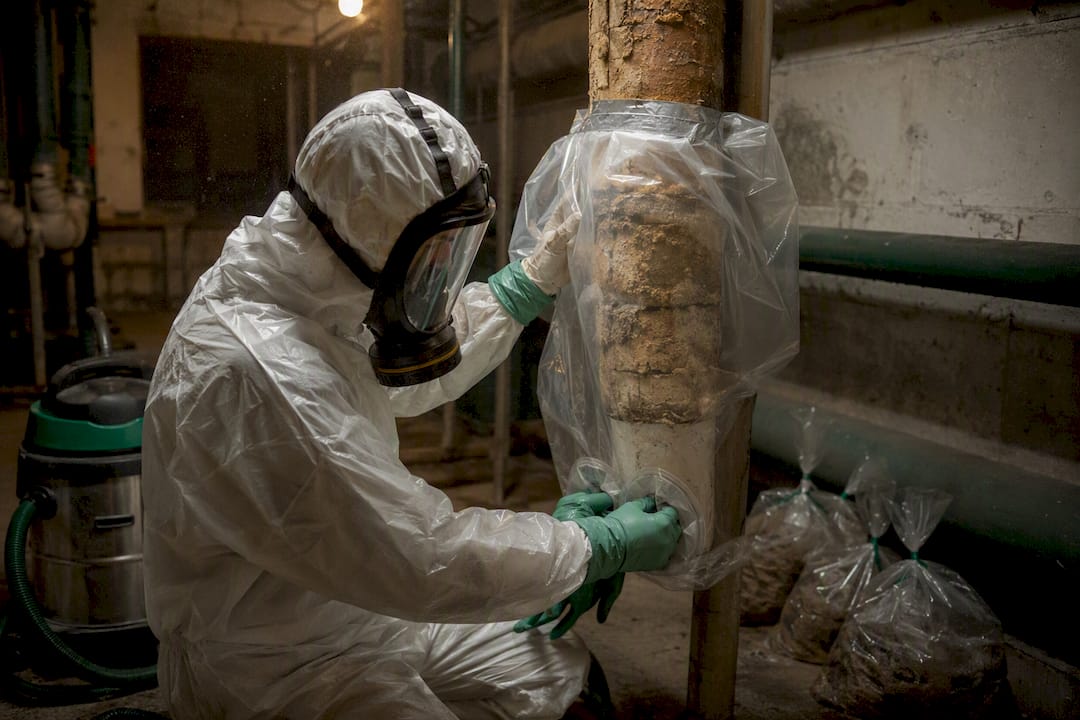
Glove bags are an accepted method for small, localised asbestos removals, but only when used exactly to regulatory and procedural requirements laid out in the Canada Occupational Health and Safety Regulations and confirmed safe only within limits documented by NIOSH air-monitoring studies. They work for short jobs like a pipe section or a valve, never for a room full of pipe chase or a basement ceiling. Anything beyond that scale needs a trained crew and full containment, not a bag and a roll of tape.
TL;DR:
- Glove bags are suitable only for small, well-defined asbestos removal tasks, such as removing a short pipe section or isolating a single valve.
- Proper setup requires sealing the bag, smoke testing for leaks, and evacuating the air with HEPA filtration before removal, with full compliance including inspection and documentation.
- Failures often occur due to unnoticed punctures, reuse of bags on long pipe runs, under-mixed wetting agents, or fouled vacuum lines, increasing asbestos exposure risk.
- Use only high-quality, single-use glove bags with seamless polyethylene, fitted collars, and compatible vacuum ports, and avoid considering them for large-scale or deteriorated insulation jobs.
- A thorough assessment by a trained, certified contractor is essential to determine whether glove bags are appropriate or if full containment is necessary for safety and compliance.
Table of Contents
- What is a glove bag, and when is it the right call?
- What do Canadian and U.S. regulations actually require?
- How do you prep the site and crew before starting?
- What’s the step-by-step glove-bag removal procedure?
- Where do glove bags actually fail?
- What should you look for in a professional-grade glove bag?
- What does MSN Environmental bring to this work?
- Where glove bags fit and where the advice gets it wrong
- Get a professional glove-bag or full containment assessment
- Sources
- FAQ
What is a glove bag, and when is it the right call?
A glove bag is an airtight polyethylene enclosure with two built-in arm sleeves, a fitted collar, and a clear body that lets a worker reach inside without opening the space to room air. It gets taped or strapped around a pipe, valve, or duct section so the asbestos-containing material can be wetted, cut, and bagged entirely inside a sealed volume.
The method suits narrow, well-defined jobs:
- Removing a short run of pipe lagging during a repair, not a full basement retrofit
- Cutting into or removing insulation around a single valve, elbow, or flange
- Isolated patch repairs where the surrounding material stays undisturbed
Glove bags are not built for large-scale abatement, and using them serially, bag after bag down a long pipe run, without stepping up to backup containment, is exactly the practice OSHA has flagged as a known failure point. If the job runs long, involves multiple rooms, or the insulation is badly deteriorated, the glove bag is the wrong tool from the start.
What do Canadian and U.S. regulations actually require?
Canada’s federal standard is specific about what a compliant glove bag operation looks like. Under the Canada Occupational Health and Safety Regulations (SOR/86-304), Section 10.26.5, glove bags used for pipe insulation removal must be sealed to prevent fibre release, inspected immediately before use, evacuated with a HEPA-filtered vacuum before the bag is removed, and followed by cleaning of any exposed surfaces.
Glove bags must be sealed, inspected immediately before use, and the air inside evacuated with a HEPA-filtered vacuum before the bag is taken down. Exposed surfaces must then be cleaned.
South of the border, OSHA’s construction standard sets the minimum bag specification at 6 mil polyethylene with a seamless bottom, and a separate standard interpretation letter confirms glove bags are acceptable for small, short-duration tasks but recommends full negative-pressure containment once a job scales up.
Practical compliance means:
- Assigning a competent person to oversee the work and sign off on the setup
- Running air monitoring where the applicable regulation calls for it
- Keeping documentation: inspection notes, disposal manifests, and worker training records
How do you prep the site and crew before starting?
Preparation determines whether the job goes smoothly or turns into a cleanup problem. Isolate the work area, post asbestos warning signage, and shut down HVAC systems serving that zone wherever reasonably possible so fibres can’t circulate.
Personal protective equipment is not optional gear you grab on the way in:
- A fit-tested respirator with HEPA filters, sized and tested for the specific worker
- Disposable coveralls with a hood, taped at the wrists and ankles
- Chemical-resistant gloves and disposable boot covers
- A dedicated decontamination area for suiting up and down
Supplies matter just as much as protective wear. Stock 6 mil polyethylene sheeting for secondary containment, a surfactant or wetting agent, an encapsulant for exposed surfaces, a HEPA vacuum with the right attachments, duct tape, and a smoke-test kit to check for leaks before any material gets disturbed.
Every job needs two trained workers, never one person alone, and someone has to be designated the competent person on-site before the bag ever gets taped to the pipe. If your crew is prepping insulation, review how to wrap asbestos pipe insulation correctly beforehand.
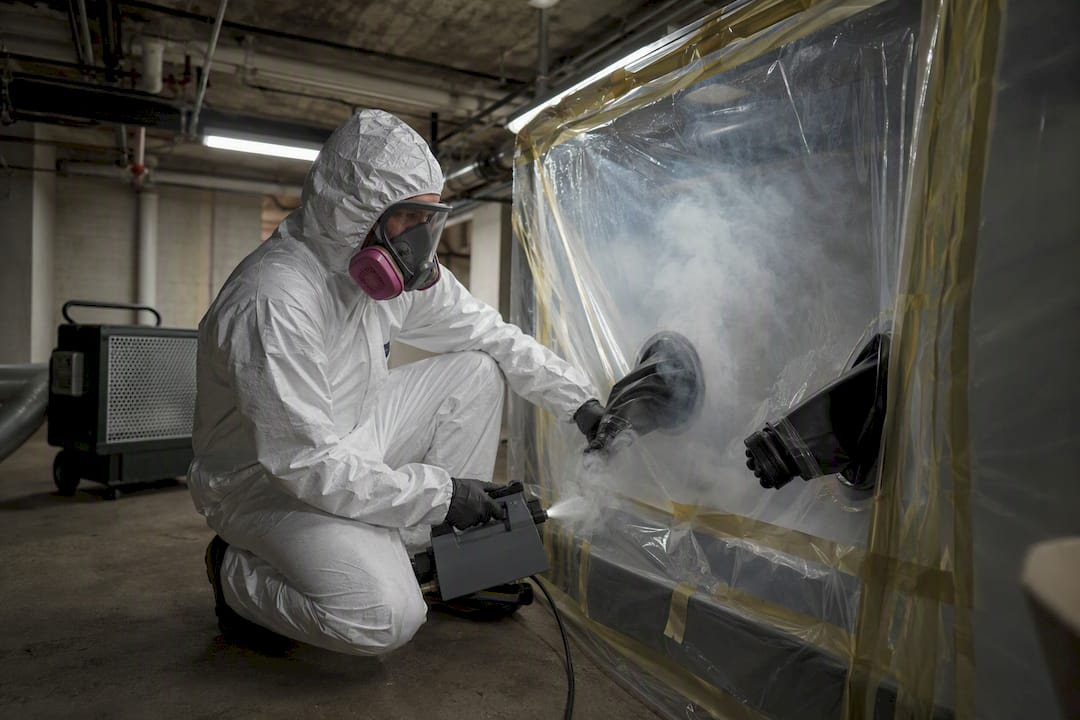
Pro Tip: Run the smoke test twice, once right after installation and again after you’ve moved around inside the bag a bit. Sleeves shift, seals stretch, and a leak that wasn’t there at minute one can open up at minute ten.
What’s the step-by-step glove-bag removal procedure?
Following the sequence in order is what keeps fibres inside the bag instead of in the room.
- Inspect and wrap if needed. If the insulation is friable or already crumbling, wrap it in poly sheeting (a candy-stripe wrap) before installing the glove bag, and set up secondary containment underneath if there’s any risk of drop-through.
- Install the bag. Fit the collar around the pipe or component, seal the seams with duct tape, and staple the top closure where the bag design calls for it.
- Smoke-test before disturbing anything. Use a smoke tube and aspirator bulb to check every seam and seal. Repair leaks immediately. Do not cut into the material until the bag holds smoke cleanly.
- Wet the material. Apply surfactant generously through the built-in port before cutting or removing anything, following the manufacturer’s mixing ratio closely, since a weak mix undercuts fibre suppression.
- Remove and encapsulate. Use HEPA vacuum fittings to control dust as material comes free, let it settle to the bottom of the bag, then apply encapsulant to any exposed pipe or duct surface still inside the bag.
- Evacuate and seal. Run the HEPA vacuum to pull the air out of the bag before untaping or removing it. A trap or moisture accumulator is worth adding to the vacuum line, since surfactant residue can foul the vacuum otherwise.
- Double-bag, label, and decon. Waste goes into labelled asbestos disposal bags, workers go through the full decontamination sequence, and the work area gets HEPA-vacuumed and wiped down.
- Air sample where required. Clearance sampling closes out the job and gives you paperwork if anyone asks later.
Where do glove bags actually fail?
Glove bags have a documented exposure profile, and it’s not zero. A CDC/NIOSH-referenced evaluation of glove-bag abatement found average airborne asbestos concentrations during removal, with a majority of short-term breathing zone samples exceeding a threshold of 0.2 fibers per cubic centimetre. That’s not a trivial number for a method often treated as inherently low-risk.
Most failures trace back to a handful of causes:
- Punctures or seam splits that go unnoticed because the smoke test got skipped or rushed
- Serial reuse of bags down a long pipe run without ever stepping up to backup containment
- Under-mixed wetting agent that fails to suppress dust during cutting
- Vacuum lines fouled by surfactant with no trap installed, cutting suction right when it’s needed most
Smoke testing every install, staging backup poly containment underneath friable material, and refusing to push a glove-bag job past its scope are the mitigations that actually show up in the exposure data. If a run is long or the material is heavily deteriorated, escalating to full containment without certification isn’t overcaution. It’s what the numbers argue for.
What should you look for in a professional-grade glove bag?
Not all glove bags on the market meet the specification a regulator would actually accept. At minimum, look for 6 mil polyethylene construction with a seamless bottom, since seams are where leaks start.
- A fitted collar sized to the pipe or component, with fibre-tight entry ports at the sleeves
- Clear, unclouded material so workers can see what they’re cutting and vacuuming
- A built-in tool pouch to keep cutters and vacuum attachments inside the sealed volume
- HEPA vacuum compatibility and ports sized for standard attachments
- Compatibility with your chosen surfactant and encapsulant products
Treat every bag as single-use. Reusing a bag that’s already held asbestos waste, even briefly, defeats the point of sealed containment, and disposal bags need the correct asbestos warning labelling before they leave the site.
What does MSN Environmental bring to this work?
MSN Environmental’s technicians train specifically on procedures like this: sealing, smoke testing, HEPA evacuation, and documented cleanup, not generic renovation cleanup. That’s the standard a compliance-focused crew works to on every job, big or small.
Some red flags mean it’s time to call a certified contractor instead of reaching for a glove bag: heavily deteriorated or crumbling insulation, work spanning multiple rooms or several days, no clear plan for regulated waste disposal, or a scope that will require air clearance testing before occupants can return. Any one of those pushes a job past what a glove bag was designed to handle.
Where glove bags fit and where the advice gets it wrong
The conventional treatment of glove bags online swings between two extremes: either they’re pitched as a simple DIY fix, or dismissed entirely as too risky for anyone outside a certified crew. Neither holds up against the actual evidence. The CDC-referenced exposure data shows real fibre release even under correct procedure, which argues against treating glove bags as a casual weekend task. But the same regulatory bodies that publish that data still permit the method for small, contained jobs, which argues against blanket avoidance too.
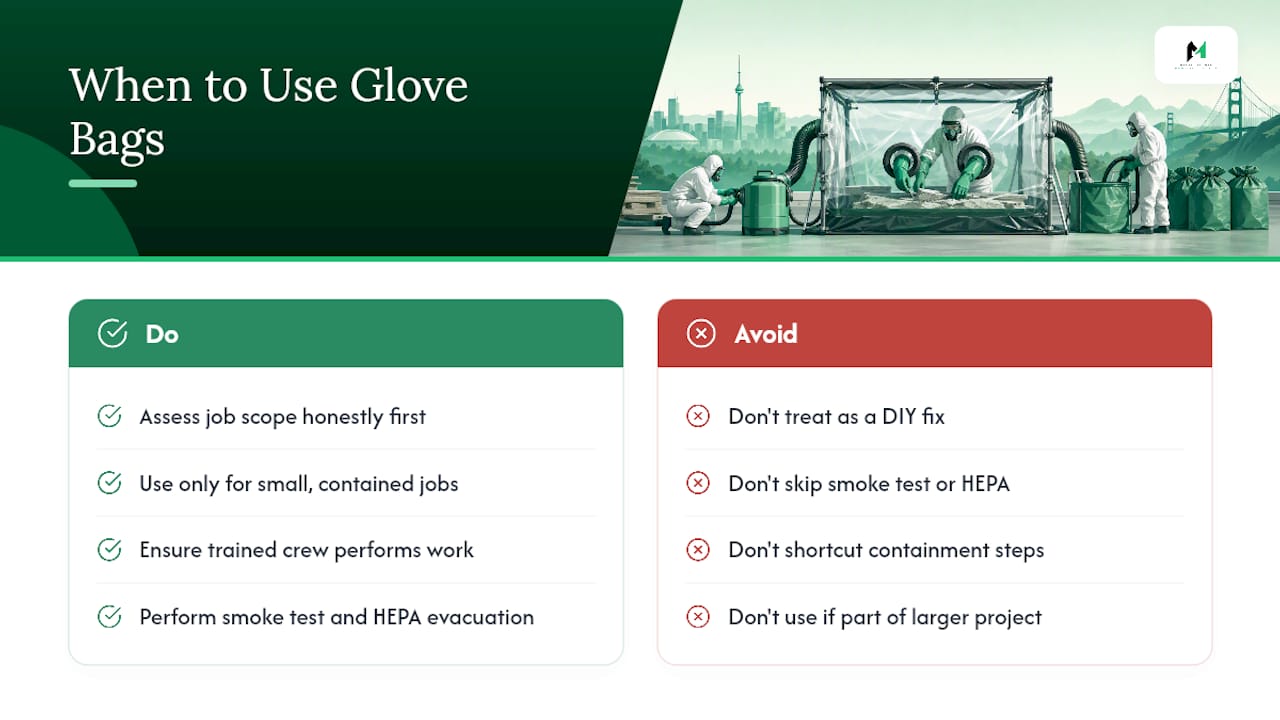
What the research actually supports is narrower and more useful: glove bags work when the scope is small, the crew is trained, and every step gets followed without shortcuts, especially the smoke test and the HEPA evacuation before takedown. Skip either of those and you’re not doing a smaller version of proper containment. You’re doing an uncontrolled removal with extra plastic around it.
The priority for anyone weighing this decision is scope assessment before technique. Decide honestly whether the job is truly small and isolated, or whether it’s the first section of something bigger. That single judgment call, made honestly before the tape comes out, matters more than any step in the procedure itself.
— Moacyr
Get a professional glove-bag or full containment assessment
Reading the procedure is one thing. Standing next to deteriorated pipe insulation deciding whether your job actually qualifies for a glove bag is another. MSN Environmental handles both ends of that decision: proper glove-bag work on small, isolated sections when it’s genuinely appropriate, and full negative-pressure containment and removal when the scope calls for it instead.
Every project starts with an inspection and a competent person assigned to the work, not a guess. That means documented air sampling before and after removal, regulated waste disposal with a proper manifest trail, and a clearance report you can hand to an insurer, buyer, or tenant without hesitation. If you’re weighing a demolition project against straightforward abatement, our breakdown of interior demolition versus abatement is worth a read before you commit either way.
If there’s any doubt about whether your pipe section, valve repair, or renovation area qualifies for glove-bag treatment, book an asbestos inspection with MSN Environmental before touching the material. It’s the fastest way to know exactly what you’re dealing with, and what it will take to remove it safely.
Sources
- Evaluation of glove bag containment and asbestos abatement clearance: methodologies for asbestos removal
- Canada Occupational Health and Safety Regulations (SOR/86-304) — Section 10.26.5
- Negative pressure glovebag usage in asbestos removal — OSHA standard interpretation
- Glove bag procedures — UAB Environmental Health and Safety
FAQ
Is an N95 mask enough for asbestos work?
No. A common particulate filter respirator isn’t rated for asbestos fibres; regulations and standard procedures call for a fit-tested respirator with HEPA filtration for any glove-bag or abatement work.
Can asbestos be washed off your hands?
Asbestos fibres don’t chemically bond to skin, so washing removes surface contamination, but the real risk is inhalation, not skin contact, which is why decontamination procedures focus on removing coveralls and washing before fibres get tracked elsewhere.
What kind of bags should asbestos waste go into?
Asbestos waste needs to go into labelled, leak-tight polyethylene disposal bags, typically double-bagged, separate from the glove bag itself, which is used for containment during removal rather than final waste storage.
How long does asbestos dust stay airborne?
Fine asbestos fibres can stay suspended in air for hours because of their light weight and shape, which is exactly why HEPA vacuum evacuation before opening a glove bag, and clearance air sampling afterward, are standard steps rather than optional extras.