

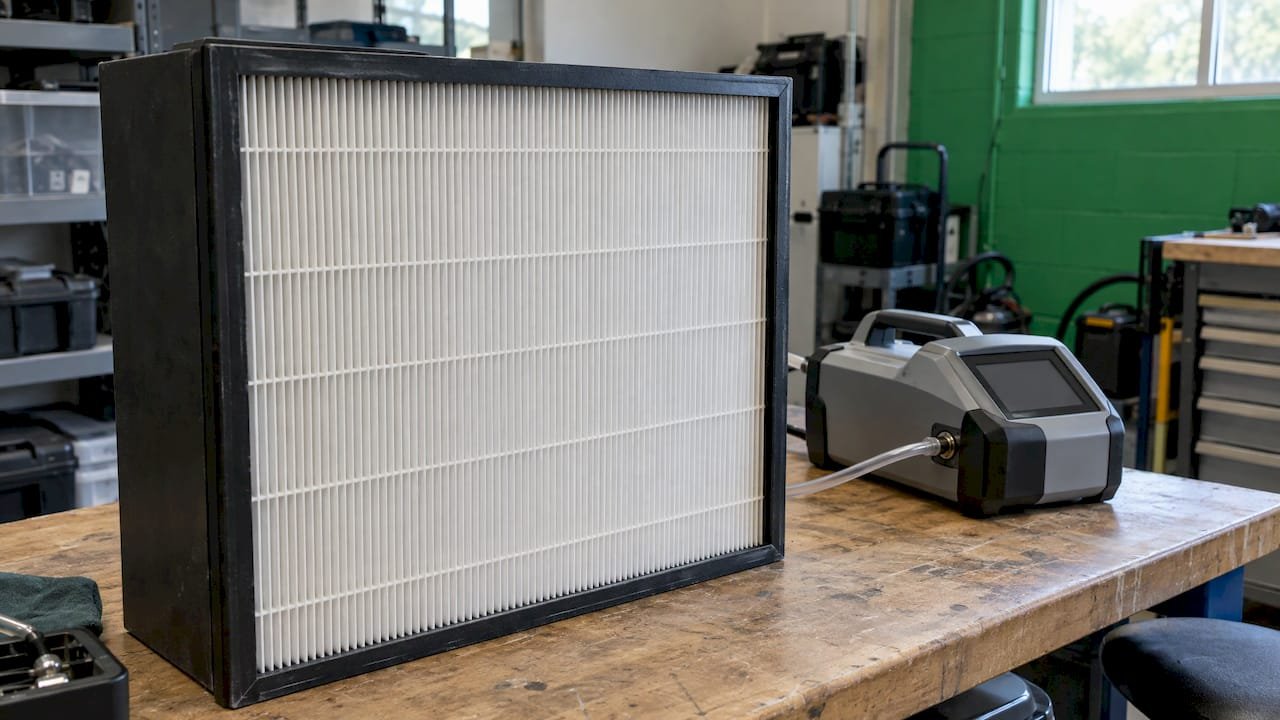
A HEPA rating is a efficiency claim at a specific particle size, measured by a specific test. “True HEPA” means at least 99.97% capture at 0.3 microns. H13 and H14 come from a European system that grades at the hardest particle size to catch and sets slightly different numbers. On an asbestos or mould job in Canada, the rating on the box is only the starting point: what protects your building is a certified filter that has been leak-tested, sealed properly and documented. That is the work we do on every abatement project, and this guide shows you how to read the ratings so you understand what that equipment is for.
TL;DR
- “True HEPA” (DOE/IEST style) means at least 99.97% efficiency on 0.3 micron particles. Canadian asbestos guidance uses that same figure as its minimum.
- EN 1822 grades HEPA as H13 (at least 99.95%) and H14 (at least 99.995%), measured at the most penetrating particle size, not a fixed 0.3 microns.
- The three systems are not interchangeable, and MERV ratings are a different scale that does not reach HEPA.
- A rated filter only works if it is leak-tested. Canadian guidance calls for testing at least yearly, and more often for equipment moved between hazardous-material jobs.
- On a regulated job, the filter rating, the test record and the containment all matter together.
Table of Contents
- What a HEPA rating actually measures
- The three rating systems you will see in Canada
- HEPA H13 vs H14
- A rating is not performance: why leak testing matters
- What Canadian asbestos work expects from HEPA equipment
- Reading ratings for a home air purifier
- What this means for your project
- Our perspective
- Hazardous materials work, done to Ontario standards
- FAQ
- Sources
What a HEPA rating actually measures
HEPA stands for high-efficiency particulate air. The US Environmental Protection Agency describes a HEPA filter as a pleated mechanical filter that can theoretically remove at least 99.97% of dust, pollen, mould, bacteria and other airborne particles at 0.3 microns. A micron is one millionth of a metre; a human hair is roughly 50 to 70 microns wide.
Why 0.3 microns? It is the most penetrating particle size, usually shortened to MPPS. Very large particles hit the fibres and stick. Very small ones wander around randomly and also get caught. Particles in the middle are the hardest to stop, so the filter is graded on its worst case. The EPA notes that larger and smaller particles are trapped at even higher efficiency.
The classic North American test uses a uniform 0.3 micron test aerosol, historically dioctyl phthalate (DOP), with a photometer measuring how much light-scattering aerosol gets through. The EPA’s air pollution control fact sheet describes this method and notes that the manufacturer tests each filter before shipping. The CDC’s infection-control guidance uses the same 99.97% at 0.3 microns figure.
Two practical points follow for an owner:
- 99.97% means that for every 10,000 particles of the hardest size, about three get through a perfect filter.
- That figure describes the filter medium and its factory test. It says nothing about whether the filter is seated correctly in the machine.
The three rating systems you will see in Canada
Shopping for a purifier, reading a contractor’s quote or reading a hospital specification, you will meet different labels. They look similar and are not the same.
| System | Where it comes from | What it promises |
|---|---|---|
| True HEPA | US DOE and IEST practice | At least 99.97% at 0.3 microns |
| EN 1822 (H13, H14) | European standard | H13: at least 99.95% at MPPS. H14: at least 99.995% at MPPS |
| ISO 29463 | International standard derived from EN 1822 | Classes from 85% up to 99.999995%, graded at MPPS |
| MERV | Ventilation industry scale | Measures capture across 0.3 to 10 microns, and does not extend to HEPA |
The IEST (Institute of Environmental Sciences and Technology) recommended practice IEST-RP-CC001 covers HEPA and ULPA units for cleanrooms and similar systems and describes 11 levels of filter performance. ISO 29463-1:2024 classifies filters from 85% to 99.999995% using particle counting at the MPPS, which is typically 0.12 to 0.25 microns for glass-fibre media. In that system the HEPA classes are ISO 35 H (at least 99.95%) and ISO 45 H (at least 99.995%).
The EPA itself points out that MERV ratings report capture of particles from 0.3 to 10 microns. A MERV 13 furnace filter is a good filter for a forced-air system. It is not a HEPA filter, and it should never be used as a stand-in on a regulated abatement project.
HEPA H13 vs H14
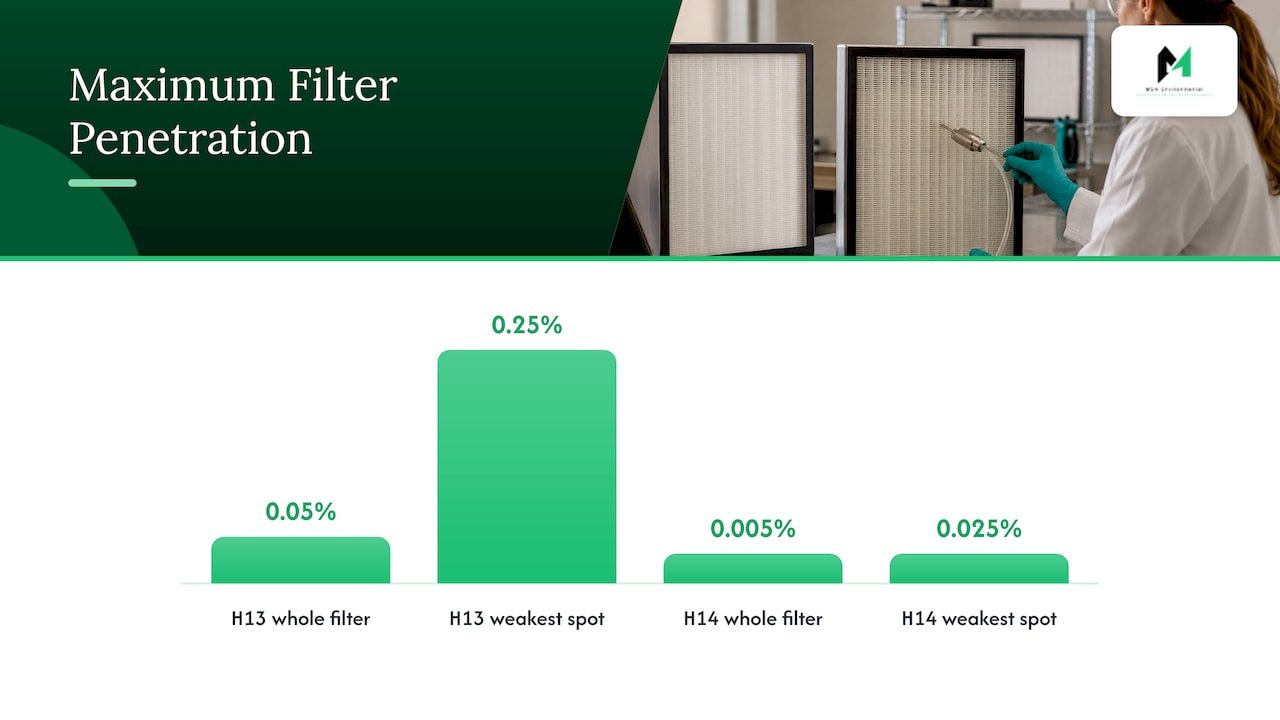
Under EN 1822-1:2019, each HEPA class has two numbers: an integral efficiency for the whole filter and a local efficiency for the weakest spot on its face.
| Class | Integral efficiency (MPPS) | Maximum penetration | Local efficiency | Maximum local penetration |
|---|---|---|---|---|
| H13 | at least 99.95% | 0.05% | at least 99.75% | 0.25% |
| H14 | at least 99.995% | 0.005% | at least 99.975% | 0.025% |
The step from H13 to H14 cuts the allowed leakage through the whole filter by a factor of ten. The EN standard also requires Group H filters to be tested individually, and the results must come with the filter in a test certificate or report.
How does this compare with True HEPA? An H13 filter’s 99.95% is measured at the worst-case particle size, so it is a stricter test than 99.97% at a fixed 0.3 microns would suggest at first glance. The numbers cannot be lined up one to one, because the methods differ. That is the reason the ISO standard moved to MPPS counting: it is sensitive enough to test the highest-grade filters and grades every filter at its own worst case.
In practice, H13 is the common grade for quality room purifiers and general clean-air equipment. H14 is specified where the stakes are higher, such as operating rooms and cleanrooms. For a typical Ontario home or building, the more useful question is not H13 or H14 but whether the equipment meets the requirement written into the job.
A rating is not performance: why leak testing matters
A filter that is 99.97% efficient on the test bench can still let contaminated air past if the gasket is damaged, the frame is loose or the unit has been dropped. That is why every serious standard pairs the rating with in-place testing.
The NIH’s technical bulletin on HEPA filtration (July 2022), written for cleanrooms, gives a clear picture of what rigorous testing looks like:
- the filter is challenged with an aerosol such as PAO (polyalphaolefin) and scanned with a probe;
- an individual leak must not exceed 0.01% of the upstream challenge;
- airflow has to be verified first, because higher face velocity lets more particles pass;
- the scan has to be slow enough for the probe to detect a leak.
That bulletin covers laboratories and cleanrooms, not abatement sites, but the logic carries over: the number on the label is earned in a test, and it has to be re-earned in the field.
In the CDC’s guidance, in-line disposable prefilters can extend HEPA filter life by approximately 25%. That is why prefilters are routine on equipment used around heavy dust.
What Canadian asbestos work expects from HEPA equipment
Canada has no single national code for this. Provinces and territories write their own rules, and industry associations publish guidance that contractors follow. The sources below are worth knowing because they show how consistent the expectations are, and they are cited here as examples from their own jurisdictions. For Ontario requirements on your project, our Ontario asbestos regulations roadmap is the place to start.
The filter standard. WorkSafeBC’s Safe Work Practices for Handling Asbestos defines a HEPA filter as one at least 99.97% efficient at collecting a 0.3 micrometre aerosol particle, and states that HEPA filters used for asbestos applications must meet that figure. The Environmental Abatement Council of Canada (EACC) guideline on performance leak testing (June 2021) uses the same definition, expects filters to be pre-certified and labelled by the manufacturer, and states that filters are certified to the IEST standard for Canadian hazardous-materials abatement work.
The testing schedule. Under the same WorkSafeBC document, employers assess HEPA filters in vacuums and negative-air systems with an indicator chemical (DOP or PAO) at least annually, after a filter is replaced, if the unit is dropped or damaged, and before use in a high-risk activity. Test details, including the model and serial number, the testing agency, the date and the results, are posted on the equipment.
The EACC guideline is broadly similar. It recommends leak testing at least every 12 months, after maintenance that affects the filter or seal, after impact, for each project where exhaust is vented indoors or near HVAC intakes, and every 3 months for transient equipment used on hazardous-material jobs such as asbestos or lead.
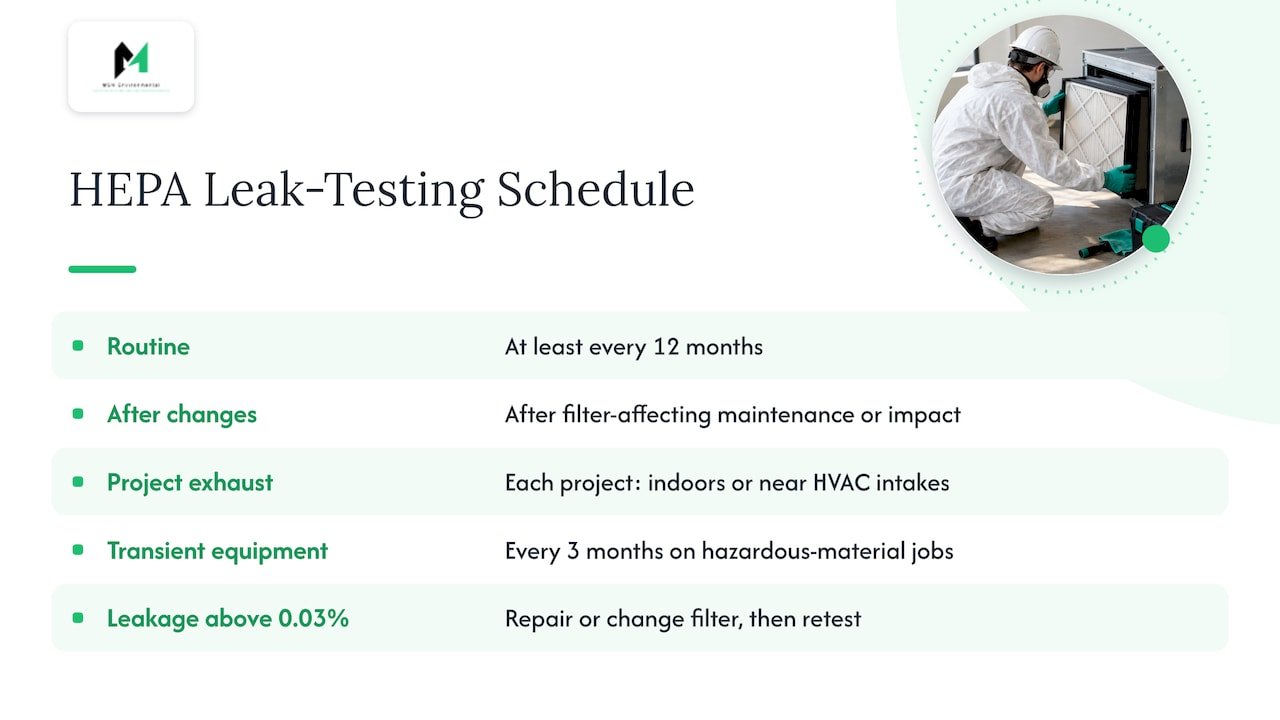
The leak threshold. The Northwest Territories and Nunavut Asbestos Abatement Code of Practice requires HEPA-filtered equipment to be repaired or have its filter changed, and then retested, when photometer readings show leakage above 0.03%.
Put together, these documents describe one idea: 99.97% is the floor for the filter, and a dated test record on the machine is the evidence that the filter is doing its job.
Where the HEPA units sit on your job
On an asbestos or mould project, HEPA filtration works in two places. HEPA vacuums clean surfaces and tools. Negative air machines pull air out of the work area through HEPA filters so that the enclosure stays at lower pressure than the rooms around it, and air leaks inward rather than outward. If you manage tenants, our page on proving negative air containment at minus 2.5 Pa explains how that pressure difference is read. The step-by-step asbestos removal process shows where the machines fit in the sequence, and our Type 3 asbestos abatement guide covers the higher-risk work where containment matters most.
HEPA filtration does not stand alone. Air sampling during and after the work is how a project shows that fibres are not escaping and that the area is clean. Our practical guide to asbestos air sampling explains what that sampling involves.
Reading ratings for a home air purifier
Homeowners often ask the same question for ordinary living spaces: is a HEPA purifier worth having? For everyday dust, pollen and smoke, a purifier with a True HEPA or H13 filter is a sound choice, and the ratings above are what to compare. If you are weighing purifiers against other approaches to indoor air, this look at HEPA purifiers versus plants for home and office lays out the comparison.
There is one boundary worth stating plainly. A room purifier cleans the air that passes through it. It does not remove asbestos-containing material from walls, insulation or flooring, and it does not remove the moisture source or the growth behind a mouldy wall. Once material is disturbed or the source is in the structure, the job is containment and removal under the applicable rules, and the HEPA equipment on that job is a tool inside a controlled process.
What this means for your project
- Homeowners with asbestos or mould. You are not expected to judge H13 against H14. You are hiring a team to run containment, negative air and HEPA vacuums at the standard the job requires, with the filters tested and documented. Start with testing so the scope is written down: see when Canadians must test before asbestos removal.
- Property managers. Your concern is tenant safety and a paper trail. Test records on equipment, pressure readings and clearance air sampling make up that trail.
- Renovators and construction managers. The practical risk is starting demolition before materials are identified. The 0.5% asbestos rule for older Ontario homes and a pre-renovation survey settle that question early, and our interior demolition versus abatement explainer shows where one job ends and the other begins.
- Business owners with mould. Containment and HEPA filtration are part of safe remediation, along with fixing the moisture source.
Our perspective
We read HEPA ratings the way a technician reads them, not the way a catalogue does. The number tells you what a filter can do. It does not tell you what happened to it after it left the factory.
On our projects the filter is one part of a system: trained technicians, equipment kept in good working order, containment built to suit the material, and work done to Ontario regulations and industry standards. When a negative air machine or HEPA vacuum is doing its job, you never notice it. That is the point.
The mistake we see people make in conversation is treating “HEPA” as a product feature that makes any job safe. It is a requirement inside a procedure. The same 99.97% filter is a protection in a sealed enclosure and a false comfort in an open room where drywall is being torn out.
That is why we handle asbestos, mould, lead paint, UFFI and other hazardous materials as projects with a scope, testing and oversight, for homes and commercial buildings alike. Our technicians are certified, we carry full liability insurance, and we tailor each job to the building in front of us.
Moacyr
Hazardous materials work, done to Ontario standards
If you have found or suspect asbestos or mould in your home or building, MSN Environmental provides asbestos removal, mould remediation and environmental testing, including air sampling and designated substance surveys, for residential, commercial and industrial properties across southwestern and central Ontario. Our work follows Ontario regulations and industry standards, with certified technicians and full liability insurance.
Tell us what you have found and where, and we will help you work out the right scope from our main site.
FAQ
Is HEPA H13 better than True HEPA?
They are measured differently, so the comparison is not one to one. True HEPA is at least 99.97% at 0.3 microns. H13 is at least 99.95% at the most penetrating particle size, which is a worst-case test. H14 goes further, at least 99.995%. For asbestos work in Canada, the guidance cited above sets 99.97% at 0.3 microns as the minimum.
What is the efficiency of a HEPA filter?
A True HEPA filter captures at least 99.97% of particles at 0.3 microns, according to the US EPA. Particles larger or smaller than that are caught at even higher efficiency. EN 1822 filters are graded from 99.95% (H13) to 99.995% (H14) at their most penetrating particle size.
Does a HEPA filter need to be tested after it is installed?
Yes, for regulated hazardous-material work. The guidance above calls for leak testing with an indicator aerosol at least annually, after a filter change, after damage and before high-risk work. It also calls for results to be recorded on the equipment. The NIH bulletin describes the same idea for cleanrooms: a rating has to be confirmed in place.
Can a HEPA vacuum or purifier remove asbestos from my home?
No. A HEPA vacuum or purifier captures airborne particles and dust that pass through it. Asbestos-containing materials in walls, ceilings, insulation or flooring need to be identified by testing and handled under the applicable rules. Disturbing them yourself can release fibres, so the next step is testing and a written scope.
Sources
- What is a HEPA filter? | US EPA
- Air Pollution Control Technology Fact Sheet | US EPA
- Air | Infection Control | CDC
- IEST-RP-CC001: HEPA and ULPA Filters
- ISO 29463-1:2024
- EN 1822-1:2019
- NIH technical bulletin: HEPA Air Filtration in Cleanrooms, July 2022
- Safe Work Practices for Handling Asbestos (WorkSafeBC)
- EACC Performance Leak Testing Guideline for HEPA Filtered Equipment, June 2021
- Asbestos Abatement Code of Practice, NT and NU
- HEPA purifiers versus plants for home and office