

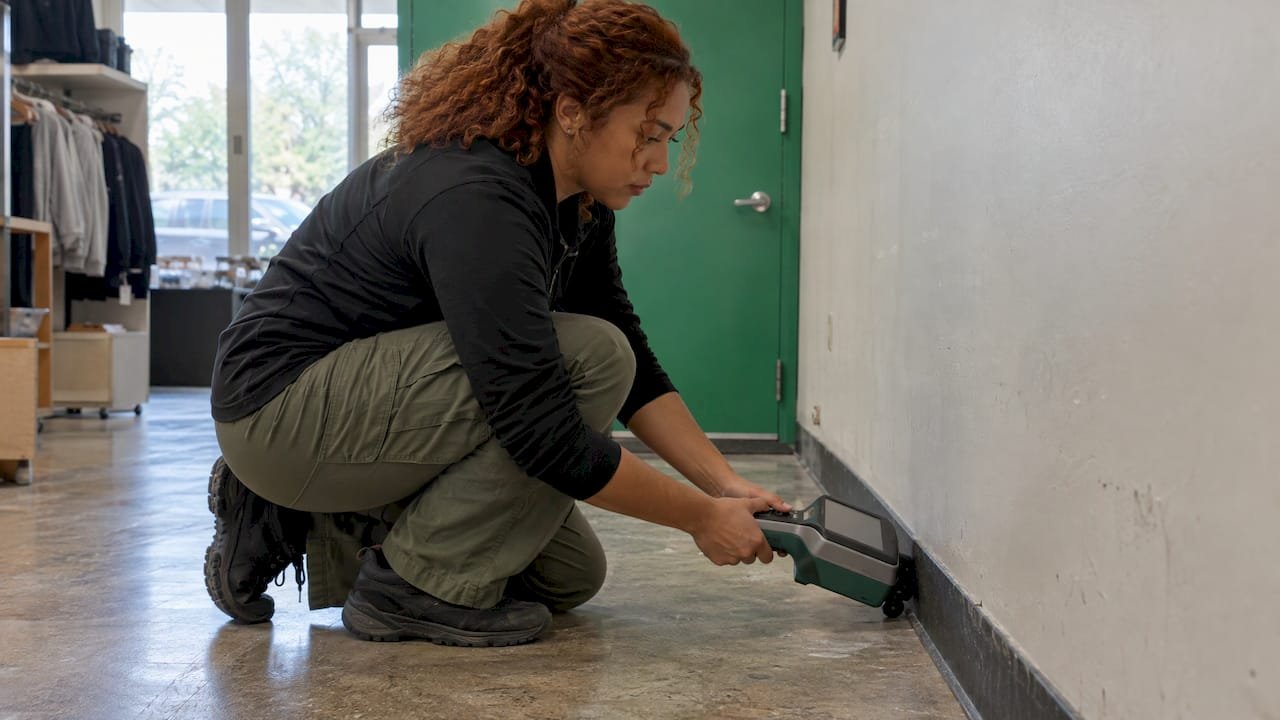
Mercury vapour testing measures how much mercury is in the air of a room. It uses a field-portable detector to find the source and map the affected area, or air samples sent to a certified laboratory to judge exposure. Both should be done by qualified professionals. You test after a spill, a broken device or an old industrial use turns up in a building. You also test to confirm that a cleanup actually worked.
This guide explains when testing makes sense, which methods exist, how to read the numbers when Canada has no single federal air standard, and what happens after a high reading.
TL;DR
- Mercury vapour is the form of mercury that is easiest to inhale. It can affect the nerves, kidneys and lungs, so a suspected spill is worth taking seriously.
- Two methods are used: portable detectors to find sources and track cleanup progress, and air samples analysed by a certified lab to assess exposure and clearance.
- Canada has no specific federal air sampling standard for mercury. Results are usually compared with available exposure limits or guidelines, with the local health authority involved.
- Testing is rarely the first step. Remove the source, ventilate and filter the air, and call a professional for anything beyond a small, contained spill.
- In southern Ontario, our mercury abatement team handles assessment, removal and post-cleanup checks.
Table of Contents
- Why mercury vapour matters indoors
- Where indoor mercury comes from
- When you should test
- How mercury vapour is tested
- How to read the results
- What to do if levels are high
- Choosing who does the testing
- Our perspective
- Mercury testing and removal with MSN Environmental
- FAQ
- Sources
Why mercury vapour matters indoors
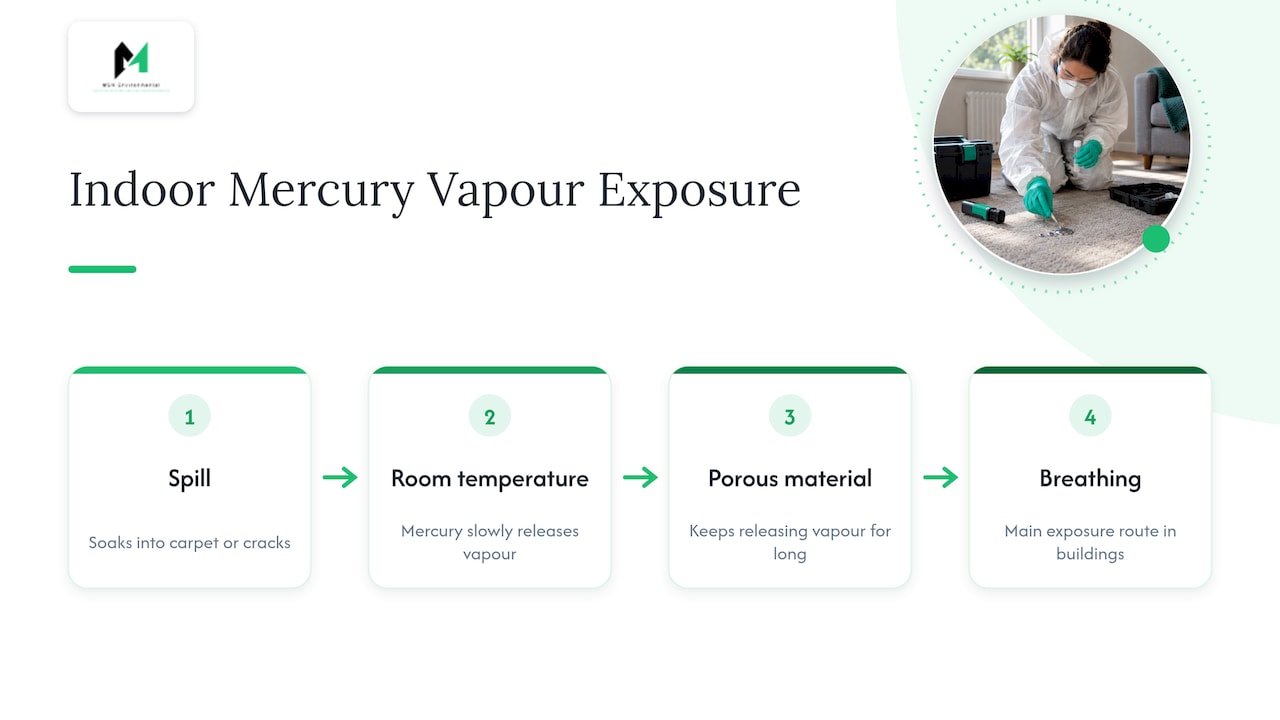
Liquid mercury does not need to be hot to become a gas. At room temperature it slowly releases vapour, and a spill that has soaked into carpet, floor cracks or porous material keeps releasing it for a long time. Breathing that vapour is the main route of exposure in buildings.
The health effects are well documented. The US EPA says inhaled metallic mercury vapour can cause tremors, mood and neuromuscular changes, insomnia, headaches and poorer performance on mental function tests, and that higher exposures may cause kidney effects, respiratory failure and death. Health Canada likewise reports that inhaled mercury vapour can affect the respiratory, cardiovascular, kidney and nervous systems. Mercury is also listed as a toxic substance under the Canadian Environmental Protection Act, 1999, according to the same Health Canada page.
If anyone in the space has symptoms like these after a known spill, speak to a physician or your local public health unit. Mercury in urine is a common way to assess long-term exposure to elemental mercury, and your doctor decides whether that test is needed.
Where indoor mercury comes from
Most homeowners meet mercury in one of a few ways:
- A broken thermometer, thermostat or barometer. Older mercury thermostats and glass thermometers are still found in older Ontario homes. Our guide to the first ten minutes after a broken mercury thermometer covers what to do before anyone calls for testing.
- Switches, gauges and equipment in older commercial and industrial buildings. Boilers, manometers, meters and lab equipment can contain liquid mercury that spills during renovation or demolition.
- Broken fluorescent lamps. These contain small amounts. Canada’s Products Containing Mercury Regulations prohibit the manufacture and import of most mercury-containing products, with limited exemptions for essential products such as some fluorescent lamps. A single lamp is a different problem from a pooled spill.
- Mercury brought into a home by a previous occupant. Elemental mercury has been used in some cultural and religious practices, and a published review of those cases is one reason public health units treat unexplained contamination seriously. If you find beads of mercury or a bottle of it that you did not put there, treat it as a spill.
Because mercury was so widely used before the restrictions, a pre-renovation or pre-demolition survey of an older building often turns up mercury items alongside asbestos, lead paint and other designated substances. That is the cheapest moment to find them.
When you should test
Health Canada does not generally recommend air sampling as a first step for indoor air problems. Its guidance for indoor air quality professionals notes that source reduction, ventilation and filtration are usually effective whatever the airborne concentration. Applied to mercury, the sensible order is: find and remove the source, then measure to confirm.
Testing does make sense in these situations:
- A spill larger than a thermometer. Anything involving a thermostat’s worth of mercury or more, mercury that has soaked into carpet or flooring, or mercury that has been tracked through a house.
- You cannot find all of it. Beads that rolled under baseboards, into floor cracks or down a drain mean you cannot judge by eye whether the room is clear.
- Vulnerable occupants. Children, pregnant people and anyone with kidney or neurological conditions raise the stakes.
- Clearance after cleanup. Before people move back into a space, a measurement shows whether the work succeeded.
- Before renovation or demolition. A survey of the building, including a walkthrough and inspection, tells you whether air sampling is needed at all. Health Canada’s draft guidance for building professionals says assessments should draw on walkthroughs, inspections and operational reviews to decide if sampling is warranted.
- Workplaces and tenanted properties. Employers and landlords have duties to keep people safe, and a documented result protects everyone involved.
How mercury vapour is tested
There are two main approaches, and they answer different questions.
Portable mercury vapour detectors
For this approach, a technician walks the space with a field-portable analyzer that reads airborne mercury in near real time. The New York State Department of Health explains that these instruments are mainly used to identify sources, delineate contaminated areas and evaluate cleanup progress.
That makes them the right tool for the first visit. A reading that jumps near a baseboard, a heating register or a cabinet points to where mercury is hiding. Readings also let a crew work room by room, and see whether each step lowers the number.
Air samples analysed in a certified laboratory
The second approach collects air on a sampling medium for a set period and sends it to a certified lab. The same New York guidance recommends laboratory analysis where ongoing human exposure is a concern, such as clearance after a cleanup. Health Canada says testing should follow established methods, such as those published by NIOSH or the US EPA, and be carried out by qualified professionals.
Why one reading is not enough
Mercury vapour levels move. The Connecticut Department of Public Health notes that indoor concentrations depend on room temperature, volume, ventilation, source surface area and how recently the mercury was disturbed. It also advises that because air currents affect readings, multiple samples or longer sampling periods are preferred to catch spikes.
In practice this means the person testing should record conditions, such as whether windows were open, the heating was on and the room was recently disturbed. A quick reading on a cold, ventilated afternoon can under-report a problem that appears on a warm evening.
Comparing the two methods
| Portable detector | Laboratory air sample | |
|---|---|---|
| Main purpose | Find sources, map affected areas, track cleanup | Assess exposure and confirm clearance |
| Result | Immediate, on site | After lab analysis |
| Best used | At the start and during cleanup | After cleanup, or where occupants are exposed over time |
| Limitation | Snapshot of conditions at that moment | Slower, reflects the sampling period |
Most real jobs use both: the detector to hunt and guide the cleanup, the lab sample to document the finish.
How to read the results
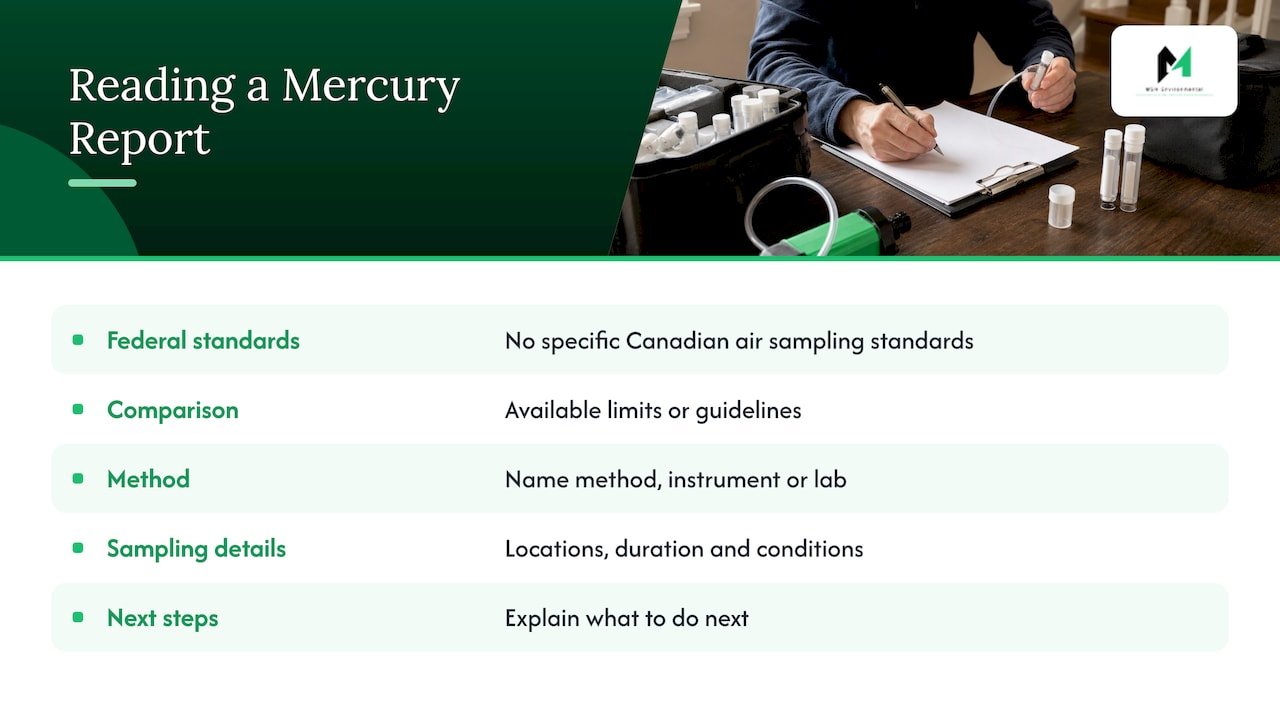
This is the part that surprises people. According to Health Canada’s guidance, there are no specific Canadian federal air sampling standards for mercury. Professionals therefore compare results with available exposure limits or guidelines, in consultation with local health authorities, and consider the space and who occupies it.
That is why a result should never arrive as a bare number. A useful report names the method, the instrument or lab, the sampling locations and duration, the conditions on the day, the guideline it was compared with and why that guideline fits. It should also say what you should do next.
Also keep in mind that guideline values are not all the same kind of number. Connecticut’s mercury values, for example, are recommendations for guiding responses, not enforceable cleanup limits. Workplace limits are written for healthy adults at work, and a home with children is a different situation. A professional should explain which benchmark they used and ask the local public health unit when the case is borderline.
What to do if levels are high
Health Canada’s guidance says indoor air can often be improved by removing or reducing the source, ventilating with filtered outdoor air and filtering indoor air, and that chemical spills may need qualified professionals. For mercury, that translates into practical steps:
- Keep people out of the affected room. Close the door and keep children and pets away. Do not walk through the area in shoes that will carry beads elsewhere.
- Do not vacuum or sweep. Both spread droplets and put more vapour in the air. Do not pour mercury down a drain.
- Ventilate to the outside if you can do so without drawing air through the rest of the house.
- Call a professional for anything beyond one small, contained spill on a hard surface.
- Test again after cleanup. A clearance result is your record that the space is fit to reoccupy.
- Dispose of it properly. Mercury waste is not regular garbage. Your municipality’s household hazardous waste program or the abatement contractor will handle it. If your project involves wider waste management and permitting, resources on waste disposal and permitting support can help you understand the approvals around larger developments.
Choosing who does the testing
Mercury work rewards experience. Look for a contractor who:
- Uses calibrated, field-portable detectors and certified labs, and can tell you which methods they follow.
- Starts with a walkthrough, rather than jumping straight to sampling.
- Provides a written scope and a written report that you can show an insurer, a buyer, a tenant or an inspector.
- Carries liability insurance and can handle the removal and disposal too, so one team owns the result from the first reading to the clearance reading.
Our article on why to hire certified hazardous material removal professionals goes into more detail on what that credential buys you.
Our perspective
The most common mistake we see is treating a mercury spill as a measuring problem. People want a number first. The number matters, but the order of work matters more: identify the source, contain it, remove it, then measure to prove it.
A detector in the hands of someone who knows where mercury hides is the fastest way to find it. Beads travel into baseboard gaps, floor seams and vent runs, and in older buildings we often find mercury items we were not called about. That is why we like to fold mercury into a wider survey of designated substances, so nothing is discovered halfway through a renovation.
We design our work so you end up with a clear record: what was found, what was removed, and what the air looked like afterward. Whether you manage a rental building, run a workplace or own an older house, that record is what lets you move forward with confidence.
Moacyr
Mercury testing and removal with MSN Environmental
We provide mercury abatement, environmental testing and pre-renovation or demolition surveys for homes, commercial buildings and industrial sites across southern Ontario, including Kitchener-Waterloo, Cambridge, Guelph, Hamilton, London and the surrounding area. Our work follows Ontario regulations and industry standards, and our technicians work under full liability insurance.

If you have had a spill, found mercury in an older building or are planning a renovation, talk to us about mercury abatement or start with our testing and inspection services. You can also reach us through our main site to describe your situation.
FAQ
How do you test for mercury in a house?
A qualified professional walks the space with a portable mercury vapour detector to find the source and affected areas. They may also collect air samples for analysis in a certified laboratory. Health Canada’s guidance says this work should be done by qualified professionals using recognised methods.
Can you smell mercury vapour?
No. Mercury vapour gives no useful warning, so you cannot judge a room by smell or by looking at it. That is why instruments are used, and why a suspected spill should be treated as real until measured.
Is there a Canadian standard for mercury in indoor air?
Health Canada’s guidance says there are no specific federal air sampling standards for mercury. Professionals usually compare results with available exposure limits or guidelines and consult the local health authority. The report should state which benchmark was used.
Do I need air testing after a broken thermometer?
Not always. Health Canada does not generally recommend air sampling as a first step, because removing the source and ventilating is usually effective. A spill that soaked into carpet or cannot be fully recovered, or one involving children, justifies a professional visit and a clearance check.
Who handles mercury testing and cleanup in Ontario?
An environmental abatement contractor can assess, remove and dispose of the mercury and test again afterward. For a small spill, your local public health unit or municipal household hazardous waste program can advise on disposal.
Sources
- Health Effects of Exposures to Mercury, US EPA
- Mercury in Canadians, Health Canada
- Guidance for indoor air quality professionals, Health Canada
- Draft guidance on improving indoor air quality in office buildings, Health Canada
- Measuring Mercury in Air, New York State Department of Health
- Mercury Vapor Action Levels and Guidance for Indoor Spills, Connecticut Department of Public Health