

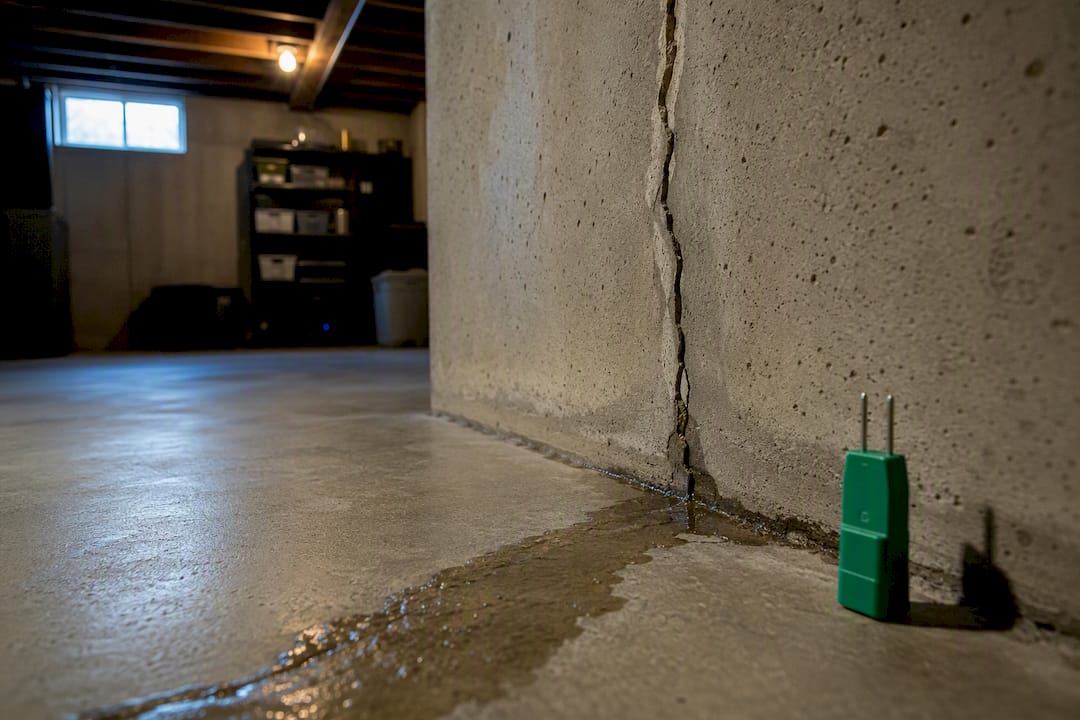
Mould in a Hamilton basement is a moisture problem before it’s a cleaning problem, and treating it as anything else wastes money. A dry patch of surface mould on tile or concrete, smaller than about one square metre, is usually safe for a homeowner to clean up. Anything recurring, larger, tied to flooding or sewage, or hitting a household with health concerns needs a certified remediation contractor and, often, a look at Hamilton’s flood-prevention grant programs.
TL;DR:
- Cleaning small, non-porous mould patches under one square metre is safe for homeowners with proper gloves, respirator, and detergent, but larger or recurring issues require professional help.
- Moisture problems in Hamilton basements are caused by groundwater seepage, sewer surcharges, and condensation, which must be addressed before mould remediation.
- Using a dehumidifier and proper drainage modifications, such as grading and extending downspouts, effectively reduce basement moisture levels if maintained properly.
- Professionals should be brought in if mould covers more than one square metre, persists after cleaning, spreads into porous materials, or affects vulnerable household members.
- Post-remediation verification requires visual clearance, moisture readings, and time to ensure mould does not reappear during wet seasons.
Table of Contents
- How to identify mould in a Hamilton basement and document what you find
- What causes basement moisture in Hamilton homes?
- Practical moisture-control steps that actually work
- When should you hire a professional mould remediation company?
- What can mould testing actually tell you?
- What can you safely handle yourself in a small area?
- Health risks and who’s most at risk
- Long-term prevention built for Hamilton’s climate
- Common DIY mistakes that make basement mould worse
- How to verify a mould remediation contractor’s credentials
- How do you confirm mould is actually gone after remediation?
- A local perspective on basement mould in Hamilton
- How MSN Environmental supports Hamilton homeowners through mould assessment and removal
- Sources
- FAQ
How to identify mould in a Hamilton basement and document what you find
Mould rarely announces itself cleanly. It shows up as dark or greenish stains, a white powdery bloom called efflorescence on concrete, paint that bubbles or peels, or wood that’s gone soft and warped along the bottom edge. A musty smell that gets stronger after rain, or after the furnace kicks on, often means growth is active somewhere you can’t see. Health Canada’s guidance on moisture and mould points out that mould frequently hides behind stored boxes, inside wall assemblies, or under carpet where nobody looks until the smell forces the issue.
Before you touch anything or call an assessor, build a paper trail:
- Photograph every affected area with a date stamp, including close-ups and wide shots that show location.
- Note when the odour is strongest and whether it correlates with rain, snowmelt, or the furnace running.
- Track humidity readings from a basic hygrometer over a week if you can, not just once.
- Write down any recent plumbing events, sump pump failures, or storms.
That timeline matters more than people expect. It helps an assessor tell the difference between a one-off leak and a recurring groundwater or condensation problem, which changes the entire remediation plan. Health Canada’s own escalation guidance is specific: bring in an Environmental Health Officer or a professional once mould covers more than roughly one square metre, keeps coming back after cleaning, or coincides with respiratory symptoms in the household.
What causes basement moisture in Hamilton homes?
Hamilton’s basements fight water on five fronts, and most homes deal with more than one at once. Groundwater pushes through hairline foundation cracks during wet springs, especially in older neighbourhoods built on clay soils that drain poorly. Foundation cracks widen over decades as the concrete settles, giving water a permanent entry point that gets worse every freeze-thaw cycle.
Sewer surcharge is the one homeowners underestimate most. During heavy storms, Hamilton’s combined sewer system in older parts of the city can back up under pressure, forcing wastewater up through basement drains rather than away from the house. The City of Hamilton’s basement flooding guidance names sewer surcharge, blocked sewer laterals, groundwater intrusion, and faulty sump pumps as the four most common flooding pathways in the city, alongside surface water pooling against foundations.
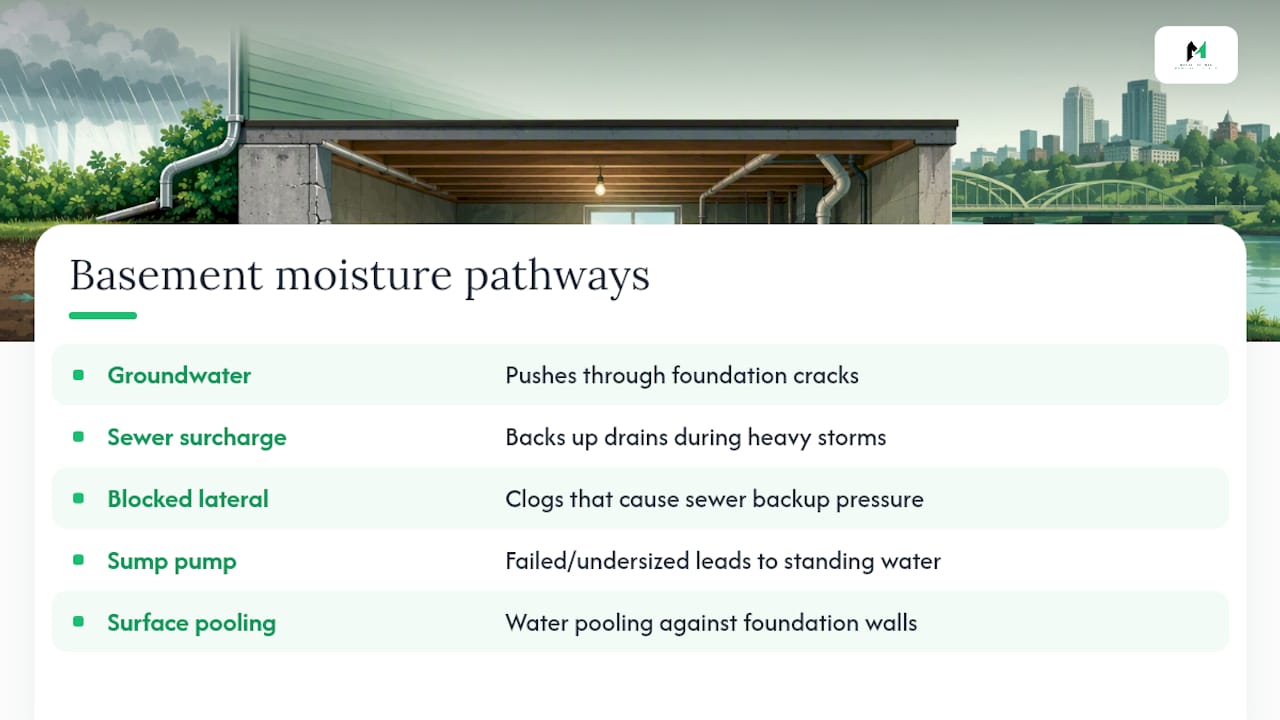
A failed or undersized sump pump turns a manageable seepage problem into standing water within hours. And condensation, the quiet source, forms when warm humid air meets a cold foundation wall or an uninsulated cold-water pipe, year-round, with no storm required at all.
Practical moisture-control steps that actually work
Health Canada recommends keeping indoor relative humidity between 30% and 55%, and a basement often needs its own dehumidifier to hit that range, since central air rarely reaches the lowest level effectively. A continuous drain hose on the dehumidifier saves you from forgetting to empty a tank, which is how good intentions turn into a flooded reservoir by August.
Here’s the part that surprises most homeowners: opening basement windows in summer to “air it out” often backfires. Natural Resources Canada warns that warm, humid outdoor air condenses on cool basement surfaces, adding moisture rather than removing it. Ventilation helps in winter when outdoor air is drier than indoor air; in a humid Hamilton July, it works against you.
Pro Tip: Check your dehumidifier’s humidistat setting against an independent hygrometer once a season. Built-in sensors drift, and a unit reading “45%” when the room is actually at 60% gives you false confidence.
Grading soil away from the foundation, extending downspouts at least two metres from the house, and keeping window wells clear all reduce the water reaching your walls in the first place. For sump systems, pair the pump with a backwater valve so surcharged sewer water can’t push back through the drain when the pump is working hardest. The Protective Plumbing Program offers grants up to $2,000, plus loans, toward exactly this kind of work.
When should you hire a professional mould remediation company?
Health Canada’s threshold is a useful gut check: bring in professionals when mould covers a large area, keeps returning after you’ve cleaned it, follows sewage backup or major flooding, has spread into porous materials like drywall or carpet, has gotten into HVAC ductwork, or when someone in the home has asthma, an immune condition, or is very young or elderly. Any one of those on its own is reason enough.
A competent scope of work from a contractor should never arrive as a verbal quote scrawled on a business card. Ask for a written scope that separates the moisture diagnosis from the mould removal, because fixing one without the other is how homeowners end up paying twice. That scope should specify containment procedures (poly sheeting, negative air pressure where the area warrants it), the technicians’ qualifications and insurance coverage, and a plan for verifying the space is dry before anything gets rebuilt.
References matter here more than a polished website. Ask for two or three past Hamilton jobs you can call about, not just a testimonial page. A contractor confident in their work will hand these over without hesitation.
MSN Environmental’s Hamilton mould remediation service follows this structure: assessment first, then containment and removal, then documented drying verification before a job is closed out. That order isn’t a formality. Skipping the moisture diagnosis is the single most common reason mould comes back within a year of a cleanup.
What can mould testing actually tell you?
Testing splits into two types, and homeowners often expect more certainty from both than either delivers. Surface sampling (tape lifts or swabs) identifies what species of mould is growing on a specific spot, useful for confirming a visible patch is actually mould and not a stain. Air sampling measures spore concentration in the room’s air at the moment of testing, a snapshot rather than a trend.
Here’s the limitation that catches people off guard: Health Canada does not set a universal indoor mould exposure limit, because different building materials host different mould species and people react differently to the same exposure. A lab report that says “1,200 spores per cubic metre” tells you almost nothing without context, no regulatory line to compare it against, no “safe” number to celebrate clearing.
That means testing is a diagnostic tool, not a verdict. A spore count paired with a visual inspection and a moisture reading tells a coherent story. A spore count alone, without someone checking where the water is actually coming from, is a number in search of meaning. If a company sells you air sampling as the whole service, ask what they’re doing about the moisture source, because that’s the part that determines whether the mould stays gone.
What can you safely handle yourself in a small area?
A patch smaller than roughly one square metre, on a hard non-porous surface like tile, concrete, or metal, sits within DIY territory for most healthy adults. Wear rubber gloves and an N95 respirator, keep the room ventilated to the outside if possible, and use a stiff brush with plain detergent and water rather than reaching for anything harsher.
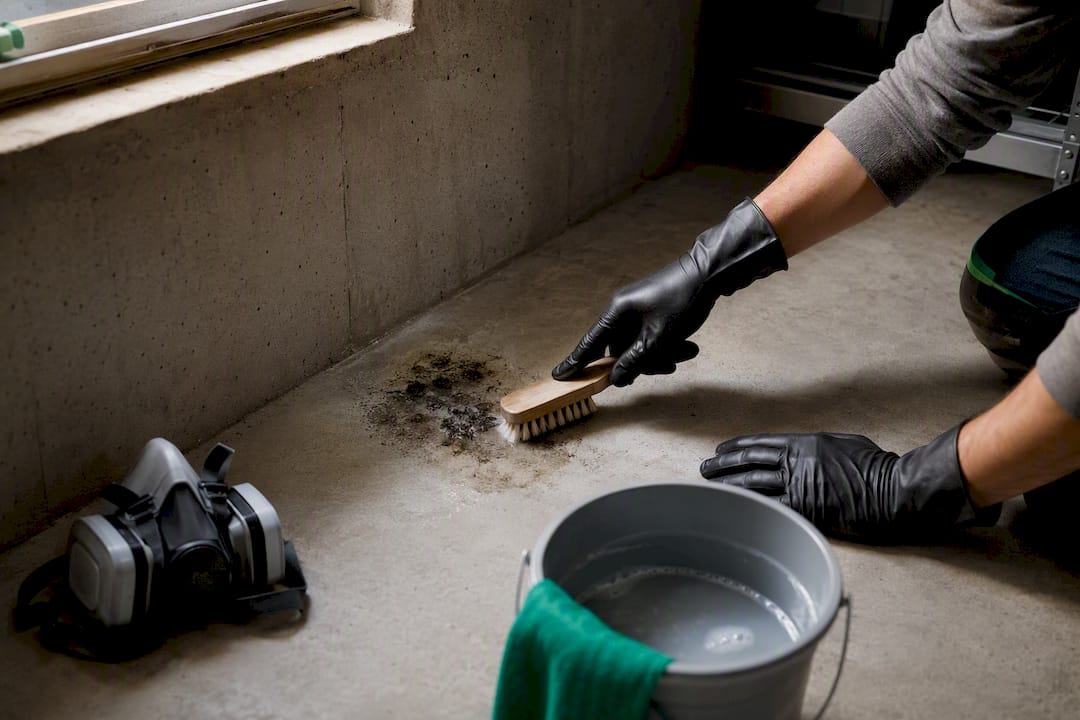
Household bleach is popular advice online and it’s not the right tool here: it can bleach the colour out of a stain without actually stopping the growth underneath, particularly on porous material where the roots sit below the surface bleach can reach. Health Canada’s own household guidance points toward removing and correcting moisture rather than relying on chemical treatment as the fix.
Discard anything porous and wet, cardboard boxes, damp insulation, water-stained drywall, rather than trying to save it. And don’t push salvaged belongings back against a cold foundation wall once the area is dry; that gap between wall and stored items is what lets air circulate and keeps condensation from forming again behind the boxes. If the patch reappears within a few weeks despite cleaning, that’s your signal the moisture source, not the mould itself, needs professional attention.
Health risks and who’s most at risk
Basement mould exposure most commonly triggers respiratory symptoms: coughing, throat irritation, wheezing, and worsened asthma. Some people develop skin irritation or allergic reactions after handling contaminated materials directly.
Children, older adults, and anyone with asthma, allergies, or a compromised immune system face a higher risk from the same exposure level that a healthy adult might barely notice. That’s exactly why Health Canada’s remediation guidance flags “vulnerable occupants” as a standalone reason to call in professionals rather than DIY, independent of how much square footage is affected. A household with a newborn and a small mould patch behind the water heater is a different risk calculation than a single adult with the same patch.
Basements amplify this because they’re often the least ventilated, least visited room in the house, which means a moisture problem can run for months before anyone notices the smell. By the time a musty odour is obvious on the main floor, growth in the basement has usually had time to spread.
Long-term prevention built for Hamilton’s climate
Hamilton’s mix of older housing stock, clay-heavy soils, and a combined sewer system in the lower city means prevention has to work on two fronts at once: keeping groundwater and surface water out, and making sure sewer backup can’t push its way in during a storm.
A backwater valve installed on the main drain line stops sewage from surcharging back into your basement when the municipal system is overloaded, which is a genuinely different failure mode than a leaky foundation. Pairing that valve with a sump pump, and disconnecting downspouts so roof runoff doesn’t overload the storm system, covers the three interventions the Protective Plumbing Program grant is actually built around. Homes with older clay-tile weeping systems around the foundation should have them inspected; collapsed or root-clogged weeping tile is a slow, invisible source of chronic basement dampness.
Seasonally, that means running a dehumidifier through Hamilton’s humid summers rather than opening windows, sealing new foundation cracks as soon as they appear rather than waiting for a wet spring to reveal them, and checking the sump pump and battery backup every fall before the first freeze. None of this is glamorous work, but it’s the difference between a basement that stays dry for a decade and one that needs remediation every few years.
Common DIY mistakes that make basement mould worse
The most common mistake is bleaching a stain and calling the job done without ever finding out why the wall got wet in the first place. Health Canada’s own framing is direct: correcting moisture is the actual fix, and cleaning without it is a temporary cosmetic patch that mould treats as an invitation to return.
A second mistake is painting over a mould patch with a sealant-style paint. It hides the stain, sometimes for months, while the growth continues underneath and works its way further into the drywall or framing. A third is running a dehumidifier without ever emptying or maintaining it, so it quietly stops working while the humidity readout still looks fine on the unit’s own gauge.
Homeowners also tend to under-protect themselves during small cleanups, skipping the respirator because the patch “isn’t that big,” which matters more than it sounds like it should when you’re disturbing spores at close range in a low-ventilation space. And a surprising number of people store boxes right back against a foundation wall the moment it looks dry, recreating the exact condensation trap that caused the problem originally.
How to verify a mould remediation contractor’s credentials
Ask three things before signing anything: proof of liability insurance, references from completed Hamilton-area jobs, and a written scope that separates diagnosis from removal. A contractor who can’t produce insurance documentation on request is not one to hire, full stop, regardless of price.
Ask specifically about containment procedures for the job size you have. A single basement corner needs different containment than a whole finished basement with HVAC involvement, and a contractor who quotes the same approach for both hasn’t actually assessed your situation. Ask how they document drying before rebuild, because that’s the step that separates a real remediation from a quick clean-and-paint job.
MSN Environmental’s Hamilton service page lays out this kind of scope structure directly, and it’s worth using as a benchmark even if you’re comparing quotes from several companies. A good contractor won’t flinch at being asked to explain their containment plan or show past work; a company that gets vague or defensive about those questions is telling you something.
How do you confirm mould is actually gone after remediation?
Visual clearance is the first check: the treated area should show no visible mould growth and no lingering musty odour once containment comes down. That’s necessary but not sufficient on its own.
Moisture readings on the repaired surfaces should return to normal, dry baseline levels before any drywall, insulation, or flooring goes back in. A contractor who rebuilds a wall the same day materials look dry to the touch, without an actual moisture meter reading, is skipping the step that determines whether the job holds. Post-work documentation, photos of the cleared area, moisture readings, and a written summary of what was found and fixed, protects you if the issue resurfaces and you need to show what was actually done, including for insurance purposes.
The real test is time. A properly remediated basement, with the moisture source actually corrected rather than just the visible mould removed, shouldn’t show new growth through the next wet season. If it does, the original diagnosis missed something, and that’s worth raising with whoever did the work.
A local perspective on basement mould in Hamilton
Hamilton homeowners get sold on cleaning products when the real fight is against a combined sewer system and clay soil that don’t care how much bleach you buy. Small, dry, non-porous patches are genuinely fine to handle yourself. But once flooding, sewage, or recurrence enters the picture, the honest move is calling a certified team and pairing that work with the Protective Plumbing Program rather than treating the two as separate problems.
— Moacyr
How MSN Environmental supports Hamilton homeowners through mould assessment and removal
A professional mould remediation company offers a written moisture diagnosis before anyone touches containment or removal, as an alternative to guessing your way through a basement mould problem. That order matters, because a cleanup that skips the diagnosis is the most common reason Hamilton homeowners end up paying for the same job twice within a year.

A proper engagement starts with an assessment matched to what you’re actually dealing with, whether that’s a suspicious stain behind the water heater or a basement that flooded last spring. From there, air and bulk sampling confirm what’s growing and where, insured and certified technicians handle containment and removal, and the job closes with documented drying verification rather than a handshake and an invoice. That written scope, and the insurance and reference checks that go with it, are exactly what a competent contractor should offer without you having to ask twice.
If your basement has recurring mould, followed a flood or sewer backup, or affects a household member with asthma or a weaker immune system, request an assessment through MSN Environmental’s mould remediation page and get a written plan before deciding your next step.
This article is general information, not a substitute for advice from a qualified doctor. Consult a qualified healthcare professional about your own circumstances before acting on anything here.
Sources
- Addressing moisture and mould in your home — Health Canada
- Moisture and your home — Natural Resources Canada
- Basement flooding preparedness — City of Hamilton
FAQ
Is mould in a Hamilton basement dangerous to live with?
Small, dry patches on hard surfaces pose limited risk to healthy adults, but ongoing exposure can trigger coughing, wheezing, and worsened asthma, especially in children and older adults. Recurring or widespread growth, or any growth tied to sewage backup, warrants professional evaluation rather than continued exposure.
Can I remove basement mould myself, or do I need a professional?
You can safely clean patches smaller than about one square metre on non-porous surfaces like tile or concrete using detergent, gloves, and an N95 respirator. Larger areas, recurring mould, growth following flooding or sewage, or cases involving vulnerable household members call for a certified remediation company instead.
Does the City of Hamilton offer help for basement flooding prevention?
Yes. The Protective Plumbing Program offers grants, plus loans, for backwater valves, sump pumps, and downspout disconnection, subject to eligibility and using pre-qualified contractors.
How much does MSN Environmental charge for mould testing or removal?
Pricing for mould remediation and testing services is available directly through MSN Environmental rather than published as a flat rate, since scope varies by basement size and moisture source. You can request current pricing through the testing and assessment page or the main mould remediation page.
Can air sampling alone tell me if my basement mould problem is fixed?
No. Air sampling gives a spore count at one moment, but Health Canada sets no universal exposure limit, so a number alone can’t confirm a problem is resolved. Clearance depends on visual inspection, moisture readings returning to a dry baseline, and confirming the water source has actually been corrected.