

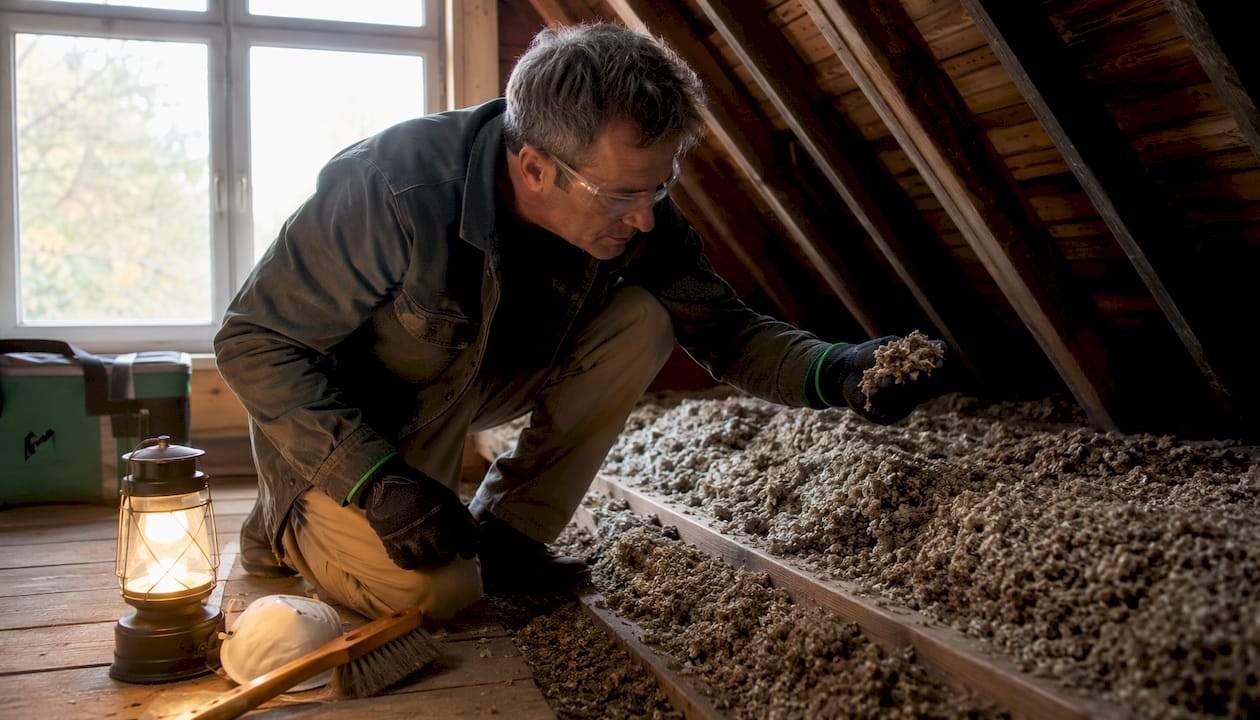
Do not disturb vermiculite insulation. Treat it as asbestos-containing until a qualified inspector says otherwise, and stop all attic access immediately.
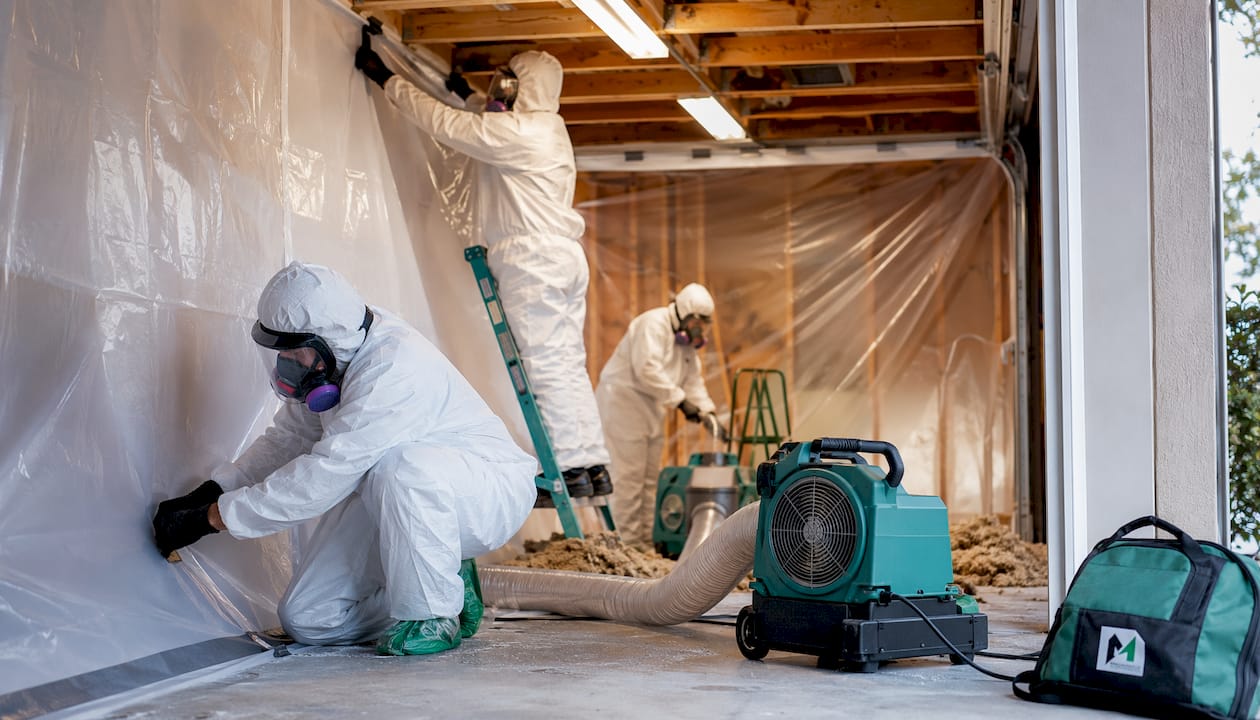
That is the single most important thing Health Canada and the CCOHS agree on. If you have loose, pebble-like insulation in your attic and your home was built or insulated before 1990, the precautionary principle applies: assume it may be contaminated and act accordingly.
Your immediate checklist:
- Stop using the attic for storage or access
- Post a visible warning at the attic hatch
- Seal the hatch with tape if possible
- Do not vacuum or sweep any loose material
- Contact a certified occupational hygienist or asbestos inspector for professional sampling
- Do not start any renovation, rewiring, or HVAC work until sampling results are in hand
The EPA recommends the same precautionary approach, and MSN Environmental’s certified abatement teams follow these protocols on every residential project.
Table of Contents
- What is vermiculite insulation and why does the Libby/Zonolite history matter?
- How asbestos in vermiculite can affect your health
- Does your vermiculite actually contain asbestos?
- Should you remove it, or leave it alone?
- How does professional sampling and testing work?
- What professional vermiculite removal actually looks like
- Can you stay in your home during removal?
- How much does vermiculite removal cost in Canada?
- How to choose a certified asbestos abatement contractor
- What happens after removal: clearance testing and documentation
- When to call MSN Environmental for vermiculite abatement
- Key takeaways
- Why testing and containment beat DIY removal every time
- MSN Environmental: certified vermiculite abatement across Ontario
- Key sources and where to get help
What is vermiculite insulation and why does the Libby/Zonolite history matter?
Vermiculite is a naturally occurring mineral that expands dramatically when heated, producing a lightweight, fire-resistant, pebble-like material. As attic insulation, it looks like small grey-brown or silver-gold flakes, roughly the size of a pea or smaller, poured loosely between joists. It does not look like fibreglass batts or blown cellulose. If you see a loose, shiny, granular fill in your attic, that is what you are dealing with.
The contamination problem traces directly to a single mine near Libby, Montana. That mine was a major supplier of worldwide vermiculite production during much of the 20th century, and the deposit happened to sit alongside a natural asbestos vein. The result: virtually all vermiculite from Libby was contaminated with tremolite asbestos fibres. In North America, Libby vermiculite was sold primarily under the brand name Zonolite, and it ended up in hundreds of thousands of Canadian homes as attic insulation.
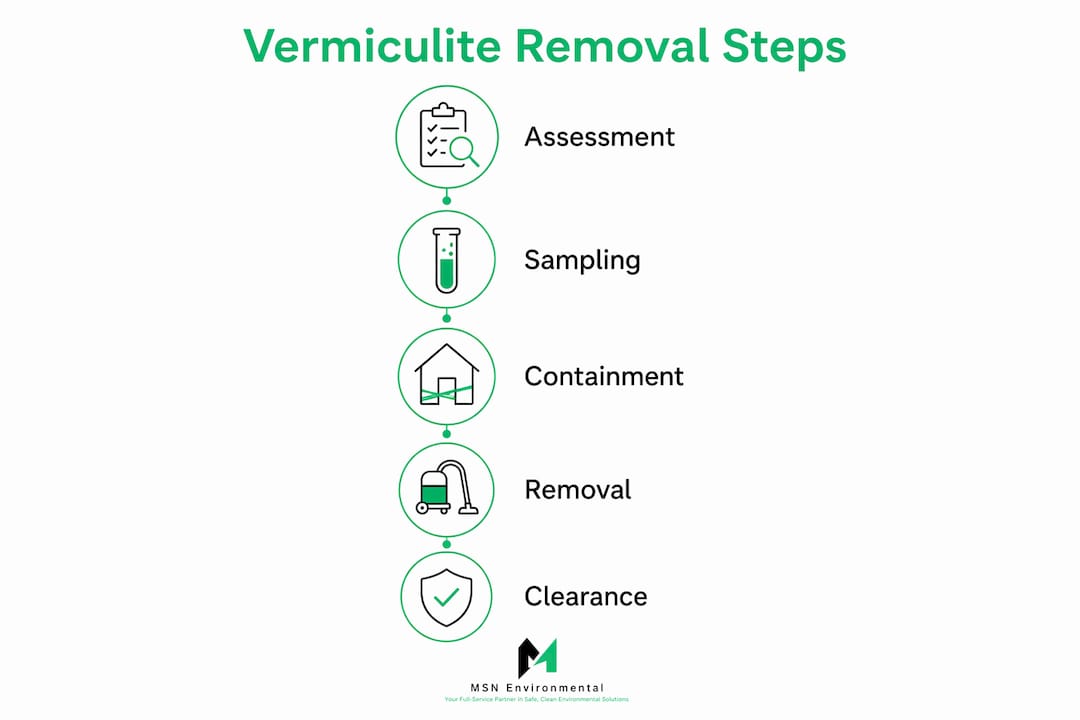
The mine closed in 1990. That date is your threshold. Any home insulated before 1990 with loose-fill vermiculite has a meaningful probability of containing Libby-sourced material, regardless of what the original packaging said.
Pro Tip: If your home was built or insulated before 1990 and you find loose granular fill in the attic, treat it as suspect vermiculite until a certified inspector tests it. Do not rely on colour alone — Libby vermiculite ranged from silver-gold to grey-brown and is not visually distinguishable from safer sources.
How asbestos in vermiculite can affect your health
Asbestos fibres are hazardous when airborne and inhaled. There is no known safe level of asbestos exposure, and that statement comes directly from the U.S. EPA’s guidance on vermiculite insulation dangers.
The primary health outcomes from asbestos inhalation are asbestosis (scarring of lung tissue), lung cancer, and mesothelioma, a rare and aggressive cancer of the lining around the lungs and abdomen. What makes asbestos particularly insidious is its latency: diseases may not appear until decades after exposure, which means a homeowner who regularly accessed a contaminated attic in the 1980s may only be seeing health consequences now.
How everyday actions create exposure:
- Climbing into the attic to retrieve stored items
- Running new electrical wiring or cable through the attic
- HVAC return ducts that pass through or draw air from a contaminated attic space
- Ceiling fans, pot lights, or cracks in the ceiling that allow fibres to sift into living areas
- Renovation work that opens walls or ceilings where vermiculite was used as cavity fill
Highest-risk groups: children (whose lungs are still developing), renovation workers, HVAC technicians, and anyone who spent significant time in a contaminated attic.
The risk is not theoretical. NIOSH documented serious health problems among construction workers exposed to Libby vermiculite, and concerns about residential exposure have persisted since the mine closed.
Does your vermiculite actually contain asbestos?
Assume it does. That is the precautionary position endorsed by Health Canada, and it is the right starting point for any Canadian homeowner with pre-1990 attic insulation.
Visual inspection tells you almost nothing useful. Tremolite asbestos fibres are microscopic. You cannot see them, and the vermiculite itself looks the same whether it is contaminated or not. A single “grab” sample from one corner of the attic can also give a false negative, because contamination is not evenly distributed throughout the material. One pocket may test clean while another, two metres away, contains fibres.
The Libby mine was a significant source of vermiculite sold in the U.S. during much of the 20th century (https://epa.illinois.gov/content/dam/soi/en/web/epa/documents/air-quality/asbestos/vermiculite-message-to-the-public.pdf), and Canada drew from the same North American supply chain. The odds are not in your favour if the insulation pre-dates 1990.
Pro Tip: Never disturb the material to collect a sample yourself. Hiring a certified occupational hygienist or asbestos inspector is the only way to get a representative, legally defensible result. A professional uses multiple sample locations, chain-of-custody documentation, and an accredited laboratory.
Should you remove it, or leave it alone?
Removal is not automatic. The CCOHS is explicit on this: the decision depends on location and disturbance risk, not simply on the presence of vermiculite.
If the material is sealed in an isolated attic with no HVAC penetrations, no cracks into living spaces, and no planned renovation, leaving it undisturbed is often the lower-risk option in the short term. Removal itself, if done improperly, can create a larger immediate hazard than the material sitting quietly in place.
Remove when:
- You are planning renovations that will disturb the insulation (adding a dormer, rewiring, installing pot lights)
- There is visible dust migration into living spaces through cracks, light fixtures, or ceiling fans
- HVAC return ducts run through or draw air from the contaminated attic
- The insulation has been visibly disturbed or damaged
- You are selling the property and disclosure requirements apply
Consider managing in place when:
- The attic is fully sealed with no access and no HVAC penetrations
- Insulation is behind intact walls or under sealed floorboards with no planned disturbance
- A professional risk assessment confirms low migration risk and encapsulation is feasible
Pro Tip: Do not start any renovation, rewiring, or attic storage project until a professional risk assessment and sampling are complete. A contractor who opens your attic ceiling before testing has already created the exposure you were trying to avoid.
How does professional sampling and testing work?
Have a qualified occupational hygienist or certified asbestos inspector perform representative sampling and send it to an accredited laboratory. That is the non-negotiable starting point before any decision about remediation.
A proper assessment is not a quick visit. The inspector will conduct a visual survey of the attic and any other areas where vermiculite may be present, then collect multiple bulk samples from different locations to reduce the risk of false negatives. Each sample goes into a sealed container with chain-of-custody documentation, and the laboratory analysis identifies fibre type and concentration. If removal is being planned, the inspector will also set up baseline air monitoring to document conditions before work begins.
MSN Environmental’s testing and inspection services cover bulk sampling, air quality monitoring, and designated substance surveys for exactly this scenario.
Questions to ask any inspector before hiring:
- What licences and certifications do you hold in this province?
- How many bulk samples will you collect, and from which locations?
- Which accredited laboratory will you use?
- Do you carry liability insurance and WSIB coverage?
- Will I receive a written report with photographed sample locations?
- What is the turnaround time for lab results?
Insist on written reports and photographs of every sample location. Keep these records permanently. They matter for real-estate disclosure, insurance claims, and any future application to the Zonolite Attic Insulation (ZAI) Trust, which provides partial reimbursement for Zonolite removal costs.
Pro Tip: Keep the attic sealed and undisturbed until you have both the sampling results and the inspector’s written report in hand. Do not let a contractor begin removal work based on a verbal assessment.
What professional vermiculite removal actually looks like
Certified contractors use containment, negative-pressure enclosures, HEPA filtration, full PPE, and staged decontamination. That is the industry standard, and anything less is not safe.
The EPA recommends using a negative-pressure enclosure technique specifically because it prevents fibres from escaping the attic into the rest of the house. DIY removal does the opposite: it spreads micro-particles through the home’s air and surfaces.
The professional removal sequence:
- Pre-job survey and sampling — confirm contamination, document baseline conditions, and establish the scope of work
- Site preparation — seal all HVAC penetrations, light fixtures, and ceiling openings; establish decontamination units and airlocks at attic access points
- Negative-pressure enclosure — industrial HEPA-filtered negative-pressure units create a pressure differential so air flows into the work zone, not out of it
- Controlled removal — bulk vermiculite is carefully removed and placed into sealed, labelled hazardous-waste bags; no dry sweeping
- HEPA vacuuming — all joists, cavities, and surfaces are HEPA-vacuumed to capture residual micro-particles; this step is often underestimated but is critical
- Waste packaging and manifest — all material is double-bagged, labelled, and transported under a hazardous-waste manifest to an approved disposal facility
- Final clearance air testing — an independent inspector collects post-abatement air samples before the enclosure is removed and the space is re-occupied
Asbestos-containing vermiculite is classified as hazardous waste under provincial regulations. Expect your contractor to provide disposal receipts and a signed waste manifest as part of the project documentation.
Containment approaches: what to expect
| Approach | Scope | Typical use | Key considerations |
|---|---|---|---|
| Full negative-pressure enclosure | Entire attic sealed; airlocks at entry | Standard for bulk vermiculite removal | Highest protection; required for significant contamination |
| Local containment | Targeted area sealed; negative pressure within zone | Small disturbed area or repair work | Lower cost; appropriate only for very limited scope |
| Encapsulation / sealing | No removal; material sealed in place | Isolated attic, no planned disturbance | Avoids immediate hazard; does not eliminate long-term risk if attic is later disturbed |
Can you stay in your home during removal?
Occupants are generally advised to vacate the immediate work area and, in most cases, the entire home while active abatement and final clearance testing are under way. Many experts and provincial advisories recommend leaving the property entirely during abatement.
Contractors protect the rest of the home by establishing controlled zones with physical barriers, sealing all HVAC penetrations to prevent fibre migration, maintaining continuous negative pressure so air flows toward the work area rather than away from it, and running continuous air monitoring throughout the job. Airlocks at the attic access point prevent cross-contamination when workers move in and out.
Occupant dos and don’ts:
- Do follow every instruction your contractor gives about when to leave and when it is safe to return
- Do arrange alternative accommodation for the duration of abatement and clearance testing
- Don’t enter the attic or touch any containment barriers during the project
- Don’t run the home’s HVAC system while abatement is active unless the contractor has specifically cleared it
- Don’t re-enter the work area until the contractor provides written clearance results
Pro Tip: Ask your contractor in writing what the re-occupancy criteria are before the job starts. “We think it looks clean” is not a clearance standard. You want a written air-clearance result from an accredited laboratory.
Typical timelines vary by attic size and contamination level. Expect inspection and sampling to take one to two days, lab results to take three to seven business days, and the abatement itself to run one to three days for an average residential attic. Final clearance results add another two to four business days.
How much does vermiculite removal cost in Canada?
Costs vary widely, and any quote you see without a site visit is a rough estimate at best. The main variables are attic size and accessibility, the extent of contamination, containment requirements, disposal distance, and whether re-insulation is included.
| Cost component | Typical range (CAD) | Notes |
|---|---|---|
| Inspection and bulk sampling | — | Varies by number of samples and travel |
| Laboratory analysis | — | Accredited lab; multi-sample plans cost more |
| Abatement (removal) | — | Attic size, access, and containment drive this figure |
| Hazardous waste disposal | — | Depends on volume and disposal site distance |
| Final clearance air testing | — | Independent inspector; separate from abatement contractor |
| Re-insulation | — | Optional but usually needed after removal |
These ranges reflect typical Canadian residential projects; your actual quote will depend on local labour rates, provincial disposal requirements, and site-specific conditions. The ZAI Trust provides partial reimbursement for confirmed Zonolite removal, so preserve all receipts, lab reports, and waste manifests from the start.
Pro Tip: Request itemised quotes that separate testing, removal, disposal, and re-insulation as distinct line items. A single lump-sum quote makes it impossible to compare contractors fairly or to apply for ZAI Trust reimbursement.
How to choose a certified asbestos abatement contractor
Hire licensed, insured, and certified asbestos abatement contractors with documented clearance testing and hazardous-waste manifests. Provincial regulations in Canada require certified workers, specific containment methods, and disposal documentation, and those requirements vary by province.
Contractor checklist
- Valid provincial asbestos abatement licence or certification
- Proof of worker training (asbestos abatement training programme, not just general construction)
- Liability insurance and current WSIB (or provincial equivalent) coverage
- References from completed residential asbestos projects
- Before-and-after photographs from previous jobs
- Written clearance report provided as a standard deliverable
- Accredited laboratory used for all sampling and clearance testing
- Hazardous-waste manifest and disposal receipts provided at project completion
Questions to ask before signing
- What containment method will you use, and why?
- Who performs the final clearance air testing, and are they independent of your abatement crew?
- Which accredited laboratory do you use?
- How do you handle waste disposal, and can I see a sample manifest?
- What is your warranty or remedial clause if clearance testing fails?
- What is the realistic timeline from start to final clearance?
A home inspection professional can also help you understand the scope of a pre-renovation assessment. The role of an inspector in safe housing is worth understanding before you engage any contractor.
Red flags to walk away from:
- Verbal-only quotes with no written scope of work
- Refusal to provide documentation, references, or lab accreditation details
- No chain-of-custody for samples
- No final clearance report offered as part of the service
- No hazardous-waste disposal receipts
- Pressure to start work before sampling results are available
What happens after removal: clearance testing and documentation
Final clearance testing by an independent accredited laboratory is non-negotiable before re-occupying or re-insulating. The abatement contractor should not perform their own clearance testing; that is a conflict of interest the EPA explicitly flags.
Post-abatement clearance checklist
| Document | Purpose | Who provides it |
|---|---|---|
| Post-abatement visual inspection report | Confirms no visible residue before air sampling | Independent inspector |
| Clearance air sampling results | Laboratory confirmation fibres are below threshold | Accredited lab, independent inspector |
| Asbestos waste manifest | Chain-of-custody for all removed material | Abatement contractor |
| Disposal receipts | Proof of legal hazardous-waste disposal | Disposal facility / contractor |
| Before-and-after photographs | Visual record of conditions and completed work | Abatement contractor |
| Contractor warranty or remedial clause | Recourse if clearance fails | Abatement contractor |
Keep every document in both digital and printed form. These records are required for real-estate disclosure in most provinces, and they are the foundation of any ZAI Trust reimbursement claim. An insurance claim related to asbestos exposure will also depend on this paper trail.
Pro Tip: Create a dedicated folder, physical and digital, labelled with the property address and project date. Store it with your property deed. Future buyers, insurers, and lawyers will ask for it.
When to call MSN Environmental for vermiculite abatement
Call a certified abatement contractor like MSN Environmental once sampling confirms asbestos, or whenever planned renovations will disturb suspect material. Waiting until the renovation is already under way is not a plan.
MSN Environmental provides the full service chain: inspection and bulk sampling, accredited laboratory testing, negative-pressure containment and abatement, HEPA vacuuming of all surfaces and cavities, documented hazardous-waste disposal with manifests, and independent final clearance testing. Every project is handled by trained technicians with the certifications and insurance required under Ontario regulations.
What MSN Environmental delivers on a vermiculite project:
- Designated substance survey and bulk sampling before any work begins
- Negative-pressure enclosure and HEPA filtration throughout abatement
- Full PPE and staged decontamination for all workers
- Hazardous-waste manifests and disposal receipts provided at project close
- Written clearance report from accredited air testing
- Before-and-after photographic documentation
MSN Environmental serves residential and commercial clients across Ontario, including asbestos removal in Toronto, Kitchener, Waterloo, Cambridge, Guelph, Hamilton, London, and Brantford. Provincial regulations and disposal requirements are built into every project scope.
Key takeaways
Vermiculite insulation in a pre-1990 Canadian home should be treated as asbestos-containing until professional sampling proves otherwise, and removal requires certified abatement with negative-pressure containment, HEPA filtration, and independent clearance testing.
| Point | Details |
|---|---|
| Assume contamination | Treat all pre-1990 attic vermiculite as potentially asbestos-containing; do not disturb it. |
| Professional sampling first | Hire a certified occupational hygienist for multi-sample bulk testing before any decision. |
| Removal is not always required | Leave undisturbed material in place if there is no renovation or migration risk. |
| Certified abatement only | Removal requires negative-pressure enclosure, HEPA filtration, and hazardous-waste manifests. |
| MSN Environmental | Provides full-service inspection, abatement, and clearance testing across Ontario. |
Why testing and containment beat DIY removal every time
The instinct to “just get it out” is understandable. You find out your attic might contain asbestos and you want it gone. But that instinct, acted on without professional help, is exactly how a contained hazard becomes a whole-house contamination event.
What most homeowners do not fully appreciate is that bulk removal is only part of the job. After the loose vermiculite is bagged and removed, the joists, cavities, and every surface the material touched still carry micro-particles. A proper abatement includes HEPA-vacuuming every inch of those surfaces, and that step alone often takes longer than the bulk removal itself. Skip it, and you have traded a contained attic problem for fibres embedded in your ceiling structure.
The precautionary approach, professional testing, containment, and documented clearance, is not bureaucratic caution. It is the only way to know, with evidence, that the work was done correctly. A clearance report from an accredited lab is the difference between “we think it’s clean” and proof you can hand to a buyer, an insurer, or a lawyer. That distinction has real financial and legal weight, not just health weight.
Regulatory compliance matters too. Provincial rules in Canada require certified workers, specific containment methods, and disposal documentation. A contractor who skips those steps is not saving you money; they are transferring liability onto you.
MSN Environmental: certified vermiculite abatement across Ontario
Vermiculite insulation remediation is not a project to hand to a general contractor. The containment requirements, disposal regulations, and clearance documentation are specific to hazardous-material abatement, and the stakes of getting it wrong are high.
MSN Environmental handles the entire process, from the first inspection call to the final clearance report, with certified technicians, proper insurance, and the waste manifests your records require. Whether you are in Toronto, Hamilton, Waterloo, or anywhere across Ontario, the team brings the same documented process to every residential project.
If you have vermiculite in your attic and are not sure what to do next, the right move is a professional assessment before anything else is touched. Visit MSN Environmental’s asbestos removal services page to request an inspection or get a quote, or review the reasons to hire certified professionals for hazardous-material removal if you want to understand what certification actually means for your project.
Key sources and where to get help
Government and regulatory resources:
- Health Canada: Vermiculite insulation containing tremolite asbestos — Canadian guidance on precautionary approach and homeowner responsibilities
- CCOHS: Vermiculite insulation containing asbestos — occupational health guidance and risk assessment advice
- U.S. EPA: Protect your family from asbestos-contaminated vermiculite — supplementary reference on Libby/Zonolite history and removal guidance
- NIOSH: Vermiculite — research and worker health data on Libby vermiculite exposure
Finding certified contractors and inspectors:
- Your provincial Ministry of Labour or equivalent regulator maintains lists of licensed asbestos abatement contractors; requirements vary by province
- Occupational hygienists can be found through the Canadian Registration Board of Occupational Hygienists (CRBOH)
- Accredited laboratories for asbestos analysis are listed through the Standards Council of Canada
Reimbursement:
- Zonolite Attic Insulation (ZAI) Trust — partial reimbursement for confirmed Zonolite removal; requires product identification and expense documentation; preserve all receipts, lab reports, and waste manifests from the start of your project