

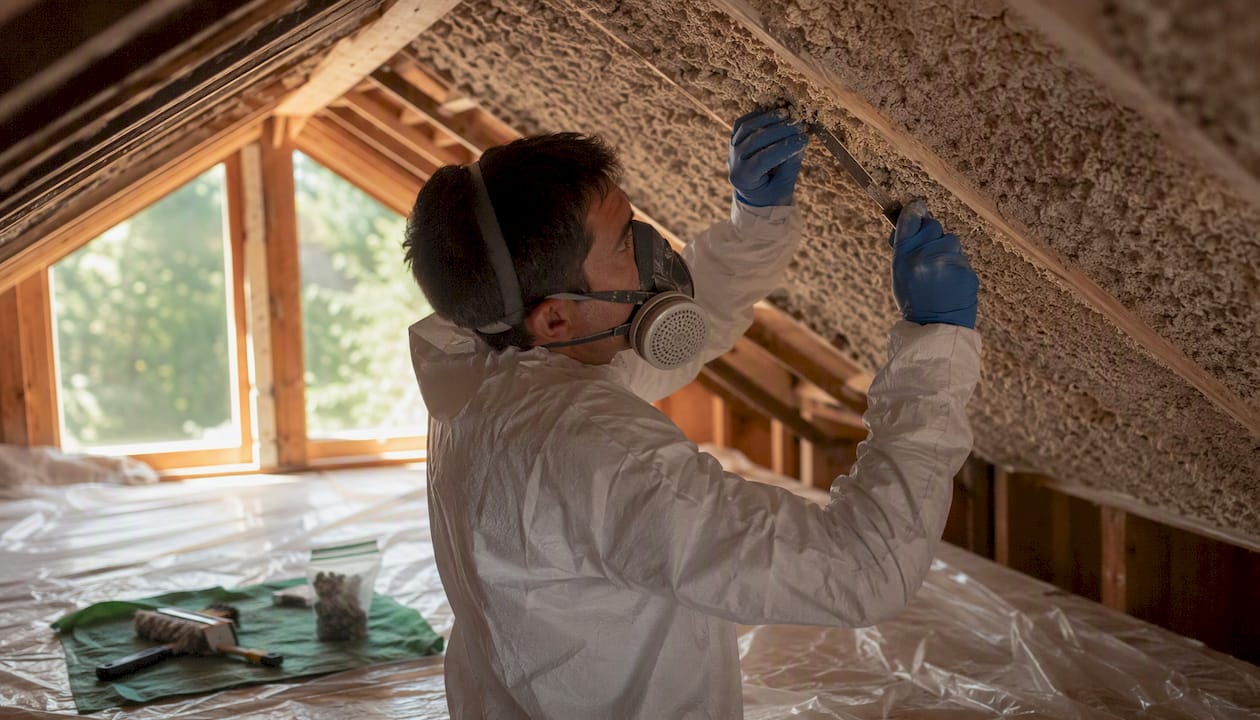
Asbestos bulk sampling means collecting a small, representative piece of suspect building material and sending it to an accredited laboratory to confirm whether asbestos is present, which type it is, and at what concentration. If you have just disturbed a suspect material during renovation or demolition, stop work immediately, isolate the area, and do not vacuum or sweep the debris. Then arrange for a certified sampler or accredited testing service before anyone re-enters.
What to do right now:
- Stop all work in the affected area and restrict access.
- Do not disturb the material further; wet it lightly if fibres may already be airborne.
- Photograph the location and note the material type, approximate area, and building age.
- Contact a qualified sampler or testing and inspection service to arrange collection and lab submission.
- Prepare a chain-of-custody form before samples leave the site.
Pro Tip: If your building was constructed before 1990, treat all suspect materials as asbestos-containing until lab results prove otherwise. Presuming the negative is the most common and most costly mistake in pre-renovation planning.
Table of Contents
- What is asbestos bulk sampling and why does it come first?
- Ontario’s 3-5-7 rule and the regulatory framework you need to know
- When should you hire a professional sampler?
- Step-by-step bulk sampling procedure for trained technicians
- How to handle, package, and document samples correctly
- How accredited labs test your samples and what the results mean
- How to choose an accredited Canadian laboratory
- How MSN Environmental supports your sampling and compliance needs
- How asbestos regulations vary across Canadian provinces
- Health risks from improper asbestos sampling
- Legal consequences of non-compliance in Ontario and Canada
- Key takeaways
- Why cutting corners on sampling always costs more in the end
- MSN Environmental: certified sampling and abatement across Ontario
- Useful sources and further reading
- FAQ
What is asbestos bulk sampling and why does it come first?
Asbestos bulk sampling is the formal process of collecting physical specimens from suspect building materials so a laboratory can identify asbestos fibres under polarised light microscopy (PLM). It is distinct from air sampling, which measures airborne fibre concentrations after disturbance, and from clearance testing, which confirms a space is safe after abatement. Bulk sampling comes first because it determines whether a material is asbestos-containing at all, and that result drives every decision that follows: whether licenced abatement is required, what PPE workers must wear, and whether a demolition permit can be issued.
Common materials that require sampling before renovation or demolition include:
- Floor tiles and associated adhesive (vinyl floor tiles from the 1950s–1980s frequently contain chrysotile)
- Pipe and boiler insulation (often amosite or chrysotile wrapped in a plaster-like matrix)
- Sprayed-on fireproofing and acoustic ceiling texture (high-risk friable materials)
- Drywall joint compound applied before the mid-1980s
- Vermiculite attic insulation (associated with Libby, Montana tremolite contamination)
- Roof shingles, siding, and transite panels
- Plaster and stucco on older masonry
The reason you collect multiple samples from the same material type is representativeness. A single tile from one corner of a room may not reflect the composition of tiles installed in a different batch or repaired at a later date. University of Toronto EHS guidance on bulk material collection emphasises that samples must span the full area of a homogeneous material group and penetrate all layers down to the substrate to avoid false negatives.
Ontario’s 3-5-7 rule and the regulatory framework you need to know
Ontario O. Reg. 278/05 sets the minimum number of bulk samples required for each homogeneous area of surfacing material before any construction, renovation, or demolition work begins:
The 3-5-7 rule: collect at least 3 samples for smaller areas (less than 90 m²), 5 samples for medium areas (90–450 m²), and 7 samples for large areas (450 m² or more). Thermal insulation generally requires a minimum of 3 samples per homogeneous section, but consult the regulation for specific details. These minimums are not relaxed for minor work.
The regulation applies to construction projects and building repair operations across Ontario. It requires that sampling be conducted by a trained person, that results come from an accredited laboratory, and that documentation be retained. Non-compliance is not a paperwork technicality: a stop-work order can be issued on the spot, and the project cannot legally resume until compliant sampling and, where necessary, abatement are completed. Property owners who skip sampling and proceed with demolition face mandatory remediation orders and potential prosecution under the Occupational Health and Safety Act.
Pro Tip: The 3-5-7 rule applies per homogeneous area, not per building. A single renovation project may involve a dozen distinct homogeneous material groups, each requiring its own minimum sample count. Map your materials before you count your samples.
Beyond Ontario, every province has its own occupational health and safety legislation that references asbestos sampling requirements. British Columbia’s WorkSafeBC, Alberta’s OHS Code, and Quebec’s RSST each impose pre-disturbance assessment obligations that parallel Ontario’s approach, though the specific sample minimums and documentation formats differ. The regulatory principle is consistent coast to coast: you must know what is in the material before you touch it.
When should you hire a professional sampler?
The honest answer is: almost always. The scenarios where a trained in-house person may collect samples are narrow, and the consequences of getting it wrong extend well beyond a failed inspection.
Hire a certified professional when:
- The suspect material is friable (crumbles easily by hand pressure), such as sprayed fireproofing or deteriorated pipe insulation.
- The project involves demolition, major renovation, or any work requiring a permit.
- The material is in a ceiling space, mechanical room, or rooftop location requiring elevated access.
- Results will be submitted to a regulator, insurer, or as part of a property transaction.
- The building is occupied during sampling, particularly if children, elderly residents, or immunocompromised individuals are present.
- You are sampling vermiculite, which requires larger volumes and specific scoop techniques.
A trained, competent person may collect samples in limited circumstances:
- Small, non-friable materials in a well-controlled, unoccupied space (a single floor tile in an empty basement, for example).
- The person has completed formal asbestos awareness and sampling training.
- Full PPE is available and will be worn correctly.
- The sample will still be submitted to an ISO/IEC 17025–accredited laboratory under a proper chain-of-custody form.
The risk matrix is straightforward. Friable material, large project area, building occupancy, regulatory submission requirements, and difficult access each push the decision firmly toward a professional. For most homeowners and property managers, the combination of at least two of those factors applies, which means professional sampling is the practical default. MSN Environmental’s testing and inspection services cover the full range of pre-renovation and pre-demolition sampling scenarios across Ontario.
Step-by-step bulk sampling procedure for trained technicians
This procedure follows EPA NIOSH 9002 field guidance and SESD operating procedures, adapted for Canadian practice.
1. Conduct a pre-sampling risk assessment
Identify the material type, condition (friable vs. non-friable), location, and approximate area. Determine the minimum sample count required under O. Reg. 278/05 or your provincial equivalent. Confirm ventilation status and whether the space is occupied.
2. Don PPE before entering the sampling area
Minimum PPE for non-friable materials: nitrile gloves, N95 respirator, and safety glasses. For friable materials or any situation where fibre release is likely: a half-face or full-face respirator with P100 filters, disposable Tyvek coveralls, gloves, and boot covers. Seal coverall cuffs with tape.
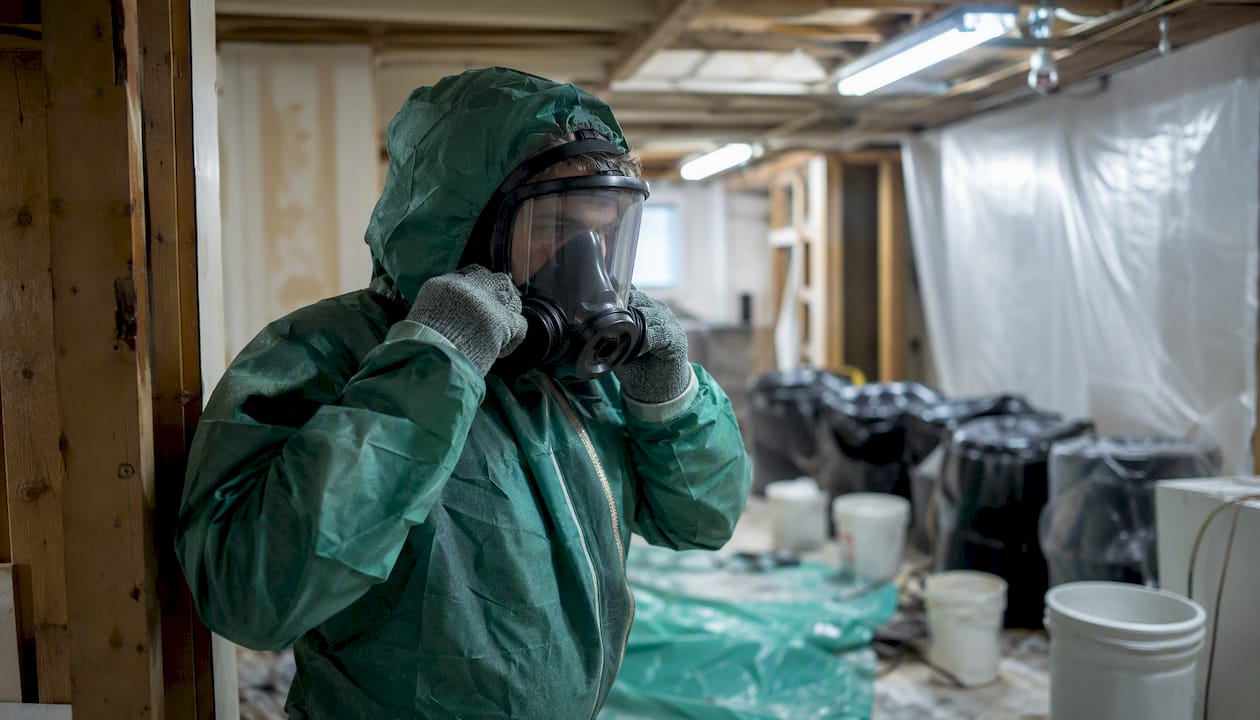
3. Isolate the sampling area
Close doors and disable HVAC to prevent fibre migration. Lay a poly drop sheet beneath the sampling point to capture any debris.
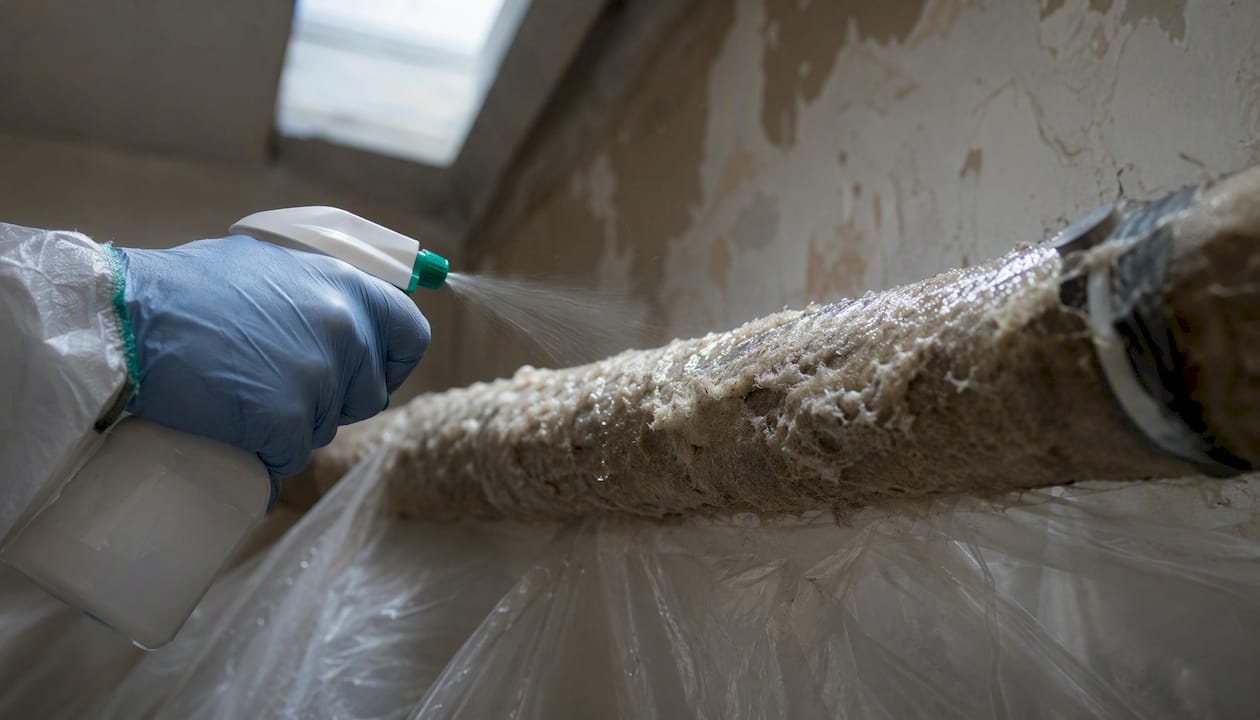
4. Wet the material
Apply a fine mist of water (with a small amount of dish soap as a surfactant) to the sampling location before cutting. Wetting suppresses fibre release significantly and is a standard requirement in both EPA and provincial guidance.
5. Collect the sample
Use a sharp knife, chisel, or core sampler to cut through the full depth of the material, including all layers down to the substrate. Collect 1–10 g of material (roughly one teaspoon). For layered or repaired materials, sample each distinct layer separately and label them accordingly. Patches and repairs from different construction periods must be sampled independently because their composition may differ from the surrounding material.
6. Seal the sample immediately
Place the sample in a clean, sealable plastic bag or screw-top container. Seal it, wipe the exterior with a damp cloth, and place it inside a second sealed bag (double-bag). Label the outer container with sample ID, location, date, time, and collector name.
7. Clean tools and the sampling area
Wipe tools with damp disposable wipes between each sample to prevent cross-contamination. Fold the drop sheet inward to contain debris, seal it in a poly bag, and dispose of it as asbestos waste if the material is confirmed or presumed positive.
8. Photograph and document
Take a photograph of each sampling location before and after collection. Mark sample locations on a floor plan or site drawing. Complete the chain-of-custody form on site.
Minimum PPE summary:
| Material condition | Respirator | Coveralls | Gloves |
|---|---|---|---|
| Non-friable, intact | N95 | Optional | Nitrile |
| Non-friable, damaged | Half-face P100 | Disposable Tyvek | Nitrile |
| Friable or sprayed | Full-face P100 | Disposable Tyvek | Nitrile, taped |
Sample size guidance: EPA NIOSH 9002 specifies 1–10 g per bulk sample. One level teaspoon of material falls within that range for most building products. Collecting too little material can prevent the lab from completing point-counting if PLM screening returns a low-level positive.
Pro Tip: Always sample patches and repairs separately from the surrounding material. A 1985 repair on a 1965 floor tile may have a completely different asbestos content, and grouping them as one homogeneous area is one of the most common causes of false negatives in bulk surveys.
How to handle, package, and document samples correctly
Proper handling between the field and the laboratory is where legally defensible results are made or lost. A contaminated or mislabelled sample can invalidate an entire survey.
Packaging and sealing checklist:
- Double-bag each sample in clean, sealable poly bags; wipe the outer bag before sealing.
- Use rigid screw-top containers for friable or powdery materials that could puncture a bag.
- Label each container with: sample ID, project address, exact location within the building, material description, date and time of collection, and collector’s name.
- Do not pool multiple samples into one container, even from the same material type.
Chain-of-custody form fields:
- Client name and project number
- Sample ID (matching the field label exactly)
- Sample location description and GPS coordinates or drawing reference
- Date and time of collection
- Collector’s name and signature
- Requested analysis (PLM screening, PLM point-counting, TEM)
- Special instructions (rush turnaround, stop-positive policy)
- Laboratory receiving technician’s name and date of receipt
Keep a copy of the completed chain-of-custody form, all field photographs, and the annotated site drawings together in a project file. Regulators, insurers, and property lawyers may request this documentation years after the original sampling event. The WorkSafe Saskatchewan safe work procedure reinforces that all samples must travel to the lab under a completed chain-of-custody form, regardless of project size or province.
How accredited labs test your samples and what the results mean
The standard method for asbestos bulk sample analysis is polarised light microscopy (PLM). A trained analyst prepares a small portion of the sample, disperses it on a glass slide, and examines it under polarised light to identify asbestos fibre types by their optical properties: refractive index, birefringence, and extinction angle. PLM can identify all six regulated asbestos types (chrysotile, amosite, crocidolite, tremolite, actinolite, anthophyllite) and provides a qualitative or semi-quantitative estimate of the percentage of asbestos in the sample.
When PLM is not enough:
- Point-counting is used when PLM screening suggests asbestos is present at less than 1%. A trained analyst counts a statistically significant number of points across the slide to produce a quantitative percentage estimate. This matters because the regulatory threshold in many Canadian contexts is 0.5% or 1% by weight, and a rough PLM estimate of “trace” is not sufficient for a legal determination.
- Transmission electron microscopy (TEM) is used for vermiculite samples, floor tiles with heavy mineral interference, and situations where PLM cannot definitively identify or rule out asbestos. TEM provides fibre morphology and elemental analysis at a level PLM cannot reach.
- X-ray diffraction (XRD) is occasionally used alongside TEM for mineral identification in complex matrices.
Reading a lab report:
- The report will identify asbestos type(s) detected, the estimated percentage range, and the analyst’s comments.
- A result of “none detected” means asbestos was not found in the portion analysed; it does not guarantee the entire material is asbestos-free, which is why representative sampling across the full homogeneous area matters.
- A “stop-positive” policy means the lab stops analysing remaining samples in a group once one returns positive, treating the entire group as asbestos-containing material (ACM). This saves both time and cost when you expect a positive result.
Pro Tip: Ask your lab whether they apply a stop-positive policy by default or only on request. For large surveys with many samples from a single material type, requesting stop-positive upfront can reduce lab fees meaningfully without affecting the regulatory outcome.
For a deeper look at how test results connect to abatement decisions, understanding asbestos testing explains the practical implications of positive and negative findings.
How to choose an accredited Canadian laboratory
Not every lab that advertises asbestos testing holds the accreditation required for regulatory submissions in Canada. The standard to look for is ISO/IEC 17025 accreditation for asbestos analysis by PLM, issued by the Standards Council of Canada (SCC) or an equivalent body. In the United States, NVLAP (National Voluntary Laboratory Accreditation Program) is the parallel standard; some Canadian labs hold both.
Vetting checklist before you submit samples:
- Confirm ISO/IEC 17025 accreditation for PLM and, if needed, TEM. Ask for the accreditation certificate number and verify it on the SCC registry.
- Ask whether the lab performs point-counting in-house or subcontracts it.
- Request a sample report so you can confirm it includes asbestos type, estimated percentage, method used, and a certificate of analysis.
- Confirm standard turnaround time (typically 5–10 business days for PLM) and rush options (24–48 hours at a premium).
- Ask about the lab’s stop-positive policy and whether it is applied automatically or by client instruction.
- Confirm the lab’s chain-of-custody intake process and whether they accept samples by courier.
- Ask about minimum sample volume requirements, particularly for vermiculite, which requires larger volumes than standard building materials.
A certificate of analysis from an ISO/IEC 17025–accredited lab is the document that makes your sampling results legally defensible. Without it, results may not be accepted by Ontario’s Ministry of Labour, Immigration, Training and Skills Development or by a property insurer reviewing a claim.
How MSN Environmental supports your sampling and compliance needs
MSN Environmental provides end-to-end support for property owners, renovators, and construction managers who need bulk sampling done correctly the first time. Services include on-site sample collection by trained technicians, chain-of-custody submission to ISO/IEC 17025–accredited laboratories, result interpretation, and abatement planning when samples return positive.
What MSN Environmental brings to a sampling project:
- Trained technicians who follow Ontario O. Reg. 278/05 sampling minimums and provincial equivalents.
- Full PPE protocols and containment procedures that protect building occupants during sampling.
- Coordination with accredited Canadian labs, including rush turnaround when project timelines are tight.
- Legally defensible documentation: annotated site drawings, chain-of-custody forms, and lab certificates of analysis retained for your project file.
- Single-point responsibility: if sampling returns positive results, MSN Environmental can move directly to licenced asbestos abatement and removal without the delay of sourcing a separate contractor.
Pro Tip: Bundling sampling and abatement with one certified contractor eliminates the handoff gap where documentation gets lost and project timelines slip. A single chain of custody from site visit to clearance certificate is cleaner for regulators and faster for you.
For home buyers, MSN Environmental also covers pre-purchase asbestos inspections, which follow the same bulk sampling methodology and produce the same legally defensible documentation.
How asbestos regulations vary across Canadian provinces
Ontario’s O. Reg. 278/05 is the most detailed provincial framework for asbestos sampling on construction projects, but every province imposes pre-disturbance assessment obligations. The core principle is identical: identify asbestos before work begins. The differences lie in specific sample minimums, documentation formats, and which authority enforces the rules.
British Columbia: WorkSafeBC requires an asbestos survey before any demolition or renovation that may disturb suspect materials. The survey must be conducted by a qualified person, and results must be documented in a written report. BC does not publish a numerical equivalent to Ontario’s 3-5-7 rule in the same explicit table format, but the qualified-person standard and accredited-lab requirement are consistent.
Alberta: The OHS Code requires a designated substance assessment before demolition. Alberta’s approach emphasises the “qualified person” standard and requires written notification to Alberta OHS before major demolition projects involving asbestos.
Quebec: The RSST (Règlement sur la santé et la sécurité du travail) and the Act respecting occupational health and safety impose asbestos management obligations. Quebec has additional requirements around asbestos in schools and public buildings, with specific sampling and reporting protocols administered through the CNESST.
Saskatchewan: WorkSafe Saskatchewan’s safe work procedures treat bulk sampling as a controlled, low-risk process but require a risk assessment, minimum PPE, and accredited lab submission for all samples. Vermiculite receives special treatment: larger sample volumes and multiple samples are required due to the uneven distribution of tremolite contamination.
The practical takeaway for national projects or properties near provincial borders: confirm the applicable provincial regulation before sampling begins, because submitting an Ontario-format report to a BC regulator may not satisfy local requirements.
Health risks from improper asbestos sampling
Asbestos fibres cause disease through inhalation. The three primary conditions are mesothelioma (a cancer of the lung lining), asbestosis (progressive lung scarring), and lung cancer. All three have long latency periods, typically 20–40 years between exposure and diagnosis, which means the consequences of a careless sampling event in 2026 may not appear clinically until the 2040s or 2050s.
The specific risk from improper sampling is fibre release. Cutting or breaking a friable asbestos-containing material without wetting, containment, or respiratory protection can release millions of respirable fibres into the air of an enclosed space. A single uncontrolled sampling event in a poorly ventilated room can produce airborne concentrations well above occupational exposure limits. Vacuuming debris with a standard household vacuum makes it worse: standard filters do not capture asbestos fibres and instead re-aerosolise them throughout the space.
The risks extend beyond the person doing the sampling. Fibres settle on surfaces and clothing, and can be carried into other areas of the building or into a vehicle. Family members and co-workers who were not present during sampling can be exposed through secondary contact with contaminated clothing or dust.
Proper sampling practice, as described in the procedure section above, keeps fibre release to a minimum. Wetting, containment, correct respirator selection, and immediate double-bagging of samples are not bureaucratic formalities. They are the specific controls that separate a safe sampling event from an exposure incident.
Legal consequences of non-compliance in Ontario and Canada
Non-compliance with asbestos sampling requirements carries real consequences under both occupational health and safety law and environmental legislation.
Under Ontario’s Occupational Health and Safety Act (OHSA) and O. Reg. 278/05:
- Inspectors from the Ministry of Labour, Immigration, Training and Skills Development can issue stop-work orders immediately upon discovering that sampling was not conducted or was inadequate.
- Orders to comply can require full designated substance surveys, abatement, and clearance air testing before work resumes.
- Fines for individuals convicted of OHSA violations can reach $100,000 per offence. Corporations face fines up to $1,500,000 per offence under OHSA.
- Directors and officers of corporations can be held personally liable for offences committed by the corporation.
Federal exposure: the Canadian Environmental Protection Act (CEPA) and Transport Canada regulations govern asbestos waste disposal and transport. Improper disposal of asbestos-containing waste is a separate offence from the sampling violation itself.
Civil liability: a property owner who fails to disclose known or reasonably discoverable asbestos to a buyer or contractor faces civil claims for damages. If a worker is subsequently diagnosed with an asbestos-related disease and can trace the exposure to a project where sampling was skipped, the property owner and constructor are exposed to significant tort liability.
The cost of compliant sampling, even for a large commercial project, is a fraction of the cost of a single stop-work order, mandatory remediation, or civil claim. Regulatory compliance is not the ceiling of good practice; it is the floor.
Key takeaways
Proper asbestos bulk sampling requires following Ontario’s 3-5-7 minimum sample rule, using ISO/IEC 17025–accredited laboratory analysis, and maintaining a complete chain-of-custody from collection to certificate of analysis.
| Point | Details |
|---|---|
| Ontario 3-5-7 rule | Collect a minimum of 3 samples for areas less than 90 m², 5 samples for areas of 90–450 m², and 7 samples for areas of 450 m² or more for each homogeneous material group under O. Reg. 278/05. |
| Accredited lab required | Submit all samples to an ISO/IEC 17025–accredited lab with a completed chain-of-custody form. |
| PLM and point-counting | PLM is the standard method; point-counting is required for quantitative results below 1% asbestos. |
| Professional sampling | Hire a certified sampler for friable materials, large projects, occupied buildings, or regulatory submissions. |
| MSN Environmental | Provides certified on-site sampling, accredited lab coordination, and licenced abatement across Ontario. |
Why cutting corners on sampling always costs more in the end
The most persistent mistake in asbestos management is treating sampling as a formality rather than the foundation of every decision that follows. A survey with too few samples, collected from the wrong locations, or submitted to an unaccredited lab does not just fail a regulatory check. It produces a false picture of the building that contractors, occupants, and future owners rely on.
The 3-5-7 rule exists because asbestos was not applied uniformly. A floor tile installer in 1968 might have used three different product batches across a single floor. A single sample from one corner tells you almost nothing about the other 400 square metres. The regulation forces a sampling density that actually reflects material variation, and that is the point.
What concerns me about the DIY sampling trend is not the ambition but the gap between collecting a sample and conducting a survey. Dropping one tile chip into a bag and sending it to a lab is not a survey. It does not satisfy O. Reg. 278/05, it does not protect the next contractor who enters the building, and it does not protect the person who did the sampling if a disease claim surfaces 30 years later. The documentation gap is where most enforcement actions begin.
Professional sampling is not expensive relative to what it protects. The chain-of-custody form, the annotated floor plan, the accredited certificate of analysis: these are the documents that close a property transaction, satisfy a demolition permit, and defend against a future liability claim. They are worth doing once, correctly.
MSN Environmental: certified sampling and abatement across Ontario
When a bulk sample returns positive, the last thing you need is to start over with a new contractor. MSN Environmental handles the full sequence: certified on-site sampling, accredited lab submission, result interpretation, and licenced asbestos removal when abatement is required. That single-contractor model means your chain-of-custody documentation is continuous, your project timeline stays intact, and you are not managing two separate companies through a regulatory process.
MSN Environmental serves residential, commercial, and industrial clients across Ontario, including Toronto, Kitchener, Waterloo, Cambridge, and Hamilton. Whether you need a pre-renovation bulk sampling visit or a full designated substance survey before demolition, the process starts with a site assessment. Contact MSN Environmental to book your sampling visit and get a clear picture of what is in your building before work begins.
Useful sources and further reading
- Designated Substance – Asbestos on Construction Projects and in Buildings and Repair Operations (O. Reg. 278/05)
- Collection of Bulk Materials for Asbestos Analysis — University of Toronto EHS
- EPA — Bulk sampling and analysis commentary (PLM and point counting)
- Asbestos (Bulk) by PLM: Sampling instructions | US EPA archive (NIOSH 9002)
- SESD guidance — Bulk sampling for asbestos (EPA snapshot)
- Safe work procedure for bulk asbestos sampling — WorkSafe Saskatchewan
- Designated substance survey guidance — Prescott
FAQ
What is the 3-5-7 rule for asbestos sampling?
Ontario O. Reg. 278/05 requires a minimum of 3 bulk samples for a homogeneous surfacing material area less than 90 m², 5 samples for areas between 90 and 450 m², and 7 samples for areas of 450 m² or more. These minimums apply to each distinct homogeneous material group, not per building.
What is bulk sampling for asbestos testing?
Bulk sampling is the collection of a small, physical specimen from a suspect building material, such as floor tile, pipe insulation, or plaster, for laboratory analysis to confirm whether asbestos is present, which type, and at what concentration.
What technique is used to measure asbestos in bulk samples?
Polarised light microscopy (PLM) is the standard method for bulk asbestos analysis. For results below 1%, point-counting is used to produce a quantitative estimate; transmission electron microscopy (TEM) is used for vermiculite or when PLM cannot definitively identify fibres.
How much does a full asbestos survey cost in Ontario?
A full designated substance survey for a residential property in Ontario typically costs $1,500–$5,000 or more, depending on building size and material complexity. Per-sample PLM analysis generally runs $25–$60 at standard turnaround, with point-counting adding $75–$150 per sample.
Do I need a certified professional to collect bulk samples?
For friable materials, large projects, occupied buildings, or any regulatory submission, yes. A certified professional is required. A trained, competent person may collect samples from small, non-friable, unoccupied settings, but all samples must still go to an ISO/IEC 17025–accredited laboratory under a completed chain-of-custody form.