

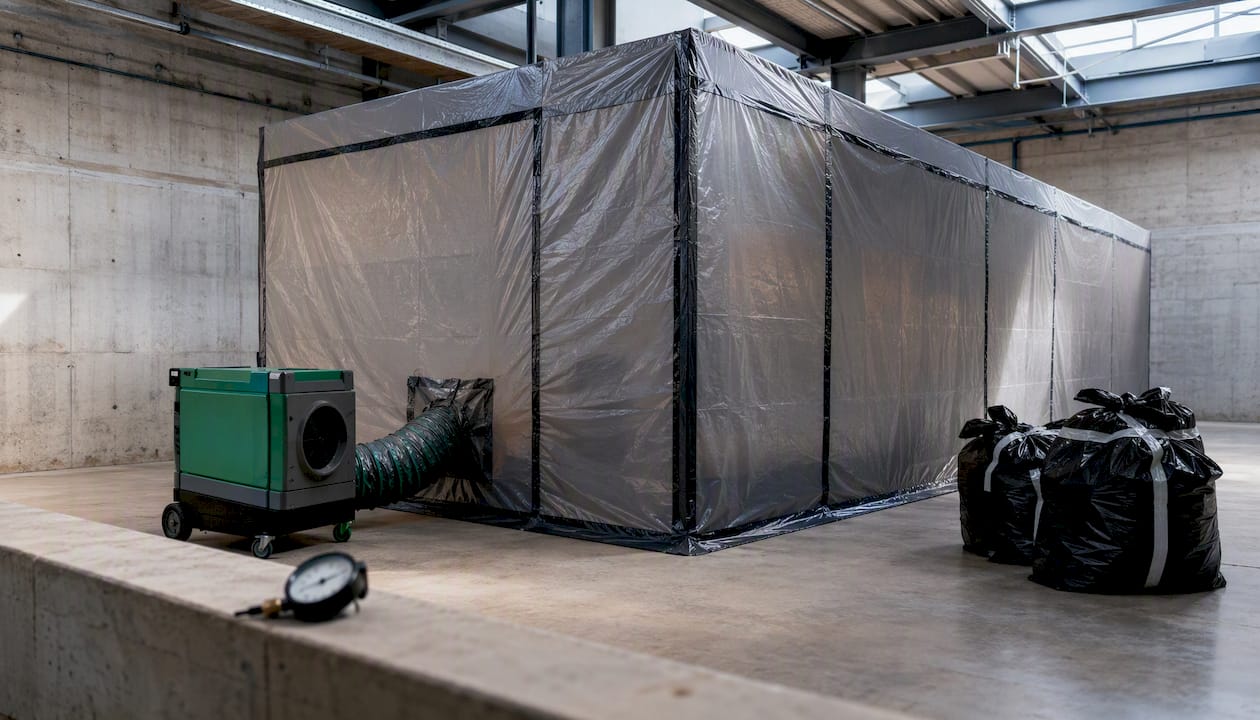
Type 3 asbestos abatement is the highest-risk category of asbestos work under Ontario’s regulatory framework, covering operations that generate high fibre concentrations or carry significant potential for fibre migration. Before any Type 3 activity begins, three things must be in place: certified personnel, a fully enclosed containment with HEPA-filtered negative-pressure machines, and a multi-stage decontamination unit. Nothing proceeds without them.
The risk-based classification system used by Ontario’s Ministry of Labour means a job can qualify as Type 3 based on how the material is disturbed, not just what it is. Removing a significant area of friable asbestos-containing material (ACM), cutting non-friable ACM with non-HEPA power tools, or disturbing sprayed fireproofing all trigger Type 3 requirements.
If controls are not in place when work starts, stop immediately. Notify the responsible supervisor or constructor and contact the Ministry of Labour, Immigration, Training and Skills Development before resuming.
Key non-negotiables at a glance:
- Full enclosure with double-layer polyethylene sheeting
- HEPA-filtered negative-pressure machines maintaining measurable negative pressure
- Multi-stage decontamination unit (clean room, shower, equipment room)
- Fit-tested respirators and full-body disposable coveralls for all workers
- Clearance air testing and independent visual inspection before dismantling containment
- Written notification to the Ministry of Labour before work begins
Table of Contents
- 1. When does a job become Type 3?
- 2. What regulations and official checklists apply?
- 3. How do you set up a Type 3 containment correctly?
- 4. What PPE, training, and medical surveillance do workers need?
- 5. Air monitoring, sampling, and clearance testing
- 6. Waste handling, packaging, and disposal
- 7. Step-by-step operational checklist for a Type 3 job
- 8. How long does Type 3 abatement take, and what drives the cost?
- 9. How do you verify a contractor before hiring?
- 10. Why Type 3 controls focus on stopping fibre migration
- Key takeaways
- The part of Type 3 work most project managers get wrong
- MSN Environmental handles Type 3 abatement across Ontario
- Useful sources and official checklists
- FAQ
1. When does a job become Type 3?
Ontario’s classification system is explicitly risk-based, not task-based. The Ministry of Labour guidance makes this clear: the method of disturbance can elevate work to Type 3 even when the material itself is non-friable. Two workers who both touch asbestos floor tile may be doing Type 1 or Type 3 work depending entirely on the tools they use and the area they disturb.
The CCOHS control strategies resource identifies the following as common Type 3 triggers:
- Removal or disturbance of more than 1 m² of friable ACM
- Use of power tools without HEPA dust collection on any ACM
- Removal of sprayed-on fireproofing or insulation
- Cleaning HVAC systems where sprayed ACM is present
- Demolition activities where ACM cannot be fully segregated
Edge cases catch people off guard. Non-friable vinyl floor tiles become a Type 3 concern when a grinder or non-HEPA saw is used, even though the same tiles removed by hand scraping might qualify as Type 1 or Type 2. Whole-building demolition triggers its own set of requirements under the regulation, and the classification of individual operations within that demolition must still be assessed separately.
For a practical look at how non-friable materials like floor tile can escalate to higher-risk classifications depending on removal method, MSN Environmental’s floor tile removal guide walks through the decision points in plain terms.
2. What regulations and official checklists apply?
The primary instrument in Ontario is O. Reg. 278/05 — the Regulation Respecting Asbestos on Construction Projects and in Buildings and Repair Operations under the Occupational Health and Safety Act. The overview guide covers notification, procedures, training requirements, and recordkeeping obligations in one place.
Key regulatory obligations for Type 3 work:
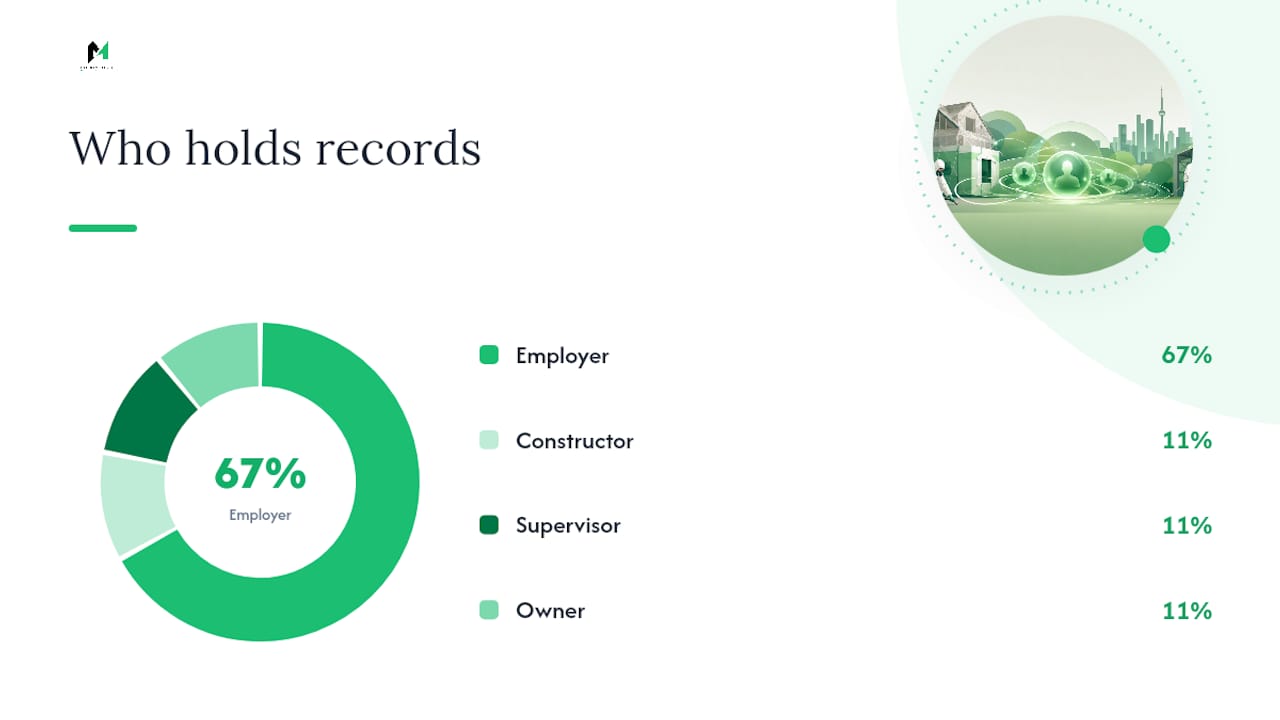
| Obligation | Regulatory basis | Who holds the record |
|---|---|---|
| Written notification to Ministry of Labour before work begins | O. Reg. 278/05 | Constructor / employer |
| Written asbestos work plan | O. Reg. 278/05 | Employer / supervisor |
| Annual asbestos work report (Form 1) for each Type 2/3 worker | O. Reg. 278/05, s. 21 | Employer |
| Training and certification certificates for all workers | O. Reg. 278/05 | Employer |
| Clearance air testing report and visual inspection sign-off | O. Reg. 278/05 | Employer / owner |
| Waste transport manifests and disposal receipts | Ontario Environmental Protection Act | Employer |
For work on federal properties, the PSPC Standard on Asbestos Management adds documentation of competency and specific management controls on top of provincial requirements. Federal procurement contracts frequently reference this standard as a condition of engagement.
The Ministry of Labour publishes Appendix 3 checklists as part of the regulation guide series. These checklists map directly to the inspection criteria an officer would use on site. Download them from the Ontario government’s regulation guide pages and keep printed copies in the site office.
3. How do you set up a Type 3 containment correctly?
Containment failure is the single most common cause of a failed clearance test. Getting the setup right before work starts saves far more time than trying to remediate a breach after the fact.
Enclosure and negative pressure
The work area must be fully enclosed with at least two layers of polyethylene sheeting, sealed at all seams and penetrations. Every opening, including electrical conduit penetrations, pipe sleeves, and floor drains, must be sealed before the negative-pressure machines are activated. HVAC supply and return registers within the containment must be isolated and locked out.
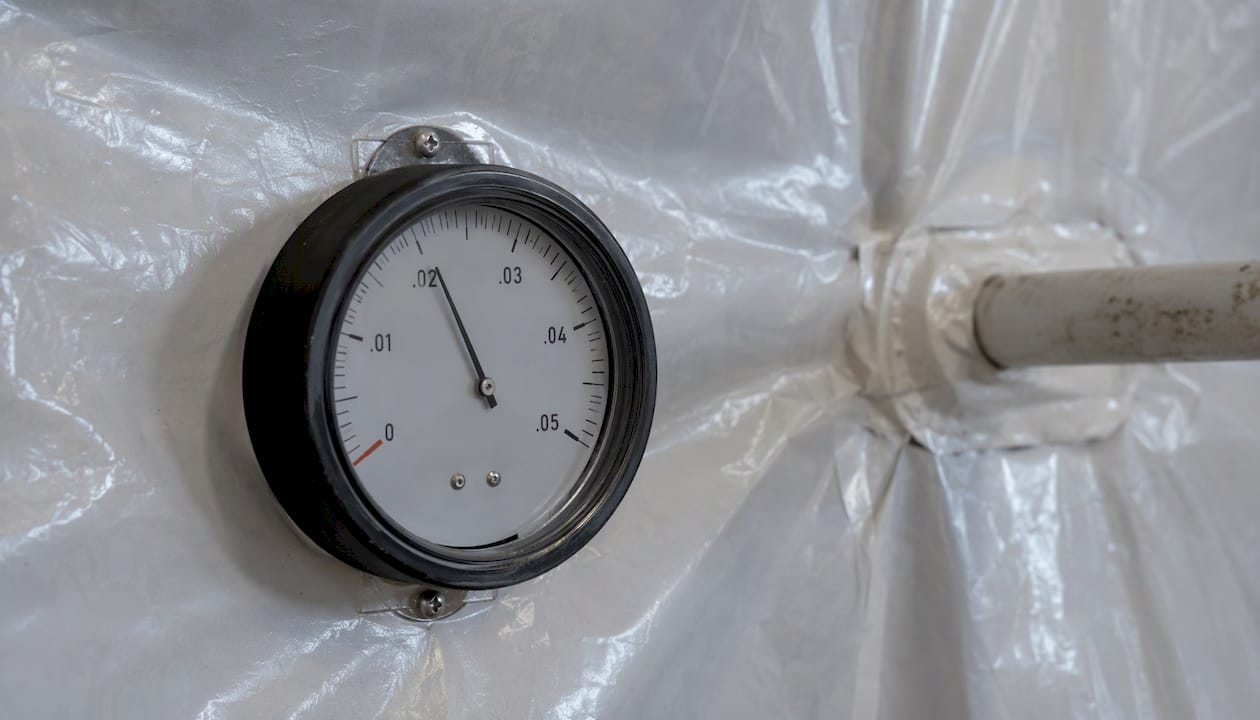
IHSA’s Type 3 safety brief specifies a minimum negative pressure of 0.02 inches of water column (approximately 5 Pa) relative to adjacent clean areas. A calibrated manometer or magnehelic gauge must be used to verify and continuously monitor this pressure differential. Relying on visual observation of sheeting movement is not sufficient.
CCOHS guidance identifies HEPA filtration and negative-pressure machines as the core engineering controls for high-risk asbestos work. The number of negative-air units must be calculated based on the containment volume to achieve a minimum of four air changes per hour.
4. What PPE, training, and medical surveillance do workers need?
Respiratory protection
At minimum, workers in a Type 3 containment must wear a fit-tested half-mask respirator with P100 (HEPA) cartridges. Supplied-air respirators (SARs) or self-contained breathing apparatus (SCBA) are required when airborne fibre concentrations are expected to exceed the protection factor of a half-mask, or when the work involves very high-disturbance activities such as removing sprayed fireproofing in a confined space.
Fit testing is not optional and not a one-time event. Ontario’s regulation requires fit testing before a worker uses a respirator for the first time and whenever there is a change in the worker’s facial features that could affect the seal. Records of fit tests must be retained by the employer.
Training and certification
Workers performing Type 3 asbestos abatement must hold a valid certificate from a Ministry of Labour-approved training provider. The certificate must specifically cover Type 3 operations. Supervisors require a separate, higher-level certification that covers work planning, regulatory compliance, and emergency procedures.
Required PPE and documentation checklist:
- Fit-tested half-mask or supplied-air respirator (with current fit-test record)
- Full-body disposable Tyvek or equivalent coveralls (Type 5/6 minimum)
- Disposable boot covers and gloves (taped at wrists)
- Safety glasses or goggles under the respirator
- Valid Type 3 worker training certificate
- Valid supervisor certification (for the designated supervisor)
- Current medical surveillance record or referral
Medical surveillance and annual reporting
Under O. Reg. 278/05, employers must provide an annual asbestos work report (Form 1) for every worker involved in Type 2 or Type 3 operations. This form documents the worker’s exposure history and must be retained by the employer. Workers are entitled to a copy. Section 21 compliance is frequently overlooked, and Ministry of Labour inspectors do ask for these records.
Pro Tip: When verifying a worker’s training certificate, check the issuing organization’s name, the certificate number, and the expiry date. Legitimate Ontario-approved certificates will name the training provider and specify the type of operation covered. A certificate that says only “asbestos awareness” does not authorize Type 3 work.
5. Air monitoring, sampling, and clearance testing
Clearance testing is not a formality. It is the legal gate between the end of abatement work and the dismantling of containment. Getting the sequence right protects both the occupants and the contractor.
Clearance criteria and documentation
Ontario’s regulation requires clearance air testing inside Type 3 enclosures in buildings that will not be demolished. The regulation overview sets out the conditions under which clearance testing is mandatory and what the documentation must include.
Required clearance documentation:
- Laboratory air sample results (PCM or TEM) with chain-of-custody forms
- Written visual inspection report signed by the inspector
- Identification of the sampling professional and their qualifications
- Date, time, and location of each sample
Pro Tip: Schedule clearance sampling for the morning after the final cleaning cycle, not the same afternoon. Fibres disturbed during cleaning need time to settle, and a sample collected too soon after cleaning will often fail even in a well-executed abatement. Build 24–48 hours into every project schedule between the end of cleaning and clearance sampling.
6. Waste handling, packaging, and disposal
Asbestos waste from a Type 3 operation is a designated substance and a hazardous waste. Every step from the containment to the landfill has a paper trail attached to it.
On-site handling
Wet methods are mandatory throughout the abatement. ACM must be kept damp during removal to suppress fibre release. Waste must be double-bagged in 6-mil polyethylene bags, sealed with tape, and labelled with the required asbestos warning label before it leaves the containment through the waste transfer hatch. Drop sheets and disposable PPE are treated as asbestos waste and packaged the same way.
The IHSA safety brief explicitly prohibits the use of compressed air for cleaning inside the containment. HEPA vacuums and damp wiping are the only acceptable cleaning methods.
Transport and disposal
| Step | Requirement | Governing instrument |
|---|---|---|
| Waste labelling | Asbestos warning label on each bag/container | O. Reg. 278/05 |
| Waste transport | Licensed hazardous waste carrier; manifest required | Ontario Environmental Protection Act |
| Landfill acceptance | Approved facility only; call ahead to confirm acceptance | Ontario Environmental Protection Act |
| Federal transport (interprovincial) | Subject to federal hazardous materials rules | Federal consolidated regulations |
| Record retention | Transport manifests and disposal receipts | Minimum 2 years (verify current requirement) |
Interprovincial waste transport adds a layer of federal oversight. The consolidated federal regulations set out the hazardous materials rules that apply when asbestos waste crosses provincial boundaries, and these requirements sit on top of Ontario’s provincial rules, not instead of them.
7. Step-by-step operational checklist for a Type 3 job
Pre-job phase
- Obtain a designated substance survey or bulk sampling report confirming ACM presence and classification.
- Classify the work as Type 3 based on area, friability, and disturbance method.
- Prepare a written asbestos work plan including scope, controls, PPE, emergency procedures, and waste disposal plan.
- Submit written notification to the Ministry of Labour before work begins.
- Confirm all workers hold valid Type 3 certificates and current fit-test records.
- Arrange for an independent industrial hygienist for clearance testing.
Setup phase
- Erect full enclosure with double-layer polyethylene; seal all penetrations.
- Install and test negative-pressure machines; verify minimum 0.02 in. water column differential with a manometer.
- Construct and commission the multi-stage decontamination unit.
- Post required signage at all entry points.
- Isolate and lock out HVAC systems within and adjacent to the containment.
- Collect baseline air samples outside the containment.
Execution phase
- Use wet methods throughout; keep ACM damp during removal.
- Use HEPA vacuums for cleaning; no compressed air.
- Conduct continuous personal and area air monitoring.
- Supervisor to conduct daily site inspections and document findings.
- Package and stage waste in the equipment room using double-bag, label, and seal protocol.
Post-work and clearance phase
- Complete final cleaning cycle: HEPA vacuum all surfaces, damp wipe, re-vacuum.
- Conduct independent visual inspection; document and re-clean any areas with visible debris.
- Wait the required settling period, then collect clearance air samples.
- Receive and review laboratory results; confirm they meet clearance criteria.
- Remove waste from containment through the transfer hatch; transport to an approved facility.
- Dismantle containment only after written clearance sign-off is received.
- Compile and retain all documentation.
| Stage | Required documents | Audit checkpoint |
|---|---|---|
| Pre-job | Work plan, notification, training certificates, fit-test records | Before mobilisation |
| Setup | Manometer readings, baseline air sample results | Before work starts |
| Execution | Daily inspection logs, personal monitoring results | During work |
| Clearance | Visual inspection report, lab results, chain-of-custody | Before containment removal |
| Disposal | Transport manifests, disposal receipts | After waste leaves site |
8. How long does Type 3 abatement take, and what drives the cost?
Timeline and cost vary considerably based on the specifics of the job. A small residential Type 3 removal of sprayed ceiling texture in a single room might take three to five days from setup to clearance. A commercial project involving multiple floors of sprayed fireproofing can run several weeks.
9. How do you verify a contractor before hiring?
Hiring the wrong contractor for Type 3 work is not just a quality problem. It is a legal liability. The constructor or owner who engages an uncertified contractor can face orders, stop-work orders, and fines under the Occupational Health and Safety Act.
Documents to request before signing a contract
- Copies of Type 3 worker training certificates for all workers who will be on site (check issuing organization, certificate number, and expiry date)
- Supervisor certification specific to Type 3 operations
- Proof of WSIB coverage (clearance certificate, not just a policy number)
- Commercial general liability insurance certificate naming your organization as additional insured
- Evidence of a medical surveillance programme for workers (not necessarily individual records, but confirmation the programme exists)
- Fit-test records for all workers who will wear respirators on your project
Operational proof to request
- A sample clearance report from a previous comparable project (redacted for client confidentiality is fine)
- Chain-of-custody documentation from a previous air sampling programme
- Equipment list confirming HEPA-filtered negative-air machines and HEPA vacuums
- Waste manifests and disposal receipts from a previous project confirming use of an approved facility
For broader guidance on hiring asbestos abatement contractors, Simon Air Quality’s property owner’s guide covers procurement questions and red flags to watch for during the selection process.
Sample pre-qualification request (paste into an RFP or email)
“Please provide: (1) copies of Type 3 training certificates for all workers assigned to this project; (2) supervisor certification; (3) WSIB clearance certificate; (4) CGL insurance certificate; (5) a sample clearance air testing report from a comparable project; (6) equipment list confirming HEPA negative-air machines and HEPA vacuums; (7) waste manifests from a previous project.”
10. Why Type 3 controls focus on stopping fibre migration
The entire architecture of Type 3 controls, the negative pressure, the multi-stage decontamination unit, the HEPA filtration, exists for one reason: to prevent asbestos fibres from leaving the work area and entering clean zones where unprotected people are present.
Asbestos fibres are invisible to the naked eye and remain airborne for extended periods. A single breach in containment, an unsealed pipe penetration, a door propped open during a waste transfer, can contaminate an adjacent corridor or mechanical room that was never part of the abatement scope. Remediation of secondary contamination is expensive, disruptive, and entirely avoidable.
The IHSA safety brief frames the primary purpose of Type 3 controls as stopping fibre migration from the work area into clean zones. The CCOHS control strategies guidance reinforces this by placing HEPA filtration and negative pressure at the top of the engineering control hierarchy for high-risk asbestos work. Ontario Ministry of Labour guidance ties both of these to the specific regulatory obligations in O. Reg. 278/05.
A containment breach scenario worth understanding: a supervisor on a commercial project approved the visual inspection before clearance sampling, but failed to notice that a stairwell door adjacent to the containment had been left unsealed at the bottom. The clearance samples failed. The entire containment had to be re-cleaned, the stairwell assessed, and clearance sampling repeated. The project ran an additional three days past the planned completion date, and the building owner faced delayed re-occupancy. The cost of that oversight was multiples of what a proper setup inspection would have taken.
Pro Tip: Assign one person on the abatement crew the specific role of containment integrity monitor during setup. Their only job for the first two hours is to walk the perimeter, check every penetration seal, verify the manometer reading, and confirm the DCU is functioning correctly. This role is rarely written into work plans, but it is the single most effective way to catch setup failures before work begins.
Key takeaways
Type 3 asbestos abatement in Ontario requires certified personnel, full HEPA-filtered negative-pressure containment, independent clearance testing, and a complete documentation trail before, during, and after the work.
| Point | Details |
|---|---|
| Type 3 triggers | Any removal of a significant area of friable ACM, or power-tool disturbance without HEPA dust collection, qualifies as Type 3. |
| Non-negotiable controls | Full enclosure, HEPA negative pressure at 0.02 in. water column, multi-stage decontamination unit, and fit-tested respirators are mandatory before work starts. |
| Clearance timing | Build 24–48 hours into the schedule between final cleaning and clearance sampling; containment cannot be dismantled until written clearance sign-off is received. |
| Documentation trail | Notification to the Ministry of Labour, training certificates, annual asbestos work reports (Form 1), clearance reports, and waste manifests must all be retained. |
| MSN Environmental | MSN Environmental provides full Type 3 containment, abatement, clearance testing, and waste disposal for residential and commercial projects across Ontario. |
The part of Type 3 work most project managers get wrong
Most of the serious compliance failures in Type 3 abatement do not happen during the abatement itself. They happen in the planning phase and the clearance phase, at the two ends of the job where the pressure to move quickly is highest.
The planning failure is almost always the same: the work is classified too late. A renovation contractor discovers sprayed fireproofing behind a ceiling tile on day two of a gut renovation, and the project manager has to decide in real time whether to stop work, notify the Ministry of Labour, and mobilise a certified abatement crew, or to keep going and deal with the consequences later. The regulation is not ambiguous about what the right answer is. But the cost and schedule pressure in that moment is real, and it leads to decisions that create far larger problems downstream.
The clearance failure is subtler. Teams consistently underestimate how much time and staffing the post-clean visual inspection requires. A proper visual inspection of a large containment, done correctly, takes hours. It is not a walk-through. Every surface, every corner, every piece of equipment that was inside the containment must be inspected. When that inspection is rushed because the schedule is tight, debris gets missed, clearance samples fail, and the project loses more time than the inspection would have taken.
The documentation gap is the third recurring problem. Annual asbestos work reports under Section 21 of the regulation are frequently not completed for every worker on every Type 3 job. Employers often track the big compliance items, the notification, the clearance report, and miss this one. Ministry of Labour inspectors know this and ask for it.
The practical hint for owners and managers: build the clearance period into the contract as a fixed line item, not a variable. Agree with the contractor before work starts that clearance testing will take 24–48 hours after the final cleaning cycle, that this time is included in the contract price, and that re-occupancy is conditional upon written clearance sign-off. That single contractual clarity eliminates most of the pressure that leads to rushed clearances.
MSN Environmental handles Type 3 abatement across Ontario
Type 3 abatement is not a job for a general contractor with a dust mask. The regulatory requirements, the equipment, the certification burden, and the documentation trail require a specialist.
MSN Environmental provides the full scope of Type 3 asbestos removal services in Ontario: on-site assessment, bulk and air sampling, full containment build and abatement, independent clearance testing coordination, and compliant waste disposal with manifests. Every project is staffed with certified Type 3 workers and supervisors, and every clearance package includes the lab reports, chain-of-custody documentation, and visual inspection sign-off your insurer and regulator will ask for.
When requesting a quote, ask for line-item pricing that separates containment, monitoring, labour, and disposal manifests. That structure makes it straightforward to compare proposals and confirm that clearance testing is included, not an afterthought. MSN Environmental serves residential, commercial, and industrial clients across Ontario, including Toronto and the surrounding region. To discuss your project and get a compliant quote, visit msnenvironmental.com or contact the team directly.
Useful sources and official checklists
The following authoritative sources are cited throughout this article. Download the checklists and forms directly from the government and association pages listed.
| Source | What it contains | Why it matters for Type 3 |
|---|---|---|
| Ontario Ministry of Labour — Classification of Work Guide | Risk-based classification criteria, examples, and Appendix 3 checklists | Determines whether your job is Type 3 and what controls are required |
| Ontario Ministry of Labour — Regulation Overview | Full regulatory obligations: notification, training, reporting, clearance | Maps every employer and constructor duty under O. Reg. 278/05 |
| IHSA — Type 3 Operations Safety Talk | Operational controls, containment specs, decon requirements, waste handling | Practical field-level checklist for supervisors and workers |
| CCOHS — Control Strategies for Workplaces | National control strategy framework; Type 1–3 classification and engineering controls | Cross-reference for engineering controls and national best practice |
| PSPC — Standard on Asbestos Management | Competency documentation and management controls for federal properties | Required reading for any work on federally owned or leased buildings |
| Justice Laws — Consolidated Federal Regulations | Federal hazardous materials rules for interprovincial transport | Applies when asbestos waste crosses provincial boundaries |
| Ontario Ministry of Labour — Clearance Timing Guide | Clearance testing requirements and timing guidance | Sets the legal standard for when containment can be dismantled |
- A guide to the Regulation respecting Asbestos on Construction Projects and in Buildings and Repair Operations — classification of work
- Asbestos—Type 3 operations (IHSA safety talk)
- Asbestos – Control Strategies for Workplaces (CCOHS)
- Standard on Asbestos Management (PSPC / Government of Canada)
- Overview of the regulation — A guide to the Regulation respecting Asbestos on Construction Projects and in Buildings and Repair Operations
- Consolidated federal regulations (Justice Laws Website)
- A guide to the Regulation respecting Asbestos on Construction Projects and in Buildings and Repair Operations — clearance timing
FAQ
What is Type 3 asbestos work?
Type 3 asbestos work is the highest-risk classification under Ontario’s Regulation Respecting Asbestos on Construction Projects and in Buildings and Repair Operations, covering operations that generate high fibre concentrations or carry significant potential for fibre migration, such as removing more than 1 m² of friable ACM or using power tools without HEPA dust collection on any ACM.
What are the levels of asbestos abatement in Canada?
Ontario and most Canadian jurisdictions use a three-tier risk-based system: Type 1 covers low-risk, small-scale work with minimal fibre release potential; Type 2 covers moderate-risk operations; and Type 3 covers high-risk work requiring full containment, negative pressure, and certified personnel.
How much does asbestos abatement cost in Canada?
Cost varies significantly by project size, material type, accessibility, and location. Precise figures require an on-site assessment and sampling. MSN Environmental’s Ontario pricing guide breaks down typical cost drivers and what line items to expect in a compliant quote.
Is clearance testing mandatory for Type 3 work in Ontario?
Yes. Ontario’s regulation requires clearance air testing inside Type 3 enclosures in buildings that will not be demolished, along with an independent visual inspection, before containment can be dismantled. Clearance testing and visual sign-off typically add 24–48 hours to the project schedule after the final cleaning cycle.
How do I confirm a contractor is certified for Type 3 abatement?
Request copies of Type 3 worker training certificates (check the issuing organization, certificate number, and expiry date), supervisor certification, WSIB clearance, and a sample clearance report from a previous comparable project. A contractor who cannot produce these documents has not performed Type 3 work at the required standard.
This article provides general information about Type 3 asbestos abatement requirements in Ontario and Canada. It is not a substitute for professional advice or legal counsel. Confirm current regulatory requirements with the Ontario Ministry of Labour or a qualified occupational health and safety professional before beginning any asbestos abatement work.