

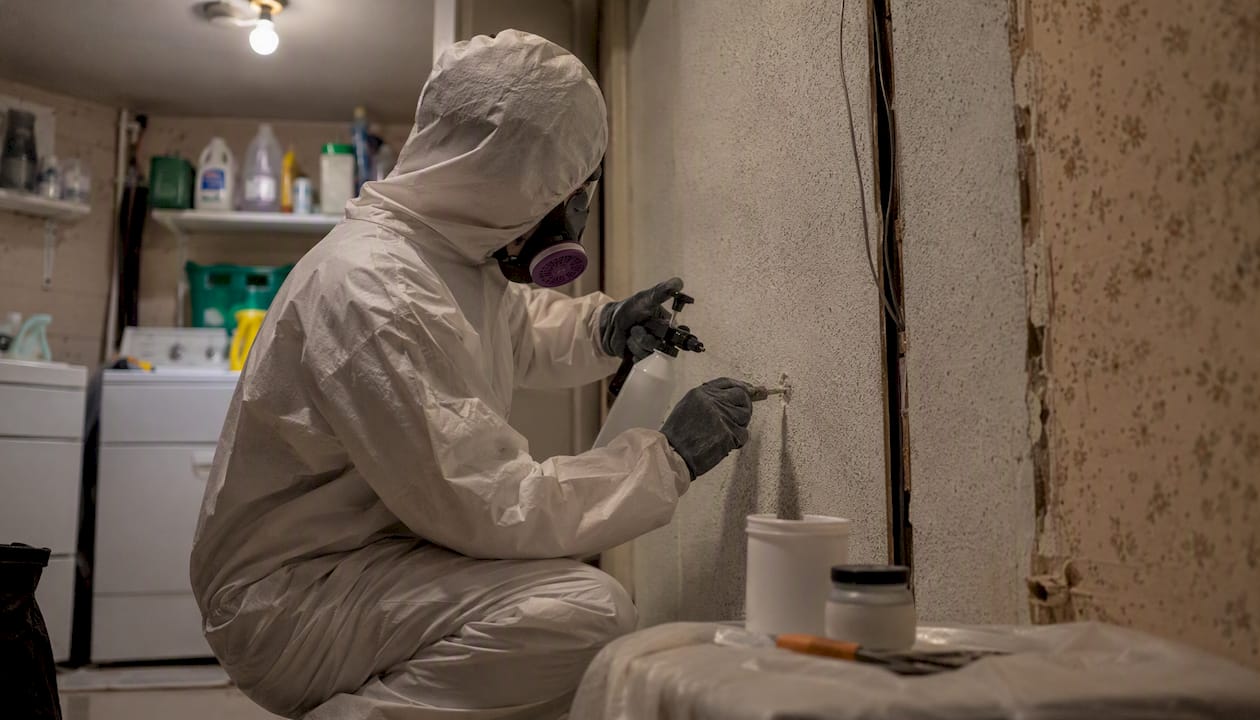
Plaster walls can contain asbestos, and there is no reliable way to confirm it by looking. Visual identification cannot distinguish asbestos-containing plaster from safe material; only accredited laboratory analysis of a bulk sample using polarised light microscopy (PLM) can do that. If your home was built between the 1950s and the early 1980s, or if you are about to renovate, the safest move is to stop work and test before anything else gets disturbed. Health Canada and provincial regulators consistently say the same thing: assume risk first, confirm with testing.
Immediate actions if you suspect asbestos in plaster:
- Stop all sanding, drilling, scraping, or demolition in the area immediately.
- Limit access to the room and keep children and pets out.
- Do not sweep or vacuum dust from a disturbed area — that spreads fibres.
- Arrange bulk sampling through an accredited testing service or contact a licensed abatement contractor such as MSN Environmental.
Pro Tip: Testing costs are modest compared with the cost of unplanned regulated abatement. A single bulk sample analysed by an ISO/IEC 17025-accredited lab is the cheapest decision you can make before a renovation.
Key takeaways
Asbestos in plaster walls is a confirmed risk in Canadian homes built between the 1950s and early 1980s, and the only reliable way to manage it is accredited PLM testing followed by provincially compliant abatement when the material is disturbed.
| Point | Details |
|---|---|
| Testing is the only confirmation | Visual inspection cannot identify asbestos; PLM analysis by an ISO/IEC 17025-accredited lab is required. |
| Stop disturbance immediately | Sanding, drilling, or demolishing suspect plaster releases fibres; stop work and isolate the area first. |
| Sample every layer separately | Asbestos content varies by plaster layer; a single composite result can miss a positive layer. |
| Hire a provincially licensed contractor | Ontario Regulation 278/05 and WorkSafeBC set licensing and clearance requirements for abatement work. |
| MSN Environmental covers the full process | From accredited bulk sampling through regulated removal and clearance testing across Ontario. |
Table of Contents
- What asbestos in plaster actually means for your home
- How to tell if plaster walls might contain asbestos
- How professional testing for asbestos in plaster works in Canada
- Health risks from asbestos in plaster
- What to do if asbestos is confirmed in your plaster
- Why PLM from an accredited lab is the reliable standard
- A contractor’s perspective on plaster asbestos jobs
- MSN Environmental: testing, abatement, and clearance for Ontario homeowners
- Sources
- FAQ
What asbestos in plaster actually means for your home
Asbestos-containing plaster is plaster that was mixed with asbestos fibres, typically chrysotile, during manufacturing or application. Builders and plasterers added it for fire resistance, sound dampening, and tensile strength. The fibres themselves are microscopic and odourless, which is why the material looks identical to asbestos-free plaster once it is on the wall.
When was it used in Canadian homes?
- 1950s through late 1970s: highest risk period. Textured and acoustic plasters from this era sometimes contained chrysotile asbestos in some finish or acoustic mixes.
- Pre-1950s: traditional lime-and-horsehair plasters generally did not contain asbestos, though some specialty products did.
- 1980s onward: asbestos use in building materials declined sharply after Canadian regulations tightened, but residual stock was sometimes used into the early 1980s.
The multilayer nature of plaster assemblies matters here. A typical wall has a lath substrate (wood or rock lath), a scratch coat, a brown coat, and a finish coat. Asbestos may appear in one layer but not another, so a single negative result from the finish coat does not clear the whole wall. Labs must test each distinct layer when a full assessment is needed.
Pro Tip: Textured or acoustic finishes, including swirl, stipple, and skip-trowel patterns, raise the probability of asbestos compared with a smooth painted surface. If your walls have any texture at all, treat them as higher risk until tested.
How to tell if plaster walls might contain asbestos
Visual clues can raise or lower suspicion, but they cannot confirm asbestos. Use the checklist below to assess your risk level before deciding whether to test.
Risk factor checklist:
- Build year between 1950 and 1982: the single strongest indicator.
- Textured finish: swirl (circular trowel marks), stipple (bumpy, almost popcorn-like surface), skip-trowel (irregular raised patches), or acoustic spray. Acoustic and decorative textured plasters were more likely to include asbestos additives.
- Rock lath or wood lath substrate: visible if plaster is cracked or partially removed; common in homes built before the 1960s.
- Patched areas or skim coats: different mixes were often used for repairs, and patch compounds sometimes contained asbestos even when the original plaster did not.
- Vermiculite in the mix: some plaster mixes used vermiculite as a lightweight aggregate. Vermiculite can be naturally contaminated with asbestos depending on its source, so even materials that look modern can carry risk. See our guide on vermiculite insulation removal for more detail.
- Renovation history: any area that has been sanded, scraped, or partially demolished is a higher-priority test candidate.
- Damage or water staining: friable (crumbling) or water-damaged plaster releases fibres more readily than intact material.
| Risk factor | Risk level |
|---|---|
| Smooth painted plaster, post-1985 build | Lower risk |
| Textured finish, 1950–1982 build | Moderate to high risk |
| Acoustic/stipple ceiling or wall, 1960s–1970s | High risk |
| Damaged, friable, or water-damaged plaster | High risk regardless of era |
| Patched areas with unknown compound | Moderate risk |
| Vermiculite-containing mix, any era | Test before disturbing |
Pro Tip: If you are buying a home built before 1985, commission an asbestos inspection before purchase. Discovering asbestos after you own the property is far more expensive than discovering it during due diligence.
How professional testing for asbestos in plaster works in Canada
Testing follows a clear sequence: collect a bulk sample, send it to an accredited lab, receive a PLM report with percent-by-weight results, and make a management decision from there.
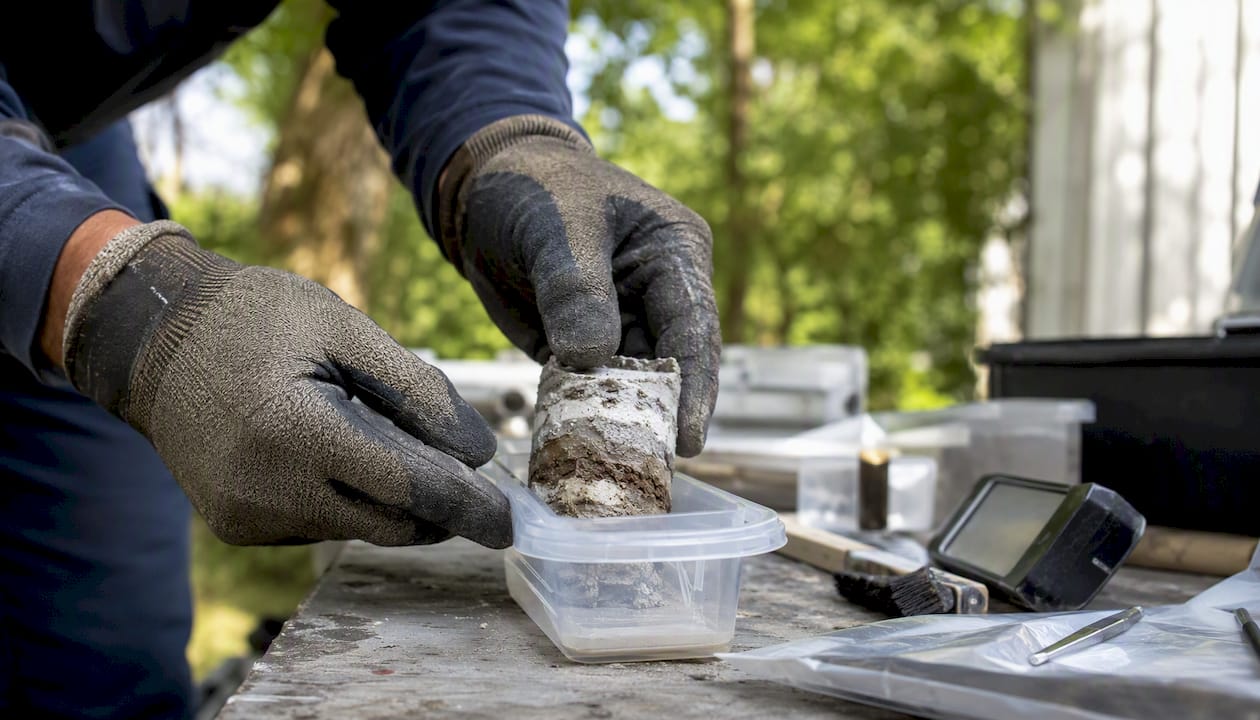
The testing workflow:
Self-sampling is technically possible but not recommended. Improper sampling can disturb fibres and create the very exposure you are trying to avoid. A qualified sampler wets the area, cuts a small core through each distinct layer, seals the sample in a labelled container, and maintains a chain-of-custody record from collection to lab receipt. That chain-of-custody document matters: provincial regulators in Ontario and British Columbia may ask for it if abatement is later required.
The lab then analyses the sample using PLM, which identifies fibre type and reports asbestos content as a percentage by weight. The standard regulatory threshold in Canada, aligned with U.S. EPA NESHAP guidance on multilayer plaster systems, is 1% by weight. Material at or above that threshold is classified as asbestos-containing material (ACM) and triggers regulated abatement requirements.
What to look for in a lab:
- ISO/IEC 17025 accreditation (the international standard for testing and calibration laboratories).
- PLM results reported per layer, not as a composite.
- Fibre type identified (chrysotile, amosite, crocidolite, etc.).
- Percent-by-weight stated clearly on the report.
| Testing step | Typical timeline | Ballpark cost (CAD) |
|---|---|---|
| Professional bulk sampling (per sample) | Same day | $75–$150 |
| Standard PLM lab turnaround | 5–10 business days | $30–$75 per sample |
| Rush PLM turnaround | several days | $75–$150 per sample |
| Designated substance survey (full home) | 1–2 days on-site | $500–$1,500+ |
Costs are ballpark estimates and vary by region, number of samples, and lab. Confirm current pricing directly with your sampler or lab.
Pro Tip: Ask the lab for a copy of their ISO/IEC 17025 accreditation certificate before submitting samples. A reputable lab will provide it without hesitation. Also request that results be broken down by layer, not averaged across the whole sample.
Health risks from asbestos in plaster
Intact, undisturbed plaster poses a low day-to-day risk. The danger is in the dust. When plaster is sanded, drilled, broken, or demolished, it releases microscopic fibres into the air. Those fibres are inhaled, lodge in lung tissue, and can remain there for decades.
Health outcomes linked to asbestos exposure:
- Asbestosis: scarring of lung tissue that reduces breathing capacity; develops after prolonged high-dose exposure.
- Lung cancer: risk is elevated by asbestos exposure and compounded significantly by smoking.
- Mesothelioma: a cancer of the lining of the lungs, abdomen, or heart; strongly linked to asbestos inhalation with latency periods that can span decades.
- Pleural disease: thickening or plaques on the lung lining, often asymptomatic but a marker of past exposure.
The WHO documents that risk correlates with inhalation dose and exposure frequency. A single brief, low-level exposure carries far less risk than repeated or high-concentration exposures. That said, there is no confirmed safe threshold for asbestos, which is why Canadian regulators treat any confirmed ACM as requiring controlled management.
Pro Tip: If you have already disturbed a suspect area, stop immediately, leave the room, and close the door. Do not re-enter until a professional has assessed the space and, if needed, set up containment. Air testing after disturbance is the only way to confirm the area is safe to reoccupy.
What to do if asbestos is confirmed in your plaster
A positive test result does not automatically mean you need to tear out every wall. The right response depends on the condition of the material and what you plan to do with the space.
Manage in place or remove?
Leave undisturbed or encapsulate when:
- The plaster is in good condition with no cracks, water damage, or friability.
- No renovation or demolition is planned for that area.
- The material is in a low-traffic location where accidental damage is unlikely.
Encapsulation involves applying a sealant or covering the surface with new drywall to prevent fibre release. It is less disruptive and less expensive than removal, but it requires ongoing monitoring and must be disclosed to future buyers or contractors.
Remove (abatement) when:
- Renovation or demolition will disturb the material.
- The plaster is friable, water-damaged, or already crumbling.
- The area is high-traffic and the material is at risk of physical damage.
Demolition commonly converts non-friable plaster into friable regulated waste. This is why any renovation involving plaster removal in a pre-1985 home should be treated as a potential abatement project until testing confirms otherwise.
Hiring an abatement contractor: what to check
- Provincial licence: in Ontario, contractors must comply with the Ontario Ministry of Labour’s Regulation 278/05 (Designated Substance — Asbestos on Construction Projects and in Buildings and Repair Operations). In British Columbia, WorkSafeBC sets equivalent requirements. Ask for the contractor’s licence number and verify it.
- Worker safety practices: workers should use appropriate respiratory protection (minimum half-face respirator with P100 filters for Type 2 or 3 work) and disposable coveralls.
- Containment and negative air: the work area must be sealed and maintained under negative air pressure during removal.
- Clearance air testing: a third-party clearance test after abatement confirms fibres are below the reoccupation threshold. Provincial regulators require documented clearance before the area is reoccupied.
- Proof of insurance: general liability and workers’ compensation coverage.
- Disposal documentation: ACM must be double-bagged, labelled, and disposed of at an approved facility. Ask for the waste manifest.
For commercial building projects, the same provincial licensing and clearance requirements apply, often with additional notification obligations to the regulator before work begins.
These are ballpark estimates only. Actual costs depend on asbestos concentration, accessibility, provincial disposal fees, and contractor rates in your area.
Why PLM from an accredited lab is the reliable standard
PLM analysis by an ISO/IEC 17025-accredited lab is the accepted method for quantifying asbestos in bulk plaster samples. No other visual or field test comes close to its reliability for regulatory purposes.
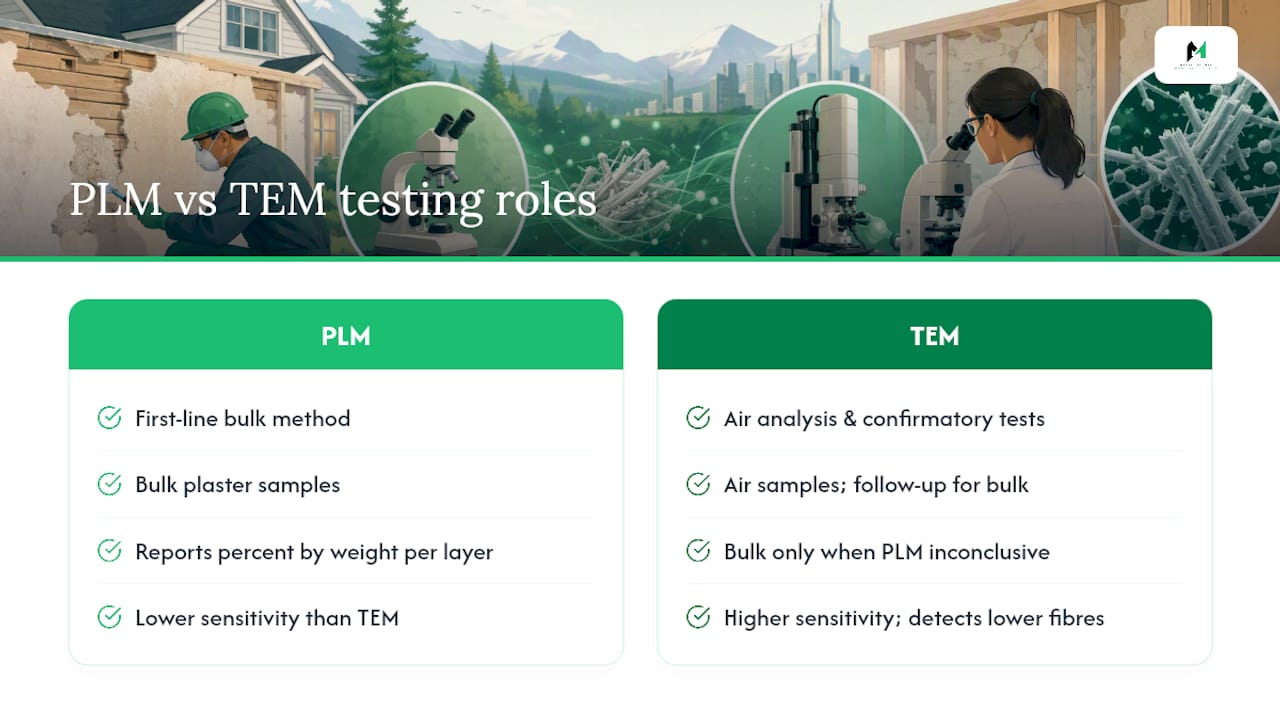
PLM works by passing polarised light through a prepared sample and identifying fibre type by optical properties. It reports asbestos content as a percentage by weight per layer. The 1% threshold, referenced in U.S. EPA guidance on multilayer plaster systems and adopted in Canadian regulatory practice, is the line between regulated ACM and non-regulated material.
PLM vs. TEM: when each applies
Transmission electron microscopy (TEM) can detect lower fibre counts than PLM and is used for air sample analysis or when PLM results are inconclusive. For bulk plaster samples, PLM is the standard first-line method. TEM is typically reserved for clearance air testing after abatement, where confirming very low fibre concentrations matters for reoccupation decisions.
Why layered sampling matters
A plaster wall is not a single homogeneous material. Each distinct layer must be sampled and tested separately because asbestos content can vary significantly from the scratch coat to the finish coat. A lab report that composites all layers into a single result can mask a positive layer and lead to a false sense of safety.
Pro Tip: When you receive a lab report, check that it lists each layer separately with its own percent-by-weight figure and fibre type. A report that gives only a single composite result for a multilayer sample is not adequate for regulatory or remediation decisions.
A contractor’s perspective on plaster asbestos jobs
The calls that concern me most are the ones that come after the fact. A homeowner has already spent a weekend sanding down old plaster walls, and now they want to know if they should be worried. The honest answer is: it depends on what the test shows, but the disturbance has already happened.
A typical job starts with a site visit and bulk sampling before any work begins. The sampler takes cores from each distinct layer, the lab returns PLM results within a week, and from there the decision tree is straightforward: intact and low-risk means manage in place with a monitoring plan; friable or above 1% means regulated abatement with containment, negative air, and a third-party clearance test before anyone reoccupies the space. The clearance test is not optional. It is the document that protects both the homeowner and the contractor.
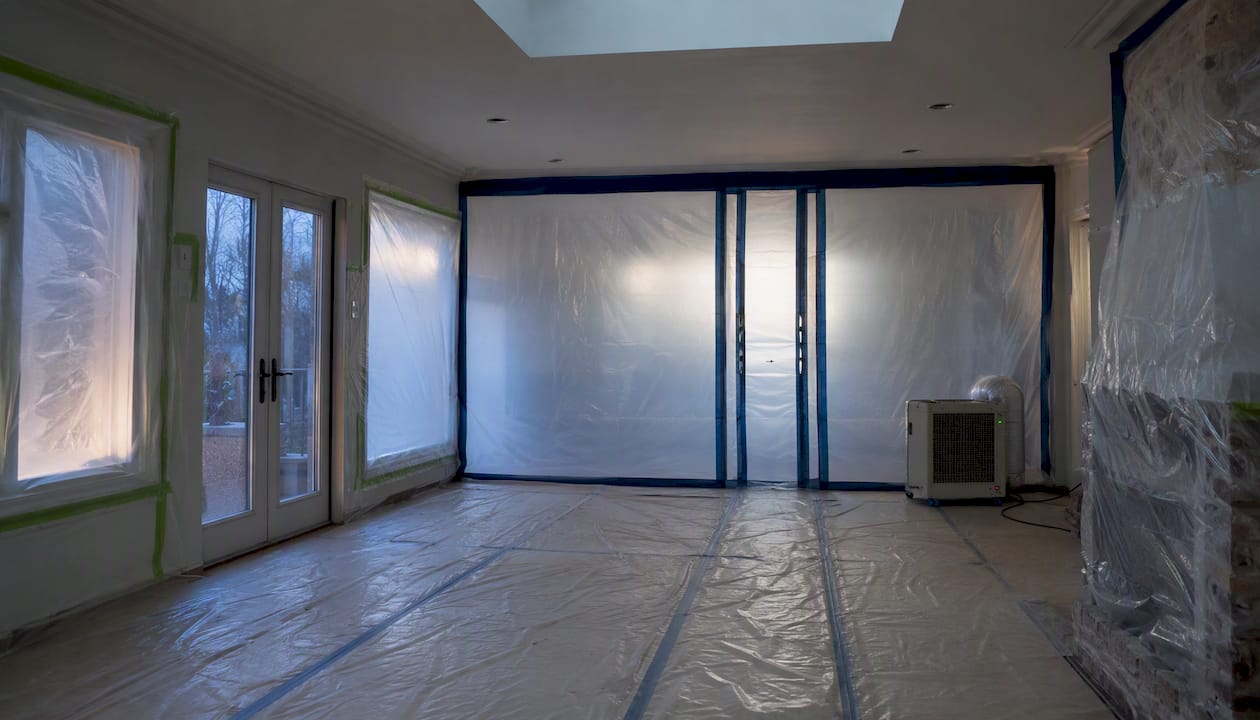
What surprises most homeowners is how often a patched area tests differently from the original plaster. A 1970s repair done with a different compound can be the only positive layer in an otherwise clean wall. That is exactly why sampling each layer separately matters.
MSN Environmental: testing, abatement, and clearance for Ontario homeowners
When asbestos turns up in plaster, the next call should be to a contractor who handles the full sequence: sampling, lab coordination, regulated abatement, and post-abatement clearance testing. That is exactly what MSN Environmental does for residential and commercial clients across Ontario.
MSN Environmental works with ISO/IEC 17025-accredited labs for bulk sampling and PLM analysis, holds the provincial certifications required for Type 1, 2, and 3 asbestos work under Ontario Regulation 278/05, and provides written clearance documentation before any work area is reoccupied. For homeowners who need interior demolition alongside asbestos removal, that work is handled under the same project rather than coordinated across separate contractors. Read why hiring certified professionals matters before you sign any abatement contract. To book an inspection or get a quote, visit MSN Environmental’s asbestos removal services page or contact the team directly at Msnenvironmental.
Sources
- Asbestos — what is asbestos? | CCOHS
- Does plaster have asbestos? A homeowner guide | AsbestosHQ
- Asbestos content in plaster ceilings and walls | InspectApedia
- Asbestos in plaster and wall systems | U.S. EPA
- Vermiculite and asbestos | CCOHS
- WHO: Chrysotile asbestos and health effects (background document)
This article is general information, not a substitute for advice from a qualified doctor. Consult a qualified healthcare professional about your own circumstances before acting on anything here.
FAQ
How can you tell if plaster walls have asbestos?
You cannot tell by looking. The only reliable method is bulk sampling of each plaster layer analysed by PLM in an ISO/IEC 17025-accredited lab. Build year (1950–1982) and textured finishes raise suspicion, but they do not confirm presence.
Does 100-year-old plaster contain asbestos?
Plaster from before 1950 is less likely to contain asbestos than midcentury material, but it is not automatically safe. Some specialty and acoustic products from that era did include asbestos additives, and later repairs or skim coats may have introduced it. Test before disturbing any pre-1985 plaster.
Is a small amount of asbestos exposure dangerous?
A single brief, low-level exposure carries far less risk than repeated or high-concentration exposures, according to WHO documentation on chrysotile asbestos. There is no confirmed safe threshold, however, which is why Canadian regulators require controlled management of any confirmed asbestos-containing material.
What are the first signs of asbestos-related illness?
Asbestos diseases typically have latency periods spanning decades, so early exposure rarely produces immediate symptoms. When symptoms do appear, they often include persistent shortness of breath, a dry cough, or chest tightness. Anyone with known significant asbestos exposure should discuss monitoring with a physician.
What should I do if I have already disturbed suspect plaster?
Leave the area immediately, close the door, and do not re-enter. Do not sweep or vacuum the dust. Contact a licensed abatement contractor such as MSN Environmental to assess the space, arrange air testing, and set up containment if needed before anyone reoccupies the room.