

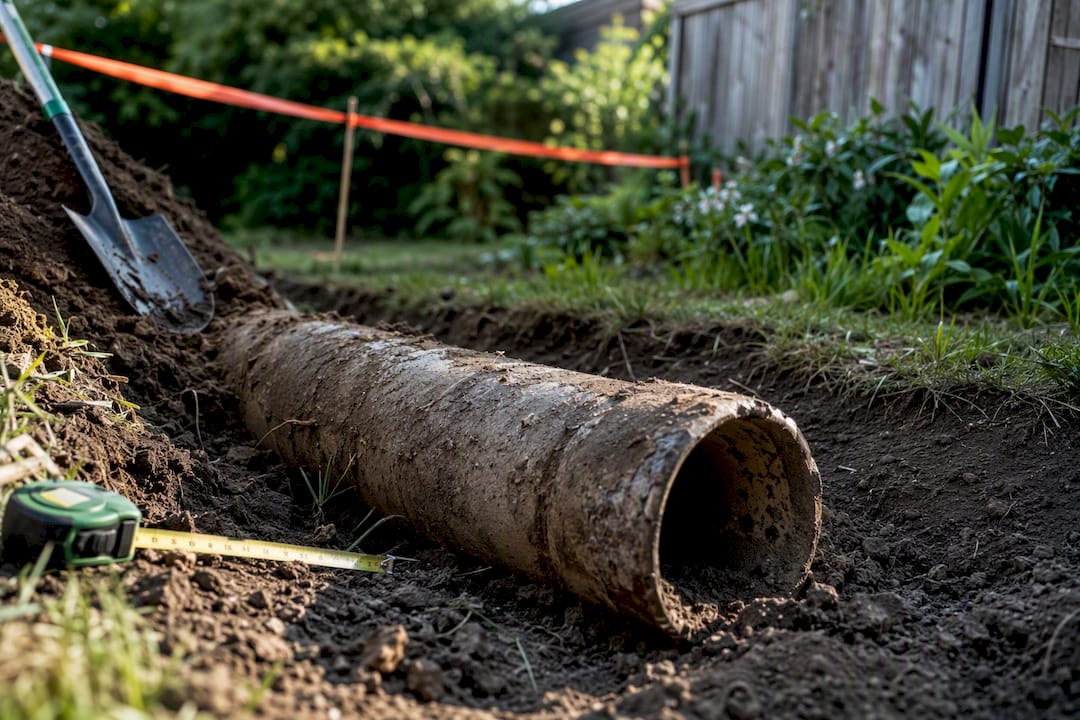
Yes. Transite pipe is asbestos cement, almost always reinforced with chrysotile fibres at loadings that historically ran from the low teens up to around 20% by weight. Intact, buried, or otherwise undisturbed pipe generally poses low immediate risk. The danger starts the moment someone cuts, breaks, or grinds it. If you’re facing disturbance, stop work, isolate the area, and call a licensed asbestos inspector before anyone touches that pipe again.
TL;DR:
- Most transite pipes installed before 1980 are aging and may require replacement or repair, especially if signs of deterioration like leaks or breakage appear.
- Visual inspection and tap tests can help identify potential asbestos cement pipes but must be confirmed through laboratory analysis before disturbance.
- Disturbing or cutting transite pipes releases hazardous asbestos fibers into the air, demanding regulated containment and professional abatement procedures.
- Regulatory frameworks in the US and Canada mandate notification, containment, and disposal protocols for any work involving asbestos cement pipe, with strict oversight from licensed contractors.
- Leaving stable, undisturbed pipes in place is often safer and more cost-effective than unnecessary removal, provided they are not scheduled for excavation or renovation.
Table of Contents
- What is transite pipe asbestos, and when was it installed?
- How common is transite pipe, and how does it break down?
- Do you need to worry about asbestos in drinking water?
- How do you identify transite pipe before touching it?
- What regulations apply once a transite pipe will be disturbed?
- Should you leave transite pipe in place, repair it, or replace it?
- What does transite pipe removal actually cost?
- How MSN Environmental approaches transite pipe projects
- What conventional advice gets wrong about transite pipe
- Get a transite pipe inspection from MSN Environmental
- Sources
- FAQ
What is transite pipe asbestos, and when was it installed?
Transite is a trade name that stuck as the generic term for asbestos cement pipe: a Portland cement matrix reinforced with chrysotile asbestos fibres, moulded into rigid pipe sections for water and drainage systems. The asbestos loading in most formulations sits in the low teens to roughly 20%, though some older manufacturing runs reportedly pushed higher. Eternit was another common brand name used across similar product lines, though the material and hazard profile are functionally identical regardless of the stamp on the pipe.
Manufacturers produced this pipe heavily from the 1930s through the 1970s and into the early 1980s in some regions, before asbestos-cement products fell out of favour. Typical applications include:
- Municipal water mains and residential service lines
- Sanitary and storm sewer piping
- Vent stacks and sewer gas vents
- HVAC duct and flue liners in older commercial buildings
If your property connects to municipal infrastructure installed before 1980, there’s a real chance transite runs somewhere on that line.
How common is transite pipe, and how does it break down?
Asbestos cement pipe was one of the dominant materials for underground water distribution across North America for roughly five decades, which means a large share of legacy infrastructure still relies on it. Utilities that never fully replaced their networks are now managing pipe well past its intended lifespan.
Expected service life for AC pipe typically falls in the 50 to 70 year range, and a lot of what went into the ground mid-century is now aging out of that window. Deterioration accelerates under specific conditions:
- Aggressive or acidic soil chemistry that erodes the cement matrix
- Soft or corrosive water that leaches cement binder from the pipe interior
- Repeated freeze-thaw cycling in shallow-buried sections
- Physical stress from nearby excavation or ground settlement
Utilities watching for these signs usually see it first in the break record: more frequent leaks, sudden main failures, and pipe sections that snap rather than flex under load. That pattern is often the first clue a network needs a serious look, not just a patch job.
Do you need to worry about asbestos in drinking water?
Inhalation is the hazard that matters. Health authorities including the World Health Organization and Health Canada treat airborne asbestos fibre exposure as the established route linked to mesothelioma and lung disease, while the evidence connecting ingested asbestos fibres in drinking water to health harm remains far less conclusive. That distinction shapes almost every regulatory decision made about this material.
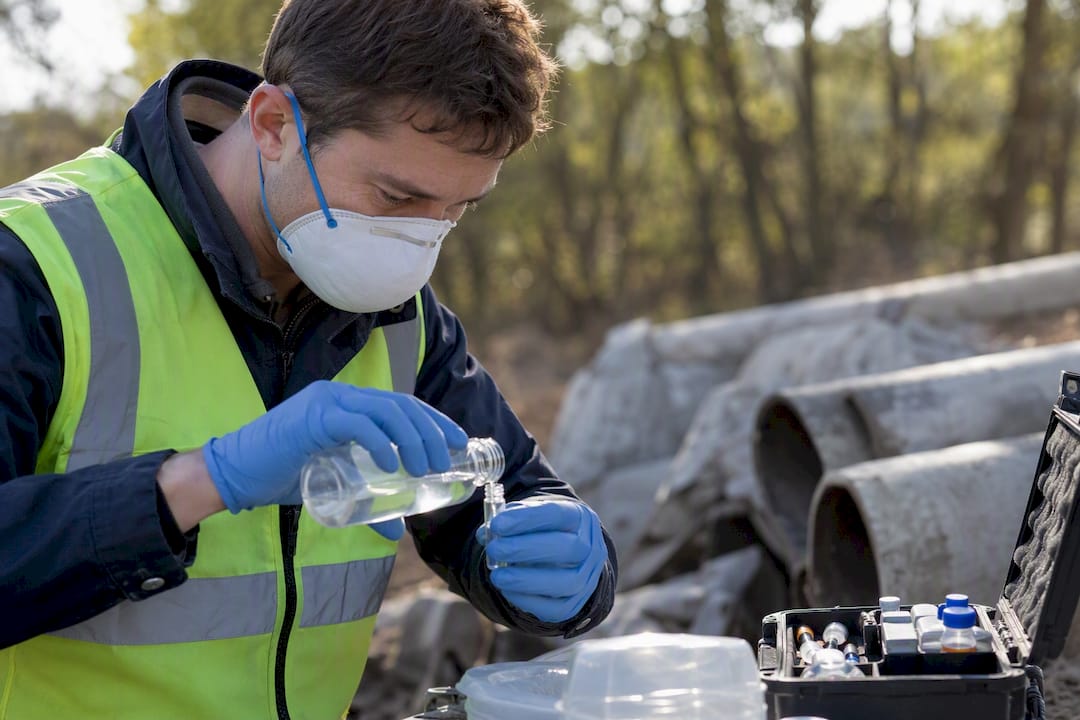
Statistic Callout: Intact, undisturbed AC pipe generally does not push finished-water asbestos fibre counts above regulatory limits, according to testing summarized by industry guidance on the material. The pipe simply doesn’t shed fibres into water under normal, stable conditions.
That said, deterioration introduces problems that have nothing to do with asbestos directly. Some transite pipe installations included a vinyl lining, and as that lining ages, it can leach PCE (a chlorinated solvent) into water, creating a water-quality issue distinct from fibre release. This has pushed some utilities to reline or replace sections purely on water-quality grounds, separate from any asbestos concern.
Here’s the point that actually matters for anyone standing near a transite pipe with a shovel or a saw: the moment that pipe is disturbed, everything changes.
- Cutting, grinding, or breaking transite releases respirable chrysotile fibres directly into the air
- Dry demolition or uncontrolled excavation is the highest-risk scenario
- Airborne fibre exposure is cumulative and has no established safe threshold
- Any planned disturbance requires regulated containment and monitoring, not guesswork
Ingesting a few fibres from tap water is a minor, unsettled question. Breathing in a cloud of them from a cracked pipe is not.
How do you identify transite pipe before touching it?
You can narrow things down visually before ever bringing in a lab, but visual inspection alone should never be your final answer.
- Check the colour and texture. Transite typically shows a uniform grey, cementitious surface, sometimes with a faint fibrous grain visible where the coating has worn.
- Look at the joints. Bell-and-spigot connections are common on transite mains, distinct from the threaded or soldered joints typical of metal pipe.
- Try the tap test. Tapping AC pipe produces a dull thud, while metal pipe rings with a metallic tone. It’s a useful field cue, not proof.
- Note the diameter and era. Municipal AC mains commonly run 4 to 16 inches in diameter, consistent with construction records from the 1930s through the 1970s.
- Stop there. Visual and tap-test clues narrow the possibilities. They don’t confirm anything.
Confirmation requires bulk sampling analyzed by polarized light microscopy at an NVLAP-accredited laboratory, which typically returns results within a few business days depending on lab volume.
Pro Tip: Never chip, scrape, or cut a suspect pipe just to “get a look inside.” That single act can turn a low-risk situation into an active inhalation hazard. Leave sample collection to a professional using wet methods and proper containment.
What regulations apply once a transite pipe will be disturbed?
Once you’re past identification and into actual disturbance, this stops being a DIY decision. In the United States, NESHAP under 40 CFR Part 61, Subpart M governs demolition and renovation involving asbestos-containing material, and OSHA 29 CFR 1926.1101 sets worker exposure limits and required controls for construction activity. Provincial and municipal rules frequently add stricter thresholds on top of the federal baseline, so the applicable rule in your jurisdiction may be tighter than either framework alone.
Certain quantities of disturbed material trigger written notification requirements before work starts, along with a cascade of procedural obligations:
- Establishing a regulated work area with restricted access
- Using wet methods to suppress fibre release during cutting or breaking
- Requiring respiratory protection rated for asbestos work
- Conducting air monitoring during and after the activity
The single most reliable protection for a property owner facing a transite pipe disturbance is professional inspection followed by licensed abatement, not a homeowner’s best guess about risk.
Recordkeeping matters just as much as the physical controls. Proper NESHAP notification paperwork and signed waste manifests aren’t bureaucratic overhead. They’re the documentation that proves the job was done to standard, which is exactly why hiring a licensed abatement contractor rather than a general contractor is worth insisting on.
Should you leave transite pipe in place, repair it, or replace it?
Not every transite pipe needs to come out of the ground tomorrow. Here’s how to think through the decision:
- Leave in place (abandon in place) when it’s appropriate. Pipe that’s stable, undisturbed, and not scheduled for nearby excavation can often stay put indefinitely with periodic monitoring.
- Repair when disturbance is limited. Point repairs using containment collars or sleeve fittings can address a localized leak without wholesale replacement, provided the repair method doesn’t require extensive cutting.
- Replace via open trench with wet-cutting when full removal is warranted. This traditional method allows controlled, wetted cutting of pipe sections under regulated conditions, minimizing airborne fibre release during removal.
- Consider close tolerance pipe slurrification (CTPS) for a trenchless alternative. This approach reduces surface disruption in urban settings, an advantage where excavation would tear up roadways or landscaping.
- Avoid pipe bursting. The U.S. EPA has flagged burst-and-break methods as capable of rendering transite friable in ways that conflict with NESHAP requirements.
Whichever route you take, insist on documentation afterward: an inspection report, signed waste manifests, and clearance air testing before the site is called done.
What does transite pipe removal actually cost?
Costs swing widely based on diameter, depth, and how much surface restoration a job requires. Small residential point repairs can run a few thousand dollars, while full municipal main replacement can climb into the tens or even hundreds of dollars per linear foot, depending on method and site complexity.
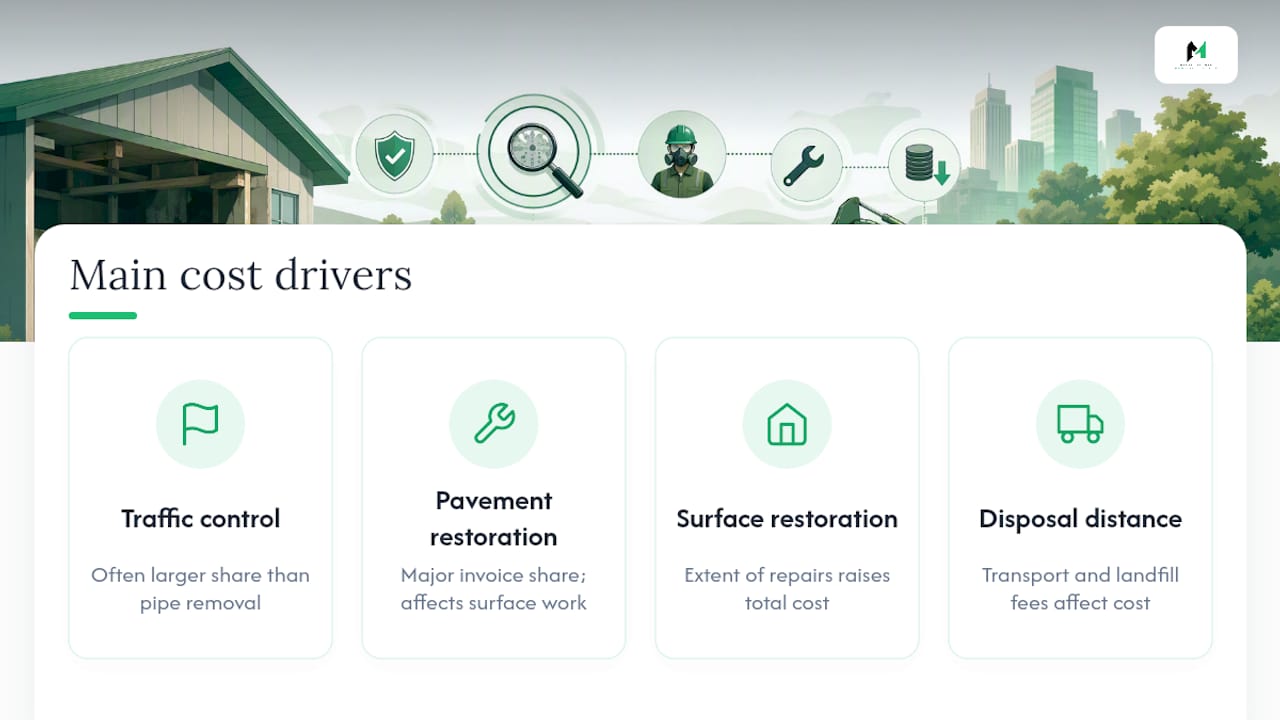
Statistic Callout: Diameter and depth aren’t the only cost drivers. Traffic control, pavement restoration, and disposal distance often account for a larger share of the invoice than the pipe removal itself.
Disposal isn’t a simple dumpster run either. Asbestos-concrete debris requires double-bagging or equivalent containment, and landfill acceptance varies by facility, some sites charge premiums or refuse asbestos waste outright. Waste manifests track the material from removal to final disposal, and transport distance to an accepting facility can meaningfully affect total project cost.
Trenchless methods like CTPS often carry a higher per-unit cost than open trenching, but that premium buys lower surface restoration expense and less disruption to traffic or landscaping, a trade-off worth running the numbers on before choosing a method.
How MSN Environmental approaches transite pipe projects
MSN Environmental combines trained technicians with laboratory-confirmed testing protocols, drawing on NESHAP notification experience and full waste manifesting on every abatement project. That combination matters because a contractor who documents the process properly is a contractor who can prove the job met standard.
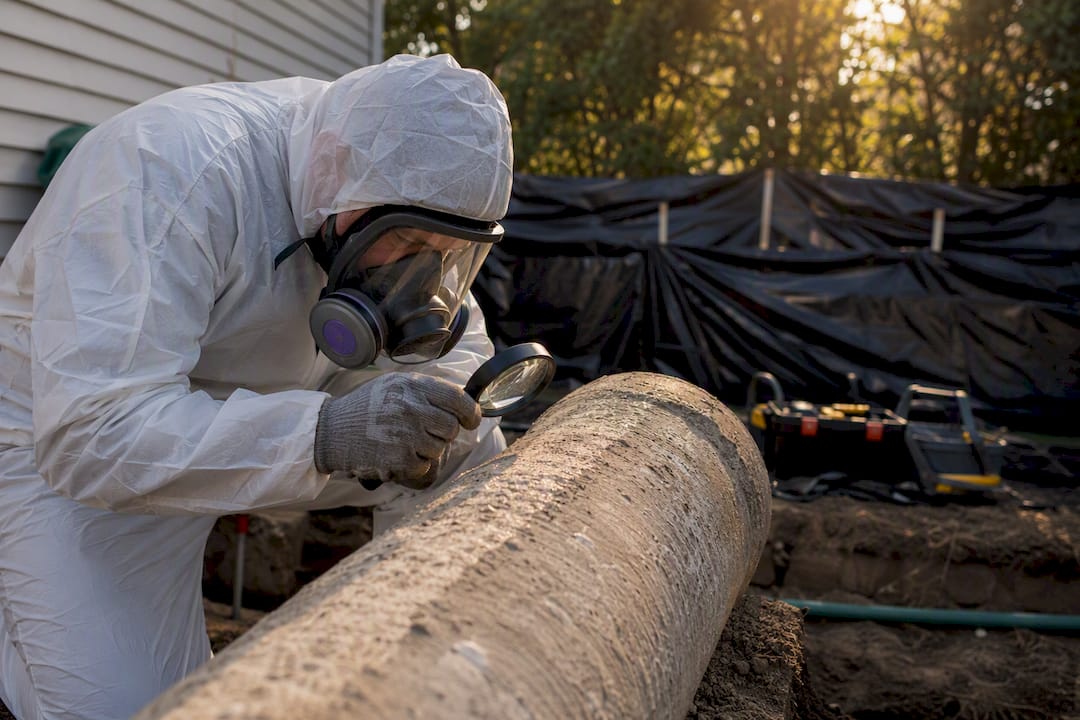
The typical path runs: inspection, sampling sent for polarized light microscopy analysis, a scope and quote, NESHAP notification where required, controlled removal or containment, disposal with full documentation, and post-work clearance testing.
What conventional advice gets wrong about transite pipe
Most guidance on transite pipe treats it as a binary: either it’s a ticking time bomb or it’s nothing to worry about. Neither framing holds up. The pipe sitting quietly under your lawn for the last sixty years isn’t the threat. The threat shows up the day someone rents an excavator to fix a leak and doesn’t know what they’re cutting into.
That’s the gap I’d push readers to close first. Testing before disturbance isn’t a bureaucratic checkbox, it’s the one step that separates a routine repair from an emergency abatement scenario. Untrained crews trigger exactly that outcome more often than people realize, because a fractured transite section goes from stable to friable in seconds, and airborne fibre counts spike fast without wet methods and containment already in place.
The other misconception worth correcting: people assume replacement is always the responsible choice. It isn’t. Leave-in-place management is often the safer, cheaper, and more defensible option for stable pipe that isn’t scheduled for excavation. The judgment call isn’t asbestos versus no asbestos. It’s disturbance versus no disturbance, and that’s a decision worth making with a professional inspection in hand, not a guess.
— Moacyr
Get a transite pipe inspection from MSN Environmental
If you’ve got a suspect pipe on your property and no way to confirm what it’s made of, that uncertainty is exactly the problem MSN Environmental solves. Rather than guessing based on age or a tap test, our technicians collect bulk samples, send them for polarized light microscopy analysis, and give you a clear answer along with a documented path forward if abatement is needed.
Reaching out is straightforward: describe the pipe’s location, age if known, and whether any excavation or renovation is planned nearby. That’s enough for our team to scope an inspection and outline next steps, including NESHAP notification if the project requires it. From there, you get a full asbestos removal plan covering testing, controlled removal or containment, disposal manifesting, and clearance testing before the site is signed off. If a plumbing contractor is already involved in the project, coordinating early on avoiding code violations during repair work can save a second trip back to the site. Request a quote today and get a professional inspection scheduled before any work near that pipe begins.
This article is general information, not a substitute for advice from a qualified doctor. Consult a qualified healthcare professional about your own circumstances before acting on anything here.
Sources
- Asbestos in water and asbestos cement water pipes — Safe Drinking Water Foundation
- Transite pipe guide: identification, risk, and removal | AsbestosHQ
- U.S. EPA Asbestos Cement (AC) Pipe Replacement (EPA memo)
- Asbestos transite pipe ID & hazards — InspectApedia
FAQ
How can you tell if a pipe has asbestos?
Visual cues like a grey cementitious surface, bell-and-spigot joints, and a dull thud on the tap test suggest asbestos cement pipe, but only bulk sampling analyzed by polarized light microscopy at an accredited lab confirms it.
When was transite pipe commonly used?
Transite pipe saw its heaviest use from the 1930s through the 1970s, with some installations continuing into the early 1980s, mainly in municipal water mains, service lines, and sewer vent systems.
What is transite made of?
Transite is asbestos cement: a Portland cement matrix reinforced with chrysotile asbestos fibres, typically making up somewhere in the low teens to around 20% of the material by weight.
Is it safe to drink water from transite pipes?
Intact, undisturbed transite generally does not raise finished-water asbestos fibre counts above regulatory limits, though deteriorated linings can introduce separate water-quality concerns unrelated to asbestos content.
Do I need a permit to remove transite pipe?
In most jurisdictions, yes. Disturbance triggers notification requirements under frameworks like NESHAP and OSHA 29 CFR 1926.1101, and provincial or municipal rules can add stricter obligations, which is why hiring a licensed abatement contractor rather than a general contractor matters.