

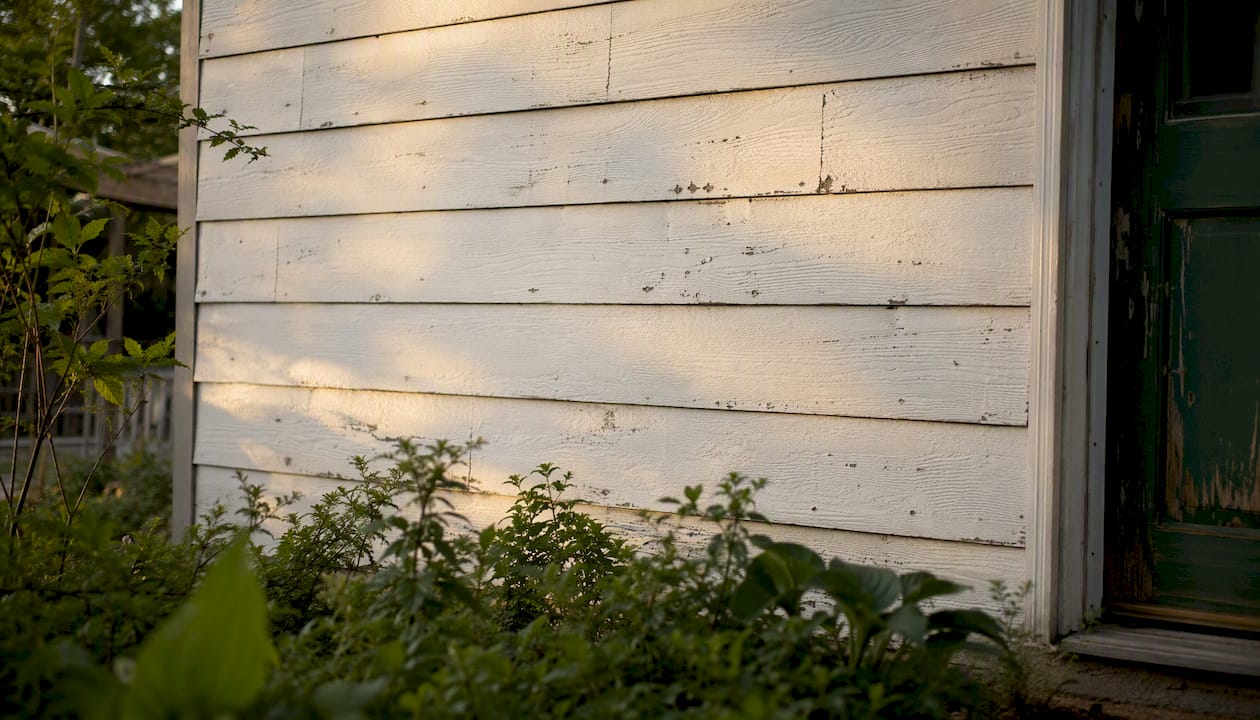
Asbestos cement siding is exactly what it sounds like: cement board or shingles reinforced with asbestos fibres for strength and fire resistance. If your home has it and the panels are intact, painted, and undamaged, it’s generally stable and not an active health threat. The one rule that matters right now: leave it alone.
Don’t sand it, pressure-wash it, cut it with a power saw, or pry off a chunk to “check.” Any of those actions can break brittle fibres loose into the air, and that’s when the material shifts from harmless-looking wall covering to a genuine inhalation hazard. If you suspect you have it, your job today is simple: restrict access to the area (keep kids, pets, and contractors away from any repairs or holes), photograph the condition, and arrange for testing or a professional assessment before anyone touches it with tools.
- Don’t sand, grind, saw, or drill into the siding.
- Don’t power-wash or scrub it aggressively.
- Don’t break, snap, or pry off a piece to inspect it up close.
- Do note any cracked, crumbling, or missing sections and keep people away from them.
- Do book a bulk sample test or professional inspection before any renovation, repair, or removal.
Pro Tip: If your home was built or re-sided before the late 1970s and the siding feels heavy, brittle, and cement-like rather than flexible or fibrous, treat it as likely asbestos-cement until a lab says otherwise. Age plus texture is the fastest gut-check you can do without touching a thing.
Key Takeaways
Safe handling of asbestos cement siding depends on one core principle: intact material left undisturbed is low risk, while cutting, sanding, or pressure-washing it creates the exposure that causes disease.
| Point | Details |
|---|---|
| Leave intact siding alone | If panels are painted and undamaged, monitoring beats disturbing them. |
| Never use power tools or pressure washers | Sanding, cutting, or power-washing turns stable cement into airborne fibres. |
| Test before you renovate | A bulk sample sent to an accredited lab is the only definitive identification method. |
| Match the option to the condition | Leave in place, cover, or remove, based on damage level and renovation plans. |
| Hire licensed abatement for removal | MSN Environmental provides testing, containment, HEPA-filtered removal, and disposal documentation for Ontario homeowners. |
Table of Contents
- What is asbestos cement siding, exactly?
- How can I tell if my siding contains asbestos?
- Is asbestos cement siding dangerous to live with?
- Should I get my siding tested for asbestos?
- Leave it, cover it, or remove it: which option fits your situation?
- What does professional asbestos abatement actually involve?
- What should I never do myself around asbestos siding?
- How do you choose a qualified asbestos abatement contractor?
- What regulations and disposal rules apply to asbestos siding?
- Why we recommend caution over confidence
- Get a professional assessment before you touch a single panel
- Sources
- FAQ
What is asbestos cement siding, exactly?
Asbestos cement siding is a cementitious building product, usually formed into flat panels or shingles, where asbestos fibres were mixed into the cement slurry during manufacturing. The fibres added tensile strength and fire resistance that plain cement board couldn’t match on its own, which is exactly why builders loved it for exterior cladding for most of the mid-20th century.
The best-known brand name tied to this material is Transite, manufactured for decades by Johns-Manville, one of the largest asbestos product makers in North America. Transite siding, along with similar products from other manufacturers, was marketed on durability and low maintenance, and it delivered on both. Many of these panels are still doing their job on homes 60 or 70 years later, which is part of why this conversation keeps coming up: the stuff simply doesn’t wear out the way wood siding does.
- Manufactured chiefly throughout much of the mid-20th century, roughly from the 1920s through the late 1970s
- Sold as both flat panels and individual shingles, often in a shiplap or wavy-edge pattern.
- Prized for fire resistance and rot resistance, unlike wood clapboard.
- Phased out as asbestos health risks became undeniable and regulations tightened through the 1970s and 1980s.
Modern fibre-cement siding, like James Hardie’s HardiePlank, looks remarkably similar from the curb: same rigid board format, same painted finish, same wood-grain texture options. The difference is entirely in the formulation. Post-1980s fibre-cement products replaced asbestos fibres with cellulose or synthetic fibres, so a HardiePlank installation from last year carries zero asbestos risk. That visual overlap is precisely why so many homeowners can’t tell their siding apart just by looking at it, and why age of installation matters as much as appearance.
How can I tell if my siding contains asbestos?
Start with the physical clues, but understand upfront that none of them, alone or together, gives you certainty. Asbestos-cement panels are rigid and notably heavy for their size, with a brittle, almost slate-like feel rather than the slight flex you’d get from vinyl or wood. Broken edges tend to look jagged and fibrous rather than clean, and the surface often shows a subtle wavy or striated wood-grain texture pressed into the cement during manufacturing.
Panel and shingle sizing offers another clue. Original asbestos-cement shingles commonly measured around 12 inches by 24 inches, laid in overlapping rows much like traditional wood shingles. If your siding matches that rough dimension, sits under decades of paint layers, and the house dates to before the late 1970s, the odds shift meaningfully toward asbestos content.
Here’s the catch, though: visual inspection alone cannot reliably distinguish asbestos-cement siding from asbestos-free fibre-cement. They can look, feel, and weather almost identically. And many older homes have a patchwork history: original asbestos shingles mixed with later repair panels that contain no asbestos at all, so testing only the newest-looking section can give you a false sense of security.
- Rigid, brittle panels or shingles, heavier than vinyl or engineered wood.
- Wavy, striated, or wood-grain surface texture under the paint.
- Panel or shingle size close to 12" x 24", especially on pre-1980 homes.
- Sharp, fibrous edges where the material has chipped or broken.
- A home built or re-sided during much of the mid-20th century
Never chip, sand, or power-wash a section to get a better look. That impulse to “just check” is precisely the action that turns a stable material into an airborne hazard. If you want a closer visual read, take a photo at an angle that shows the texture and any broken edges, and leave the physical sample collection to someone trained to do it safely.
Is asbestos cement siding dangerous to live with?
Intact, painted, undisturbed asbestos-cement siding is generally low risk. The Canadian Centre for Occupational Health and Safety notes that intact asbestos-cement material is stable and that removing it can actually introduce more risk than simply leaving it alone. The danger isn’t sitting quietly on your exterior wall. The danger shows up the moment someone disturbs it.
This comes down to a distinction worth understanding: friable versus non-friable. Friable material crumbles easily under hand pressure and releases fibres readily. Non-friable material, which describes most intact asbestos-cement siding, holds its fibres locked in a solid cement matrix. The moment you cut it with a power saw, sand it, smash it during removal, or blast it with a pressure washer, you’re pulverizing that matrix and turning stable, non-friable siding into an airborne fibre source.
Common scenarios that push risk upward include:
- Renovation or re-siding projects where old panels get pried off carelessly.
- Demolition without containment or dust suppression.
- Drilling holes for new fixtures, shutters, or house numbers directly into the siding.
- Using a pressure washer for routine exterior cleaning.
- Storm or impact damage that cracks or shatters panels.
The medical stakes are serious enough that health authorities don’t hedge on this point. The National Cancer Institute states plainly that inhaled asbestos fibres are linked to asbestosis, lung cancer, and mesothelioma, and that no exposure level has been established as safe. Mesothelioma in particular can take decades to develop after exposure, which is part of why prevention, not cleanup after the fact, is the entire strategy.
Should I get my siding tested for asbestos?
Yes, if you’re planning any renovation, repair, or removal, or if the siding shows visible damage. A lab test is the only way to know for certain, because visual identification simply isn’t definitive even for experienced eyes. Testing means taking a small bulk sample and sending it to an accredited lab for polarized light microscopy analysis, which identifies the fibre type and percentage present.
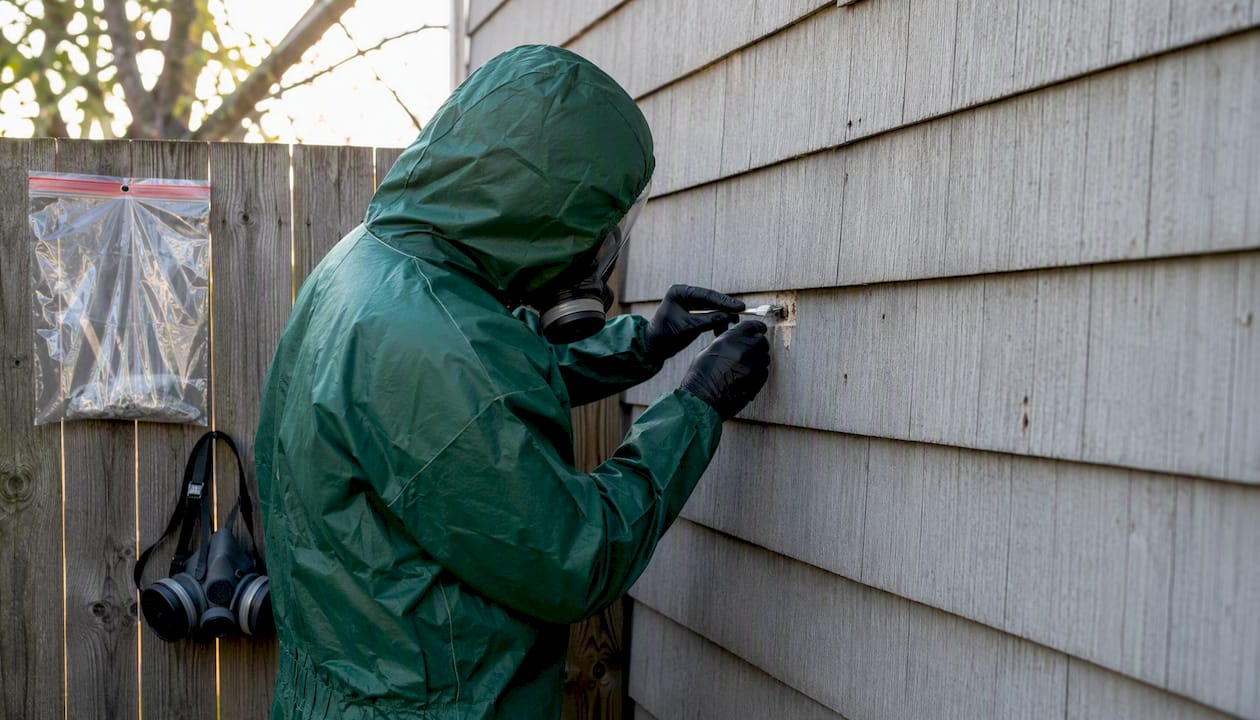
Timing matters here. Test before you re-side, before you drill into the wall for a new deck ledger board, and before any demolition or major exterior renovation. If your siding is already cracked or shedding material, that’s also a trigger to test promptly rather than waiting.
Who should collect the sample matters too. A single small sample from an inconspicuous spot carries some risk, but that risk climbs fast if the material is already deteriorating or if you’re not confident about disturbing it minimally. Professional sampling is the safer route for anything beyond pristine, fully intact panels, and it comes with an added benefit: technicians know to sample from older, original shingles rather than newer repair sections, which avoids the false-negative trap of testing only the part of the house that got re-sided in 1995.
Lab turnaround for bulk sampling typically runs a few business days. If a renovation is already underway or has disturbed material, air sampling may also be recommended to confirm fibre counts in the surrounding environment before work continues or before an area is cleared for reoccupancy. Booking a proper testing and inspection appointment before you touch a single panel saves you from guessing and from potentially expensive mistakes.
Leave it, cover it, or remove it: which option fits your situation?
Most homeowners face one of three paths once asbestos-cement siding is confirmed, and the right answer depends heavily on the material’s condition and your renovation plans, not just personal preference.
If the siding is intact, painted, and you have no immediate renovation plans, leaving it in place is often the smartest move. Disturbing stable material to “get rid of the problem” can create more airborne risk than the material posed sitting there quietly, a point occupational health authorities make explicitly. If the panels are cracking, chalking heavily, or you’re planning a full exterior renovation anyway, covering or encapsulating with new cladding over top is frequently the lower-cost, lower-disruption choice. Full removal becomes necessary when you’re demolishing the structure, doing a major renovation that requires stripping the wall down to sheathing, or when deterioration has progressed to the point where covering isn’t a durable fix.
| Option | Recommended action | Risk level after work | Who should do the work | Cost factors | Timeline / disruption |
|---|---|---|---|---|---|
| Leave in place | Monitor condition annually; repaint as needed | Low, if undisturbed | Homeowner (visual monitoring only) | Minimal, aside from routine maintenance | None |
| Cover / encapsulate | Install new siding over existing panels | Low to moderate | Licensed contractor familiar with layering rules | Size of home, trim and venting adjustments, code compliance | Days to a couple of weeks |
| Remove | Full abatement and disposal | Low, once cleared, but high during active work | Licensed abatement specialist only | Home size, accessibility, number of layers, disposal distance | Several days to a couple of weeks, plus disposal logistics |
Pro Tip: If you’re leaning toward covering rather than removing, check with your local building department first. Adding a second layer of siding changes wall thickness, which affects window and door trim alignment, soffit venting, and sometimes fire-code clearances near property lines. A contractor experienced in this kind of layering catches those details before they become a costly surprise mid-project.
On the resale front, most provinces expect sellers to disclose known material defects, and known asbestos-containing siding often falls into that category. Getting ahead of it with a clean inspection report, whether you choose to leave, cover, or remove, tends to reassure buyers far more than silence does.
What does professional asbestos abatement actually involve?
Licensed abatement work follows a fairly consistent sequence, and understanding it helps you judge whether a contractor’s quote reflects real methodology or a corner-cutting rush job.
- Pre-work survey and scope: the crew confirms which materials are affected, documents the condition, and drafts a written scope of work.
- Containment setup: plastic sheeting and barriers isolate the work zone from the rest of the property, often with negative air pressure for larger jobs.
- Wetting: panels are misted with water (sometimes with a surfactant added) before any handling begins, which suppresses dust and keeps fibres from becoming airborne.
- Manual removal: siding comes off by hand, panel by panel, never with power tools, saws, or grinders.
- Double-bagging and labelling: removed material goes straight into sealed, labelled asbestos waste bags, not loose into a dumpster.
- Decontamination: crews and equipment go through a decon process before leaving the containment zone.
- HEPA filtration and air monitoring: HEPA-filtered vacuums clean the work area, and air monitoring may confirm fibre counts are within acceptable limits before the site is cleared.
- Disposal: bagged waste is transported to a landfill licensed to accept asbestos-containing material, with disposal receipts kept on file.
This methodology exists because containment, wet removal, and controlled handling measurably reduce fibre release compared with uncontrolled demolition. A homeowner tearing off panels dry, dropping them into a truck bed, is doing the exact opposite of every one of these steps at once.
Once the job wraps, you should walk away with a documentation package: a waste manifest showing where the material went, lab results if air monitoring was part of the job, disposal receipts from the accepting landfill, and a clearance report if one was required. If a contractor can’t produce these, that’s worth noticing.
- Pre-work survey and written scope
- Waste manifest and disposal receipts
- Air monitoring results, if performed
- Final clearance documentation
Cost and timeline swing on a handful of factors: total square footage of siding, how accessible the walls are (a simple bungalow versus a home with tight setbacks or a steep roofline), whether there are multiple layers of siding stacked on top of each other, and how far the crew has to haul waste to a landfill that accepts it. A detailed pricing breakdown for Ontario abatement projects can help you set realistic budget expectations before you start collecting quotes.
What should I never do myself around asbestos siding?
If you need to do minor yard work, hang a light fixture, or handle an unrelated repair near suspected asbestos siding before professionals arrive, a short list of hard limits keeps you safe in the meantime.
- Never sand, saw, grind, drill, or cut into the siding, even for a “small” job like mounting a mailbox bracket.
- Never power-wash it, not even on a low setting. High-pressure water is aggressive enough to pit and pulverize cement over time.
- Never hit it with a hammer, ladder, or falling object if you can help it. Impact damage is one of the most common accidental triggers of fibre release.
- Wetting a small area lightly can suppress dust temporarily if you must brush against it, but this is not a substitute for proper containment.
- If brief proximity to damaged material is genuinely unavoidable, disposable coveralls and a properly fitted N95 or P2 respirator reduce your personal exposure, though this is a stopgap, not a solution.
Where DIY control genuinely runs out is anywhere the material is already broken, crumbling, or about to be disturbed at scale. A cracked corner panel you can photograph and leave alone is manageable. A wall full of siding that needs to come off for a renovation is not a weekend project, no matter how capable you are with tools.
Common mistakes that cause real fibre release include using a pressure washer for routine cleaning, tearing off old siding with a pry bar and letting panels crack as they drop, and cutting new window or vent openings straight through existing panels without checking what’s underneath first. Every one of these feels like ordinary home maintenance until the material turns out to be asbestos-cement, at which point it becomes a cleanup problem instead of a five-minute task.
How do you choose a qualified asbestos abatement contractor?
Not every contractor who says “I can handle that” actually should. A few credentials and questions separate the ones worth hiring from the ones worth walking away from.
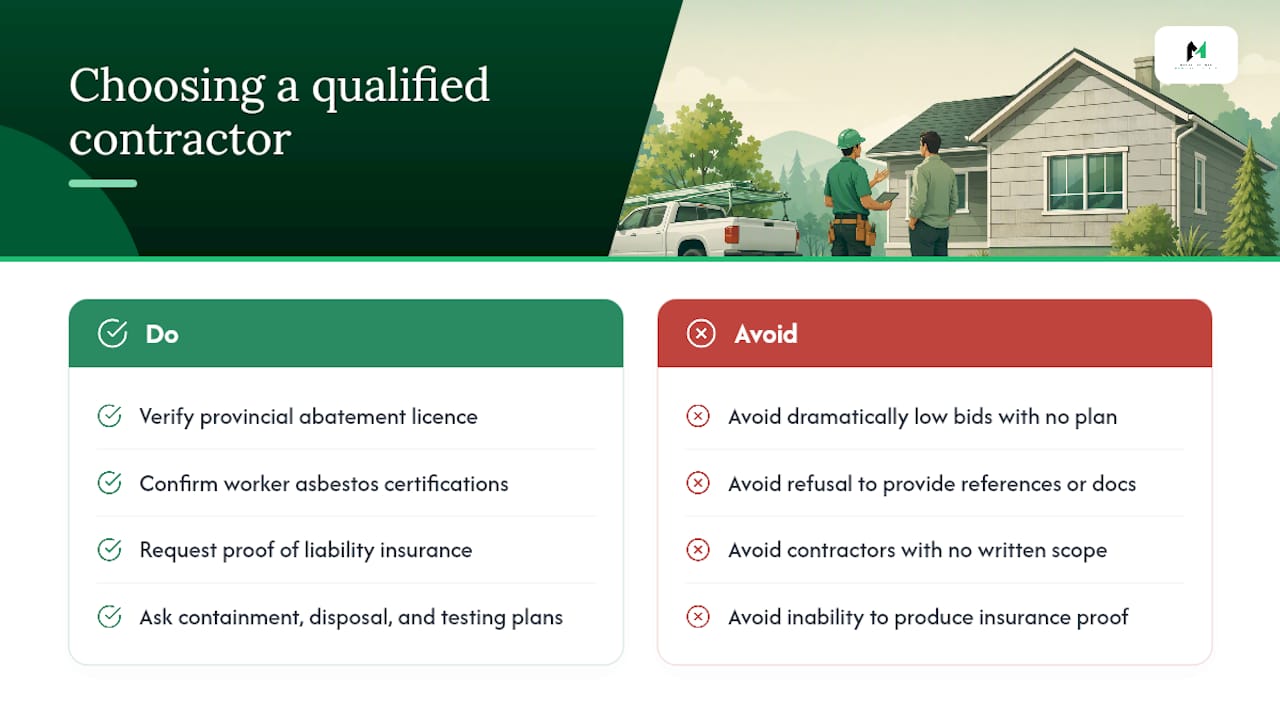
Look for a contractor holding the appropriate provincial licensing for asbestos abatement work, along with worker certifications specific to asbestos handling and current liability insurance. Ask how long they’ve worked on residential siding specifically, since commercial demolition experience doesn’t always translate to the careful, small-scale work a house re-siding job demands.
During the estimate, ask direct questions: What containment and wet-removal methods will you use? Where does the waste go, and is that landfill licensed to accept asbestos material? Will I receive a waste manifest and disposal receipts? Is air monitoring or clearance testing included, or available as an add-on? A contractor who answers these clearly and specifically, without hesitation, is usually one who does this work regularly.
Red flags are just as telling. Watch for a bid that comes in dramatically lower than others with no explanation of containment or disposal plans, reluctance to provide references or show past inspection documentation, no written scope of work, or an inability to produce proof of insurance on request. Any of those should send you looking elsewhere. Reviewing licensed removal service standards before you start collecting quotes gives you a useful benchmark for what a proper process actually looks like.
What regulations and disposal rules apply to asbestos siding?
Disposal and certain removal activities are regulated, but the specific rules vary by province and municipality, so confirming local requirements before work starts is not optional. What holds broadly true is that once asbestos-cement material is broken, cracked, or otherwise disturbed, it typically gets reclassified as regulated asbestos-containing material, which triggers different handling, notification, and disposal obligations than intact material would.
A few things worth checking before any renovation or demolition:
- Whether your municipality requires a permit or notification for renovation or demolition involving known asbestos materials.
- Which local landfills are licensed to accept asbestos waste, since not all facilities do.
- Whether documentation (manifests, receipts) is required to prove lawful disposal.
- Any provincial workplace safety rules that apply if you’re hiring workers, even for a small residential job.
If you’re unsure where to start, three calls usually get you the answers: your local building department for permit requirements, your provincial workplace safety or environmental agency for handling rules, and a licensed abatement contractor who deals with these regulations daily and can walk you through what applies to your specific project.
Why we recommend caution over confidence
Homeowners often want a fast answer: is this dangerous, yes or no? The honest answer is almost always “it depends on whether you touch it,” and that nuance gets lost in a lot of the advice circulating online. We’d rather give you the slightly less satisfying, more accurate picture than a false sense of certainty in either direction.
What concerns us most isn’t the siding sitting quietly on a 1960s bungalow. It’s the well-meaning homeowner who rents a pressure washer for a Saturday project, or the contractor who quotes a same-day tear-off without mentioning containment. Every abatement project MSN Environmental has handled reinforces the same lesson: the sequence matters as much as the intent. Wetting before removal, containing before disturbing, testing before assuming. Skip any one of those steps and you’ve turned a manageable material into a genuine exposure event.
If your siding shows any damage, or if you’re planning renovation work that will touch it, get a professional assessment rather than relying on forum advice or a quick visual check. The cost of proper testing is small compared to the cost, financial and otherwise, of getting it wrong.
Get a professional assessment before you touch a single panel
If your siding turns out to be asbestos-cement and needs attention, MSN Environmental gives you a documented, licensed path from uncertainty to a clean, disposal-verified result, without the guesswork of DIY testing or the liability of hiring someone unlicensed.
Our process starts with a site assessment and bulk sampling sent to an accredited lab, followed by a written estimate that spells out containment methods, timeline, and disposal plans before any work begins. If removal is the right call, our crews handle wetting, manual removal, HEPA filtration, and disposal at a landfill licensed to accept asbestos waste, and you receive full clearance documentation and disposal receipts when the job wraps. That’s the same paperwork trail we’d tell you to demand from any contractor, because it’s the difference between a job done properly and one you’ll be worrying about later.
Services relevant to asbestos-cement siding include testing and inspection, licensed abatement and removal, containment and disposal, and post-removal clearance testing. If you’ve found suspected asbestos siding and want a straight answer instead of a guess, read the top reasons to hire certified hazardous materials professionals and book an inspection through MSN Environmental to get a written quote for your specific siding and property.
Sources
- Asbestos — Canadian Centre for Occupational Health and Safety (CCOHS)
- Asbestos and Cancer — National Cancer Institute
- Asbestos Cement Siding or Shingles Identification — InspectApedia
- Compliance Advisory — Asbestos Cement (Transite) Siding and Roofing — BAAQMD
- Is My Siding Asbestos? (Transite / Asbestos-Cement) | AsbestosIndex
FAQ
How can I tell if my siding is asbestos?
Look for rigid, brittle panels or shingles around 12 by 24 inches, a wavy or wood-grain texture, and a home built or re-sided before the late 1970s. These clues suggest asbestos-cement siding, but only a lab test of a bulk sample confirms it.
Is it safe to put new siding over asbestos siding?
Yes, in most cases covering existing asbestos-cement siding with new cladding is a recognized, safer alternative to removal, since it avoids disturbing the material. Check local building codes first, since added thickness can affect trim, venting, and window clearances.
Do I need to remove asbestos siding if it’s not damaged?
Not necessarily. Intact, undisturbed asbestos-cement siding is generally stable, and health authorities note that removal can introduce more risk than leaving it in place when the material is in good condition.
How much does asbestos siding removal cost?
Cost depends on home size, accessibility, number of siding layers, and disposal distance to an approved landfill. A detailed Ontario pricing guide breaks down these cost factors for homeowners budgeting a project.
Can I test asbestos siding myself?
You can collect a small sample from an inconspicuous spot, but professional sampling is safer for damaged or deteriorating material and ensures older, original shingles get tested rather than newer repairs. MSN Environmental’s testing and inspection services handle this safely and send samples to accredited labs.