

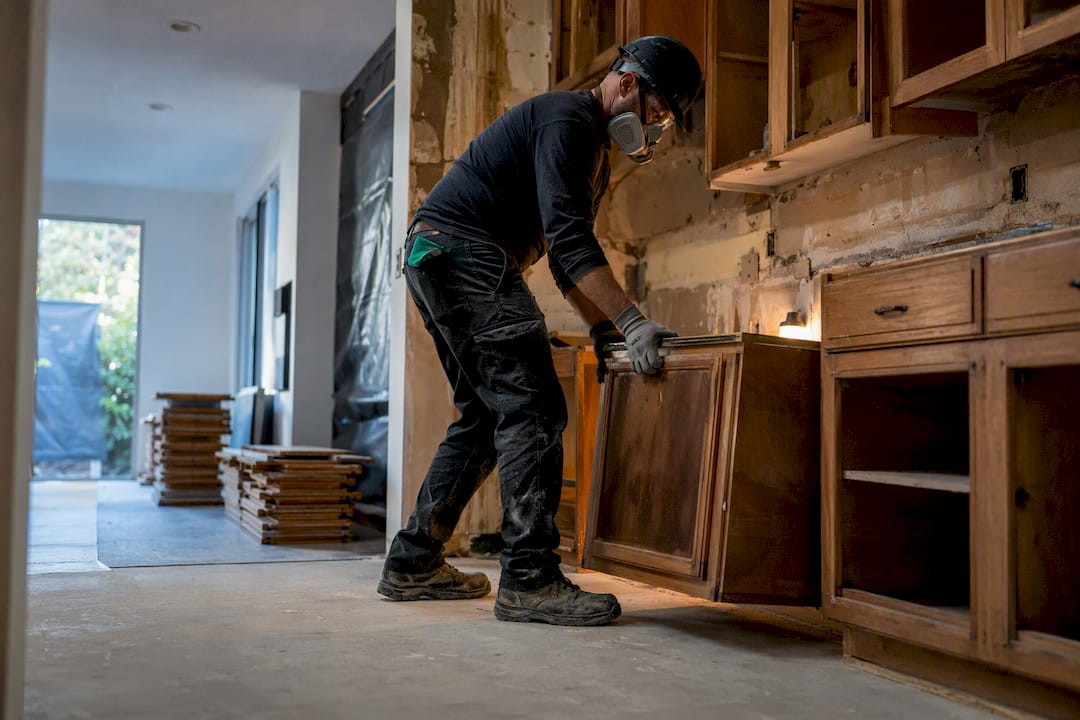
Soft strip demolition is the removal of a building’s non-structural elements, walls, ceilings, flooring, fixtures, wiring, while leaving the structural frame standing. It applies to fit-outs, renovations, and pre-demolition clearing alike. The single rule that matters most is this: if there’s any chance the building contains asbestos, lead paint, or mould, treat the job as a demolition project from day one, not a casual gut job, because that changes what surveys and licensed work are required before anyone picks up a crowbar.
TL;DR:
- Soft strip demolition removes only non-structural elements, such as interior walls, ceilings, flooring, and fixtures, leaving the load-bearing structure intact.
- Hazardous materials like asbestos, lead paint, or mold require licensed abatement and proper clearance testing before or during soft strip work.
- Proper site preparation includes utility disconnection, permits, utility utility notification, site protection, and obtaining relevant surveys and documentation upfront.
- For buildings built before the 1990s, conducting an asbestos survey is essential, and licensed professionals should handle hazardous material removal if identified.
- Contractors should provide a clear containment strategy, experienced air testing, and licensed waste handling to ensure safety and regulatory compliance.
Table of Contents
- What does soft strip demolition actually remove?
- Soft strip or full demolition: which one do you need?
- How does a soft strip project actually run, start to finish?
- What health risks come with soft strip demolition, and how are they controlled?
- How do you prepare your site before soft strip work starts?
- When should you hire a certified contractor instead of doing it yourself?
- What does a soft strip demolition project actually look like in practice?
- What MSN Environmental sees on the ground
- Ready to get your soft strip project surveyed and quoted?
- Where to go for deeper regulatory and technical detail
- Sources
- FAQ
What does soft strip demolition actually remove?
A soft strip clears everything that isn’t holding the building up. That distinction, structural versus non-structural, is what separates it from full demolition, and it’s why contractors can often complete a strip-out while the building’s shell, foundations, and load-bearing walls stay untouched.
Typical removals include:
- Stud partitions and non-load-bearing interior walls
- Suspended ceilings, ceiling tiles, and lighting grids
- Floor finishes: carpet, vinyl, tile, and sometimes subfloor coverings
- Kitchen and bathroom fixtures, cabinetry, and fittings
- Doors, windows (non-structural), and interior trim
- Mechanical, electrical, and plumbing fixtures not tied to the building’s core systems
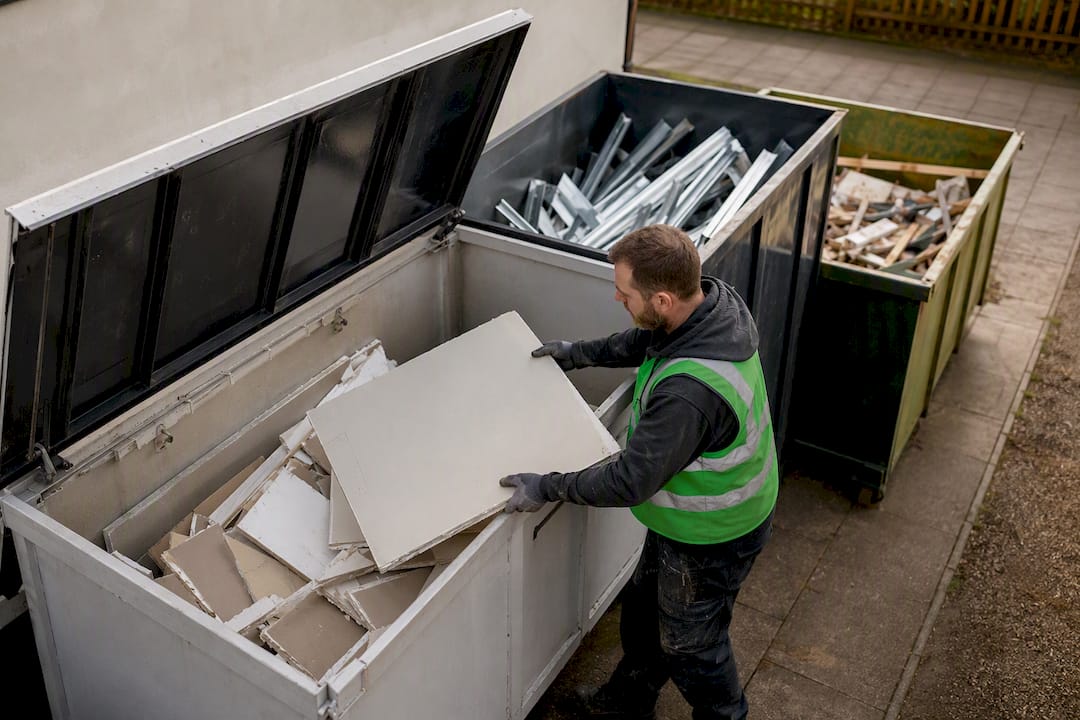
What stays put is the structural frame: load-bearing walls, floor slabs, roof structure, and the building envelope. According to industry guidance, soft strip work also involves segregated waste management from the start, since materials like wood, metal, and drywall each have different recycling paths. A well-run strip project separates recoverable materials, timber framing, copper wiring, steel studs, on site rather than dumping everything into one bin. That’s not just good practice; it’s often cheaper than paying mixed-waste disposal rates.
Soft strip or full demolition: which one do you need?
The two are not interchangeable, and picking the wrong one wastes money or creates a compliance headache. Soft strip preserves the shell; hard demolition takes the building down entirely, structure included.
- Scope: Soft strip removes interior non-structural elements only; hard demolition removes everything, including foundations and load-bearing walls.
- Cost and timeline: Soft strip is typically faster and cheaper per square foot since it avoids heavy equipment and structural engineering sign-off, though hazardous material findings can change that quickly.
- Regulatory trigger: A soft strip job can still fall under demolition regulation once hazardous materials or significant structural interfaces are involved.
- When to combine them: If a soft strip reveals compromised structural elements, or the client’s end goal is a rebuild from the ground up, a structural demolition phase usually follows.
Confusing the two also has legal weight. Industry summaries note that standards like BS 6187:2011 place interior strip-out within demolition safety frameworks, meaning some jurisdictions expect written demolition arrangements and a competent-person survey before soft strip work starts, not just before the wrecking ball shows up.
How does a soft strip project actually run, start to finish?
Every well-run soft strip follows roughly the same sequence, though the pace depends heavily on building size and what the pre-work surveys turn up.
- Pre-work surveys. A refurbishment and demolition (R&D) asbestos survey, hazardous-material inspection, and, where structural interfaces are involved, an engineering survey by a competent person come first. Skipping this step is the single most common cause of costly mid-project stoppages.
- Planning and permits. Contractors confirm municipal requirements, insurance, and waste carrier arrangements before mobilizing crews.
- Service isolation. Electrical, gas, water, and HVAC systems get disconnected and tagged so nobody hits a live line mid-strip.
- Containment and abatement. If surveys flag asbestos, lead, or mould, licensed abatement happens in contained zones before general strip work resumes nearby.
- Controlled strip-out. Crews remove fixtures, finishes, and partitions in a planned sequence, generally top to bottom.
- Waste segregation and site clearance. Materials are sorted for recycling or disposal, and the site gets a final sweep before handover.
For a small residential renovation, expect roughly two to five days once surveys are complete. Mid-size commercial strip-outs run anywhere from one to four weeks, with the biggest time swings caused by asbestos findings, which can add a week or more for abatement and clearance testing, or by tight occupied-building access that limits work hours.
What health risks come with soft strip demolition, and how are they controlled?
Soft strip work generates a surprising amount of airborne dust, more than many homeowners expect from what looks like “just tearing out drywall.” According to HSE guidance on construction dust, soft strip demolition is classified as high dust risk, and uncontrolled exposure over time contributes to lung disease. The dust itself can carry silica from masonry and tile, wood particles from framing and trim, and in older buildings, asbestos fibres from insulation, floor tiles, or textured ceiling finishes.
Controlling that risk follows a hierarchy, and it’s worth understanding because contractors who skip straight to masks are cutting corners:
- Elimination or isolation: keep hazardous work contained and away from occupied areas using sealed zones and negative-pressure air handling.
- Engineering controls first: water suppression and on-tool extraction reduce dust at the source, before it ever reaches the air a worker breathes.
- Ventilation: general site airflow clears residual dust between tasks.
- Respiratory protective equipment (RPE) last: HSE recommends RPE with an assigned protection factor of 20, tight-fitting masks that have been properly fit-tested, and powered hoods for work lasting longer than one hour.
That ordering matters. Relying on a dust mask alone while skipping water suppression is treating the symptom, not the source, and it’s one of the most common shortcuts on underfunded jobs.
Asbestos gets its own protocol entirely. An R&D survey identifies suspect materials before any strip work begins, and if asbestos is confirmed, licensed abatement, air monitoring, and a documented clearance certificate are required before general crews re-enter the space, as outlined in MSN Environmental’s asbestos removal process guide.
Pro Tip: Ask your contractor how often their dust-extraction equipment gets tested. HSE recommends performance checks at least once every 14 months, and a contractor who can’t answer that question probably isn’t maintaining it at all.
Waste handling carries its own risk profile too. Plasterboard needs its own separate skip, not because it’s dangerous to handle, but because mixed gypsum waste in landfill can generate hazardous hydrogen sulphide gas as it breaks down. Licensed waste carriers and documented waste transfer notes aren’t paperwork for paperwork’s sake; they’re your record that hazardous material left the site correctly.
How do you prepare your site before soft strip work starts?
Preparation prevents most of the delays that turn a two-week job into a six-week one. Before any crew arrives, work through this list:
- Confirm permit requirements with your local municipality. Rules vary widely by region, and demolition permits are sometimes required even for interior-only work.
- Isolate utilities safely. Have a licensed electrician or plumbing contractor disconnect and cap services rather than assuming the strip crew will handle it.
- Notify neighbours if the work affects shared walls, shared access, or parking, especially in attached or multi-unit buildings.
- Set up site protection: hoarding, dust screens, and secured access points keep dust and debris from spreading beyond the work zone.
- Request contractor paperwork before signing anything: a copy of the asbestos survey, a risk assessment and method statement (RAMS), proof of insurance, and licensed waste carrier credentials.
Skipping the paperwork request is the most common regret homeowners report after a strip project goes sideways. A contractor who hesitates to produce a survey or RAMS document is telling you something.
When should you hire a certified contractor instead of doing it yourself?
DIY soft strip work is reasonable for cosmetic-only removals in buildings you’re confident predate no hazardous materials, think a kitchen cabinet swap in a house built in 2015. It stops being reasonable the moment any of the following apply:
- Suspected asbestos or lead paint, particularly in buildings constructed before the 1990s.
- Complex or unknown building services hidden behind walls or ceilings.
- Occupied buildings where dust containment protects people who can’t simply leave for the day.
- Any requirement for a clearance certificate before renovation work can legally continue.
A competent contractor should walk in with an R&D asbestos survey already scheduled or completed, a written method statement, trained operatives, and a plan for air monitoring and clearance testing if hazardous materials turn up. Licensed waste transfer documentation should be part of the standard package, not an upcharge.
Pro Tip: When comparing quotes, ask each contractor the same three questions: what’s your containment strategy, who performs the air testing, and what’s your insurance coverage limit? Vague answers to any of the three are a red flag worth taking seriously.
What does a soft strip demolition project actually look like in practice?
A typical residential example: a 1970s bungalow slated for a kitchen and bathroom renovation gets an R&D survey that flags asbestos in the floor tile mastic and textured ceiling finish. Licensed abatement contractors remove those materials under containment, air monitoring confirms clearance, and the general strip crew then removes cabinetry, drywall, and flooring over the following three days. Total added time from the asbestos finding: about a week, mostly waiting on lab results.
On the commercial side, a mid-size office fit-out strip typically involves stripping suspended ceilings, partition walls, carpet tile, and old cabling across an entire floor before a new tenant’s build-out begins. These projects often run two to three weeks and generate significant recyclable material, ceiling grid metal, copper wiring, and steel studs, all of which get sorted separately rather than landfilled.
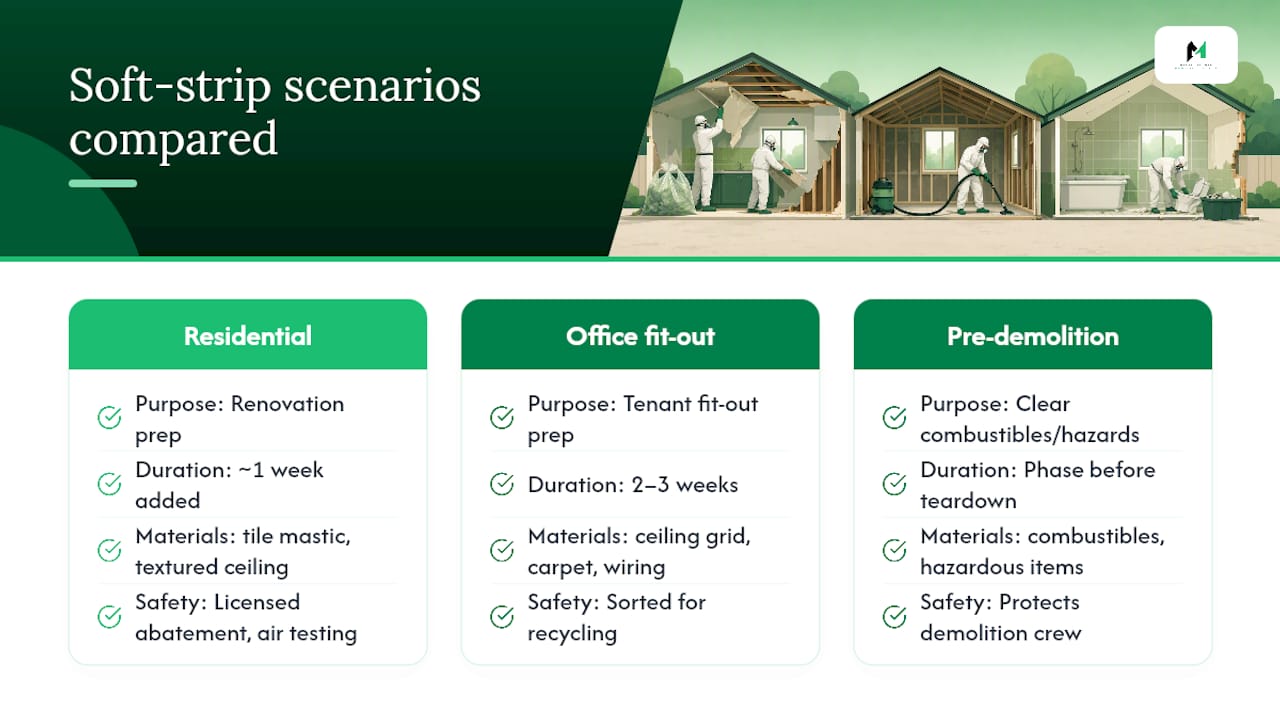
A third common scenario: pre-demolition clearing ahead of a full teardown, where the goal isn’t preservation but simply emptying a structure of anything combustible or hazardous before heavier equipment arrives. Here, the soft strip phase functions as a safety step for the demolition crew that follows, not a renovation step at all. In all three cases, the surveys and controls done first were what kept trades safe and the project on the original timeline.
What MSN Environmental sees on the ground
Interior demolition and hazardous-material abatement overlap more than most homeowners expect, and the projects that go smoothly are the ones where surveys happen before the sledgehammers do. The step-by-step asbestos removal process guide walks through what a compliant clearance looks like, from survey to final air test.
— Moacyr
Ready to get your soft strip project surveyed and quoted?
If you’re planning a strip-out and don’t yet know what’s behind your walls or under your flooring, professional services exist to help close that gap by handling refurbishment and demolition asbestos surveys, licensed Type 3 abatement, air monitoring, and interior demolition, coordinating the process efficiently.
When you request a quote, ask for the same things this guide recommends: a written containment strategy, confirmation of who performs air testing, and a realistic timeline that accounts for lab turnaround. MSN Environmental’s asbestos removal services are built around exactly that transparency. If your building predates the 1990s and you haven’t tested yet, the 0.5% asbestos rule for older Ontario homes is worth reading before you book a demo day. Reach out to schedule a site assessment before the crew shows up, not after someone finds something they shouldn’t have disturbed.
Where to go for deeper regulatory and technical detail
For dust control specifics, HSE’s soft strip demolition guidance remains the most detailed public resource on control hierarchies and RPE standards. For contractor-side operational planning, resources like OnLead’s contractor project guidance cover scoping and scheduling considerations relevant to any interior strip job.
Sources
- Construction dust: Soft strip demolition – HSE
- What is soft strip demolition? A comprehensive guide – Soft Strip Contractor
FAQ
What is the average cost of demolishing a house?
Full house demolition costs vary widely by region, size, and what hazardous materials surveys reveal, since asbestos or lead abatement adds separate costs on top of the demolition itself. Get a site-specific quote rather than relying on general estimates, since soft strip and abatement work in the same project can shift the total considerably.
What is the average cost of demolition per square foot?
Per-square-foot demolition costs depend on whether the job is soft strip only, full structural demolition, or a combination, plus whether hazardous materials are present. A soft strip is generally less expensive per square foot than full structural demolition, since it avoids heavy equipment and structural engineering costs, but a confirmed asbestos or lead finding narrows that gap fast.
Is there a specific method used to demolish buildings safely and precisely?
Controlled deconstruction methods, sometimes involving precise mechanical dismantling, are used internationally for tight urban sites where noise, vibration, and space constraints rule out conventional demolition. Soft strip demolition serves a similar precision role at the interior level, removing non-structural elements in a controlled sequence before any heavier structural work begins.
Do you need a permit to demolish a house in Ontario?
Permit requirements for demolition and significant interior strip work vary by municipality in Ontario, so confirming with your local building department before starting is essential. Some municipalities require permits even for interior-only soft strip work, particularly when hazardous materials or structural interfaces are involved.
How do I know if my building needs an asbestos survey before a soft strip?
Any building constructed before the 1990s should get a refurbishment and demolition asbestos survey before soft strip work begins, since asbestos was commonly used in insulation, floor tile mastic, and textured finishes. MSN Environmental’s asbestos removal process guide explains what that survey covers and what happens if it comes back positive.