

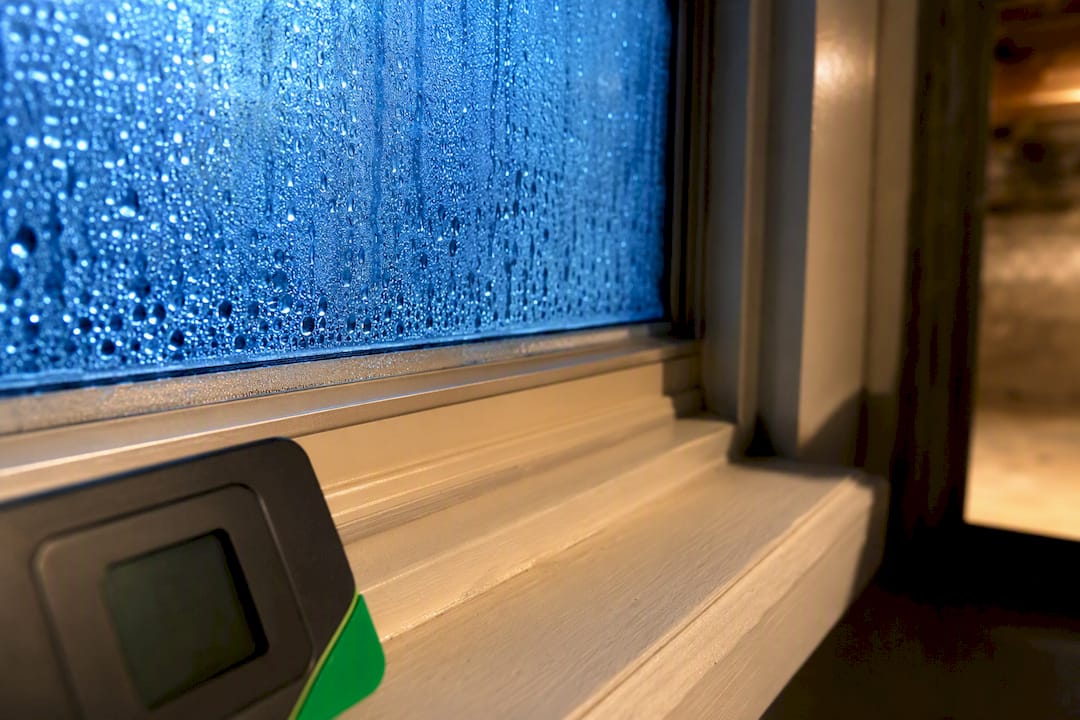
Keep indoor relative humidity between 30% and 50%, and never let it sit above 60% for long. That’s the range Health Canada and building scientists point to for keeping mould spores from finding a foothold. If you don’t already own a hygrometer, buy one soon, check a few rooms, and start running a dehumidifier or exhaust fan whenever the reading climbs above moderate levels.
TL;DR:
- Maintaining indoor humidity between 30% and 50% is crucial, with below 60% being the maximum for effective mould prevention.
- Heating alone does not reduce mould risk; controlling humidity with dehumidifiers and proper ventilation is more effective than lowering temperatures.
- Regularly measuring humidity and dew point with a calibrated hygrometer helps identify problem areas, especially in basements, bathrooms, and bedrooms.
- Addressing moisture sources early and implementing simple fixes like running exhausts during showers prevent most mould issues without costly renovations.
- Professional assessment and remediation become necessary if high humidity persists or visible mould appears despite basic controls.
Table of Contents
- Why 30%–50% humidity is the target for mould prevention
- How humidity and temperature interact in mould growth
- How do you measure humidity and dew point at home?
- Practical humidity control: room-by-room measures that work
- When to get professional help and what an inspection checks
- How long does high humidity have to last before mould appears?
- Does humidity affect different mould species the same way?
- How do seasons change your indoor humidity risk?
- How do building materials and furnishings affect mould risk?
- What are the long-term health effects of humidity-related mould exposure?
- How do you maintain the right humidity level year-round?
- What are the biggest misconceptions about humidity and mould?
- Practitioner perspective: keep prevention simple and measurable
- When simple fixes aren’t enough, here’s your next step
- Sources
- FAQ
Why 30%–50% humidity is the target for mould prevention
Health Canada and the US EPA both land on the same number: keep indoor relative humidity below 60%, and treat 30% to 50% as the working target for most homes. That’s not an arbitrary round number.
Health Canada’s guidance on moisture and mould treats that 30%–50% band as the sweet spot between two failure modes. Go too high and you feed mould, dust mites, and musty odours.
Very dry indoor air brings its own headaches:
- Dry sinuses, cracked lips, and irritated eyes, especially overnight
- Static electricity buildup on carpets and furniture
- Cracking in wood furniture, floors, and even musical instruments
- Aggravated asthma and allergy symptoms for some people
It’s an operational target that balances comfort, structural health, and mould risk for the vast majority of Canadian homes, in every season, without requiring you to run industrial equipment year round.
How humidity and temperature interact in mould growth
A lot of homeowners assume the fix for a humid house is a colder house. That’s backwards, and the research backs it up. A peer-reviewed study published in the Journal of Fungi found that relative humidity during dry periods matters more for spore survival than temperature does. Drop the RH low enough during dry stretches and you knock down spore viability more effectively than cranking the air conditioning ever will.
That finding lines up with how ASHRAE frames the problem in its position document on indoor mould and dampness.
The practical upshot: don’t fight humidity by chasing a colder thermostat setting. Cold surfaces actually invite condensation, which makes the moisture problem worse in exactly the spots where mould loves to start, window frames, exterior wall corners, basement rim joists. Run a dehumidifier, fix ventilation, and dry wet materials fast. That approach controls the variable that actually drives spore survival, and it usually costs less to run than an overworked air conditioner.
How do you measure humidity and dew point at home?
You can’t manage what you don’t measure, and RH varies more room to room than most people expect. A basement corner and a second-floor bedroom in the same house can differ by 15 percentage points or more.
Here’s how to get a real read on your home:
- Buy a hygrometer with both temperature and RH readouts. Look for data logging if you want to track trends over days rather than snapshots; accuracy within 3% to 5% RH is plenty for home use.
- Place it away from direct airflow and exterior walls. A spot at chest height, in the middle of a room, away from a heat vent or an open window, gives you a representative reading. A hygrometer stuck to a cold basement wall will always read high.
- Check basements, bathrooms, and bedrooms separately. Don’t assume one reading represents the whole house.
- Watch the dew point, not just the percentage. When a surface’s temperature drops below the dew point of the surrounding air, condensation forms, even if the room’s overall RH looks fine on paper.
- Log readings for at least three to five days, across a normal routine including showers and cooking, before deciding whether you have a real problem or a one-off spike.
Practical humidity control: room-by-room measures that work
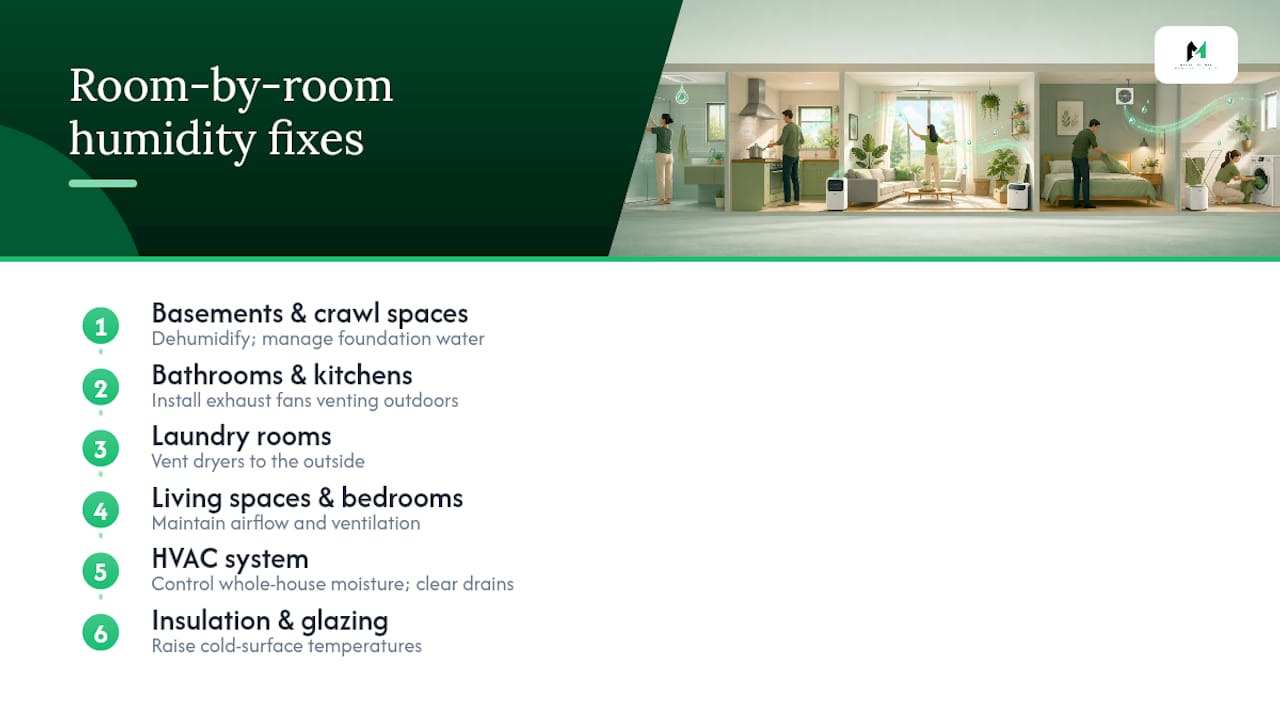
Different rooms create different moisture problems, and the fix that works in a bathroom will do nothing for a damp crawl space. Tackle the cheap, high-impact fixes first, then escalate.
Basements and crawl spaces
Basements run naturally cooler and closer to the ground, which makes them the most common spot for chronic humidity trouble. A properly sized dehumidifier, matched to square footage and how damp the space runs, is usually the single best investment here. Beyond that, check your grading and gutters; water pooling against the foundation drives moisture through the walls no dehumidifier can fully offset. For a crawl space, encapsulation with a vapour barrier over exposed soil often does more than any appliance. Ventilate only when outdoor air is drier than indoor air, opening a window on a humid August day can raise your indoor RH rather than lower it.
Bathrooms and kitchens
Run the exhaust fan during every shower and for a full 20 to 30 minutes afterward, not just while the water’s running. The same goes for kitchens when you’re boiling water or running a dishwasher. One detail trips up a surprising number of homeowners: those fans need to vent to the outdoors, never into an attic or wall cavity, where the moisture just relocates and creates a hidden problem instead of a visible one.
Laundry rooms
Vent the dryer outside, always. Skip indoor drying racks and clothes lines if you’re already fighting humidity, a single load of wet laundry can add several litres of water vapour to your indoor air over a few hours.
Living spaces and bedrooms
Keep furniture a few inches off exterior walls so air can circulate and surfaces don’t stay cold and damp. If you’re seeing consistent condensation on window glass, that’s a dew point problem, and it usually means the glazing or frame is colder than the room’s dew point, not that your overall humidity is wildly out of range.
HVAC and whole-house options
A whole-house dehumidifier tied into your HVAC system handles the entire home at once and can be more efficient than running several portable units. One diagnostic detail worth knowing: leaving your HVAC fan set to “on” instead of “auto” can occasionally reintroduce moisture from the cooling coil back into your living space in humid weather. Check that condensate drains slope properly and aren’t clogged, a blocked drain pan is a quiet, common source of hidden moisture.
Insulation and glazing
Cold spots on walls, ceilings, and window frames are where condensation forms even when your hygrometer reads a perfectly acceptable number for the room overall. Upgrading insulation or glazing in an attic or on old windows raises those surface temperatures above the dew point, which stops the condensation at the source rather than treating symptoms room by room.
Pro Tip: Start with the free and cheap fixes, exhaust fan run times, fixing a leaky gutter, unclogging a condensate drain, before you spend money on a dehumidifier or renovation. Half the humidity problems homeowners bring to a contractor trace back to one of these overlooked basics.
When to get professional help and what an inspection checks
Some signs mean it’s past the point of DIY fixes. Repeated staining on the same patch of drywall after you’ve dried it out once is another red flag; something is still feeding that spot.
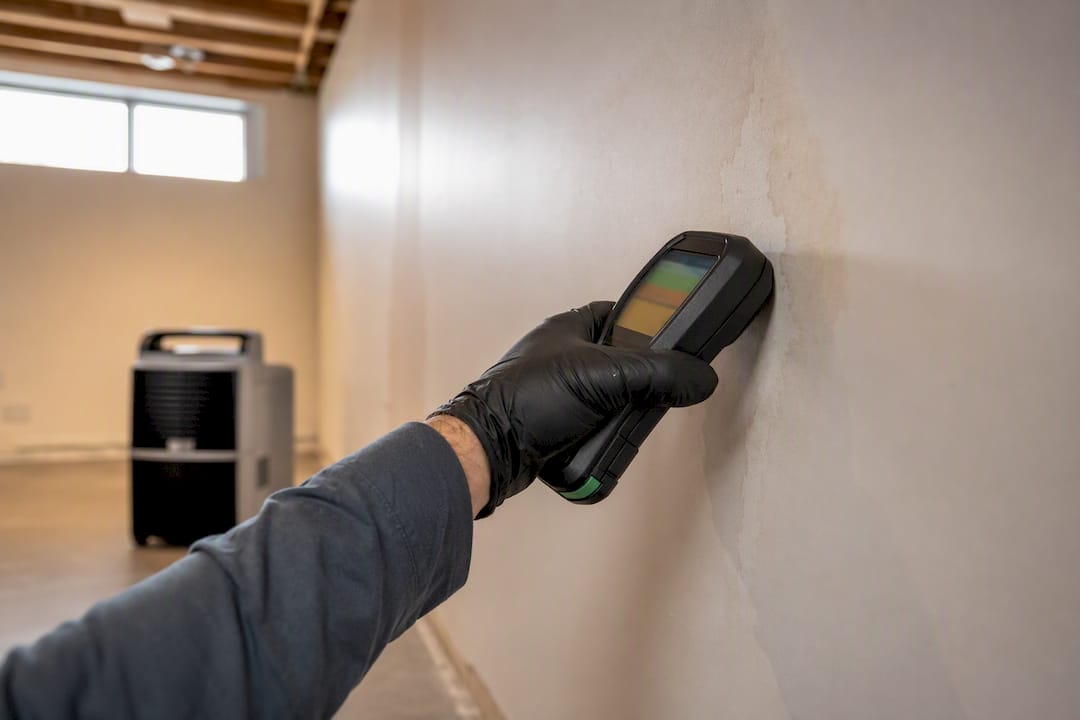
A professional inspection, like the mould assessments MSN Environmental performs, typically includes moisture mapping across the affected area, targeted readings with a calibrated moisture meter, photo documentation, and identification of the actual water source, not just the symptom. From there, you get a written remediation plan with a real timeline. The EPA notes that wet materials need to dry within 24 to 48 hours to avoid mould taking hold, and professional crews use industrial fans and dehumidifiers specifically to hit that window when a homeowner’s own equipment can’t keep pace.
How long does high humidity have to last before mould appears?
There’s no single countdown clock, but the research gives a useful working rule.
Sustained elevated RH is a different, slower risk than a single wet event. A one-time spill or a leaky pipe that gets dried fast rarely causes visible growth.
That gives you a rough timeline to work with. A short spike, an hour of steam from a shower, a single humid afternoon, isn’t the concern. Waiting past that point is how a manageable moisture issue turns into a remediation job.
The gap between “elevated” and “visible mould” is measured in days and weeks, not months, in a room that’s consistently damp.
Does humidity affect different mould species the same way?
Not quite. Stachybotrys chartarum, the species often called black mould, generally needs consistently wet material rather than just high air humidity, which is why it shows up most often on materials that have stayed soaked, like flooded drywall or water-damaged wood, rather than simply humid air.
This distinction matters for how you read a musty smell or a discoloured patch. A light dusting of grey-green mould on a bathroom ceiling is usually one of the fast colonizers responding to chronic high humidity, and it often clears up once ventilation improves. A dark, slimy patch on a water-stained basement wall suggests sustained saturation, not just elevated air humidity, and that calls for finding and fixing an actual water source, not just running a fan.
Different species also tolerate different temperature ranges, which is part of why basements and attics develop different mould profiles even in the same house. Cooler, damper basements tend to favour different colonizers than warmer, drier attic spaces with occasional condensation. The common thread across nearly all of them: control the moisture and you starve every species at once, regardless of which one you’re dealing with. That’s the advantage of managing RH rather than trying to identify and target individual mould types.
How do seasons change your indoor humidity risk?
Winter and summer create opposite humidity problems in the same house. But winter also brings its own mould risk at cold surfaces: window frames, exterior wall corners, and attic sheathing, where warm, moist indoor air meets a cold surface and condenses, even while your hygrometer in the middle of the room shows an acceptable reading.
Summer flips the problem. Spring and fall bring their own wildcard: big daily temperature swings mean surfaces can dip below the dew point overnight even when daytime humidity looks fine.
This is why a single annual hygrometer check tells you almost nothing useful. A reading that’s perfectly fine in April can be dangerously high by August in the same basement, with no change to your habits. Seasonal monitoring, checking a few times a year in each problem room, especially at the start of summer and the start of the heating season, catches the shift before it becomes a sustained problem instead of after.
How do building materials and furnishings affect mould risk?
Some materials hold onto moisture and feed mould far more readily than others, independent of what your hygrometer says about the room’s air. Organic, porous materials, drywall paper facing, wood, carpet padding, upholstery fabric, act like sponges. They absorb ambient moisture and hold it against their surface longer than a smooth material like tile or glass, which gives mould more time to establish even at moderate RH levels.
Older homes with plaster and lath construction tend to handle moisture swings differently than modern drywall assemblies, sometimes better, since plaster is less hospitable to mould than the paper facing on gypsum board. But older homes also tend to have less effective vapour barriers and older, leakier building envelopes, which can offset that advantage.
Furnishings matter more than most homeowners think. Carpet directly on a basement concrete slab, cardboard boxes stored against a foundation wall, and upholstered furniture pushed tight against an exterior wall all create pockets of trapped moisture and reduced airflow, exactly the microclimate mould needs, even in a room where the overall air humidity reads fine. Swapping carpet for a moisture-resistant flooring in a basement, storing boxes on shelving instead of the floor, and leaving a few inches of clearance between furniture and exterior walls are low-cost changes that reduce risk without touching your dehumidifier settings at all.
What are the long-term health effects of humidity-related mould exposure?
Chronic exposure to mould driven by sustained high indoor humidity is associated with respiratory symptoms that range from mild irritation to more serious complications for vulnerable people. Ongoing exposure can aggravate asthma, trigger allergic reactions, and cause persistent coughing, throat irritation, and sinus congestion in otherwise healthy adults, with the effects generally worsening the longer exposure continues.
Children, older adults, and people with existing respiratory conditions or compromised immune systems face higher risk from the same exposure levels that a healthy adult might tolerate with minor symptoms. This is part of why public health guidance from Health Canada treats humidity control as preventive health, not just a maintenance chore. Fixing the moisture source addresses the health risk at its root, rather than treating symptoms as they appear.
The link between chronic damp housing and worse respiratory outcomes is well established enough that it shapes building codes and public health messaging across Canada. The health cost of “we’ll deal with it eventually” compounds the longer damp conditions persist, especially in a home with children, older residents, or anyone managing asthma or allergies already.
How do you maintain the right humidity level year-round?
Holding it through every season without babysitting a hygrometer daily takes a few habits.
Check your hygrometer readings monthly, not just when something smells off. Clean or replace furnace and HVAC filters on schedule, since a clogged filter reduces airflow and can throw off how evenly your system manages moisture across the house. Empty and clean portable dehumidifier reservoirs and filters regularly, a neglected unit loses efficiency fast and can even grow its own mould in the collection bin. Inspect gutters and grading twice a year, spring and fall, since foundation water problems are often the root cause behind basement humidity that no dehumidifier fully solves.
Reset your expectations seasonally.
What are the biggest misconceptions about humidity and mould?
The most common mistake is believing that lowering the thermostat solves a humidity problem. It doesn’t, and the Journal of Fungi research on spore survival makes that plain: moisture control affects mould growth more directly than temperature does. A cold, humid basement is still a mould risk.
Another widespread belief is that opening a window always helps. It doesn’t, not if the outdoor air is more humid than what’s already inside. Health Canada’s own guidance recommends checking outdoor conditions first, ventilation only helps when outdoor air is drier than indoor air.
Plenty of homeowners also assume a single houseplant, or even several, will meaningfully clean mould spores from indoor air. There’s no solid evidence that any houseplant removes airborne mould at a scale that matters for a real room; plants are a nice addition to a home, not a humidity or mould control strategy.
Last, a lot of people treat “no visible mould” as proof the humidity is fine. It isn’t. Hidden growth behind drywall, under carpet, or inside wall cavities can develop for months before it’s visible or smellable, which is exactly why measuring RH directly, rather than waiting for a visual cue, catches the problem while it’s still cheap to fix.
Practitioner perspective: keep prevention simple and measurable
The homeowners who solve humidity problems fastest are the ones who measure before they spend money. Buy the hygrometer before the dehumidifier. Fix the exhaust fan venting before you consider a renovation. Most humidity issues resolve with a properly run dehumidifier, better ventilation habits, and fixing one or two obvious moisture sources, not a gutted basement.
Where I’d push back on conventional advice: don’t wait for visible mould to act. By the time you can see it, you’ve usually had weeks of sustained conditions above the safe range. And if you’ve fixed the obvious sources and the reading still won’t budge, or growth has already appeared, that’s the point to bring in a professional rather than keep guessing.
— Moacyr
When simple fixes aren’t enough, here’s your next step
A dehumidifier and better ventilation solve most humidity problems. But when you’ve fixed the exhaust fans, sealed the obvious gaps, and the reading still won’t drop, or you’re already looking at visible growth on drywall or a musty smell that won’t clear, that’s a different job entirely. Professional services handle the assessment work homeowners can’t do themselves: moisture mapping, source identification, and a written remediation plan, backed by certified technicians who work to regulatory standards rather than guesswork, including Mortgage Ready PCA/RICS Moisture Testing After Removal for UK Homes.

Contact MSN Environmental’s mould assessment and remediation team if you’re seeing any of the red flags covered above, persistent condensation, a musty smell that won’t lift, or visible discolouration on walls or ceilings. If your issue is specifically in a basement, that page walks through what a targeted inspection looks like before you commit to a full remediation contract. Book an assessment now rather than waiting to see if the next humid month makes the decision for you.
This article is general information, not a substitute for advice from a qualified doctor. Consult a qualified healthcare professional about your own circumstances before acting on anything here.
Sources
- Addressing moisture and mould in your home — Health Canada
- Mold Course chapter 2 — US EPA
- Relative humidity of dry periods is more critical than temperature for mold prevention — Journal of Fungi
- Limiting indoor mold and dampness in buildings — ASHRAE position document
FAQ
Is 70% humidity too high for a bedroom?
Yes. A bedroom with humidity above the 60% upper threshold that Health Canada recommends is in a range where most common household mould species have what they need to start colonizing surfaces.
What plant removes 78% of airborne mould?
No houseplant has solid evidence behind a specific mould removal figure like that. Treat plants as decoration, not a humidity or air quality control strategy, and rely on ventilation and dehumidification instead.
What kills mould growth naturally?
Diluted white vinegar or a hydrogen peroxide solution can kill surface mould on hard, non-porous surfaces for small, visible patches. Neither addresses the underlying moisture source, and for anything beyond a small surface spot, or on porous material like drywall, a professional assessment through a service like MSN Environmental is the safer route.