

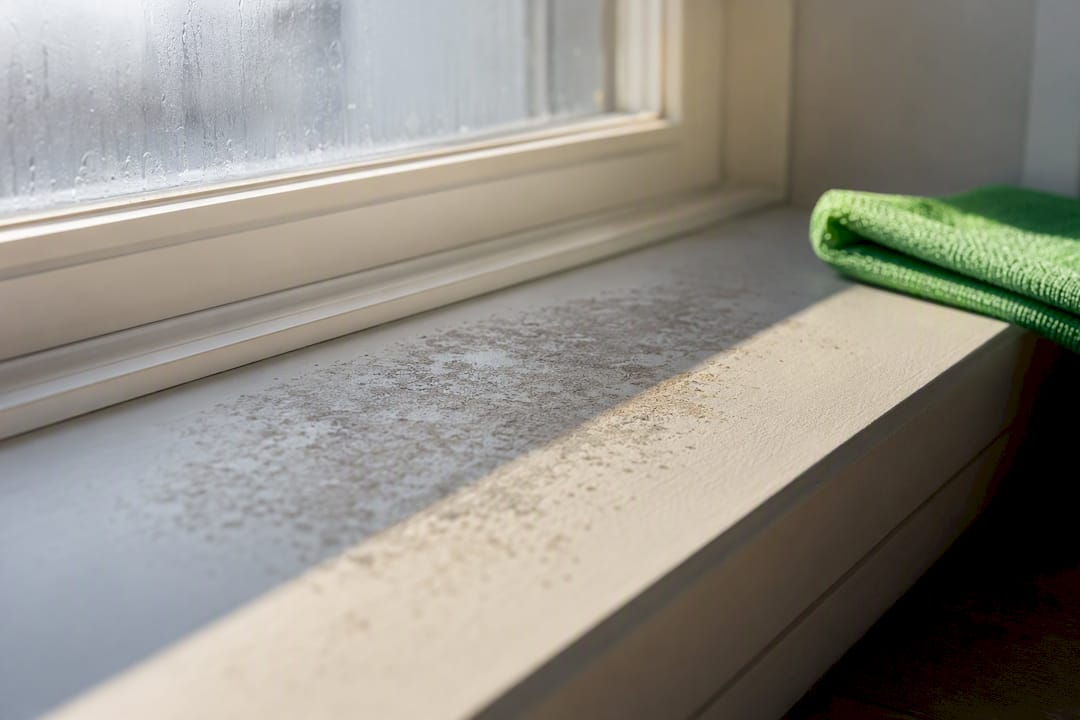
Mildew is a flat, powdery fungal growth that thrives on damp surfaces like shower grout, windowsills, and stored fabrics. Small patches, under about 10 square feet, are usually safe to clean yourself with detergent or diluted bleach. The real fix is moisture control: keep indoor humidity in a moderate range, ideally between 30% and 50%, or the same spot keeps coming back no matter how hard you scrub.
TL;DR:
- Small mildew patches under 10 square feet can be cleaned with detergent or diluted bleach, but persistent issues require moisture control.
- Mildew thrives on moisture, organic material, and typical indoor temperatures, making humidity regulation crucial for prevention.
- Larger or recurring growths, water damage, or affected areas over 10 square feet should be addressed by certified professionals to remove underlying moisture sources.
- Using exhaust fans, drying wet surfaces quickly, and sealing leaks helps keep indoor humidity below 50%, significantly reducing mildew growth risk.
- Vinegar may slow mildew on hard surfaces but is less effective than bleach or hydrogen peroxide for active colonies.
Table of Contents
- What mildew is, where it grows, and why
- Mildew vs. mould: appearance, risk, and who should be extra cautious
- How to clean small mildew patches safely
- When mildew means it’s time to call a professional
- Preventing mildew for good: humidity, airflow, and quick fixes
- What certified remediators actually do differently
- Where these guidelines come from
- Sources
- FAQ
What mildew is, where it grows, and why
Mildew grows flat and superficial, often as a thin white or grey film you can wipe off a surface without much resistance. That flat growth habit is actually its defining trait: other household moulds send up fuzzy, three-dimensional filaments called hyphae, while mildew stays close to the surface it’s colonizing. It is still a fungus, just a specific kind with a specific look.
You’ll find it in predictable spots. Shower grout and caulking, windowsills that collect condensation, damp towels left in a hamper too long, book pages, leather jackets forgotten in a humid closet. Anywhere organic residue meets sustained moisture at room temperature is fair game.
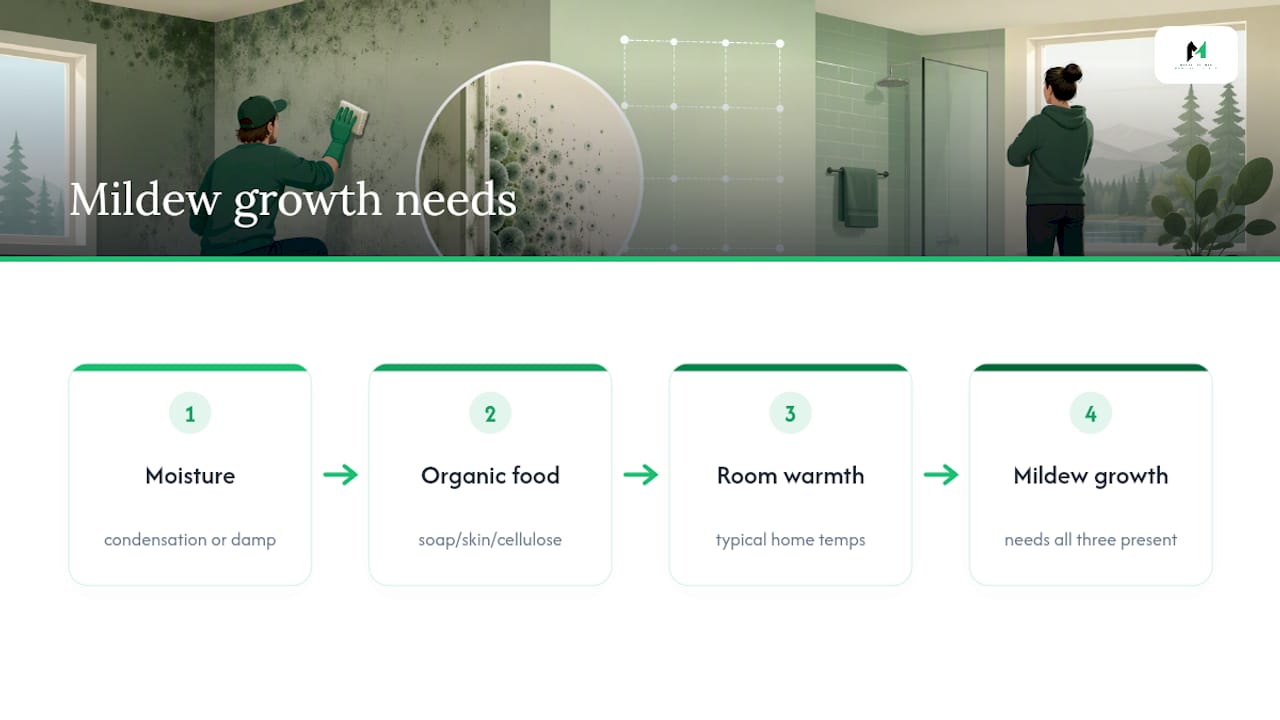
Three conditions have to line up for mildew to take hold: a moisture source, something organic to feed on (soap film, skin oils, cellulose in paper or cotton), and a temperature range most homes sit in year round. Take away any one of those three and growth stalls.
Most people say “mildew” and “mould” as if they’re the same word, and for casual conversation, that’s fine. Technically, mildew is one narrow category inside a much broader group of fungi we lump together as mould. The distinction matters more once you’re deciding how aggressively to clean, which the next section covers.
Mildew vs. mould: appearance, risk, and who should be extra cautious
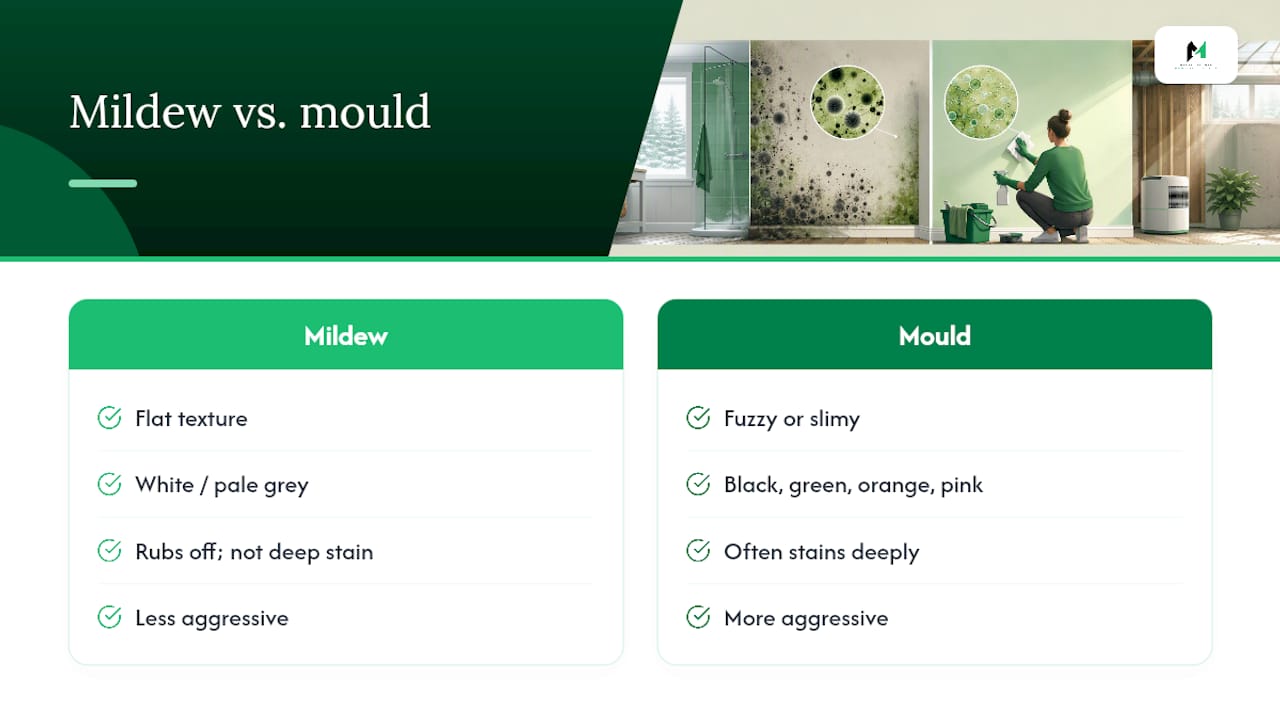
Look at the texture first. Mildew stays flat, usually white or pale grey, sometimes with a yellowish tinge as it ages. Mould, by contrast, often looks fuzzy or slimy, and its colour range runs from black and green to orange and pink depending on species. If you can rub a growth off with a fingernail and it doesn’t stain deeply, you’re probably looking at mildew rather than an established mould colony.
Here’s the part that trips people up: mildew technically is a type of fungal growth, not a separate category from mould. It’s just one specific, less aggressive presentation of it. Britannica describes mildew as a conspicuous mass of threadlike hyphae and fruiting structures capable of causing respiratory irritation in sensitive people, which puts it squarely in the same biological family as the moulds people worry about more.
Statistic worth knowing: chronic indoor mould exposure during childhood is linked to a higher risk of developing asthma, according to Harvard Health’s review of the research. That risk applies to mould exposure broadly, and there’s no reason to assume mildew’s milder appearance makes it exempt from causing symptoms in someone who’s already sensitive.
Common reactions include breathing difficulty, eye irritation, sore throat, sneezing fits, and skin rashes. People with asthma, existing allergies, or weakened immune systems tend to react faster and more severely than everyone else, so if someone in your household falls into one of those groups, treat any fungal growth, however small, as worth addressing right away.
How to clean small mildew patches safely
The EPA’s rule of thumb is straightforward: if the affected area is small enough, you can usually handle it yourself (https://www.epa.gov/mold/mold-cleanup-your-home). Bigger than that, or the growth followed serious water damage, and you’re better off calling in help. Before you touch anything, open a window, put on rubber gloves, and if you’re sensitive to dust or spores, wear an N95 mask.
- Identify the surface type first. Hard, non-porous surfaces (tile, glass, sealed grout, plastic) clean differently than fabric, paper, or unsealed wood.
- For non-porous surfaces: scrub with a household detergent and water, or a diluted bleach solution (roughly one cup bleach per gallon of water) for tougher spots. Hydrogen peroxide at 3% also works and skips the fumes.
- Rinse thoroughly, then dry the surface completely. Leftover moisture just restarts the cycle.
- For fabrics and porous items: brush off loose spore growth outdoors first so you’re not shaking spores through the house. Test any cleaner on a small hidden area before committing.
- Sun-dry fabrics when possible. UV exposure helps kill remaining spores and speeds drying.
- Discard anything saturated or structurally compromised, including drywall, insulation, or upholstery that’s stayed wet more than 48 hours.
If you’re prepping a surface for a repaint after a mildew scare, cleaning it properly first matters more than the paint job itself, a point painting contractors raise consistently in their own prep guidance.
Pro Tip: Bleach only whitens porous materials like drywall or unsealed wood. It doesn’t reach fungal roots buried in the material, so the growth often returns even though the stain is gone. For porous surfaces, physical removal beats chemical bleaching every time.
When mildew means it’s time to call a professional
Cleaning the same spot for the third time in six months is a signal, not a coincidence. It usually means there’s a moisture source you haven’t found yet, a slow roof leak, a condensation problem behind a wall, or drainage pooling somewhere it shouldn’t. Scrubbing the surface without fixing that source just buys you a few weeks before it’s back.
Some situations call for certified help regardless of how the surface looks:
- The affected area exceeds roughly 10 square feet.
- Contaminated water (sewage backup, flooding) was involved at any point.
- The growth has reached inside HVAC ductwork or behind walls you can’t easily open.
- Someone in the household has asthma, severe allergies, or a compromised immune system.
- You’ve cleaned the same spot more than once and it keeps coming back.
Certified remediators bring tools most homeowners don’t have on hand: containment barriers, negative air pressure to stop spore migration, air sampling to confirm the space is actually clear afterward, and documented clearance testing you can hand to an insurer or a future buyer. That last part matters more than people expect, particularly during a home sale.
Preventing mildew for good: humidity, airflow, and quick fixes
Moisture control beats cleaning every time, because it stops the problem instead of managing it after the fact. The EPA recommends keeping indoor relative humidity between 30% and 50%, a range you can check with a $15 hygrometer from any hardware store. Above 60%, most homes start growing something somewhere within weeks.
A few habits make the biggest difference:
- Run bathroom and kitchen exhaust fans during and after showers or cooking, not just when the mirror fogs up.
- Vent your clothes dryer outdoors, never into an attic or crawl space.
- Dry any wet carpet, drywall, or furniture within 24 to 48 hours of water exposure.
- Open windows for cross ventilation on dry days, even in winter, for 10 to 15 minutes.
- Reseal grout lines once a year in bathrooms, since cracked grout traps moisture underneath.
For chronic problems, cosmetic fixes won’t hold. Cold surfaces like uninsulated basement walls or single-pane windows collect condensation no matter how often you wipe them, so insulating those surfaces solves the root cause rather than the symptom. The same goes for grading soil away from your foundation if water keeps finding its way in through the same wall each spring.
Buy the tool, not the repeat repair.*
Consistent humidity control below the 50% threshold is the single most reliable habit for keeping fungal growth from starting in the first place.
What certified remediators actually do differently
Scrubbing a visible patch treats the symptom. A trained technician treats the cause: tracing the moisture source, containing the work area so spores don’t spread to clean rooms, then running air sampling before and after to confirm the space is actually clear, not just visually tidy. That documentation matters if you’re dealing with insurance or selling the property later.
MSN Environmental handles that full scope for homeowners and property managers across southern Ontario, from initial mould remediation through air quality testing and containment work. The gap between a can of bleach and a certified process is usually the difference between managing a problem and actually ending it.
— Moacyr
Where these guidelines come from
The cleaning thresholds and humidity targets referenced throughout come from the EPA’s mould cleanup guidance, the EPA’s mould and mildew distinction, Britannica’s entry on mildew, and Harvard Health’s review of indoor mould exposure. MSN Environmental’s own remediation and testing pages cover local next steps.
This article is general information, not a substitute for advice from a qualified doctor. Consult a qualified healthcare professional about your own circumstances before acting on anything here.
Sources
- Mildew | Definition & Description | Britannica
- Mold in the home: identifying and treating the issue to prevent health problems | Harvard Health
FAQ
Is mildew as harmful as mould?
Mildew is a milder, flatter form of fungal growth, but it’s still a type of mould biologically, so it carries the same basic health risks in smaller doses. People with asthma or allergies can still react to it, and respiratory irritation is a documented symptom even from milder growths.
How do you get rid of mildew?
For patches under about 10 square feet, scrub the surface with detergent, diluted bleach, or hydrogen peroxide, then rinse and dry it completely. The EPA confirms this size threshold as the point where DIY cleaning is usually sufficient, and drying the area matters as much as the cleaning agent itself.
What is mildew caused by?
Mildew needs three things at once: a moisture source, organic material to feed on, and a temperature most homes sit at year round. Remove any one of those, usually the moisture, and growth stops within days.
Does vinegar kill mildew?
Household vinegar can slow mildew growth on hard, non-porous surfaces through its acidity, though it’s generally less effective than diluted bleach or 3% hydrogen peroxide for an active patch. It works better as a light maintenance wipe than as a treatment for an established colony.