

Ontario’s asbestos rules come from O. Reg. 278/05, and the law requires an owner to examine the building and produce a report before any demolition or repair begins. Until a lab confirms otherwise, treat any suspect material such as old plaster, vermiculite insulation or floor tile as asbestos containing. The immediate step is simple: commission a designated substance survey or bulk sample before you touch anything.
TL;DR:
- A designated substance survey or bulk sample is required before any demolition or repair work, especially if suspect materials may contain asbestos.
- Workers handling asbestos must be trained and equipped with Canadian-standard respirators, with ongoing compliance tracked through detailed reports and clearance testing.
- Larger or friable asbestos jobs classified as Type 2 or Type 3 require sealed enclosures, negative pressure systems, and immediate notification to authorities for unexpected discoveries.
- Disposal of asbestos waste must follow strict protocols, including double bagging, labelling, and transporting to approved facilities, with contractors providing documentation.
- Owners should maintain an asbestos record, update it regularly, and disclose known asbestos issues to buyers, ensuring enforcement risks and delays are minimized.
Table of Contents
- Who is responsible: OHSA, O. Reg. 278/05 and the parties involved
- When you need testing: the 0.5% threshold and how sampling works
- Type 1, Type 2 and Type 3 work: matching the job to the controls
- Notifications, reports and the paper trail you need to keep
- A practical compliance checklist from tender to reoccupation
- Enforcement risks and selling a house with known asbestos
- How MSN Environmental supports compliance
- Roles and responsibilities during asbestos handling and abatement
- Disposing of asbestos waste the legal way
- PPE requirements for asbestos work
- Training and certification for abatement workers
- The real trade-off between speed and legal safety
- Getting help from MSN Environmental with your project
- Where these rules come from
- Sources
- FAQ
Who is responsible: OHSA, O. Reg. 278/05 and the parties involved
The Occupational Health and Safety Act sets the general duty to protect workers, and O. Reg. 278/05 is the specific rule that governs asbestos on construction projects, in buildings and during repair operations. Together they assign duties to four kinds of parties: owners, constructors, employers and tenants, in some cases.
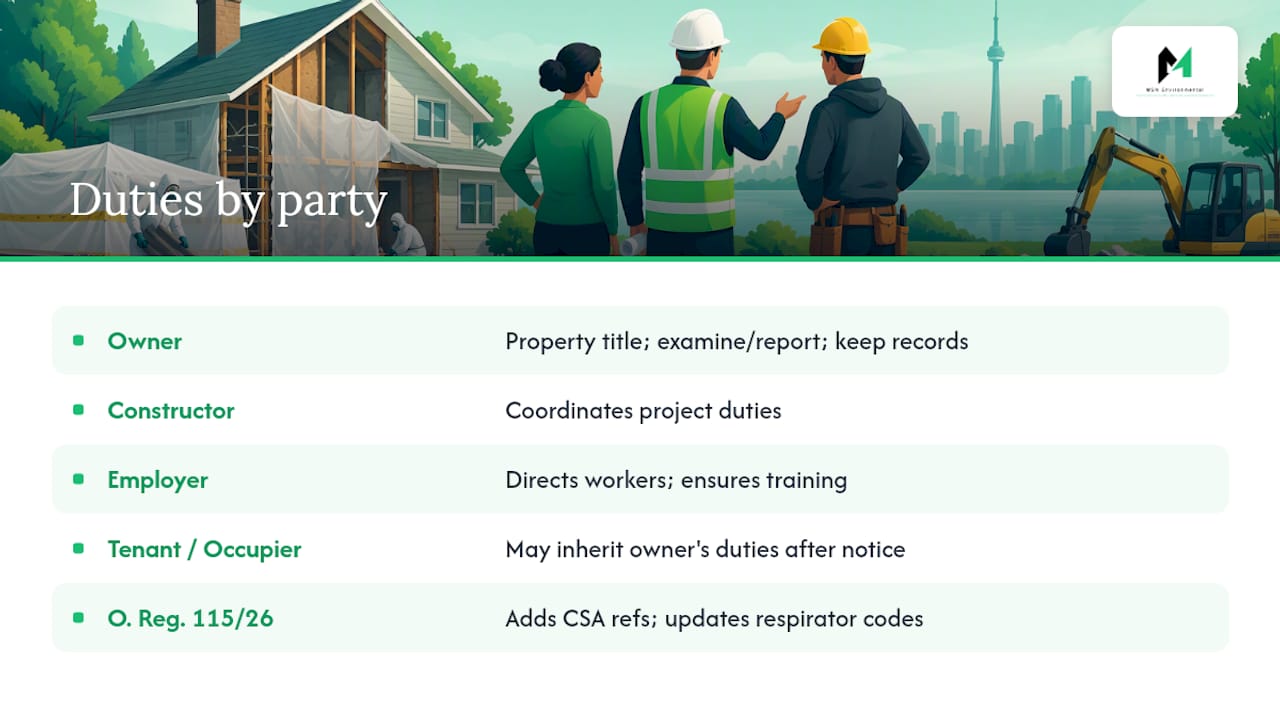
An owner holds the property title and carries the duty to examine and report. A constructor coordinates a project, an employer directs workers doing the actual work, and a tenant or occupier can inherit the owner’s duties for the space they control once they are formally notified, including training obligations for workers in that area.
A recent amendment, O. Reg. 115/26, filed on April 20, 2026, updates the base regulation by adding CSA references and revising respirator identifiers to Canadian standard listings. It takes effect on the later of July 1, 2026 or its filing date, so anyone updating a health and safety program this year should check which respirator codes now apply.
Owners of older buildings are generally expected to run an ongoing asbestos management program: a written record of where asbestos containing material is located, its condition and when it was last inspected. That record must be reviewed and updated regularly, including yearly or when new information about the building surfaces arises, such as from renovations, leaks, or tenant complaints.
When you need testing: the 0.5% threshold and how sampling works
Ontario’s regulation defines asbestos containing material, or ACM, as material containing asbestos by dry weight at or above the regulatory threshold, and it adopts the U.S. EPA Test Method EPA/600/R-93/116 for bulk sample analysis. That threshold is the line between material you can handle normally and material that triggers the full set of Type 1, 2 or 3 controls.
An examination is legally required before you request tenders, before demolition, before repair work, and any time a worker or contractor flags suspect material. The owner’s guide to the regulation is explicit that this applies to friable material (the kind that crumbles easily, like pipe lagging) and non-friable material (like vinyl floor tile) alike.
A defensible sample and report need a documented chain of custody, analysis by an accredited laboratory and, for sprayed or trowelled friable material, a statement of the specific type of asbestos found. Skipping any of these steps leaves an owner without a report that will hold up if a Ministry inspector or a bidder challenges it later.
The practical rule for renovators and contractors is to treat anything unidentified as ACM until a lab says otherwise, and to write lab accreditation into every testing contract you sign. Bulk sampling and pre-renovation testing are cheap compared to the cost of a stop-work order mid-project.
Type 1, Type 2 and Type 3 work: matching the job to the controls
Ontario groups asbestos work into three classes, and each one carries its own set of required controls, so the classification decision shapes the entire project before a single tool touches the material.
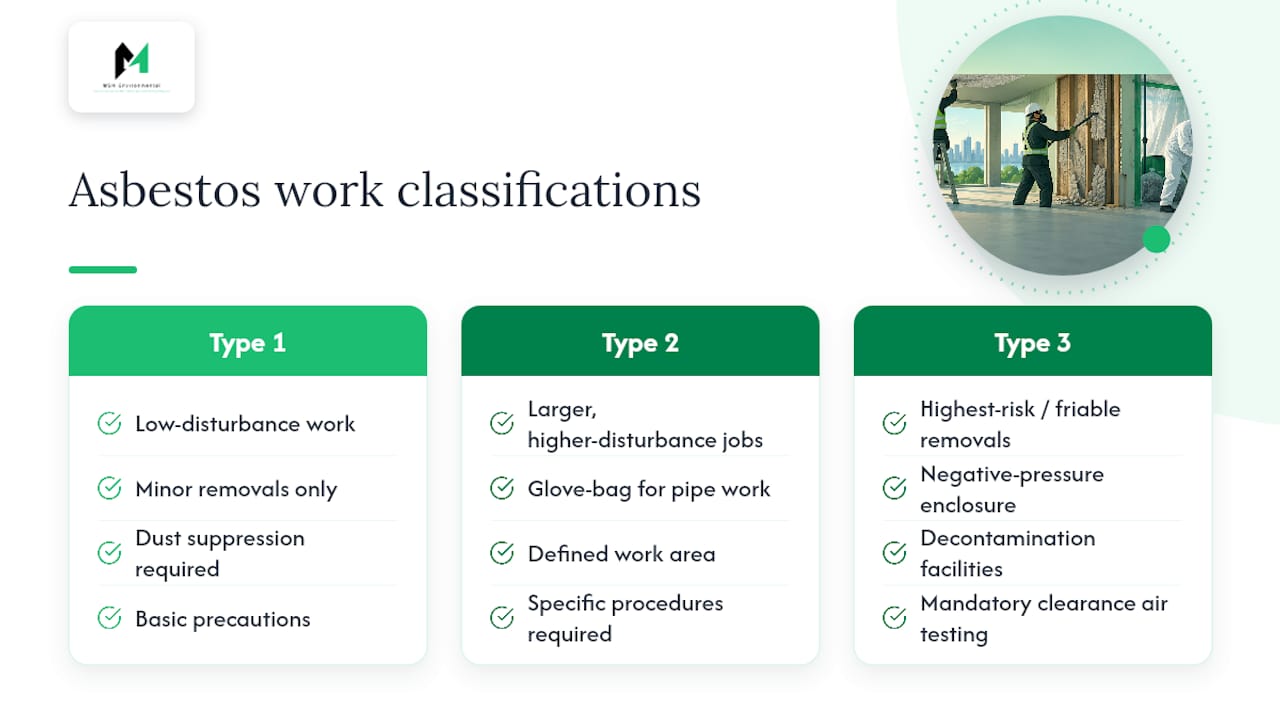
Type 1 covers minor, low-disturbance work such as removing a small section of vinyl floor tile or drilling a few holes through drywall that contains ACM. Basic precautions and a dust suppression method are usually enough.
Type 2 includes larger jobs like removing asbestos pipe insulation using a glove bag, or taking down drywall with joint compound over a bigger area. This tier requires specific procedures, often including a sealed glove bag system for pipe work and a defined work area.
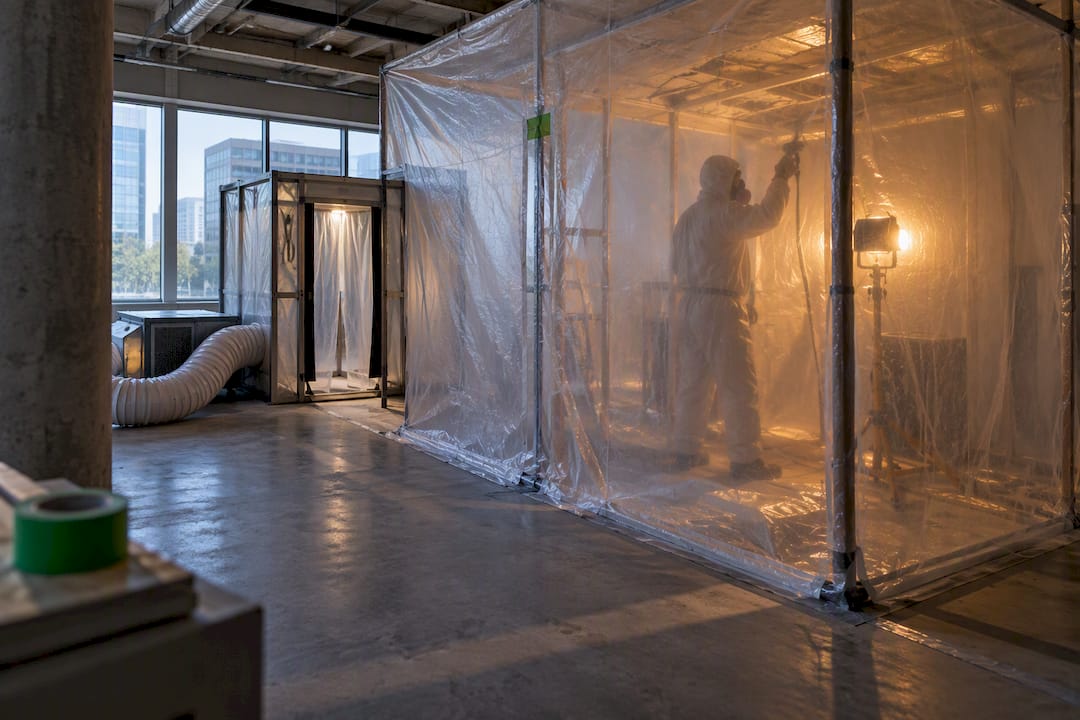
Type 3 is the highest risk category: removing large quantities of friable material, work inside a full enclosure, or any job the regulation names as automatically Type 3 regardless of quantity. This tier requires a negative pressure enclosure, decontamination facilities for workers leaving the area and mandatory clearance air testing before the space can be reoccupied.
Respirator classes named in the regulation were updated under the recent O. Reg. 115/26 amendment, so employers should confirm their current respirator models match the listed identifiers before assigning them to Type 2 or Type 3 crews.
Type 2 and Type 3 operations also require workers to have completed approved asbestos training, and larger Type 3 jobs are generally handled by certified abatement firms rather than general contractors. Our guide to Type 3 abatement walks through containment and clearance in more detail.
Notifications, reports and the paper trail you need to keep
Ontario’s rule does not stop at classifying the work. It also demands a documentation trail that starts before tendering and continues after the job is done.
- Type 3 operations and certain larger Type 2 glove bag removals require advance notice to the Ministry, including project location, scope and expected duration.
- Employers must complete an asbestos work report for each worker involved in Type 2 or Type 3 operations at least once every 12 months and again when that worker’s employment ends.
- The Provincial Physician maintains an Asbestos Workers Register, and completed work reports feed into it.
- Before requesting tenders, owners must give prospective constructors and contractors the examination report so bids reflect the actual asbestos risk.
- If suspect material turns up unexpectedly during work that the original report did not cover, the constructor or employer must give immediate written and oral notice to the Ministry inspector, the owner and the joint health and safety committee, which typically means stopping work until the material is assessed.
A practical compliance checklist from tender to reoccupation
Turning the regulation into a project plan comes down to six steps, each tied to a specific legal duty.
- Commission a designated substance survey or bulk sample before writing the tender, and ask the consultant for lab accreditation details and a written scope of what was and was not tested.
- Classify the anticipated work as Type 1, Type 2 or Type 3 based on the survey results and embed that classification directly in the tender and contract documents.
- Notify the Ministry and relevant stakeholders where the regulation requires it, and confirm the contractor holds current training for the work type.
- Require air monitoring during the work and clearance air testing before any enclosure is dismantled or the space is reoccupied.
- Keep the survey, the work report and the clearance certificate on site, and fold the results into the building’s asbestos management record within the required 12-month review cycle.
- Watch for red flags, unexpected debris behind a wall, damaged pipe insulation, or a contractor who wants to skip testing, and treat any of them as a reason to stop and call a certified abatement firm.
Pro Tip: Ask your surveyor for a written scope of exclusions, not just a pass or fail summary; a report that only lists what was tested can leave gaps a bidder or inspector will notice later.
Digital tools like the SiteChief asbestos management module can help owners track inspection dates and document versions without relying on a paper file that gets lost between contractors.
Enforcement risks and selling a house with known asbestos
Non-compliance with O. Reg. 278/05 can bring stop-work orders, fines under the Occupational Health and Safety Act and, for serious cases, prosecution. Ministry inspectors tend to focus on whether a pre-tender report existed and whether the classification matched the actual work performed.
Sellers with older homes should get a survey done before listing, disclose any known ACM to buyers, and where material is disturbed or deteriorating, arrange remediation or clearance testing before closing. A pre-purchase asbestos inspection protects both sides of the transaction. Disclosure obligations vary by situation, so confirming the specifics with a real estate lawyer is worth the conversation.
How MSN Environmental supports compliance
Meeting these obligations usually means lining up a survey, a lab sample and, if results come back positive, a certified crew. MSN Environmental offers designated substance surveys and bulk sampling that satisfy the pre-tender examination requirement, along with air quality testing for the clearance stage of a Type 3 job.
For work that crosses into Type 2 or Type 3 territory, our technicians handle containment, negative air setup and the abatement itself, backed by the certifications and insurance the regulation expects from a professional crew. We also provide the clearance air testing report owners need before reoccupying a space, so the paper trail matches the work that was actually done. Projects span residential and commercial buildings across Ontario.
Roles and responsibilities during asbestos handling and abatement
Employers carry the heavier legal load. An employer running Type 2 or Type 3 work is responsible for classifying the job correctly, providing approved training, supplying the right respirators and PPE, setting up the required enclosure or glove bag system, and arranging clearance testing before the area reopens. That employer also files the asbestos work report for each worker involved.
Workers have narrower but still binding duties. A worker assigned to asbestos work must use the PPE and respiratory protection provided, follow the decontamination procedure when leaving a work area, and report any damage to containment or any material that looks like it might contain asbestos but was not part of the original scope. A worker who spots unexpected suspect material during a job is generally the first line of defence, since that discovery is what triggers the immediate notice requirement to the Ministry, the owner and the joint health and safety committee.
Owners sit slightly apart from day-to-day handling but hold the upstream duty: commissioning the examination, sharing the report with bidders and keeping the building’s asbestos record current. When a tenant occupies part of a building and has been formally notified of asbestos in that space, some of the owner’s duties, including training for workers in that area, can shift to the tenant for the portion they control.
Disposing of asbestos waste the legal way
Asbestos waste does not go in a regular construction bin. Once material is removed, it has to be double bagged or wrapped in sealed, labelled polyethylene while still inside the containment or glove bag, before it ever leaves the work area. The labelling has to identify the contents as asbestos waste so anyone handling it downstream, from the crew loading a truck to the landfill operator, knows what they are dealing with.
From there, the waste has to go to a landfill or facility approved to accept asbestos, and the transporter needs to follow the applicable hazardous waste manifest and transport rules for the load. Mixing asbestos waste with general demolition debris, or disposing of it at a facility not approved for it, is one of the more common ways a project runs into enforcement trouble after the abatement work itself was done correctly.
For homeowners doing a small Type 1 job themselves, the safest approach is still to have a licensed hauler handle disposal rather than transporting bagged material in a personal vehicle. For anything Type 2 or larger, disposal is normally built into the abatement contractor’s scope of work, and a compliant crew will document where the waste went as part of the project’s paper trail.
PPE requirements for asbestos work
The respiratory protection required scales directly with the type of work. Type 1 jobs may only need basic dust protection, while Type 2 and Type 3 operations require specific respirator classes named in the regulation, classes that were updated under the recent O. Reg. 115/26 amendment to align with Canadian standard listings.
Beyond respirators, PPE for Type 2 and Type 3 work typically includes disposable coveralls, gloves and foot coverings, all of which get bagged as contaminated waste when a worker exits through the decontamination facility rather than reused. A full decontamination sequence for Type 3 work generally involves a dirty room, a shower area and a clean room, so a worker never carries fibres out of the enclosure on their clothing or skin.
Fit testing matters as much as the respirator model itself. A respirator that is not properly fitted to the individual worker will not provide the protection its rating suggests, regardless of how current its Canadian standard listing is. Employers running Type 2 or Type 3 jobs are expected to confirm both the respirator class and the fit before work begins, not after a worker has already been exposed.
Training and certification for abatement workers
Type 2 and Type 3 work both require workers to complete approved asbestos training before they can be assigned to the job, and that training needs to be specific to the type of work being performed rather than a single generic course covering everything.
Training programs generally cover the health risks of asbestos exposure, the specific procedures for the work type (glove bag technique for Type 2, enclosure and negative air setup for Type 3), correct use and fit of respiratory protection, and decontamination procedures. Refresher training is expected periodically, since procedures and respirator standards can change, as they did with the 2026 amendment to respirator identifiers.
For larger Type 3 projects, the crew doing the physical abatement is typically a certified abatement contractor rather than a general renovation crew, since the training, equipment and decontamination infrastructure required go well beyond what a typical construction trade carries on a truck. An owner reviewing bids for a Type 3 job should ask each bidder to show proof of worker training current to the job’s classification, not just a general safety certificate.
The real trade-off between speed and legal safety
Compliance here is really a risk management decision, not a paperwork exercise. Skipping the survey to save a week on the schedule usually costs more later, in stop-work delays, redone contracts or a fine.
For older Ontario buildings, budget contingency for testing and, if needed, abatement before you finalize a renovation timeline. Use the checklist above and keep every report on file.
— Moacyr
Getting help from MSN Environmental with your project
Meeting Ontario’s asbestos rules gets easier when the survey, the sampling and the abatement come from one accountable source instead of three separate calls. MSN Environmental handles all three, so the report a surveyor writes matches the crew that ends up doing the work.
- Designated substance surveys and bulk sampling to satisfy the pre-tender examination requirement.
- Type 3 containment, negative air abatement and clearance air testing for larger removal projects.
- Site visits across Ontario, including regions such as Kitchener-Waterloo, Hamilton, London and the Greater Toronto Area.
Reach out through our asbestos removal services page to request a quote or schedule a site visit, and our team will scope the survey or abatement work your project actually needs.
Where these rules come from
This article draws on Ontario’s primary asbestos regulation, the Ministry’s official guide to the regulation, the Ministry’s asbestos workplace page, and Health Canada’s asbestos resources for federal context.
This article is general information, not a substitute for advice from a qualified doctor. Consult a qualified healthcare professional about your own circumstances before acting on anything here.
FAQ
What is the current asbestos law in Canada?
Canada has a federal prohibition on asbestos and asbestos containing products, administered through Health Canada. In Ontario, handling asbestos already present in buildings and construction projects is governed provincially by O. Reg. 278/05.
What are the most current asbestos regulations?
Ontario’s core rule remains O. Reg. 278/05, recently updated by O. Reg. 115/26, filed April 20, 2026. That amendment adds CSA references and updates respirator identifiers, and it commences on the later of July 1, 2026 or its filing date.
Can you sell a house with asbestos in Ontario?
Yes, but sellers should get a survey done, disclose any known asbestos containing material to buyers, and arrange remediation or clearance testing before closing if the material is disturbed or deteriorating. A pre-purchase asbestos inspection helps both sides confirm the property’s condition, and a real estate lawyer can clarify disclosure obligations for the specific transaction.
What are the main safety regulations in Ontario?
The main framework combines the Occupational Health and Safety Act’s general worker protections with O. Reg. 278/05, which sets the specific rules for asbestos on construction projects and in buildings.