

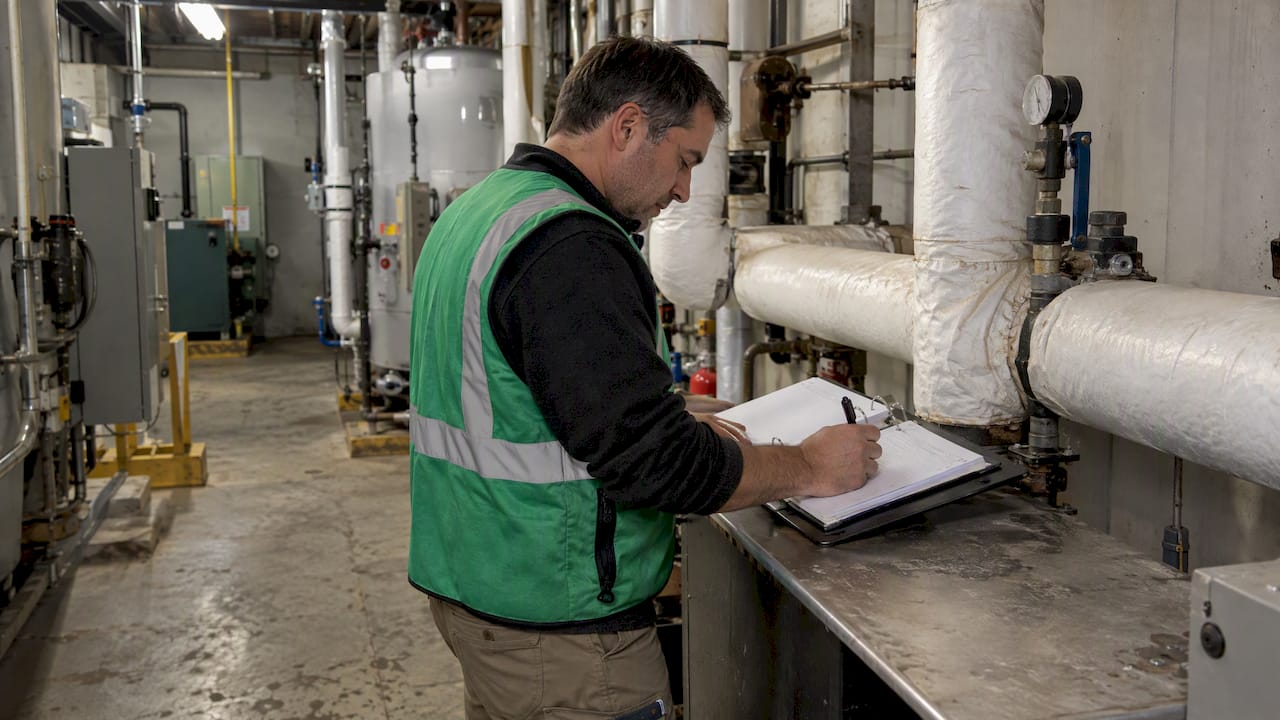
If you own a commercial, industrial or larger residential building in Ontario that contains asbestos, or that probably does, the law expects you to have a written asbestos management program. Most people call it a management plan. It is an inventory of the asbestos-containing materials (ACM) in the building, a record of their condition, and a routine of inspection and notification that keeps fibres from becoming airborne. It does not mean you have to remove everything.
This guide explains what the plan must contain, who is exempt, how often it needs updating, and the point at which managing in place stops being enough.
TL;DR
- Under Ontario Regulation 278/05, the formal term is an asbestos management program. Owners of non-exempt buildings must keep one when ACM is known or ought reasonably to be known to be present.
- The program centres on an ACM inventory, condition records and inspections, which must be updated at least every 12 months or sooner if you learn of a change.
- Owner-occupied private homes and small buildings of four units or fewer, one of them owner-occupied, are exempt. Landlords of larger buildings are not.
- Managing material in place is an accepted approach when it is in good, undisturbed condition. Renovation, demolition or damage changes that.
- A sample result, not a guess, should drive every decision. Testing comes first.
Table of Contents
- Plan or program: what Ontario actually requires
- Who needs one, and who is exempt
- What goes into the plan
- Managing in place versus removal
- Planning for renovation: Types 1, 2 and 3
- A step-by-step way to build your plan
- Our perspective
- Selling a property that has asbestos
- How we can help
- FAQ
- Sources
Plan or program: what Ontario actually requires
The phrase “asbestos management plan” is common in school boards, universities and property firms. The regulation’s own language is narrower. O. Reg. 278/05 sets out duties for owners, and the Ministry of Labour’s guide describes the combination of those duties as an asbestos management program. In practice, the two terms mean the same document set. If an inspector asks for your program, a binder or digital file titled “Asbestos Management Plan” is fine as long as it holds the required content.
The duty is triggered by knowledge. The program is expected where the owner knows, or ought reasonably to know, that a material in the building is ACM. “Ought to know” matters: a 1975 office building with sprayed fireproofing or vinyl floor tile is very likely to contain asbestos whether or not anyone has tested it.
Who needs one, and who is exempt
The regulation does not apply to the owner of a private home occupied by the owner or the owner’s family. It also does not apply to the owner of a residential building with no more than four units, one of which the registered owner or family lives in.
That leaves a long list of owners who are covered:
- Commercial and industrial property owners.
- Landlords of apartment buildings and multi-unit properties that do not meet the four-unit, owner-occupied test.
- Condominium corporations and institutions.
- Owners who rent out a whole house to tenants and do not live in it.
The Ministry guide also notes that the term “owner” under the Occupational Health and Safety Act can include tenants, so a commercial tenant who controls the space may carry owner duties. If your lease is unclear, ask for it to be settled in writing.
Being exempt from the regulation does not make asbestos harmless. A homeowner planning a renovation still has to deal with asbestos safely, and the contractor they hire is covered by the regulation.
What goes into the plan
A workable program has five working parts. The regulation and the Ministry’s guide to records and notifications shape them.
1. A building survey and ACM inventory
The starting point is a written record of where ACM is or may be: pipe insulation, boiler lagging, spray-applied fireproofing, textured ceilings, vinyl sheet and tile flooring and its mastic, cement panels, plaster, duct wrap and similar. The guide notes that old building drawings and records can point you to likely locations, though they are unreliable as proof that asbestos is absent.
A suspected material should be treated as asbestos until a sample says otherwise. Bulk sampling by a qualified inspector, analyzed by a laboratory, is how the inventory moves from “suspect” to “confirmed” or “cleared”. For larger properties, a designated substance survey covers asbestos along with other regulated substances such as lead and mercury in one report.
2. Condition and risk ratings
For each location, the record notes the type of material, whether it is friable (crumbles easily into dust) or non-friable, how much there is, its condition and how likely it is to be touched. Friable material in a mechanical room that staff enter weekly is a very different problem from intact floor tile under carpet in a storage room.
3. Inspection at least every 12 months
The owner must examine the ACM and update the record at least once every 12 months, and when they become aware of a change in condition. Water damage, a new leak, vibration from construction next door or a hole cut for cabling all count as reasons to look again. Date every inspection, name the person who did it, and keep photographs.
4. Notification
The record is not meant to sit in a drawer. Under the regulation, the owner must give occupiers written notice of the information that concerns the area they occupy, and must give employers they contract with for work written notice of the relevant information. The regulation text sets out when and how, including before tenders are requested for demolition, alteration or repair work. A plumber who cuts into a wall without knowing the pipe wrap behind it is asbestos is the exact case the notification is meant to prevent.
5. Worker instruction and control procedures
Where the owner employs workers such as maintenance staff or custodians, those workers need instruction and procedures for working near ACM. A study of Ontario school custodial workers, which appears among the top search results for this topic, looked at how aware staff were of asbestos and of management plans. The lesson for any owner is simple: a plan that front-line staff have never seen does little protecting.
Managing in place versus removal
Owners often assume the plan is a countdown to a full removal. It is not. Federal guidance, such as the Public Services and Procurement Canada standard on asbestos management, treats management as risk control. Asbestos is a hazard when fibres become airborne, so the plan focuses on catching damage before it becomes an exposure. That standard also requires its plans to be reviewed and updated at least every five years, a reasonable benchmark for private owners to adopt in addition to their annual inspections, though it is a federal rule for federal properties, not an Ontario requirement.
In plain terms:
| Situation | Typical response |
|---|---|
| ACM intact, undisturbed, low chance of contact | Manage in place: label, inspect annually, restrict access |
| ACM intact but in a spot where it is likely to be bumped | Encapsulate or enclose, or schedule removal |
| ACM damaged, friable or shedding | Remove or repair under the proper work classification |
| ACM in the path of renovation or demolition | Remove before the work begins |
The Ministry’s overview of asbestos in the workplace explains that asbestos is a designated substance under the Occupational Health and Safety Act, which is why exposure is regulated and why measures have to be in place to control it.
Planning for renovation: Types 1, 2 and 3
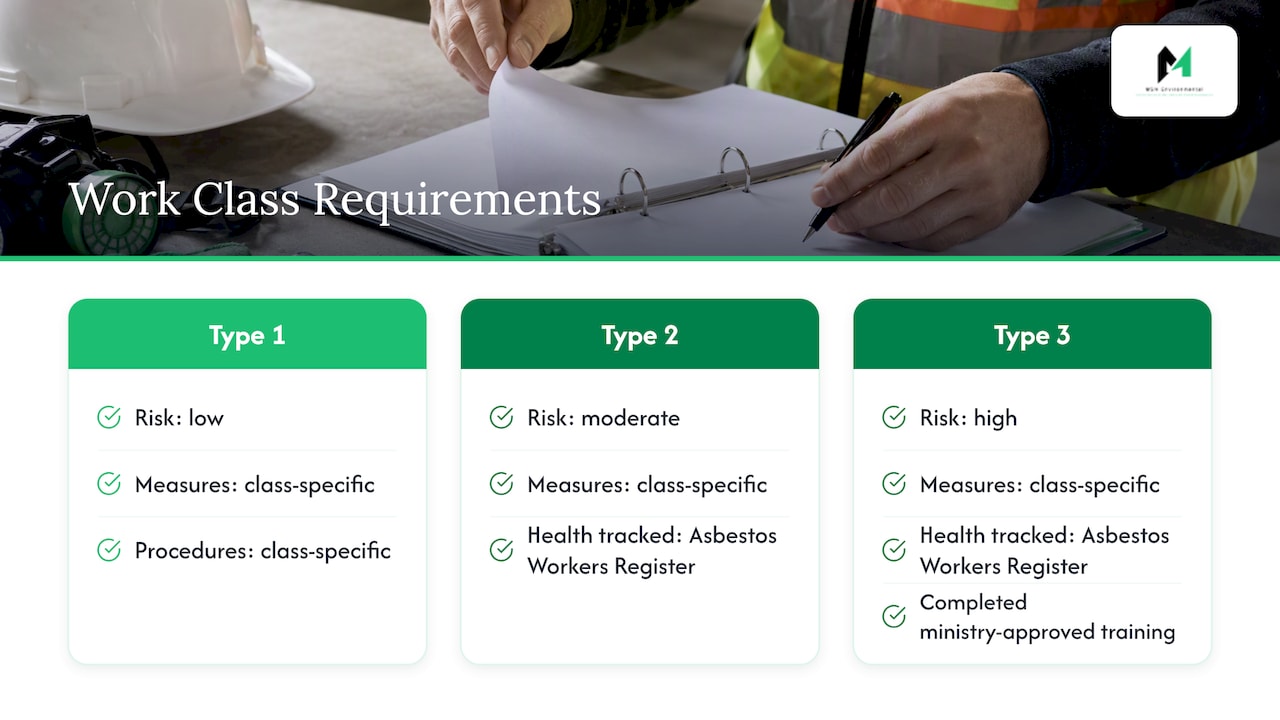
When a project will disturb ACM, the management plan hands off to a work procedure. O. Reg. 278/05 sorts work into three classes: Type 1 (low risk), Type 2 (moderate) and Type 3 (high). Each carries its own protective measures, training and procedures. Workers on Type 2 and Type 3 operations have their health tracked through the Asbestos Workers Register, and Type 3 work requires workers to have completed specific ministry-approved training.
The classification depends on the material, how much will be disturbed and the method. Getting it wrong is where owners and contractors get into trouble, because the wrong class means the wrong containment, the wrong respirators and the wrong disposal. Our own Type 3 abatement compliance guide and roadmap to Ontario asbestos regulations walk through what each class looks like on site.
The regulation also places duties on owners before they request tenders or arrange work, so the survey should be done before the scope of work is written, not after the contractor finds something. Our page on the 0.5% asbestos rule for older Ontario homes explains the threshold that decides whether a material counts as ACM.
If you are building a safety system around this, such as tracking incidents and near misses across several sites, the pilot-first approach to construction safety analytics shows one way Canadian contractors are starting small with data tools. Software does not replace a licensed survey, but it can help you see patterns in what your crews report.
A step-by-step way to build your plan
- Gather what exists. Collect drawings, past renovation records, earlier surveys and any lab reports.
- Commission a survey. Have a qualified inspector sample suspect materials, building by building. Ask for a report that lists location, material, friability, quantity and lab result.
- Rate and map. Put the results on floor plans and assign a priority to each location.
- Write the procedures. Who inspects, how often, who is notified, what staff do if they find damaged material, and who they call.
- Notify. Give occupiers and contractors the information relevant to them in writing and keep proof you did.
- Inspect and update. Re-examine at least every 12 months, record changes, and revise the plan after any abatement or building change.
- Keep it on site. The program should be where the people who need it can reach it.
Failing to maintain these records is a regulatory violation for non-exempt properties, so treat the paperwork as part of the building, like a fire panel inspection log.
Our perspective
We see the same pattern on many Ontario jobs. A property manager calls us two weeks before a tenant fit-out, and there is no survey, no inventory, and a contractor already booked. At that point the plan is being written in a hurry, and the schedule pays for it.
Our view is that the management plan is the cheapest part of dealing with asbestos, and the part owners put off longest. Sampling and a clear inventory let you decide calmly: leave the intact floor tile alone, enclose the pipe wrap, remove the ceiling texture before the renovation starts. We also tell owners honestly when removal is not needed. Not every asbestos finding is an emergency, and a well-kept record is often what separates a routine project from a stop-work order.
When removal is the right call, it needs to be classified correctly, contained properly and carried out by trained technicians with full liability insurance. That is how we approach every job, and we would rather explain the scope of work to you in detail than hand you a vague quote.
— Moacyr
Selling a property that has asbestos
Asbestos does not stop you selling in Ontario, but concealment can cost you after the sale. According to Axess Law, sellers can be sued if they know, or recklessly ignore, that a home contains asbestos and say nothing, and a latent defect that makes a home unsafe generally has to be disclosed. An “as is” clause is not a reliable shield in that situation. A current survey and a documented management record give you something concrete to show buyers and your lawyer. Speak to a real estate lawyer about your own transaction.
How we can help
We handle the testing and the work that follow from a management plan. Our testing, inspection and assessment services include bulk sampling, air testing, designated substance surveys and pre-renovation or demolition surveys, and our asbestos removal team carries out abatement for residential, commercial and industrial properties across southwestern and central Ontario, from Kitchener and Hamilton to London and Orangeville. For the sequence on site, see our asbestos removal process guide. If you want to compare budgets first, we publish a pricing guide for Ontario and a page on grants and funding.
FAQ
What is required in an asbestos management plan in Ontario?
An inventory of known or suspected ACM, a record of each material’s condition, regular inspections at least every 12 months, and written notice to occupiers and contractors about the relevant information. It should also cover worker instruction where you employ workers. The requirement comes from O. Reg. 278/05.
Does my own home need an asbestos management plan?
No, if you own and live in it. The regulation exempts owners of private residences they or their family occupy, and owners of buildings with four or fewer units where one is owner-occupied. Landlords of larger buildings are covered.
Do I have to remove all asbestos in my building?
Not necessarily. Material in good, undisturbed condition can often be managed in place with inspection and controls. Removal is typically needed when the material is damaged or will be disturbed by renovation or demolition.
Can I sell a house with asbestos in Ontario?
Yes, but you should not hide what you know. Sellers can face liability for hidden defects they knew about, and an as-is clause may not protect them. Get legal advice on your specific sale.
Sources
- O. Reg. 278/05, Designated Substance: Asbestos on Construction Projects and in Buildings and Repair Operations (e-Laws)
- O. Reg. 278/05 (current version, e-Laws)
- Examinations, records, reports and notifications: guide to the asbestos regulation (ontario.ca)
- Application: guide to the asbestos regulation (ontario.ca)
- Asbestos in the workplace (ontario.ca)
- Standard on Asbestos Management (Canada.ca)
- Selling a Home With Asbestos (Axess Law)