

TL;DR:
- If your home was built before 1980 and has white or grey corrugated pipe wrap, treat it as asbestos insulation and avoid touch. Professional testing and removal are essential if the material is damaged, friable, or disturbed during repairs.
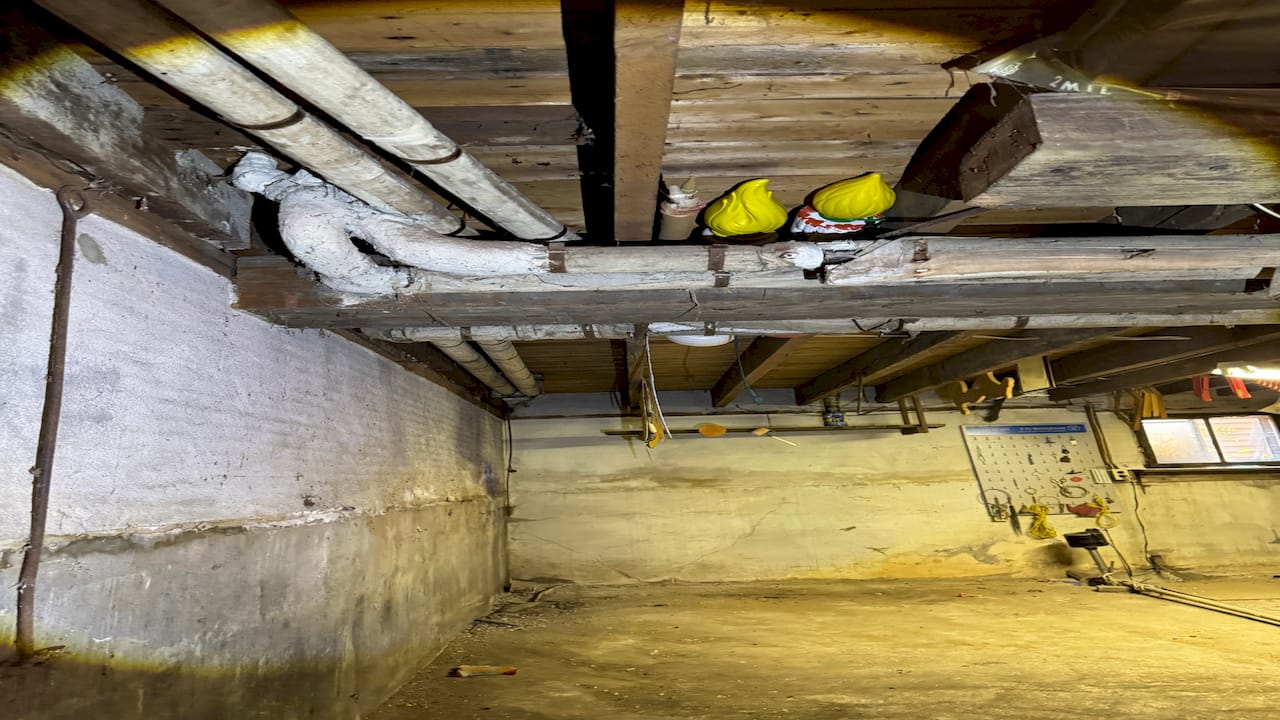
If your home was built before 1980 and the pipe wrap in your basement or mechanical room looks like white or grey corrugated paper, stiff layered cardboard, or a chalky plaster-like coating on fittings, treat it as asbestos pipe insulation wrap and do not touch it. That single rule prevents most accidental exposures.
The material itself is not automatically dangerous while it sits undisturbed. The danger starts the moment it is scraped, crumbled, cut, or even brushed during a plumbing repair. Asbestos fibres are invisible to the naked eye, and once airborne they stay suspended for hours.
If you have just discovered suspected pipe wrap, do this first:
- Stop any work in the area immediately.
- Restrict access to the space, especially for children and anyone with respiratory conditions.
- Do not vacuum, sweep, or wipe any debris you see.
- Shut off forced-air HVAC systems that draw air from the affected space if you can do so safely.
- Call a licensed asbestos abatement contractor to arrange professional testing and an inspection.
The rest of this guide walks you through identifying the material, understanding the health risk, and making the right decision between leaving it in place, encapsulating it, or having it removed by a certified professional.
Table of Contents
- What does asbestos pipe insulation wrap look like?
- Why asbestos pipe wrap becomes a health hazard
- Can you re-wrap or encapsulate asbestos pipe insulation?
- Should you leave asbestos wrap in place, encapsulate, or remove it?
- How licensed abatement professionals handle asbestos pipe removal
- How to hire a Canadian asbestos abatement contractor
- What not to do before professionals arrive
- Regulatory and disposal requirements for Canadian homeowners
- Why a certified abatement company makes a measurable difference
- Key takeaways
- The case for not cutting corners on asbestos
- MSN Environmental: certified asbestos abatement across Ontario
- Useful sources for Canadian homeowners
- FAQ
What does asbestos pipe insulation wrap look like?
Asbestos was used as pipe insulation in Canadian buildings from the late 1920s through the late 1970s. If your building’s heating or plumbing system dates to that period, the wrap on steam lines, hot-water pipes, and boiler jackets deserves close attention before any renovation work begins.
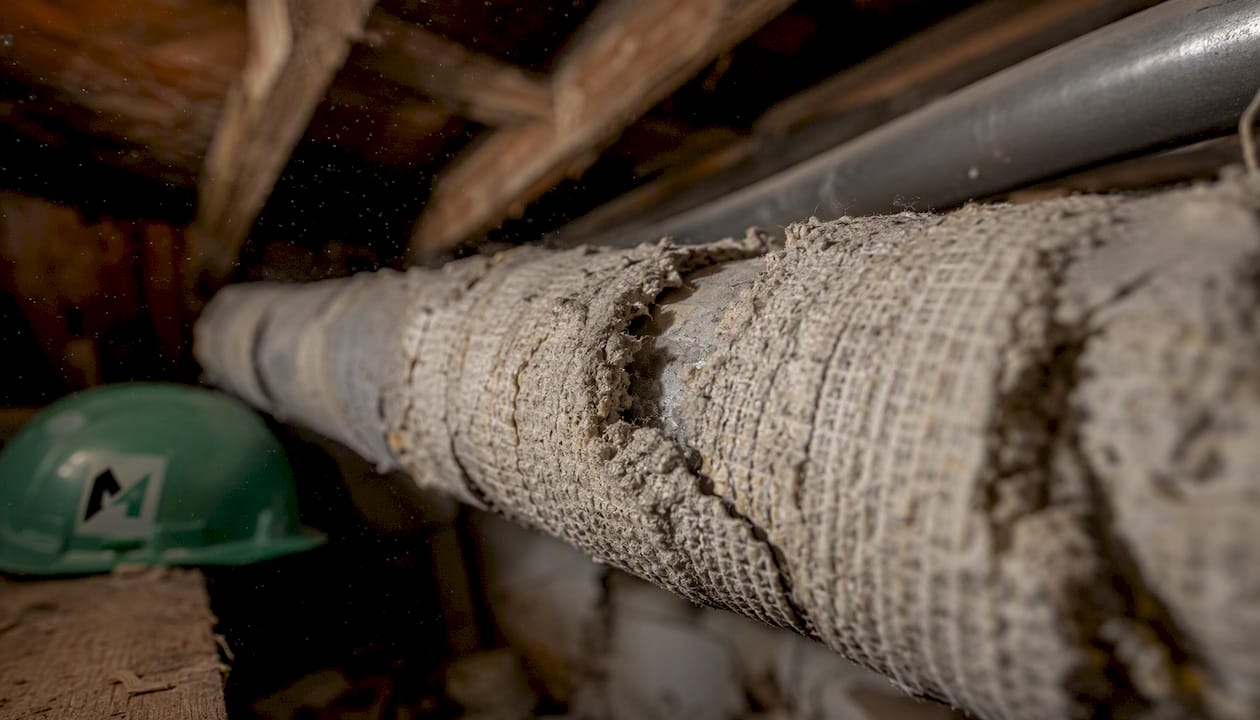
Visual identification alone is not reliable, but knowing the common forms helps you flag what needs professional testing.
Common types of asbestos pipe covering
- Air-cell insulation: White or grey corrugated paper wrapped in overlapping layers around straight pipe runs. It looks almost like a cardboard tube and is one of the most frequently encountered forms in Canadian basements.
- Magnesia or “mud” insulation: A chalky, plaster-like coating applied over fittings, elbows, tees, and valves. It often cracks and crumbles with age, which makes it the most friable type you are likely to encounter.
- Pre-formed block sections: Rigid half-shell sections held together with tape or wire, typically on larger-diameter pipes.
- Felt or wool tape: Fibrous wrapping used at joints, elbows, and valve connections, often layered under or over the main insulation.
Where to look in your home
The most common locations are basements and mechanical rooms, around boiler jackets and furnace connections, along steam and hot-water distribution lines, and at every elbow, tee, and valve on older systems. Post-1985 pipe insulation is unlikely to contain asbestos, but systems that were partially repaired or extended after that date may have a mix of old and new materials.
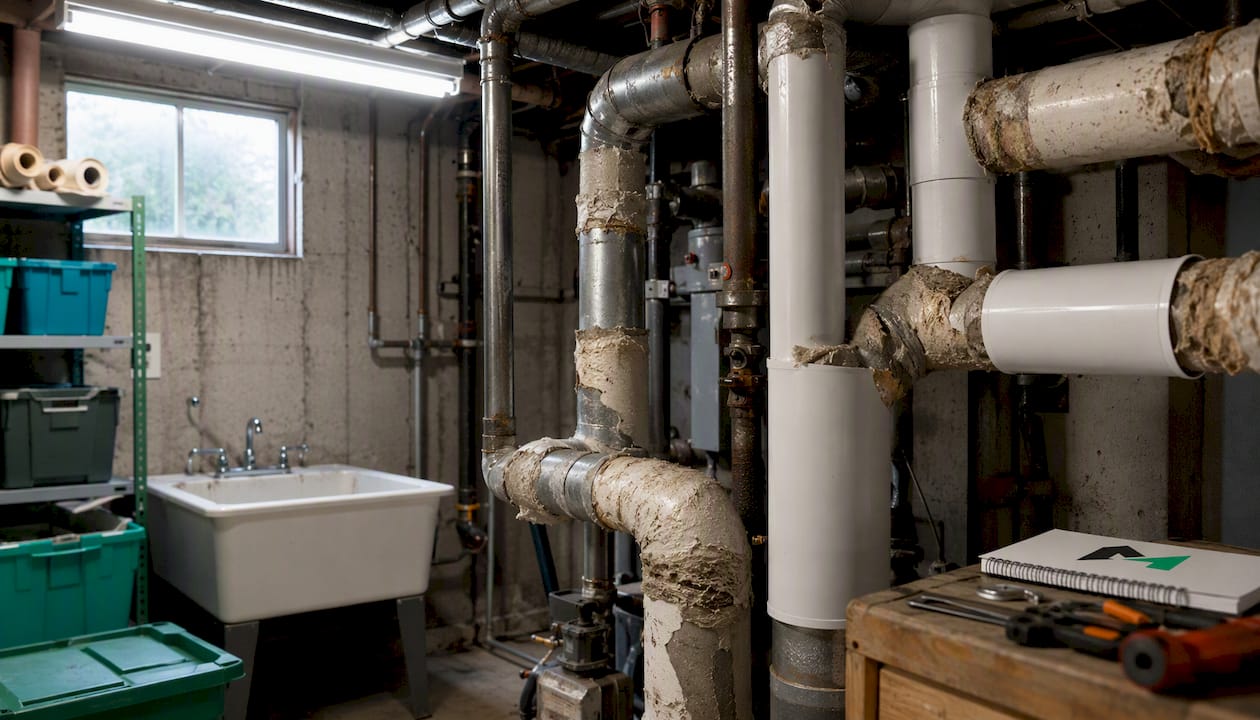
Pro Tip: Fittings carry higher risk than straight runs. The magnesia mud hand-packed onto elbows and valves degrades faster than pre-formed sections and is often already crumbling by the time a homeowner notices it. Prioritise those locations when you arrange a professional assessment.
Why asbestos pipe wrap becomes a health hazard
Asbestos pipe insulation is classified as a friable material, meaning it can be crumbled, pulverised, or reduced to powder by hand pressure. When that happens, microscopic fibres become airborne. Breathing them in is the exposure pathway that matters.
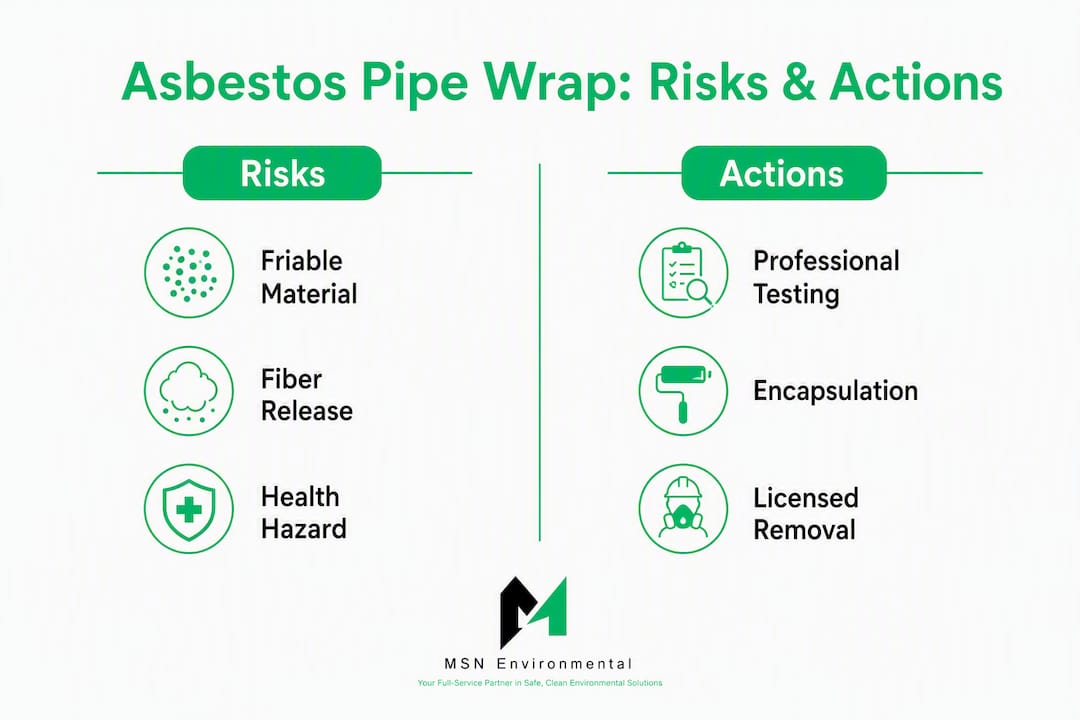
The health risks associated with asbestos exposure include mesothelioma, lung cancer, and asbestosis. What makes asbestos particularly deceptive is the latency: diseases can take 20–50 years to develop after exposure, and cumulative lifetime dose is what drives risk. A single brief exposure is unlikely to cause disease; repeated low-level exposures in an occupied basement over years are a different matter.
Situations that raise your risk
- Plumbing repairs that require cutting, bending, or removing pipe wrap.
- Water leaks or condensation that have softened and degraded the insulation.
- Renovation work near mechanical rooms, including framing, drywall, or ductwork.
- Regular occupancy of the basement by children, elderly residents, or anyone immunocompromised.
- Vibration from nearby construction or heavy equipment.
Pro Tip: Do not wet down debris and try to wipe it up yourself. Wetting loose asbestos material without proper containment can spread contaminated water and actually increase the surface area of disturbed fibres. Leave debris in place and call a professional.
Can you re-wrap or encapsulate asbestos pipe insulation?
Yes, under specific conditions. The US EPA defines two approaches: encapsulation, which applies a sealant that binds or coats the fibres so they cannot become airborne, and enclosure, which places a physical jacket or cover around the material to contain it. Both are legitimate risk-management strategies when the underlying conditions are right.
When encapsulation is appropriate
- The insulation is intact, with no visible crumbling, flaking, or water damage.
- No renovation, plumbing repair, or demolition work is planned in the area.
- Occupancy of the space is low and access can be controlled.
- A professional has confirmed the material’s condition through inspection and bulk sampling.
A sealed PVC jacket or a bridging encapsulant applied by a trained technician can be a reasonable short- to medium-term solution in those circumstances. It costs less than full removal and avoids the disturbance that removal itself creates.
Where encapsulation falls short
Encapsulation is not permanent. Sealants cannot bond to loose, crumbly debris, and the underlying material continues to degrade. If the insulation is already friable, a sealant coat will not hold it together reliably over time. Monitoring is required after any encapsulation work, and most encapsulated systems eventually need full abatement anyway.
| Factor | Encapsulation | Full removal |
|---|---|---|
| Upfront cost | Lower | Higher |
| Longevity | Medium-term; requires monitoring | Permanent solution |
| Disturbance during work | Minimal | Significant; full containment required |
| Suitable for friable material | No | Yes |
| Future renovation flexibility | Limited | Unrestricted after clearance |
| Ongoing monitoring needed | Yes | No |
Pro Tip: A sealed PVC jacket is a practical stopgap when removal is not yet in the budget and the material is genuinely intact. But schedule a re-inspection every two to three years, and plan for full abatement before any plumbing or renovation work that touches those pipes.
Should you leave asbestos wrap in place, encapsulate, or remove it?
If the insulation is intact and undisturbed, leaving it in place and managing access is often the safest immediate approach. Removal is recommended when the material is damaged, deteriorating, or when planned work will disturb it. The decision is not always obvious, which is why a professional inspection should precede any choice.
Decision pathway
- Do not disturb the material until you have a professional assessment.
- Arrange bulk sampling through a licensed inspector or abatement contractor. Visual identification is not sufficient to confirm asbestos content.
- Review the lab results with your contractor. Confirmed asbestos content triggers the next decision.
- Assess the condition: Is the material intact or friable? Are there cracks, water stains, or crumbling sections?
- Consider your plans: Any renovation, plumbing repair, or sale of the property in the near future shifts the calculus toward removal.
- Choose a management plan: Intact material with no planned disturbance may be managed in place or encapsulated. Damaged material, or any system where future access is likely, warrants full abatement.
- Implement and document: Whatever path you choose, get written documentation, including the lab results, the scope of work, and any clearance certificates.
Factors that push toward removal
- Visible crumbling, flaking, or water damage on the insulation.
- Planned plumbing repairs, renovations, or basement finishing.
- Children or vulnerable occupants regularly using the space.
- Upcoming property sale, where disclosure obligations apply.
- Fittings and elbows already showing magnesia mud degradation.
How licensed abatement professionals handle asbestos pipe removal
Professional asbestos abatement follows a structured sequence. Knowing the steps helps you evaluate contractor proposals and understand what you are paying for.
The professional removal process
- Inspection and bulk sampling. A qualified inspector collects samples with proper chain of custody and sends them to an accredited laboratory. For larger projects, an independent consultant separate from the abatement contractor reduces scope bias and ensures the management plan reflects actual building conditions rather than contractor preferences.
- Scope definition. The contractor prepares a written scope of work identifying all affected materials, access requirements, and containment boundaries.
- Containment setup. The work area is sealed with plastic sheeting. Forced-air HVAC systems are shut down. Negative air pressure machines fitted with HEPA filtration run continuously to prevent fibres from migrating to adjacent spaces. For small, isolated sections, glove bags allow workers to remove material without full-room containment.
- Wet removal. Workers wet the insulation before and during removal to suppress fibre release. Hand tools are used rather than power tools, which generate more dust.
- Waste handling. Removed material is double-bagged in labelled, leak-tight containers and staged for transport to an approved hazardous waste disposal facility. Nothing leaves the containment zone unsealed.
- Air monitoring. Continuous air monitoring runs throughout the project. A final clearance air sample is collected after cleanup and before the containment is dismantled.
- Clearance report and documentation. The contractor provides a written clearance report confirming that post-abatement air fibre concentrations meet the required standard. Disposal receipts and waste manifests are included in the final package.
Homeowners should request the lab chain-of-custody records, the final air-clearance report, and the signed waste manifests before releasing final payment. These documents are required for resale disclosure and regulatory compliance, and a contractor who hesitates to provide them is a red flag.
Wet methods and glove bags significantly reduce airborne fibre generation during small-scale work; negative pressure HEPA systems provide the containment required for larger removals.
How to hire a Canadian asbestos abatement contractor
Choosing the right contractor matters as much as choosing to hire one. The asbestos abatement industry in Canada is provincially regulated, and the gap between a certified, insured firm and an unlicensed operator can be the difference between a clean clearance report and a contaminated home.
Credentials to verify
- Provincial abatement licence or certification (requirements vary by province; in Ontario, contractors working under Ontario Regulation 278/05 must meet specific training and notification requirements).
- WSIB clearance certificate confirming workers’ compensation coverage.
- Proof of general liability insurance.
- Worker training documentation (e.g., two-day or four-day asbestos worker certification depending on the scope).
- Hazardous waste transport agreement with a licensed carrier.
Questions to ask before signing
- Will you perform independent bulk sampling before starting, or are you relying on a previous report?
- What containment method will you use: full room, glove bag, or mini-enclosure?
- Who performs the final air-clearance sampling, and is it independent of your crew?
- Where will the waste be disposed of, and will I receive the manifest?
- What does your scope of work include, and what is explicitly excluded?
Red flags
- A quote that is significantly lower than others with no explanation of what was removed from scope.
- Unwillingness to provide proof of insurance, WSIB, or worker training certificates.
- No mention of air-clearance testing in the proposal.
- Pressure to start immediately without a written scope of work.
- No references from comparable residential projects.
What to expect for cost and timeline in Canada
Straight-run pipe wrap removal is typically priced per linear foot. Industry guides cite ranges of roughly $15–$30 per linear foot for straight runs, with elbows, valves, and boiler jackets priced higher per unit due to the additional labour and disposal complexity. A whole-basement pipe system can reach into the low thousands of dollars depending on scope, access, and regional labour rates. Always request a detailed, line-item quote rather than a lump sum, since pricing is sensitive to the number of fittings and the difficulty of access.
A typical residential pipe-wrap project runs one to three days for the abatement work itself, plus time for lab results before and after. Expect the full process, from initial inspection to final clearance report, to take one to two weeks.
What not to do before professionals arrive
The most common mistakes happen in the first hour after someone discovers suspected asbestos pipe wrap. Good intentions and the wrong tools can spread contamination through an entire house.
Do not do any of these
- Scrape, sand, or chip at the insulation to “see what’s underneath.”
- Vacuum debris with a household vacuum. Standard vacuums exhaust fine particles back into the air.
- Use a heat gun, drill, or any power tool near suspected material.
- Dry-sweep dust or debris from the floor.
- Handle broken pieces without gloves and a properly fitted respirator (N95 is not sufficient; a P100 half-face respirator is the minimum for any incidental contact).
Safe steps you can take right now
- Close the door to the affected space and post a note restricting access.
- Shut off any forced-air system that draws return air from the basement or mechanical room.
- If there is visible debris on the floor, leave it undisturbed. Do not attempt to clean it.
- Contact a licensed abatement firm or your provincial health authority for guidance on next steps.
- For asbestos testing and inspection services, reach out to a certified provider who can arrange bulk sampling with proper chain of custody.
Pro Tip: If you need to preserve a sample location for professional testing, identify a small area of undisturbed material and mark it with tape on the floor nearby. Do not touch the insulation itself. The inspector will collect the sample using proper containment tools.
Regulatory and disposal requirements for Canadian homeowners
Asbestos handling and disposal in Canada is governed provincially, not federally, which means the specific rules you must follow depend on where your property is located. The broad obligations are consistent: asbestos waste must be handled as hazardous material, transported by a licensed carrier, and disposed of at an approved facility.
Ontario as an example
In Ontario, Ontario Regulation 278/05 governs the handling of designated substances including asbestos. Key points for homeowners:
- Contractors must notify the Ministry of Labour, Immigration, Training and Skills Development before Type 2 or Type 3 asbestos work begins.
- Workers must be trained to the level appropriate for the work type.
- Waste must be double-bagged, labelled, and transported to a licensed disposal facility.
- Air-clearance testing is required before re-occupancy after Type 3 work.
Other provinces have equivalent regulations. British Columbia, Alberta, and Quebec each maintain their own designated substance or hazardous materials frameworks with similar disposal and notification requirements.
Documentation your contractor must provide
- Pre-abatement bulk sample lab results with chain of custody.
- Written scope of work and containment plan.
- Waste manifests signed by the transporter and disposal facility.
- Post-abatement air-clearance report from an accredited laboratory.
- Disposal receipts confirming the waste reached an approved facility.
What homeowners should keep on file
- All inspection reports and lab results.
- The abatement contractor’s scope of work and completion certificate.
- Waste manifests and disposal receipts.
- The final air-clearance report.
These records matter at resale. Many provinces require disclosure of known designated substances, and a buyer’s inspector or lawyer will ask for documentation. A complete file protects you and demonstrates that the work was done properly.
Why a certified abatement company makes a measurable difference
The gap between a certified abatement contractor and an unlicensed operator is not just a matter of paperwork. It shows up in the air-clearance results, the disposal documentation, and the condition of your home after the work is done.
A certified provider delivers:
- Independent bulk sampling with accredited lab analysis and chain of custody.
- Full containment using negative air pressure and HEPA filtration, preventing cross-contamination to living spaces.
- Wet removal methods that suppress fibre release at the source.
- Post-abatement air-clearance sampling by an independent party, with a written report confirming safe re-entry.
- Certified hazardous waste transport and disposal with signed manifests.
- Complete documentation package for regulatory compliance and resale disclosure.
Hiring an independent asbestos consultant to define the scope before you invite abatement contractors to quote is one of the most underused protections available to homeowners. A consultant with no financial stake in the removal work will give you an honest assessment of what actually needs to come out, which often results in a smaller, more targeted scope and a lower final cost.
MSN Environmental provides the full range of these services for residential and commercial properties across Ontario, from asbestos testing and inspection through to full abatement, air clearance, and certified disposal. Every project includes the documentation package homeowners need for compliance and resale.
Key takeaways
Asbestos pipe insulation wrap in pre-1980 Canadian buildings requires professional testing before any disturbance, and damaged or friable material must be removed by a licensed abatement contractor, not a DIY operator.
| Point | Details |
|---|---|
| Identify before you act | Pre-1980 corrugated paper, chalky mud on fittings, or layered cardboard wrap should be treated as asbestos until lab-confirmed otherwise. |
| Do not disturb | Scraping, vacuuming, or dry-sweeping suspected material releases fibres; restrict access and call a professional first. |
| Encapsulate vs. remove | Intact, undamaged insulation with no planned work may be encapsulated; friable or damaged material requires full abatement. |
| Costs and timelines | Straight-run removal is typically priced per linear foot, with whole-basement projects costing several thousand dollars; the full process generally takes between one and two weeks. |
| MSN Environmental | Provides inspection, bulk sampling, full containment abatement, air clearance, and certified disposal for Ontario homeowners and property managers. |
The case for not cutting corners on asbestos
There is a version of this situation that plays out badly, and it usually starts with a well-meaning homeowner who figures the pipe wrap looks stable enough to leave alone during a bathroom renovation. They tell the plumber not to worry about it. The plumber cuts through a section. Three days later, the air in the house tests positive for asbestos fibres, and what would have been a $2,000 abatement job becomes a $15,000 remediation of the entire basement and HVAC system.
The frustrating thing about asbestos risk is that it is invisible and slow. Nobody gets sick the next day. That makes it easy to rationalise inaction, especially when the insulation looks intact and the renovation budget is already stretched. But the latency is not a safety margin. It is a delay between the exposure and the consequence.
What I find consistently underestimated is the value of the documentation. Homeowners who go through a proper abatement process, get the clearance report, and keep the waste manifests on file are in a fundamentally different position at resale than those who had “someone come and take care of it.” The paper trail is not bureaucratic overhead. It is proof that the hazard is gone, and buyers’ lawyers know exactly what to ask for.
The other thing worth saying plainly: encapsulation is not a lesser option when the conditions are right. A well-applied encapsulant on genuinely intact insulation, with a monitoring plan in place, is a legitimate professional choice. The mistake is using it as a cheaper substitute when the material is already crumbling. At that point, it is not risk management. It is wishful thinking.
MSN Environmental: certified asbestos abatement across Ontario
When you have confirmed or suspected asbestos pipe wrap in your home, the next step is a professional inspection, not a second opinion from a general contractor. MSN Environmental’s certified technicians handle the full scope: bulk and air sampling, designated substance surveys, full containment abatement, HEPA negative-air removal, post-abatement air clearance, and certified hazardous waste disposal, all compliant with Ontario regulations.
What sets MSN Environmental apart is the completeness of the documentation package. Every project closes with lab-verified air-clearance results, signed waste manifests, and a disposal certificate, the exact records you need for regulatory compliance and property disclosure. The team serves residential and commercial clients across Ontario, including Toronto, Hamilton, Kitchener, Cambridge, Guelph, Brantford, and London.
To request an inspection or get a quote for asbestos abatement and removal services, have your property address, a description of the visible condition of the insulation, and access details for the mechanical room ready when you call. Response times for inspections are typically within a few business days. For a broader look at why certified professionals make a measurable difference, see the top reasons to hire certified hazardous material removal specialists.
Useful sources for Canadian homeowners
These are the primary and authoritative sources to consult for regulation, testing guidance, and further reading on asbestos pipe insulation in Canada.
- Government of Canada — Asbestos guidance: Federal overview of asbestos health risks, identification, and when to seek professional help. Start here for general Canadian context.
- Ontario Regulation 278/05 — Designated Substance: Asbestos on Construction Projects and in Buildings and Repair Operations: The governing regulation for asbestos work in Ontario. Covers notification requirements, work types, and contractor obligations.
- HealthLink BC — Asbestos: Plain-language guidance from British Columbia on when to worry, when to act, and how to find help.
- US EPA — Protect Your Family from Exposures to Asbestos: — Detailed technical guidance on encapsulation, enclosure, containment methods, and DIY risk. Useful background even though it is US-sourced.
- Simon Air Quality — Asbestos testing services: Canadian asbestos bulk and air testing services with detail on sampling methodology and lab workflow.
- Simon Air Quality — Hiring asbestos abatement contractors: Practical contractor hiring guide covering what to expect from the abatement process and how to evaluate proposals.
FAQ
Can you wrap asbestos pipes to make them safe?
Yes, encapsulation or enclosure can reduce fibre release from intact asbestos pipe insulation, but only when the material is undamaged and no renovation work is planned. A licensed professional must assess the condition first; wrapping already-friable material does not make it safe.
What does asbestos wrap on pipes look like?
The most common forms are white or grey corrugated paper around straight runs, a chalky plaster-like coating on fittings and elbows, and fibrous felt tape at joints. Visual identification is not definitive, so bulk sampling by an accredited lab is required to confirm asbestos content.
When did they stop wrapping pipes with asbestos in Canada?
Asbestos pipe insulation was commonly installed in Canadian buildings from the late 1920s through the late 1970s. Use declined sharply after the late 1970s, and post-1985 pipe insulation is unlikely to contain asbestos, though partially repaired older systems may still have original asbestos-containing sections.
Is asbestos pipe wrap safe if it is still sealed?
Intact, undisturbed asbestos pipe insulation poses a lower immediate risk than damaged material. The hazard arises when fibres become airborne through crumbling, abrasion, or disturbance. Managing it in place with restricted access is a recognised short-term strategy, but any planned renovation or plumbing work near the pipes changes the risk calculation and typically warrants removal.
How do I find a licensed asbestos abatement contractor in Ontario?
Verify that the contractor holds provincial certification under Ontario Regulation 278/05, carries WSIB coverage and general liability insurance, and can provide worker training documentation. MSN Environmental offers certified asbestos abatement services across Ontario, including inspection, containment removal, air clearance, and full disposal documentation.