

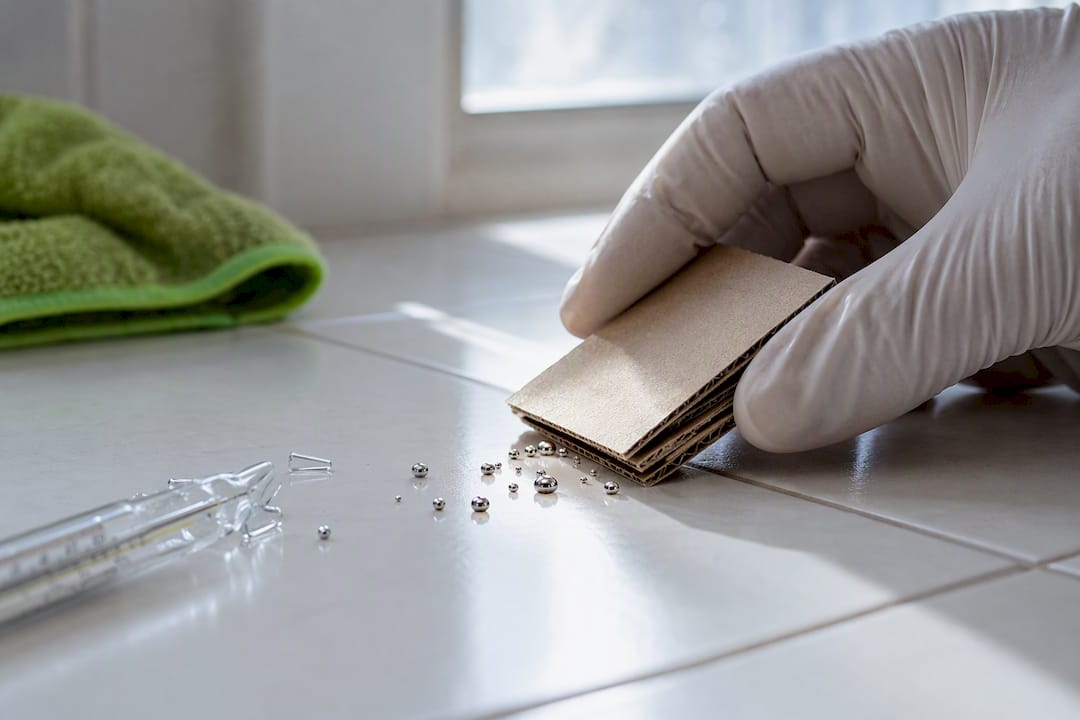
If a mercury thermometer breaks, keep people and pets out of the room, open windows to ventilate, and avoid vacuuming. From there, you have two paths: careful manual cleanup for a small spill on a hard, smooth surface, or a call to a hazardous-materials professional for anything on carpet, upholstery, or a spill that reaches cracks and vents.
TL;DR:
- Manual cleanup on hard, smooth surfaces is safe for small spills under one thermometer’s mercury if the area is properly ventilated and contamination is contained.
- Do not vacuum, sweep, or use household cleaners on mercury spills, as these methods spread vapour and tiny droplets, complicating cleanup.
- Porous materials like carpets and upholstery should be sealed and removed rather than cleaned, since micro-droplets can cause ongoing vapour release.
- Ventilate the affected room for at least 24 to 48 hours, especially to protect children, pregnant individuals, and pets from invisible mercury vapour lingering near floor level.
- Large spills or contamination reaching cracks, vents, or porous surfaces require professional hazardous-materials removal to ensure complete cleanup and safety.
Table of Contents
- Quick action checklist for the first 10 minutes
- Prepare safely: what to wear and what supplies you need
- Step-by-step cleanup for hard, smooth surfaces
- What to do if the spill is on carpet, upholstery or other porous material
- Ventilation, exposure risk and who is most vulnerable
- How to dispose of broken thermometers, mercury waste and contaminated materials
- Common mistakes to avoid
- When to stop and hire a hazardous-materials contractor
- Publisher perspective and practical judgement call
- How MSN Environmental can help with mercury and other hazards
- Sources
- FAQ
Quick action checklist for the first 10 minutes
The first few minutes decide how much mercury vapour ends up in the air you breathe. Work through these steps in order.
- Get people and pets out of the room and close the door to create an exclusion zone.
- Turn off any forced-air heating or cooling system so vapour does not spread through the ducts.
- Open windows and, if it is safe to do so, point a fan to exhaust air outdoors rather than into the rest of the home.
- Pick up broken glass and visible mercury beads using manual tools only, never a vacuum or a heat source.
- Seal contaminated tools, gloves, and debris in a sealable container reserved for hazardous waste.
Prepare safely: what to wear and what supplies you need
Before you touch anything, gather the right gear. Skipping this step is the most common reason a small spill turns into a bigger cleanup job.
- Nitrile or rubber gloves to keep mercury off your skin.
- Eye protection, plus a disposable gown or old clothing you can discard afterward.
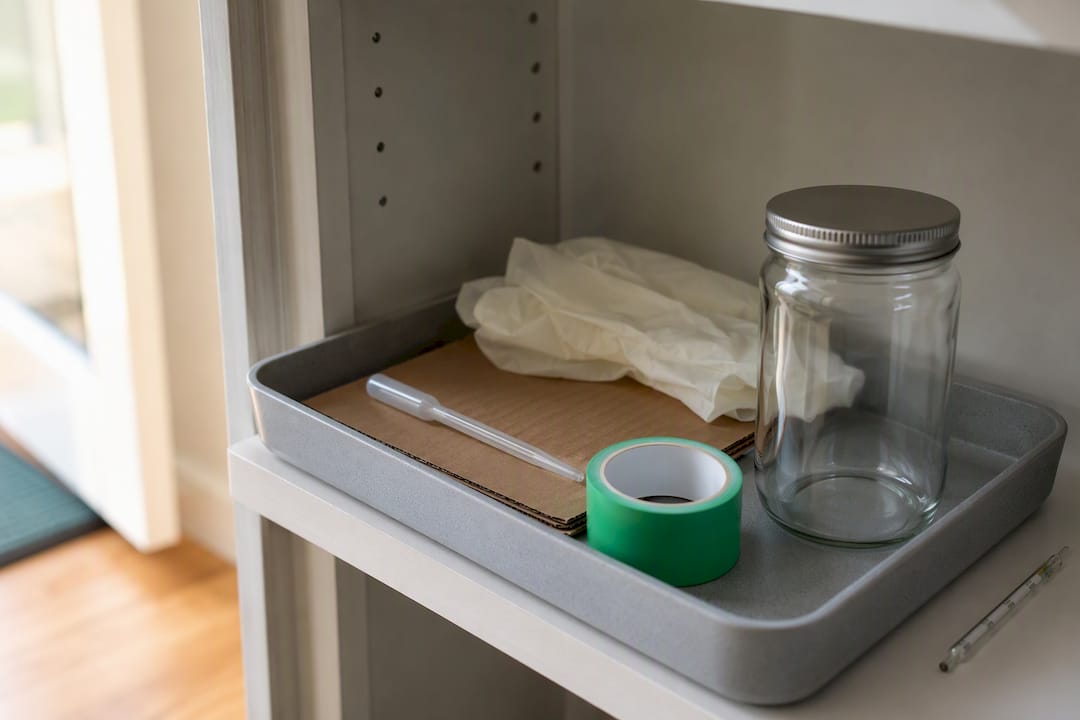
- Two sealable plastic bags and a rigid container or glass jar with a tight lid for the collected mercury.
- An eye dropper or syringe, a piece of stiff cardboard or an old playing card, and adhesive tape.
- A flashlight and some damp paper towels for the final wipe-down.
Vacuums heat and aerosolize mercury, broadcasting vapour through the exhaust. Brooms and cloth rags just scatter beads into smaller, harder-to-find droplets, and most household cleaning chemicals do nothing to bind mercury, they only spread it further across the surface.
Pro Tip: Keep a dedicated “mercury kit” (gloves, cardboard, dropper, tape, jar) in a hall closet if you still have a mercury thermometer in the house. Having it ready means you spend zero minutes searching for supplies while vapour builds up.
Step-by-step cleanup for hard, smooth surfaces
A small mercury spill, meaning the amount held in a single household thermometer, can often be handled without a contractor if it lands on tile, hardwood, or another hard, non-porous surface. Transport Canada’s CANUTEC guidance lays out manual collection as the standard approach for exactly this scenario.
- Work from the outside of the spill toward the centre so you do not track beads further afield.
- Use the edge of a playing card or stiff cardboard to gently corral scattered beads into a single pile.
- Draw the pooled mercury into the eye dropper or syringe and empty it directly into your glass jar.
- Press adhesive tape onto the surface to lift any remaining tiny droplets that are too small to corral.
- Turn off the overhead light and sweep a flashlight low across the floor at a shallow angle. Mercury beads catch the light and reflect it, which makes them easy to spot even when they are nearly invisible in normal lighting.
- Place the broken glass, tape, gloves, and any other contaminated items into the container with the mercury, seal it, then double-bag it in a second sealed plastic bag.
- Wipe the area with a damp paper towel, then wash it with soap and water once you are confident no beads remain.
- Keep the room ventilated for at least 24 to 48 hours, which matches the window CANUTEC recommends for a small household spill.
A standard oral or rectal thermometer holds about 0.5 to 0.6 grams of elemental mercury. That is a tiny amount by weight, but it is enough to raise indoor vapour levels if the beads are heated, vacuumed, or left exposed in a closed room.
What to do if the spill is on carpet, upholstery or other porous material
Mercury behaves differently once it hits fabric. Beads sink into carpet fibres, upholstery weave, or the seams of a stuffed toy, where they become almost impossible to fully retrieve by hand. Vacuuming makes it worse by heating the trapped droplets and pushing vapour, plus fine residue, straight back into the room.
- If the item is small and replaceable, such as a rug, cushion, or toy, isolate it rather than attempting to clean it in place.
- Seal the contaminated item in heavy plastic, label it clearly as mercury-contaminated, and set it aside for hazardous-waste drop-off.
- Do not launder contaminated clothing or fabric in a household washing machine. The machine and any following loads can become contaminated too.
- For larger porous surfaces, such as a full carpet or a couch, treat the affected section the same way: isolate it and plan for removal rather than DIY decontamination.
Micro-droplets trapped in fibres can continue releasing vapour long after the visible spill is gone, which is why removal and disposal, not cleaning, is the reliable fix for porous materials.
Ventilation, exposure risk and who is most vulnerable
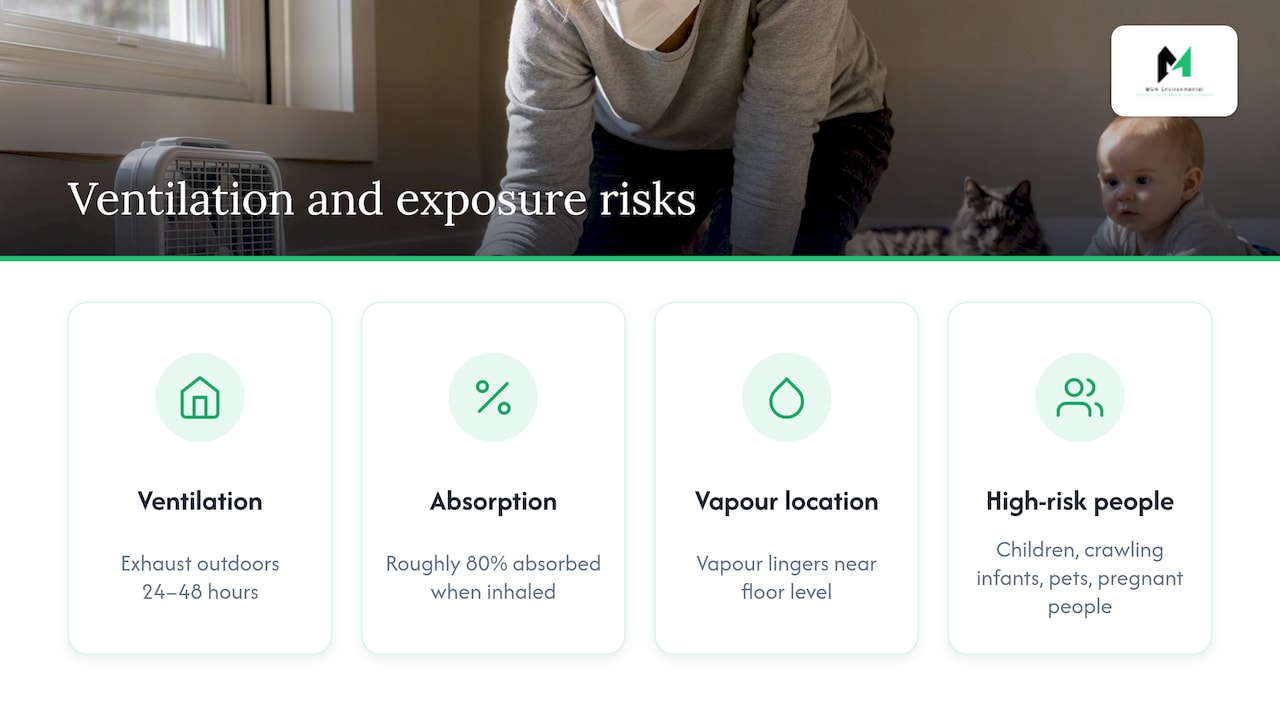
Mercury vapour has no colour and no smell, so you cannot tell by sight or scent whether a room is still contaminated. That invisibility is what makes it the main hazard. Inhaled mercury vapour is absorbed into the body at roughly 80%, compared with only limited absorption if mercury is swallowed, which is why breathing it in is the real concern after a spill.
Open windows and run fans exhausting outdoors for at least 24 to 48 hours after a small spill, longer if anyone spent time in the room before the spill was contained. Vapour tends to linger near floor level, which puts children, crawling infants, and pets at higher risk than standing adults. Pregnant people should also avoid the affected room until ventilation is complete.
How to dispose of broken thermometers, mercury waste and contaminated materials
Mercury never belongs in a household drain or the regular trash. It is persistent in the environment and a municipal wastewater plant is not built to remove it.
- Check your municipal hazardous-waste depot or a product-stewardship drop-off point, since many municipalities accept mercury-containing devices through these programs.
- Store the sealed jar and any contaminated bags in an airtight container, labelled clearly, until you can transport them.
- Keep the container upright and away from heat in the vehicle on the way to the depot.
- If you are unsure about transport rules or packaging, CANUTEC can answer technical questions about handling and moving mercury waste safely.
Mercury thermometers have not been manufactured or imported for sale for years, so most remaining units in homes are legacy products that were purchased before the rules changed.
Common mistakes to avoid
A handful of instinctive reactions actually make a mercury spill worse. Avoid all of the following.
- Never vacuum, sweep, or use a broom on spilled mercury. Each of these methods either heats the mercury or scatters it into smaller, harder-to-find droplets.
- Do not use household solvents, detergents, or bleach on the spill. None of them bind mercury, and some can help it spread across a wider area.
- Do not run the HVAC system or turn up the heat in the room. Warm air increases how much mercury evaporates into vapour.
- Do not carry contaminated clothing or tools through the rest of the house before bagging them.
When to stop and hire a hazardous-materials contractor
Some situations call for professional help rather than a DIY attempt. Spills larger than a single thermometer, mercury that has reached carpet, upholstery, floor cracks, or heating vents, and spills in homes with young children, pregnant occupants, or people with respiratory conditions are all reasons to bring in a contractor rather than risk an incomplete cleanup.
A professional visit typically includes an on-site assessment, containment of the affected area, manual and specialist collection of the mercury, air monitoring to confirm the space is safe, and disposal through a certified hazardous-waste chain of custody, steps that go beyond what household tools and a jar can achieve. You can learn more about why certified removal matters for complex spills before deciding which path fits your situation.
Publisher perspective and practical judgement call
Our view is straightforward: a small bead pile on tile is a reasonable DIY job if you follow the steps above and ventilate properly. The calculation changes the moment mercury touches carpet, a couch, or a crack you cannot fully see into. At that point, the risk of missed residue outweighs the cost of a professional visit, and we would rather see a homeowner call for testing and assessment than guess.
— Moacyr
How MSN Environmental can help with mercury and other hazards
If a spill has reached porous material or you just want confirmation that a room is clean, our mercury abatement and hazardous-materials removal service covers assessment, containment, removal, and documentation so you have a clear record the job was done properly.

A typical visit starts with an inspection of the affected area, followed by containment, removal of contaminated materials, and air testing to confirm the space is safe before we close out the job. We also handle related hazards under the same visit when needed, including asbestos removal and mould remediation. To get started, contact a qualified hazardous-materials professional with the size of the spill, the surface it landed on, and whether anyone in the home is pregnant, young, or has a respiratory condition, details that help scope the visit before arrival.
Sources
For technical or medical questions, contact CANUTEC or check Health Canada’s mercury guidance and your local household hazardous-waste depot.
This article is general information, not a substitute for advice from a qualified doctor. Consult a qualified healthcare professional about your own circumstances before acting on anything here.
- Mercury exposure and health effects (PMC)
- Mercury thermometer spills – What to do (Transport Canada / CANUTEC)
- Mercury and human health (Health Canada)
- Product containing mercury regulations (Canada)
FAQ
What happens if you break an old mercury thermometer?
The glass releases small liquid mercury beads that can vaporize into an invisible, odourless gas. The main risk comes from breathing that vapour, not from touching the beads themselves, so isolating and ventilating the room matters more than the cleanup itself.
How much mercury is toxic from a thermometer?
A single household thermometer holds about 0.5 to 0.6 grams of mercury, which official guidance treats as a small spill manageable with careful manual cleanup on hard surfaces. There is no simple toxic threshold for a healthy adult in a well-ventilated room, but children, pregnant people, and anyone with breathing conditions face higher risk from the same amount.
What do I do with an old mercury thermometer?
Do not throw it in the regular trash or pour any mercury down a drain. Take it, broken or intact, to a municipal household hazardous-waste depot or a product-stewardship drop-off point.
What should I do if my thermometer breaks?
Remove people and pets from the room, open windows, and skip the vacuum. If the spill is small and on a hard surface, follow a manual collection process with gloves, cardboard, and a sealed jar; if it landed on carpet or upholstery, isolate the item and consider professional removal instead of DIY cleaning.
When should I call a professional instead of cleaning it myself?
Call a contractor when the spill covers more than a single thermometer’s worth of mercury, when it reaches carpet, upholstery, or hard-to-reach cracks, or when children, pregnant occupants, or people with respiratory conditions live in the home. A professional visit adds containment, air monitoring, and certified disposal that a home cleanup cannot replicate.