

TL;DR:
- Vermiculite insulation in homes built before 1990 may contain asbestos and should remain undisturbed until tested by a certified professional.
- If suspected, homeowners must avoid disturbing the material, restrict access, and contact experts for proper testing and removal.
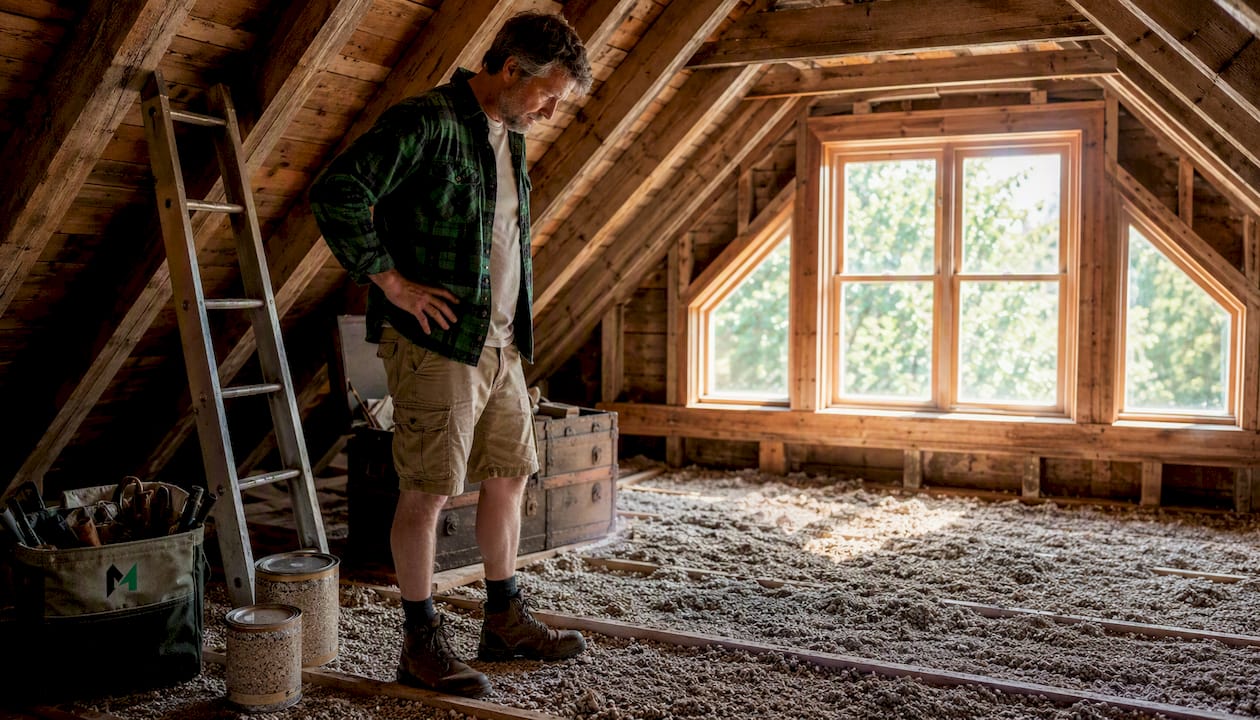
Assume any vermiculite insulation in your home may contain asbestos until a qualified professional says otherwise. Do not disturb it. The Canadian Centre for Occupational Health and Safety (CCOHS) and Health Canada both advise leaving suspected material in place and calling a certified professional before any disturbance. The U.S. EPA takes the same position: if you have vermiculite insulation, treat it as potentially contaminated and protect your family accordingly.
Right now, before you do anything else:
- Do not enter the attic or disturb the insulation.
- Close any vents or openings that connect the attic to living areas.
- Keep children and pets out of the space.
- Do not vacuum, rake, or sweep the material.
- Contact a certified asbestos assessor or abatement contractor to arrange testing.
The risk is not that the insulation is sitting there. The risk is what happens when it gets disturbed.
Table of Contents
- What is vermiculite insulation and why is some of it contaminated?
- Does vermiculite in Canadian homes actually contain asbestos?
- How to identify vermiculite insulation and safely test it in Canada
- What asbestos exposure actually does to your body
- What to do immediately if you find or disturb vermiculite insulation
- Testing options in Canada: bulk sampling, air monitoring, and clearance testing
- When does the situation require a certified abatement contractor?
- What a certified asbestos removal job looks like from start to finish
- Key takeaways
- The mistake most homeowners make before calling anyone
- MSN Environmental handles the whole process, from testing to clearance
- Useful sources for Canadian homeowners
- FAQ
What is vermiculite insulation and why is some of it contaminated?
Vermiculite is a naturally occurring mineral that expands dramatically when heated, producing a lightweight, pebble-like material that was widely used as blown-in attic insulation from the 1940s through the late 1980s. In your attic, it looks like small, shiny, grey-brown or silver flakes, roughly the size of pencil erasers. Some homeowners describe it as resembling popcorn or kitty litter.
The contamination problem traces back to a single mine near Libby, Montana. According to NIOSH, that mine accounted for a dominant share of worldwide vermiculite production during much of the 20th century, and the ore from Libby was contaminated with amphibole asbestos. The mine closed in 1990. Much of the material it produced was sold under the brand name Zonolite®, though it was also distributed under other names.
“Vermiculite from Libby is contaminated with asbestos. Because of the Libby mine’s market dominance, pre-1990 vermiculite insulation in homes is often presumed contaminated by Canadian public health authorities.”
ATSDR Consumer Products Background
Not every bag of vermiculite ever sold came from Libby, and not every installation is contaminated. But you cannot tell by looking. The asbestos fibres are microscopic and mixed into the mineral matrix. Visual identification tells you whether the material is vermiculite; it cannot tell you whether that vermiculite contains asbestos. That distinction matters, because the safety response is the same either way: leave it alone and test before doing anything else.
Does vermiculite in Canadian homes actually contain asbestos?
The short answer is: it might, and you should assume it does until testing proves otherwise.
CCOHS confirms that vermiculite itself does not cause health problems, but vermiculite contaminated with asbestos fibres can cause serious asbestos-related disease if those fibres become airborne and are inhaled. The concern is not the mineral; it is what may be mixed into it.
Because the Libby mine supplied such a large share of the North American market, Canadian authorities apply a precautionary standard: pre-1990 vermiculite insulation is treated as potentially contaminated unless testing demonstrates otherwise. The Wisconsin Department of Health Services and the EPA both apply the same logic. For Canadian homeowners, this means the default assumption for older attic insulation is contamination, not safety.
If your home was built or insulated before 1990 and you have not had the insulation tested, the professional standard is to presume it may contain asbestos and handle it accordingly.
How to identify vermiculite insulation and safely test it in Canada
What to look for
Vermiculite insulation is typically found in attic spaces as a loose-fill material. It is pebble-like, lightweight, and often has a shiny or reflective surface. Colours range from silver-grey to brown or gold. If you can see it from the attic hatch without stepping in, take a photo. That photo can help a professional confirm whether the material is likely vermiculite before anyone enters the space.
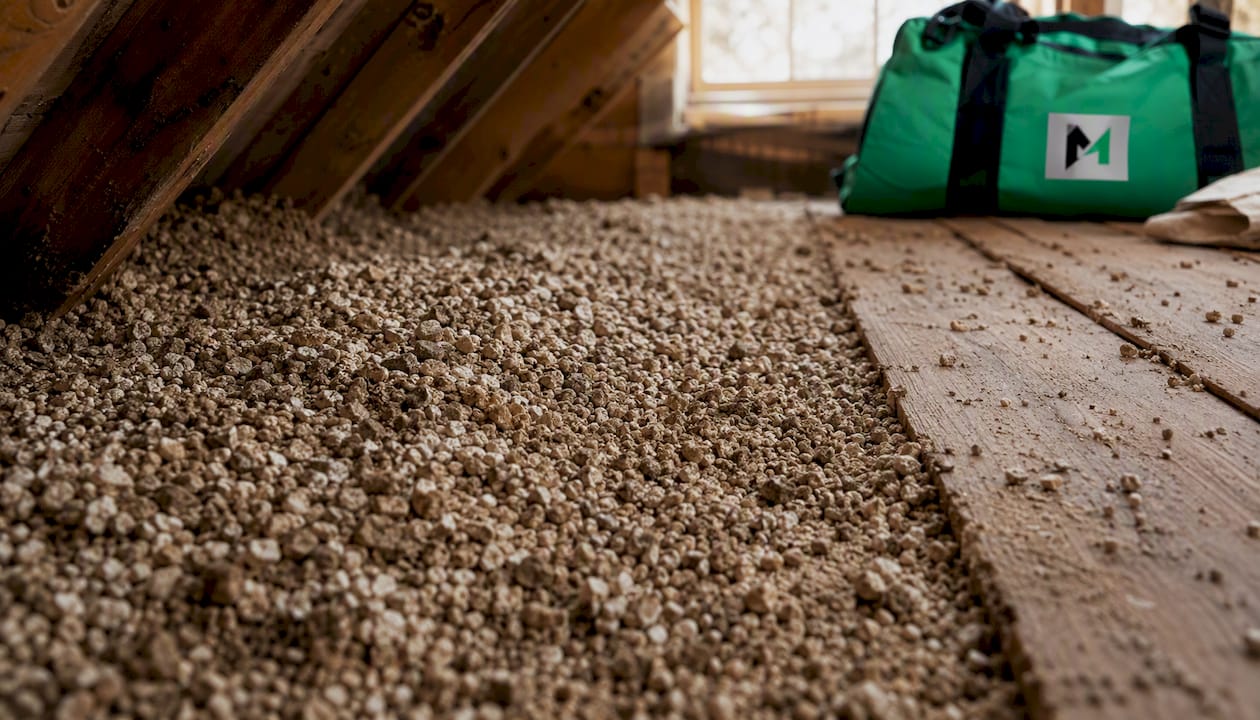
What you should not do: poke it, rake it, step on it, or try to collect a sample yourself. Any physical disturbance can release fibres into the air.
Testing options in Canada
Two types of testing apply to suspected vermiculite:
- Bulk sampling — a small physical sample of the material is collected and sent to an accredited laboratory for analysis. This tells you whether asbestos is present in the material itself.
- Air monitoring / clearance air testing — air samples are collected and analysed to measure airborne fibre concentrations. This tells you whether fibres are present in the breathing zone, and it is the standard used to confirm a space is safe after removal.
Both types of sampling should be performed by a qualified occupational hygienist or an accredited asbestos sampler, not by the homeowner and not by the contractor who will do the removal. Independent testing avoids conflicts of interest and carries more weight with insurers and regulators.
A critical limitation of bulk sampling: Ecohome’s practitioner guide explains that bulk sampling is only reliable when asbestos makes up more than roughly 1% of the material. Below that threshold, the uneven distribution of fibres through the mineral (called the “nugget effect”) means a negative result can be falsely reassuring. A lab may return a clean result even when asbestos is present. This is why clearance air testing after any removal is the only reliable confirmation that a space is safe.
Pro Tip: When hiring a sampler, ask whether they are independent of the abatement contractor. An occupational hygienist who has no financial stake in the removal outcome gives you a more credible result. Look for provincial licensing and accreditation through bodies such as the Canadian Industrial Hygiene Society (CIHS) or equivalent provincial regulators.
| Testing type | What it tells you | When to use it |
|---|---|---|
| Bulk sampling | Whether asbestos is present in the material | Before any disturbance; to confirm material identity |
| Air monitoring | Whether fibres are airborne in the space | During or after disturbance; renovation planning |
| Clearance air testing | Whether the space is safe after removal | After abatement is complete; required before re-occupancy |
For asbestos testing and inspections in Ontario, MSN Environmental offers bulk sampling, air monitoring, and clearance testing services. You can also find accredited labs through the Standards Council of Canada’s directory, and accredited hygienists through provincial occupational health and safety regulators.
What asbestos exposure actually does to your body
There is no known safe level of asbestos exposure. That is the official position of NIOSH, the EPA, and Health Canada. But “no safe level” does not mean all exposures carry the same risk.
Health risk from asbestos is closely tied to dose, duration, and frequency. A brief, accidental disturbance of a small amount of material carries far less risk than years of daily occupational exposure. The diseases associated with asbestos, including asbestosis (scarring of the lung tissue), mesothelioma (a cancer of the lining of the lungs or abdomen), and lung cancer, typically develop after prolonged, repeated exposure. Latency periods are long: mesothelioma, for example, can take 20–50 years to appear after exposure.
That context matters for homeowners. If you walked through your attic once without knowing the insulation was there, your risk from that single event is low. What you want to avoid is repeated disturbance, which is exactly what happens when homeowners try to manage the material themselves over weeks or months.
The practical risk profile looks like this:
- One-time, brief, accidental disturbance: low risk, but worth documenting and monitoring.
- Repeated disturbance during a DIY renovation: significantly elevated risk.
- Chronic exposure from insulation that has migrated into living areas through gaps, cracks, or HVAC systems: requires immediate professional assessment.
- Long-term occupational exposure (construction workers, insulators): the highest-risk category, well-documented in the literature.
Pro Tip: If you have recently disturbed vermiculite insulation, opened walls, or done any renovation work near it, contact an occupational hygienist for air testing before you spend more time in the space. Do not wait for symptoms — asbestos-related disease has no early warning signs.
What to do immediately if you find or disturb vermiculite insulation
Do these things now
- Restrict access to the affected area immediately; close the door or block the attic hatch.
- Close any HVAC vents or registers in or near the space to prevent fibres from circulating.
- Keep children, pets, and anyone not directly involved out of the area.
- Post a visible warning for tradespeople, visitors, or anyone who might enter.
- If clothing may have been contaminated, remove it carefully and bag it separately; do not launder it with the household wash.
- Contact a certified asbestos assessor before re-entering.
Do not do these things
- Do not vacuum the area with a household vacuum or shop vac. Standard vacuums do not have HEPA filtration and will blow fibres back into the air and throughout the home.
- Do not rake, sweep, or blow the material.
- Do not use compressed air anywhere near it.
- Do not attempt to bag or remove the material yourself.
- Do not seal it with paint or spray foam and assume the problem is solved.
NIOSH guidance for workers recommends avoiding all handling of loose vermiculite and using wet methods and proper enclosures when disturbance is unavoidable. For homeowners, the practical translation is simpler: do nothing, and call a professional.
Testing options in Canada: bulk sampling, air monitoring, and clearance testing
Understanding which test to order, and when, saves time and money.
Bulk sampling is the starting point. A small quantity of the material is collected by a qualified sampler, sealed in a container, and sent to an accredited laboratory. Results typically come back within a few business days to two weeks, depending on the lab and whether rush processing is requested. The result tells you whether asbestos fibres are present in the material at detectable concentrations.
The limitation is real: bulk sampling can miss low-concentration contamination because asbestos fibres are not evenly distributed through vermiculite. A negative bulk result does not guarantee the material is clean. For pre-1990 vermiculite, many professionals recommend treating it as contaminated regardless of bulk results and proceeding directly to professional assessment.
Air monitoring measures what is actually in the air you breathe. It is appropriate when disturbance has already occurred, when renovation work is planned, or when you want to understand ongoing exposure risk from insulation that may be migrating into living spaces.
Clearance air testing is the final step after any abatement work. An independent hygienist collects air samples after the contractor has completed removal and cleaned the space. Clearance testing confirms that fibre concentrations have returned to background levels and the space is safe for re-occupancy. No reputable abatement job ends without it.
| Test | Typical use | Who collects it | What a positive result means |
|---|---|---|---|
| Bulk sampling | Pre-disturbance identification | Accredited sampler or hygienist | Asbestos confirmed in material |
| Air monitoring | During disturbance or renovation | Occupational hygienist | Fibres present in breathing zone |
| Clearance air testing | Post-abatement sign-off | Independent hygienist | Space confirmed safe for re-occupancy |
To find accredited samplers and labs in Ontario, check with the Ministry of Labour, Immigration, Training and Skills Development, or ask a certified abatement contractor for their independent testing partners. MSN Environmental’s asbestos testing and assessment services include independent sampling arrangements that keep the testing function separate from the removal work.
When does the situation require a certified abatement contractor?
Some situations allow for monitoring and careful management. Others require professional removal. Here is how to tell the difference.
Hire a certified abatement contractor if:
- You are planning any renovation, demolition, or construction work that will disturb the insulation.
- The insulation has already spilled or migrated into living areas through ceiling gaps, light fixtures, or HVAC openings.
- A visual inspection or bulk test has confirmed or strongly suggested asbestos contamination.
- You have had significant accidental disturbance (a ceiling collapse, major leak, or extensive construction).
- You are selling the property and a home inspection has flagged the material.
Leave it alone and monitor if:
- The insulation is fully contained in an undisturbed attic space with no access to living areas.
- No renovation work is planned.
- There is no evidence of migration or disturbance.
The Minnesota Department of Health and the EPA both confirm: if the material is intact and undisturbed, the safest option is to leave it alone. Removal itself creates risk if not done properly.
What professional abatement involves: the contractor seals off the work area with polyethylene sheeting, establishes negative air pressure using HEPA-filtered air units so that any released fibres are drawn away from living spaces rather than toward them, removes the material using wet methods and HEPA vacuums, double-bags and labels all waste for disposal at a licensed facility, and arranges for independent clearance air testing before the space is reopened. No step in that sequence is optional, and none of it is replicable with household equipment.
What a certified asbestos removal job looks like from start to finish
Knowing the sequence helps you ask the right questions and spot shortcuts.
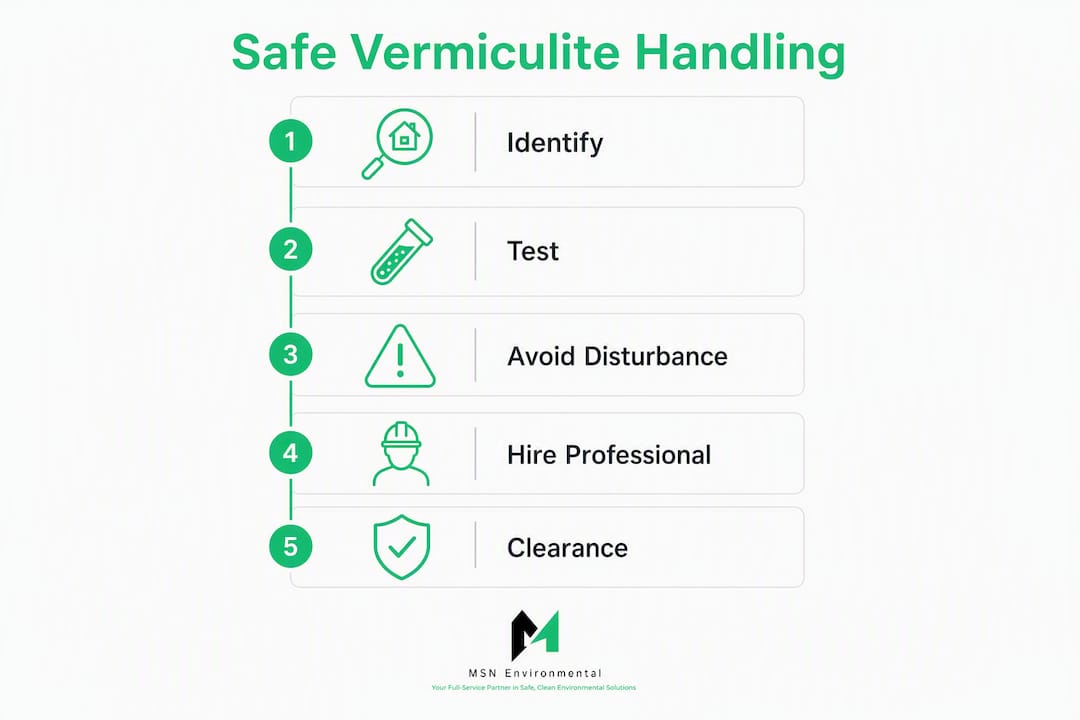
- Initial assessment and sampling. A qualified occupational hygienist or certified assessor inspects the space, collects bulk samples, and provides a written assessment. This document drives everything that follows.
- Abatement plan and permits. The contractor prepares a written abatement plan. In Ontario, the Occupational Health and Safety Act and O. Reg. 278/05 govern asbestos work; contractors must notify the Ministry of Labour for Type 3 (friable) asbestos operations.
- Site preparation and containment. The work area is sealed with polyethylene sheeting. Negative air pressure units with HEPA filtration are installed. Warning signs are posted. Workers wear appropriate respiratory protection and disposable coveralls.
- Removal. The material is carefully removed using wet methods to suppress dust, collected with HEPA vacuums, and placed in sealed, labelled asbestos waste bags.
- Waste disposal. Bagged waste is transported to a licensed disposal facility in accordance with provincial regulations.
- Visual inspection and HEPA vacuuming. After removal, the contractor performs a thorough visual inspection and HEPA vacuums all surfaces in the work area.
- Independent clearance air testing. An independent hygienist collects air samples. Results must meet the clearance criteria before the containment is removed.
- Final clearance report. The hygienist issues a written clearance report. Keep this document; you will need it for insurance, future sales, and permit sign-offs.
Questions to ask any contractor before signing:
- Are you licensed under Ontario’s O. Reg. 278/05 for asbestos abatement?
- Do you carry liability insurance and WSIB coverage?
- Who performs the clearance air testing, and are they independent of your company?
- Will I receive a written clearance report at the end of the job?
- How do you handle waste disposal, and can you provide documentation?
Trust signals to look for on the worksite:
- Sealed polyethylene enclosures at all entry and exit points.
- Negative air pressure units running continuously during work.
- Workers in full Tyvek coveralls and half-face or full-face respirators.
- HEPA vacuums (not shop vacs) for cleanup.
- Clearly labelled asbestos waste bags.
- A decontamination station at the work area exit.
Homes that typically require full abatement include pre-1990 houses with original attic insulation, properties undergoing major renovation or sale, and buildings where insulation has migrated into living areas. MSN Environmental serves homeowners across Ontario, including Kitchener, Hamilton, Toronto, and surrounding communities.
Key takeaways
Pre-1990 vermiculite insulation in Canadian homes should be treated as potentially asbestos-contaminated until independent testing by a qualified professional confirms otherwise, and removal must only be performed by a certified abatement contractor.
| Point | Details |
|---|---|
| Assume contamination | Pre-1990 vermiculite should be treated as potentially asbestos-containing until tested by a qualified professional. |
| Do not disturb it | Any physical disturbance releases fibres; leave the material alone until a certified assessor has evaluated it. |
| Bulk sampling has limits | Negative bulk results can be falsely reassuring; clearance air testing after removal is the only reliable confirmation. |
| DIY removal is dangerous | Household vacuums spread fibres; only HEPA-equipped, certified contractors should remove asbestos-containing material. |
| MSN Environmental | Provides certified asbestos testing, abatement, and clearance services for homeowners across Ontario. |
The mistake most homeowners make before calling anyone
The pattern comes up repeatedly: a homeowner finds what looks like unusual insulation in the attic, does a quick search, reads that it might be fine if undisturbed, and then spends the next two weekends up there anyway, moving boxes, adding new insulation on top of the old, or running a new light fixture through the ceiling. By the time they call a professional, the disturbance has already happened multiple times.
The “leave it alone” advice is not a bureaucratic formality. It reflects a real physical reality: vermiculite insulation releases fibres when crushed, raked, or even walked on. The fibres are invisible. You will not smell them or feel them. You will not know exposure happened until years later, if ever. That invisibility is exactly why the precautionary approach exists.
There is also a common misconception that a negative bulk test result closes the file. It does not. The nugget effect is real, and a single bulk sample from a large attic space may simply miss the contaminated pockets. Professionals who work with this material regularly treat a negative bulk result as one data point, not a final answer, especially for pre-1990 installations.
The reassuring part: when removal is done correctly, by a certified contractor with proper containment and independent clearance testing, the risk to the home’s occupants is genuinely low. The process is well-understood, regulated, and achievable. The danger is not in the material sitting quietly in your attic. The danger is in handling it without the right equipment, training, and controls.
MSN Environmental handles the whole process, from testing to clearance
When you have suspected vermiculite insulation in your home, the safest path is a single certified team that manages assessment, removal, and clearance without gaps between steps. MSN Environmental provides exactly that for homeowners across Ontario.
The services cover the full sequence: bulk sampling and air monitoring, designated substance surveys, certified asbestos abatement under Ontario’s O. Reg. 278/05, HEPA-equipped removal, waste disposal, and independent clearance air testing. Every job meets provincial regulatory requirements, and clearance reports are provided in writing so you have documentation for insurance, property sales, and permit sign-offs.
MSN Environmental serves homeowners in Kitchener, Hamilton, Toronto, Waterloo, Cambridge, Guelph, London, Woodstock, and communities across Ontario. If you are not sure whether your insulation needs testing or removal, a certified asbestos removal assessment is the right first step. For homeowners who need testing before committing to removal, asbestos testing and inspections are available as a standalone service.
Contact MSN Environmental to book an assessment and get a written quote before any disturbance occurs.
Useful sources for Canadian homeowners
Official guidance and accreditation resources to help you verify information and find qualified professionals:
- Canadian Centre for Occupational Health and Safety (CCOHS) — Vermiculite insulation containing asbestos: the primary Canadian authority on occupational health risks from vermiculite; includes guidance on when testing is required.
- Health Canada — Asbestos and your health: federal guidance on asbestos exposure risks for Canadians.
- U.S. EPA — Protect your family from asbestos-contaminated vermiculite insulation: widely referenced in Canadian guidance; covers the “leave it alone” recommendation and when to hire abatement contractors.
- NIOSH — Vermiculite: occupational health research on vermiculite from Libby and exposure risk for workers and residents.
- ATSDR — Vermiculite consumer products background: background on the Libby mine, contamination history, and consumer product risks.
- Ecohome — How to know if vermiculite insulation contains asbestos: practitioner-level guide explaining bulk sampling limitations and the nugget effect.
- Hunt Home Inspections blog: home inspection guidance that can help you safely document suspected vermiculite before professional sampling.
- Ontario Ministry of Labour, Immigration, Training and Skills Development: the provincial regulator for asbestos work under O. Reg. 278/05; their website lists licensed contractors and notification requirements.
- Standards Council of Canada: maintains a directory of accredited laboratories for asbestos analysis; search for labs accredited under ISO/IEC 17025 for asbestos fibre counting.
- MSN Environmental — Asbestos testing and inspections: Ontario-based testing, assessment, and abatement services for homeowners who need professional help.
This article provides general safety information for Canadian homeowners and is not a substitute for professional advice. Confirm current regulations and testing requirements with CCOHS, Health Canada, or a qualified occupational hygienist.
FAQ
Does vermiculite in Canadian homes contain asbestos?
It may. Because the Libby, Montana mine supplied more than half of global vermiculite production until 1990 and that ore was contaminated with amphibole asbestos, Canadian authorities recommend treating pre-1990 vermiculite insulation as potentially contaminated until independent testing proves otherwise.
How do I know if my vermiculite insulation has asbestos?
You cannot tell by looking. Visual inspection confirms whether the material is vermiculite, but asbestos fibres are microscopic and invisible to the naked eye. Bulk sampling by an accredited sampler, followed by laboratory analysis, is required to identify contamination.
Will a brief accidental exposure to vermiculite dust hurt me?
A single, short-term, low-level disturbance carries far less risk than chronic occupational exposure, but there is no known safe level of asbestos exposure. If you have disturbed suspected vermiculite, limit further access to the space and arrange air testing with a qualified hygienist before re-entering.
What are the odds that older vermiculite insulation contains asbestos?
There is no single percentage that applies to all installations, but because the Libby mine dominated the market for decades, Canadian professionals apply a precautionary presumption of contamination for pre-1990 vermiculite rather than assuming it is clean. Testing is the only way to know for certain.
Can I remove vermiculite insulation myself?
No. DIY removal is unsafe because standard household and shop vacuums lack HEPA filtration and will spread fibres throughout the home. Certified abatement contractors use sealed containment, negative air pressure, HEPA-equipped equipment, and independent clearance testing. In Ontario, Type 3 asbestos operations must be performed by licensed contractors under O. Reg. 278/05.