

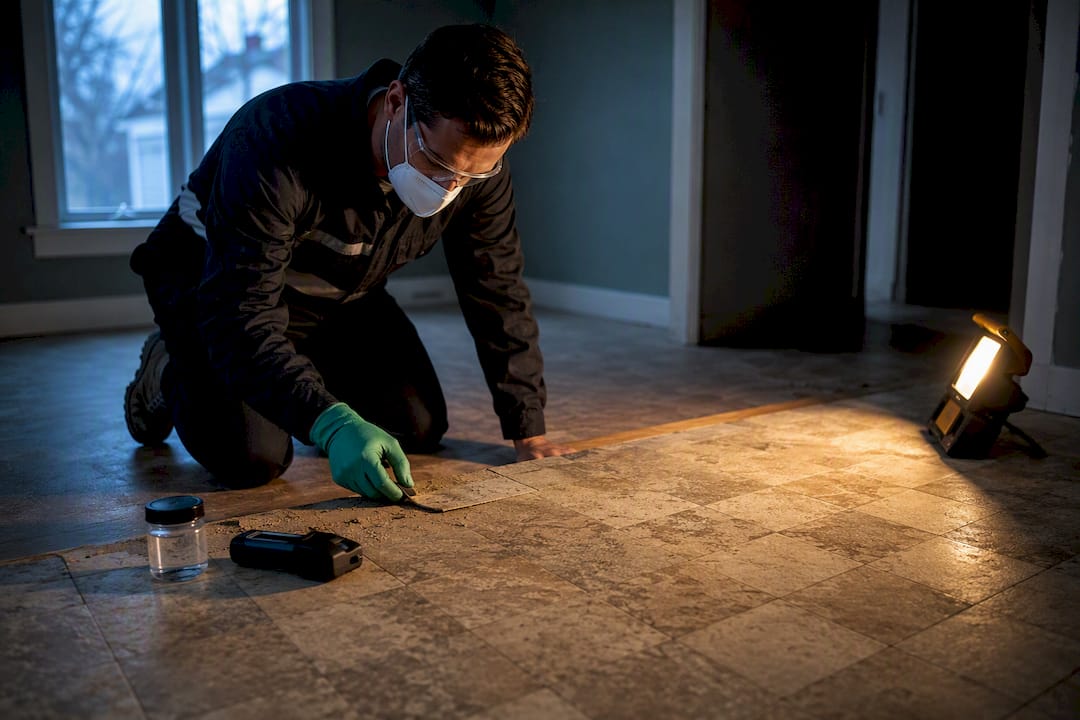
Older Kitchener homes, especially anything built before the 1980s, frequently contain asbestos in flooring, insulation, textured ceilings, or pipe wrap. If you suspect any of these materials during a renovation, stop work immediately, avoid disturbing the area, and arrange certified testing before you touch anything else. Ontario Regulation 278/05 requires an assessment before renovation or demolition in many cases, and Certified contractors provide options for testing and any abatement that follows.
TL;DR:
- Most asbestos in Kitchener homes built before the 1980s is hidden in common places like flooring, pipe wrap, textured ceilings, and exterior siding, often in non-friable form.
- Ontario law requires a certified assessment and proper documentation before any renovation or demolition involving suspect materials, regardless of the project’s size.
- Proper testing involves accredited lab analysis of samples and air clearance tests after abatement, not home test kits or visual inspections alone.
- Disturbing asbestos materials without proper precautions can release dangerous fibres, especially when handling friable or damaged substances such as vermiculite or pipe insulation.
- Reputable contractors will verify certifications, provide a detailed scope of work, and offer documented disposal plans to ensure compliance and safety during asbestos handling.
Table of Contents
- Where asbestos in Kitchener homes tends to hide
- What does Ontario law require before you renovate?
- How does asbestos testing actually work?
- Is a tiny bit of asbestos actually dangerous?
- What to do the moment you disturb suspect material
- Choosing a compliant asbestos contractor in Kitchener
- How a certified Kitchener provider handles the process
- What does asbestos testing and removal actually cost in Kitchener?
- How do you dispose of asbestos waste properly in Kitchener?
- Can you sell a house with asbestos in it, and what happens after removal?
- Get a certified assessment before you touch another wall
- Sources
- FAQ
Where asbestos in Kitchener homes tends to hide
Asbestos was cheap, fireproof, and everywhere in construction until the late 1980s, which is exactly why so many Kitchener homes built before then still have it tucked into ordinary places. It rarely shows up where you’d expect trouble. It’s usually sitting quietly under a kitchen floor or behind a basement pipe.
Common spots include:
- Kitchen flooring: vinyl floor tiles (especially 9×9 inch squares) and the black mastic adhesive underneath
- Basements: pipe wrap and boiler insulation on older heating systems
- Attics: vermiculite insulation, which can contain asbestos fibres depending on its source
- Ceilings: textured “popcorn” finishes applied before the mid-1980s
- Exterior: cement board siding, older roofing shingles, and some stucco products
There’s an important distinction between friable and non-friable materials. Friable asbestos crumbles by hand and releases fibres easily; vermiculite and old pipe lagging fall into this category. Non-friable materials, like vinyl floor tile, stay stable until you cut, sand, or drill into them. That’s the trap: a homeowner pulling up “harmless” flooring with a scraper can turn a low-risk material into an airborne hazard in minutes. Homes built or renovated before the 1980s carry the highest odds of containing at least one of these materials somewhere in the structure.
What does Ontario law require before you renovate?
Ontario Regulation 278/05 puts a legal obligation on building owners, not just contractors, to assess for asbestos before renovation, alteration, or demolition work begins. This isn’t a suggestion buried in a guideline. It’s a designated substance regulation, and it applies to Kitchener homeowners doing structural work just as much as it applies to commercial property managers.
The practical framework breaks down like this:
- Assessment first. Before any renovation or demolition, the owner must have the building or the affected area assessed for asbestos content, per O. Reg. 278/05.
- Classification by type. Work involving asbestos-containing material (ACM) gets sorted into Type 1, 2, or 3 operations, with Type 3 covering the highest-risk activities like removing sprayed or friable insulation.
- The 0.5% threshold. Materials containing more than 0.5% asbestos by dry weight are legally treated as ACM, regardless of how solid or stable they look on the surface.
- Stricter rules for friable material. Sprayed-on insulation, vermiculite, and other friable products trigger tighter containment and worker protection requirements than a intact vinyl tile floor would.
- Record-keeping is mandatory. Owners are legally required to document the location, quantity, and condition of identified ACM, and to produce that report before demolition or major alteration work.
For a private Kitchener homeowner, this means the assessment and the resulting paperwork are your responsibility, not something you can skip because it’s “just a house.” Landlords carry the same duty for rental properties, and that documentation often becomes the thing that settles a dispute later, whether with a buyer, a tenant, or a home inspector.
How does asbestos testing actually work?
A proper assessment isn’t a visual guess. It involves collecting physical samples and sending them to an accredited lab, with a documented chain of custody so the results hold up if a dispute ever lands in front of a real estate lawyer or the Landlord and Tenant Board.
Two testing methods matter here:
- Bulk sampling: a small piece of the suspect material is cut, bagged, and sent to a lab for fibre analysis under polarized light microscopy.
- Air clearance testing: after abatement work is finished, HEPA-filtration air samples confirm fibre concentrations have dropped to acceptable levels before the space is reoccupied, a step detailed further here.
You may have heard of the “3-5-7 rule” as a shorthand for asbestos sampling. It’s a rough field guideline some assessors use for how many samples to collect from a homogeneous material area (three samples for a small area, five for a medium one, seven for a larger one), not a formal legal standard written into O. Reg. 278/05. A qualified assessor decides the actual sampling plan based on material type, size of the area, and risk level, and a full bulk sampling compliance guide walks through how that plan gets built.
Pro Tip: Never trust a home test kit bought online for anything you plan to act on legally. Labs used for compliance work need accreditation, and the sample collection itself has to follow a documented method or the results won’t hold up if a sale or tenancy dispute ever questions them.
Is a tiny bit of asbestos actually dangerous?
Intact, undisturbed asbestos-containing material sitting behind a wall or under a floor is genuinely lower risk than most homeowners assume. The danger comes from disturbance, not presence. Once you cut, sand, drill, or demolish material containing asbestos, fibres become airborne and can be inhaled deep into the lungs.
Long-term exposure is linked to mesothelioma, asbestosis, and lung cancer, conditions with latency periods that often stretch two to four decades between exposure and diagnosis, according to occupational health research. That long gap is exactly why prevention during renovation matters more than treatment after the fact; there’s no early warning system for fibre exposure.
The people at highest risk during a renovation aren’t abstract statistics. They’re whoever is standing closest to the dust: the DIY homeowner with the sander, kids and pets in adjacent rooms, and any contractor working without proper containment or respiratory protection.
What to do the moment you disturb suspect material
If you’ve already cut into a tile, sanded a ceiling, or pulled back insulation before reading this, the next few minutes matter.
- Stop work immediately and leave the area. Don’t sweep, vacuum, or wipe down dust; that just spreads fibres further.
- Restrict access to the room, close doors, and if possible, turn off forced-air HVAC systems that could circulate dust through the house.
- Photograph and document the material’s condition, location, and the date you disturbed it, before anyone touches it further.
- Contact a certified assessor for sampling, and keep written records of every call and email in case the situation escalates.
If you’re a tenant, document everything in writing to your landlord and follow the habitability guidance available for Ontario renters. Landlords who fail to arrange a professional assessment after being notified risk a formal complaint to the Landlord and Tenant Board.
Choosing a compliant asbestos contractor in Kitchener
Not every contractor advertising “asbestos removal” is operating within Ontario’s rules, and the gap between a compliant job and a shortcut job usually isn’t visible until something goes wrong.
Ask to see, in writing, before you sign anything:
- Proof of training recognized by Ontario’s Ministry of Training, Colleges and Universities (MTCU), or equivalent certifications such as AAS 253S or AAW 253W
- A written scope of work that specifies whether the job is classified as Type 1, 2, or 3 abatement
- The name of the accredited lab they use for sample analysis, and how they document chain of custody
- A disposal plan naming the approved facility, and proof of liability insurance
Pro Tip: Ask directly how long clearance testing takes and when you’ll receive the written report. A contractor who can’t answer that clearly, or who pushes you toward doing the removal yourself to save money, is telling you something important about how carefully they handle the rest of the job.
Red flags worth walking away from: refusal to produce certificates on request, a quote dramatically below every other estimate with no written method statement, or any suggestion that a homeowner tackle friable material removal solo. That last one isn’t a cost-saving tip. It’s a liability you’ll own for decades.
How a certified Kitchener provider handles the process
Some local companies offer testing, bulk sampling, and Type 1 through 3 abatement services for Kitchener homeowners, backed by relevant training certifications and liability insurance appropriate for residential projects. The typical workflow runs inspection, sampling, a written report, a defined abatement scope, then post-removal clearance testing before the space is cleared for reoccupancy. That written report also happens to be useful later. A documented assessment often resolves disputes during a home sale or tenancy disagreement because it puts a date and a lab result behind the claim, rather than a verbal assurance.

What does asbestos testing and removal actually cost in Kitchener?
Pricing varies significantly based on the material involved, the size of the affected area, and whether the job is classified as Type 1, 2, or 3 under O. Reg. 278/05. A single bulk sample analysis for a small area, like one section of vinyl tile, sits at the lower end of the cost spectrum. A full designated substance survey covering an entire pre-1980s home costs considerably more, since it involves multiple sample locations, lab fees, and a written report suitable for permit applications or real estate disclosure.
Removal costs scale with complexity rather than square footage alone. Removing a small amount of non-friable material, like a section of floor tile, is a far simpler and less costly job than abating friable vermiculite insulation across an entire attic, which requires full containment, negative air pressure equipment, and mandatory clearance air testing before the space can be reoccupied.
Timelines follow a similar pattern. A straightforward bulk sample test can return lab results within a matter of days. A full assessment and report for a larger renovation project takes longer, particularly if multiple material types need separate lab analysis. Abatement itself, from initial containment setup to final clearance testing, commonly runs anywhere from a single day for a small, contained job to a week or more for a whole-house project involving several material types.
Because MSN Environmental doesn’t publish flat rates for these services, the most reliable way to get an accurate number for your specific house is to request a site visit or quote rather than relying on a generic estimate that ignores your home’s specific materials and layout.
How do you dispose of asbestos waste properly in Kitchener?
Asbestos-containing waste can’t go in your regular curbside bin, and it can’t go to a standard construction dumpster either. Ontario treats it as designated hazardous waste, and the disposal chain has to be documented from removal through to the final landfill site.
Once material is removed, it gets double-bagged in labelled polyethylene bags or wrapped and sealed before it ever leaves the property. Wellington County and the Kitchener area direct asbestos waste to specific licensed landfill facilities equipped to accept it, and transport has to follow provincial hazardous waste manifest rules that track the material from your address to final disposal. A homeowner cannot legally drop bagged asbestos material at a regular municipal drop-off site or in a rented bin destined for a standard construction and demolition landfill.
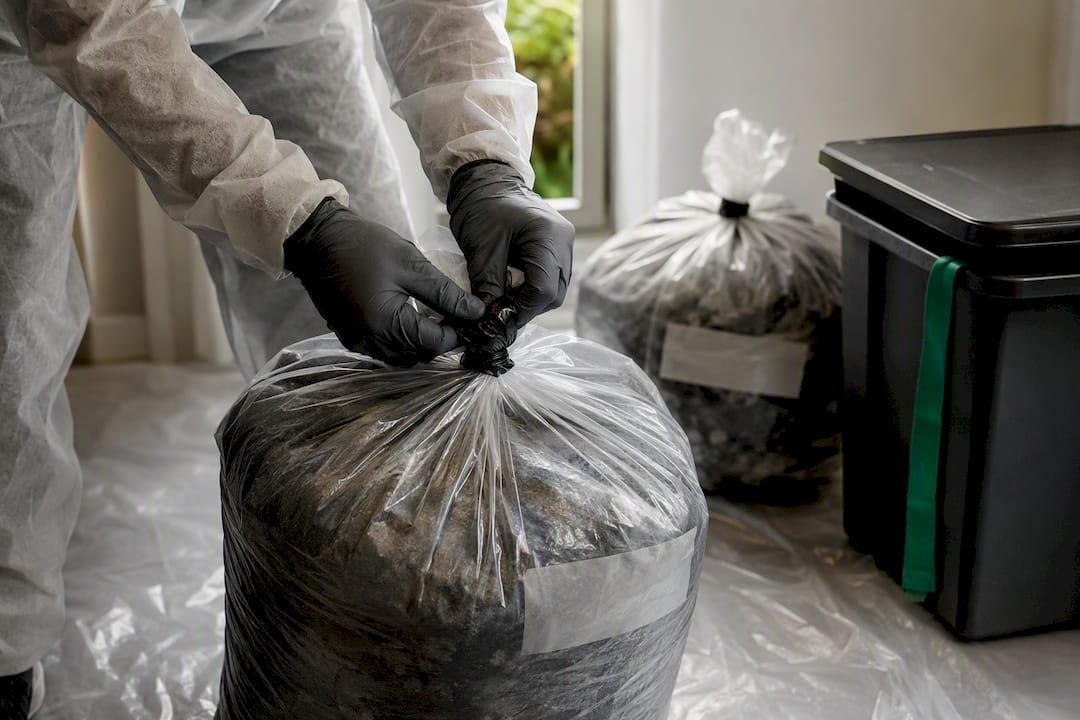
This is precisely why the disposal plan matters as much as the removal method when you’re vetting a contractor. A compliant abatement company will name the licensed facility they use and provide documentation confirming the waste was received there, not just an assurance that “it’s been taken care of.” That paperwork becomes part of the same record trail that Ontario Regulation 278/05 requires owners to keep, and it’s the kind of detail a home inspector or buyer’s lawyer will ask about during a future sale.
Can you sell a house with asbestos in it, and what happens after removal?
Selling a home with known asbestos isn’t illegal in Ontario, and plenty of older Kitchener properties change hands every year with ACM disclosed in the listing or discovered during a buyer’s inspection. What creates legal exposure isn’t the asbestos itself; it’s failing to disclose a known hazard once you’re aware of it. A documented assessment, even one that identifies asbestos, tends to reassure buyers more than it scares them off, because it proves the seller dealt with the issue transparently rather than hiding it.
The mistake most first-time renovators make isn’t ignoring asbestos entirely. It’s assuming a material looks solid, so it must be safe to disturb. Vinyl tile, cement siding, and old pipe wrap can sit undisturbed for fifty years without releasing a single fibre, right up until someone takes a sander to it. What actually protects a homeowner, financially and physically, is treating any pre-1980s material as unknown until it’s tested, then keeping the paperwork. That record is what settles a home sale question, a tenancy complaint, or your own peace of mind years later.
— Moacyr
Get a certified assessment before you touch another wall
Qualified service providers can handle the full path from testing to abatement for Kitchener homeowners, including bulk sampling, air quality testing, designated substance surveys, and Type 1 through 3 removal work, all under one contractor rather than juggling separate labs and crews.
If you’re staring at a floor tile or an attic full of vermiculite and you’re not sure what you’re looking at, the fastest path forward is a proper assessment rather than a guess. Local Kitchener testing and inspection services can confirm whether a material actually contains asbestos before you make a single cut, and if removal turns out to be necessary, the same asbestos removal services team can handle the abatement and clearance testing without you needing to find a second contractor. Reach out through the Kitchener location page to request a site visit and get a written scope of work before your renovation timeline gets any further along.
Sources
For the legal baseline, read O. Reg. 278/05 directly. For tenant situations, the habitability guidance for Ontario renters covers your practical options.
This article is general information, not a substitute for advice from a qualified doctor. Consult a qualified healthcare professional about your own circumstances before acting on anything here.
- Ontario
- Defendit
- Asbestos in schools: occupational risks and management (Occupational Cancer Research Centre)
FAQ
Can you sell a house with asbestos in Ontario?
Yes. Ontario law doesn’t prohibit selling a home with known asbestos, but sellers must disclose known hazards, and a documented assessment usually reassures buyers rather than derailing the sale.
How do you know if your home contains asbestos?
You can’t tell by looking. Materials like vinyl tile, textured ceilings, and pipe wrap installed before the 1980s need lab-tested bulk sampling to confirm asbestos content, since visual inspection alone isn’t reliable.
What is the 3-5-7 rule for asbestos sampling?
It’s an informal field guideline some assessors use for how many samples to take from a material area (roughly three for small areas, five for medium, seven for larger ones), not a formal legal standard under Ontario Regulation 278/05.
Is a tiny bit of asbestos okay?
Intact, undisturbed asbestos-containing material poses low risk sitting in place, but any amount exceeding 0.5% asbestos by dry weight is legally classified as ACM, and disturbing it, even a small area, can release hazardous airborne fibres.
Does MSN Environmental handle both testing and removal in Kitchener?
Yes. MSN Environmental provides bulk sampling, air quality testing, designated substance surveys, and Type 1 through 3 abatement services for Kitchener homeowners, with current pricing available directly through its testing and inspection page.