

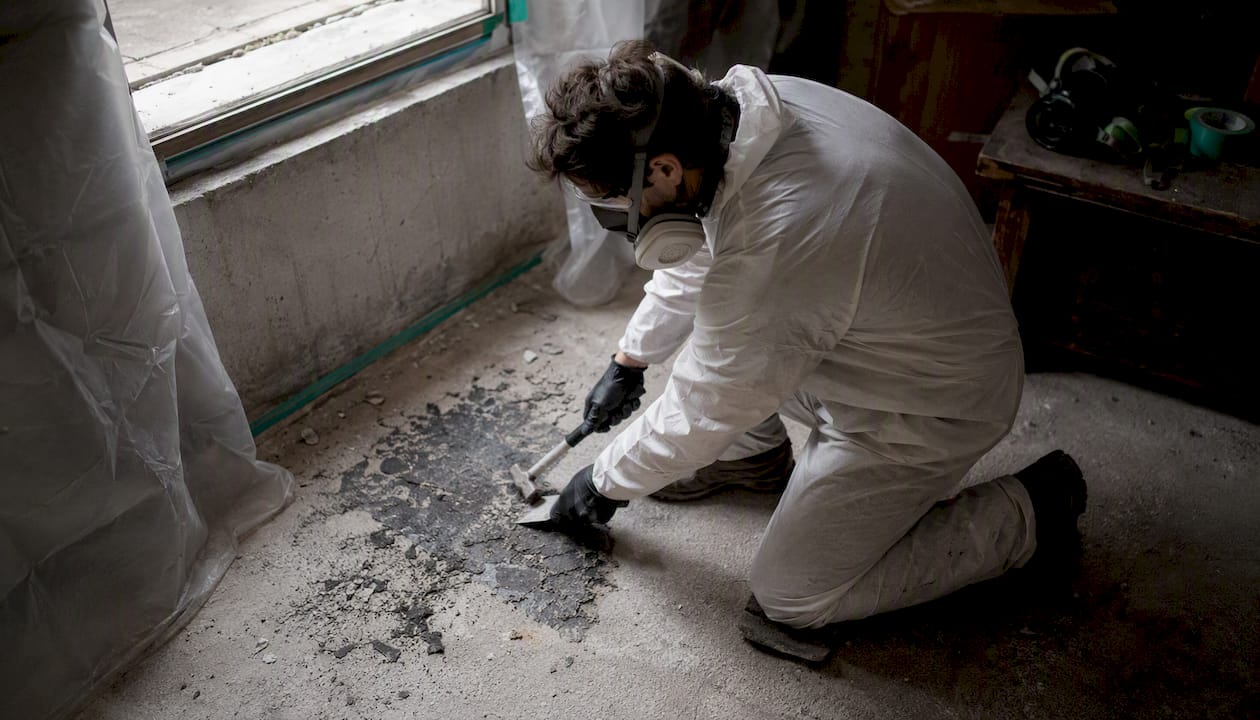
In most cases, no — a Canadian homeowner should not remove asbestos-containing mastic themselves. If your home was built or renovated before 1984 and you have black or dark brown adhesive under vinyl tile, linoleum, or sheet flooring, treat it as suspect material until a lab says otherwise. Here is what to do right now:
- Stop all disturbance. Do not sand, scrape, grind, or pull at the adhesive. Even walking on delaminating tiles can release fibres.
- Photograph the area without touching it, and note the approximate square footage and floor type.
- Arrange bulk sample testing through an ISO/IEC 17025-accredited laboratory before any renovation work proceeds.
- Consider encapsulation if the mastic is intact and well bonded. Leaving it undisturbed under new flooring is often the safest and cheapest path.
- Hire a licensed abatement contractor if testing confirms asbestos above 1% by weight, if the adhesive is flaking or delaminating, or if the affected area is large.
Provincial regulations across Canada — enforced through ministries of labour, environment, and health — require licensed contractors and specified disposal routes for regulated asbestos-containing material (ACM). Ignoring those rules does not just risk your health; it creates disclosure and liability problems at resale.
Key takeaways
| Point | Details |
|---|---|
| Test before touching | PLM bulk sampling at an ISO/IEC 17025 lab is the only reliable way to confirm asbestos in mastic. |
| 1% threshold triggers regulation | A positive result above roughly 1% by weight classifies the material as regulated ACM, requiring licensed removal and specified disposal. |
| Encapsulation is often the right call | Intact, well-bonded mastic is frequently safer and cheaper to encapsulate than to remove. |
| Dry methods are prohibited | Sanding, grinding, or uncontained scraping converts non-friable mastic into an airborne hazard and is explicitly prohibited by regulatory guidance. |
| MSN Environmental covers Ontario | MSN Environmental provides testing, certified abatement, and post-removal clearance documentation across Kitchener, Waterloo, Cambridge, Guelph, Hamilton, London, and surrounding areas. |
Table of Contents
- How do you recognise suspected asbestos-containing mastic?
- How do you confirm asbestos in mastic through testing?
- Encapsulation or full removal: which is right for your situation?
- What does a certified abatement contractor actually do?
- If you still consider DIY: strict limits and what you must never do
- What Canadian legal and disposal rules apply before you disturb mastic?
- How do you choose a certified asbestos abatement contractor?
- MSN Environmental: licensed asbestos abatement across Ontario
- Sources
- FAQ
How do you recognise suspected asbestos-containing mastic?
The adhesive industry used asbestos in flooring products for decades, and the material does not announce itself. Knowing what to look for helps you decide whether to call a lab before picking up a pry bar.
Visual clues:
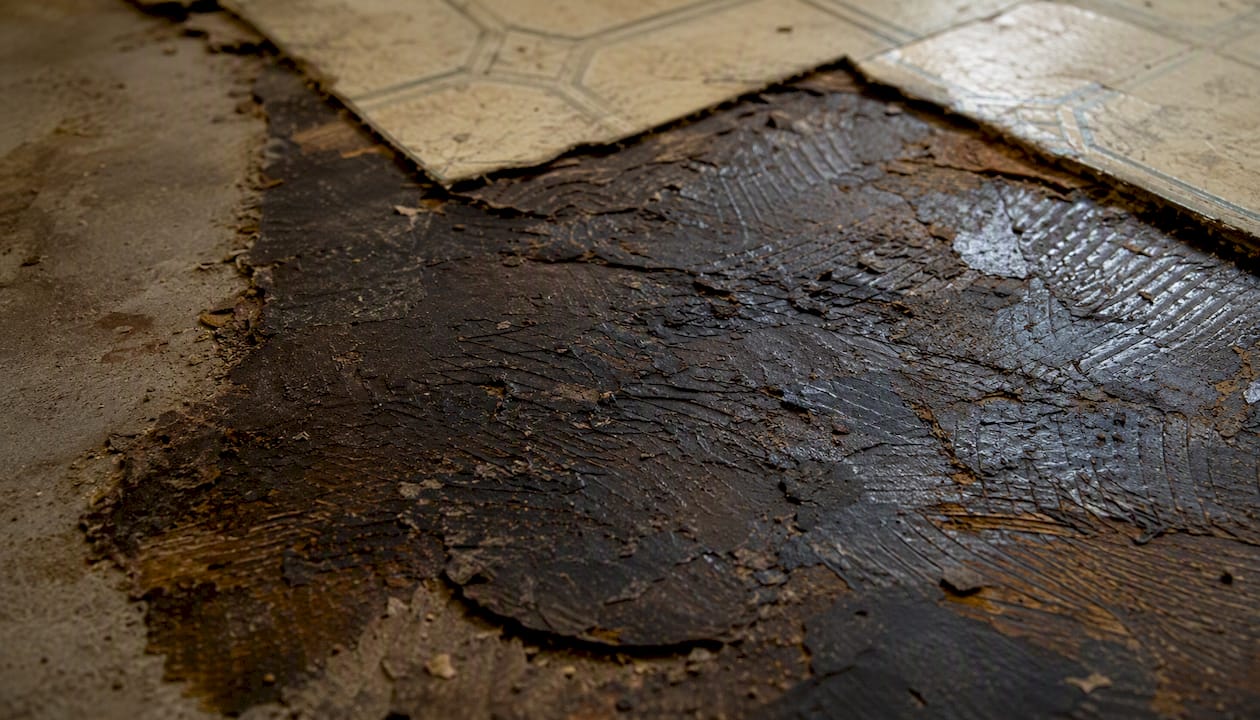
- A black, tar-like smear or dark brown film directly under resilient floor tiles, sheet vinyl, or linoleum. This is the classic profile of cutback adhesive — an asphalt-based product that frequently contained chrysotile in the pre-1984 era.
- Yellowed or amber-coloured adhesive under older linoleum, sometimes layered over an earlier black mastic coat.
- Thin, dried residue around baseboard edges, seams between tile sections, or at threshold strips.
- A brittle, crumbling layer that flakes when a tile corner lifts — a sign the adhesive bond is failing.
Typical locations:
- Below 9-inch or 12-inch resilient floor tiles (common in basements, kitchens, and bathrooms of homes built between the 1950s and early 1980s).
- Under sheet vinyl or linoleum in kitchens and utility rooms.
- Beneath stair-tread adhesive strips in older multi-unit buildings.
Construction-era guidance:
Pre-1984 is the higher-risk window. Many asphalt-based cutback adhesives manufactured before that date contained measurable chrysotile at varying percentages. Post-1984 products are far less likely to contain asbestos, but a visual inspection alone cannot confirm this. Appearance is not evidence. A black adhesive installed in 1990 is probably asbestos-free; a tan adhesive from 1972 might not be. The only reliable answer comes from a lab.
Pro Tip: Photograph the adhesive and any visible tile markings (manufacturer stamps, size, colour) before touching anything. That documentation helps a sampler or abatement contractor scope the job accurately.
How do you confirm asbestos in mastic through testing?
Testing is the only way to know. Colour, smell, and age are useful clues, but none of them replace polarised light microscopy (PLM) on a physical sample.
Safe sampling options for homeowners:
- Identify a small, accessible area at the edge of a tile or seam where minimal disturbance is needed.
- Lightly mist the spot with water from a spray bottle to suppress any loose fibres.
- Use a sharp utility knife or chisel to chip a small piece (roughly the size of a coin) from the adhesive layer, including any tile or backing material bonded to it.
- Place the chip immediately into a sealable plastic bag, seal it, then place that bag inside a second bag. Label both bags clearly.
- Wipe the sampling area with a damp cloth and seal the cloth in a third bag.
- Ship or deliver the sealed sample to an ISO/IEC 17025-accredited laboratory for PLM analysis.
Ask the lab for a report that states the percent asbestos by weight and identifies the fibre type. That format is what regulators and abatement contractors need. Turnaround at most accredited Canadian labs runs two to five business days for standard service; rush results are often available within 24 hours for an added fee.
The regulatory trigger that matters most: a PLM result above roughly 1% asbestos by weight classifies the material as regulated ACM under commonly applied Canadian and North American guidance. That result changes your legal obligations and your disposal options.
When to hire a professional sampler instead of doing it yourself:
- The adhesive covers a large area or multiple rooms.
- The substrate is fragile, crumbling, or layered (old tile over old tile over mastic).
- You cannot safely access the edge of the material without disturbing a large section.
- You want the sampling documented by a trained technician for insurance or resale purposes.
Pro Tip: A professional sampler can collect multiple samples from different adhesive layers in one visit, which matters when you have a 1960s kitchen floor that has been re-tiled twice. Each layer may have a different composition.
Encapsulation or full removal: which is right for your situation?
The short answer: if the mastic is intact and well bonded, encapsulation is frequently the safest, least disruptive, and most cost-effective path. Full removal becomes necessary when the adhesive is failing, friable, or the renovation scope demands a clean substrate.
Industry guidance consistently recommends encapsulation for intact, well-bonded mastic and professional abatement when the adhesive is delaminating or the project is large or in a sensitive occupancy such as a school or rental unit.
| Scenario | Recommended approach | Key considerations |
|---|---|---|
| Mastic intact, well bonded, no renovation planned | Encapsulation (overlay or primer seal) | Lowest cost, minimal disturbance, disclose at resale |
| Mastic intact, new flooring going over top | Overlay with compatible underlayment | Confirm adhesive compatibility; document lab result |
| Mastic delaminating or flaking | Licensed abatement and removal | Do not attempt DIY; fibres may already be loose |
| Large area (multiple rooms) confirmed positive | Licensed abatement | Containment and air monitoring required |
| Small area, confirmed positive, substrate sound | Licensed abatement preferred; encapsulation possible | Consult provincial rules; keep all paperwork |
| Material confirmed negative by PLM | Standard flooring removal methods | Soy- or citrus-based wet removers are acceptable |
Encapsulation methods:
- Overlay: Install new flooring directly over the existing adhesive layer using a compatible underlayment. This is the most common homeowner path for intact mastic.
- Penetrating primer/encapsulant: Apply a bonding primer that seals the adhesive surface before a new floor system goes down. Useful when the surface is slightly uneven but still bonded.
Removal methods (and who can use them):
- Chemical wet softening and wet scraping: Soy- or citrus-based removers soften the adhesive for wet scraping. Acceptable for homeowners only when PLM confirms the material is asbestos-free. On confirmed ACM, this method still requires licensed abatement controls.
- Shot-blast or bead-blast with HEPA recovery: A commercial method used by licensed contractors. Not a homeowner option under any circumstances.
- Mechanical grinding: Licensed only, with full containment and HEPA filtration. Prohibited without those controls.
Decision checklist before choosing a path:
- Do you have a PLM result? If not, stop and test first.
- Is the mastic intact and fully bonded, or are tiles lifting and edges crumbling?
- What is the planned renovation: overlay, full gut, or sale preparation?
- Is the property occupied by tenants, children, or immunocompromised individuals?
- What does your provincial ministry of labour or environment require for your specific situation?
What does a certified abatement contractor actually do?
Hiring a licensed crew is not just about following rules. It is about getting a contained, documented job that does not leave fibres in your HVAC or your walls.
A professional asbestos mastic abatement job follows a structured sequence. Licensed abatement work includes written work plans, containment, HEPA/negative-air systems, air clearance testing, and documented disposal manifests — all items you should require in any contractor bid.
Typical professional workflow:
- Scoping and written work plan: The contractor inspects the site, reviews lab results, measures the affected area, and produces a written plan describing containment method, removal technique, PPE requirements, disposal route, and clearance testing protocol.
- Containment setup: Plastic sheeting seals doorways, HVAC vents, and any openings connecting the work zone to the rest of the home. Warning signs and barrier tape go up.
- Negative air and HEPA filtration: A negative-air machine draws air through HEPA filters, keeping the work zone at lower pressure than surrounding rooms so fibres cannot migrate outward.
- Wet removal: The mastic is wetted with amended water (water plus a surfactant) to suppress fibre release, then scraped or chemically softened and removed in controlled sections.
- Waste handling and manifesting: All removed material, PPE, plastic sheeting, and contaminated tools go into labelled, sealed asbestos waste bags. A disposal manifest documents the chain of custody from your home to a licensed hazardous waste facility.
- Decontamination: Workers decontaminate in a staged area before leaving the work zone. Equipment is wiped down or bagged.
- Post-removal clearance testing: An independent air monitor collects samples after cleanup. Results must meet provincial clearance criteria before the containment comes down and the space is re-occupied.
The clearance test is not optional. It is the document that proves the job was done correctly, and it is what you hand to a buyer’s inspector at resale.
If you still consider DIY: strict limits and what you must never do
Most asbestos mastic work belongs with a licensed contractor. The section below covers the narrow circumstances where a homeowner might legally handle a very small, confirmed-negative or non-friable area — and the absolute limits that apply even then.
Never do any of the following, regardless of how small the area:
- Dry-sand, dry-grind, or use an uncontained floor scraper on any adhesive you have not confirmed asbestos-free by PLM. OSHA guidance explicitly prohibits aggressive dry mechanical methods for asbestos-containing mastic because they instantly convert non-friable material into an airborne hazard.
- Use a heat gun or open flame to soften adhesive — heat volatilises the binder and can release fibres.
- Run a shop vac without a HEPA filter over any adhesive residue.
- Dispose of suspect material in your regular household waste.
Strict limits for small, non-friable, confirmed-negative areas:
- Work only on a small, well-bonded section where PLM has returned a negative result.
- Wet the adhesive thoroughly before and during any scraping.
- Wear a properly fitted P100 half-face respirator at minimum. A dust mask or surgical mask provides no protection against asbestos fibres.
- Wear disposable coveralls, gloves, and boot covers. Remove them inside the work area and bag them before leaving.
- Use a HEPA vacuum (not a standard shop vac) for cleanup.
- Double-bag all waste in heavy-gauge plastic bags, label them, and check your provincial hazardous waste rules before disposal — even confirmed-negative material may require specific handling depending on what else it contains.
Pro Tip: If the mastic starts to flake, crumble, or delaminate while you are working, stop immediately. Bag your tools, seal the area, and call a licensed contractor. A contained professional job costs a fraction of what whole-home remediation runs after dry disturbance spreads fibres through an HVAC system.
What Canadian legal and disposal rules apply before you disturb mastic?
Provincial rules govern asbestos work in Canada, and they vary enough that checking your specific province’s requirements is not optional. The federal framework sets a floor; provinces often go further.
Key regulatory contacts and obligations:
- Health Canada publishes guidance on asbestos health risks and acceptable exposure limits. Their materials are a useful starting point for understanding the science behind the regulations.
- CCOHS (Canadian Centre for Occupational Health and Safety) maintains detailed guidance on asbestos handling, PPE requirements, and safe work procedures applicable across Canadian jurisdictions.
- Provincial ministries of labour and environment set the actual licensing requirements for abatement contractors, define what constitutes regulated ACM work, and specify disposal routes. Ontario’s Ministry of Labour, Immigration, Training and Skills Development, for example, requires written notice for certain asbestos projects and mandates licensed Type 1, 2, or 3 abatement depending on the scope.
- Hazardous waste disposal: Confirmed ACM waste cannot go to a regular landfill. It must go to a licensed hazardous waste facility with a completed disposal manifest. Fees and accepted materials vary by province and by facility.
A PLM result above roughly 1% asbestos by weight is the commonly applied regulatory trigger for classification as ACM. This is not a medical safety threshold — it is a regulatory line that determines which rules apply to removal, disposal, and contractor licensing.
Regulatory note: Asbestos regulations in Canada are a provincial responsibility. Before disturbing any suspect material, contact your provincial ministry of labour or environment to confirm current licensing thresholds, permit requirements, and approved disposal facilities in your area.
What to verify before hiring anyone:
- Contractor’s provincial asbestos abatement licence (ask for the licence number and verify it with the issuing ministry).
- Proof of liability insurance and workers’ compensation coverage.
- Name of the licensed hazardous waste facility they use and confirmation it accepts ACM.
- Whether a permit or written notification to the ministry is required for your project scope.
Homeowners planning broader renovations should also consider adjacent hazards. Radon, for instance, is another invisible risk worth addressing during a renovation; radon mitigation services are available from specialists who can assess and address that risk alongside your flooring project.
How do you choose a certified asbestos abatement contractor?
Hire a licensed abatement firm with documented experience, verifiable insurance, and a clear written process. The cheapest bid is rarely the right one when the job involves a regulated hazardous material.
Vendor checklist — ask for written confirmation of each:
- Provincial asbestos abatement licence (verify the number directly with your ministry of labour).
- Workers trained and fit-tested for respirator use under a formal respiratory protection programme.
- Negative-air machines and HEPA filtration equipment on-site (not rented at the last minute).
- Written work plan provided before work starts, not after.
- Disposal manifests from previous jobs available on request.
- Post-removal air clearance testing included in the scope, performed by an independent monitor.
Questions to ask during quoting:
- What containment method will you use, and how will you seal the HVAC?
- Who conducts the post-removal air clearance testing — your crew or an independent monitor?
- What happens if airborne fibre counts exceed clearance criteria after cleanup?
- Can you provide an itemised quote separating containment, removal labour, air monitoring, disposal fees, and clearance testing?
- Which licensed hazardous waste facility will receive the material, and will I receive a copy of the disposal manifest?
Red flags that should end the conversation:
- Proposing to dry-sand or grind without full containment.
- Refusing to provide a written work plan or references from similar jobs.
- Unable to name the disposal facility or provide past manifests.
- Quoting a single lump-sum price with no breakdown for containment, monitoring, or disposal.
- Suggesting that “a little bit of mastic” does not need containment or air monitoring.
Cost drivers to understand:
Square footage is the biggest variable, but it is not the only one. Containment complexity (basement versus open-plan main floor), the number of air monitoring samples required, provincial disposal fees, and whether clearance testing requires a third-party monitor all affect the final number. For a detailed breakdown of what abatement typically costs in Ontario, the asbestos removal cost guide for Ontario covers current pricing factors in plain language.
Verifying that your contractor carries appropriate pollution liability coverage is worth a direct question. A guide to pollution liability coverage for construction explains what that insurance covers and why it matters when a contractor is handling regulated hazardous waste on your property.
What a licensed contractor sees that homeowners usually miss
The most common mistake is treating asbestos mastic as a flooring problem rather than an air quality problem. A homeowner who dry-scrapes even a small patch of positive mastic is not just disturbing the floor. They are potentially loading their HVAC system with fibres that then redistribute through every room in the house. Remediation after that kind of contamination is not a flooring job anymore; it is a whole-home project that can cost many times more than a contained professional abatement would have.
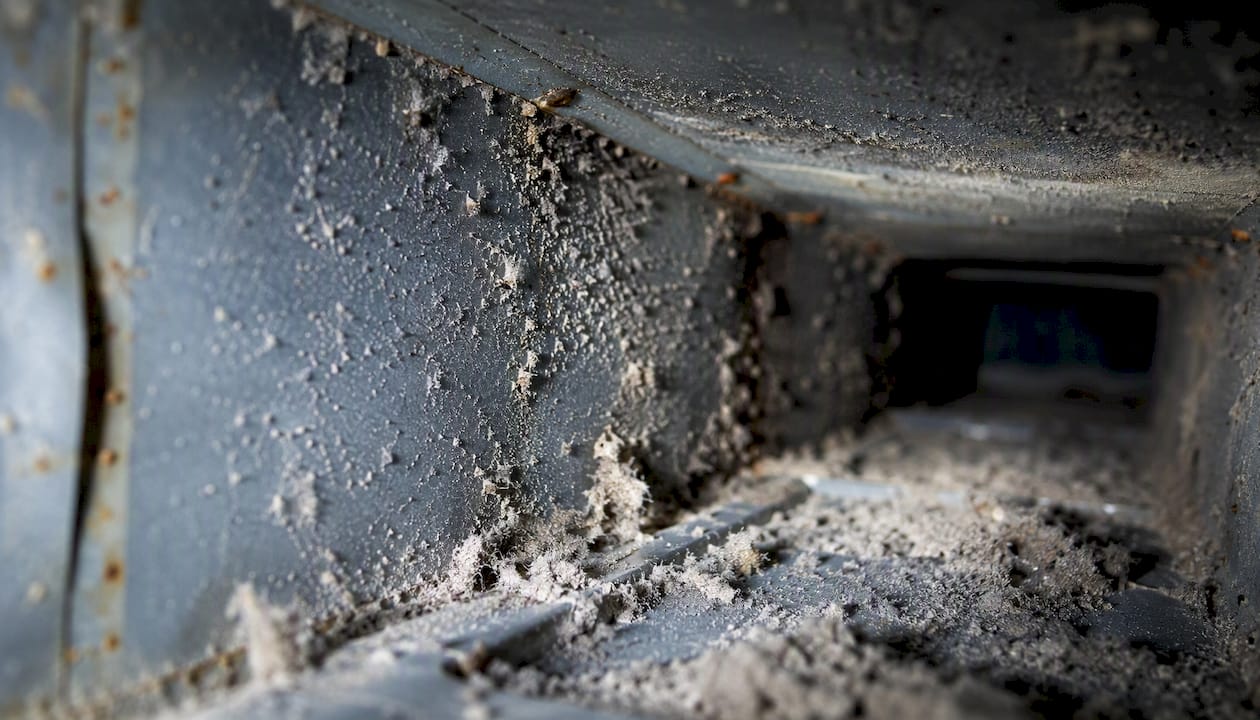
The second thing licensed crews see repeatedly is homeowners who encapsulate correctly but keep no paperwork. A lab result, a disposal manifest, and a clearance test certificate are worth real money at resale. Buyers’ inspectors ask for them, and a missing clearance certificate on a pre-1984 floor raises questions that can stall or kill a sale. The job is not finished when the floor looks clean. It is finished when the documentation is in a folder.
MSN Environmental: licensed asbestos abatement across Ontario
When testing confirms asbestos-containing mastic, the decision about who handles the removal matters as much as the decision to remove it. MSN Environmental provides certified asbestos abatement services across Kitchener, Waterloo, Cambridge, Guelph, Hamilton, London, Brantford, and surrounding Ontario communities, covering the full scope from bulk sampling and designated substance surveys through containment, wet removal, waste manifesting, and post-removal air clearance.
Every job starts with a written work plan and ends with documented clearance testing, so you have the paperwork you need for compliance and resale. MSN Environmental’s technicians are trained and certified to Ontario standards, and the company works with licensed hazardous waste facilities for all ACM disposal. Whether you need testing and inspection services to confirm what you have, or a full abatement crew to remove it safely, the process is straightforward: contact MSN Environmental for a site assessment and itemised quote, and know exactly what the job involves before any work begins.
Sources
- Black mastic guide: Asbestos risk, testing, removal (2026) | AsbestosHQ
- Black mastic asbestos basics and removal | The Spruce
- Engineering controls for removal of asbestos-containing construction mastic (Class II work operations) | OSHA
This article is general information, not a substitute for advice from a qualified doctor. Consult a qualified healthcare professional about your own circumstances before acting on anything here.
FAQ
What does asbestos mastic look like?
Asbestos-containing mastic is typically a black or dark brown tar-like adhesive found directly under resilient floor tiles, sheet vinyl, or linoleum in homes built before 1984. Some formulations appear amber or yellowish-brown, and the adhesive may be brittle or crumbling if the bond has aged.
Is it safe to walk on floors with asbestos mastic underneath?
Intact, well-bonded mastic under undisturbed flooring poses minimal risk because the fibres are not airborne. The hazard arises when the adhesive is disturbed, scraped, sanded, or when overlying tiles delaminate and expose the adhesive layer.
What percentage of asbestos is typically found in black mastic?
Asphalt-based cutback adhesives from the pre-1984 era could contain chrysotile at varying percentages depending on the product and manufacturer. A PLM lab report will state the exact percent by weight for your specific sample, which is the figure that determines your regulatory obligations.
Can I remove asbestos mastic safely myself?
For confirmed asbestos-containing mastic, DIY removal is not recommended and may violate provincial regulations. Small confirmed-negative areas may be wet-scraped with proper PPE, but any sign of friability means stopping work and calling a contractor.
How long does professional asbestos mastic abatement take?
A single-room residential job typically runs one to three days, covering containment setup, wet removal, waste handling, and post-removal air clearance testing. Larger multi-room projects or those requiring third-party air monitoring may take longer depending on clearance results and provincial notification requirements.