

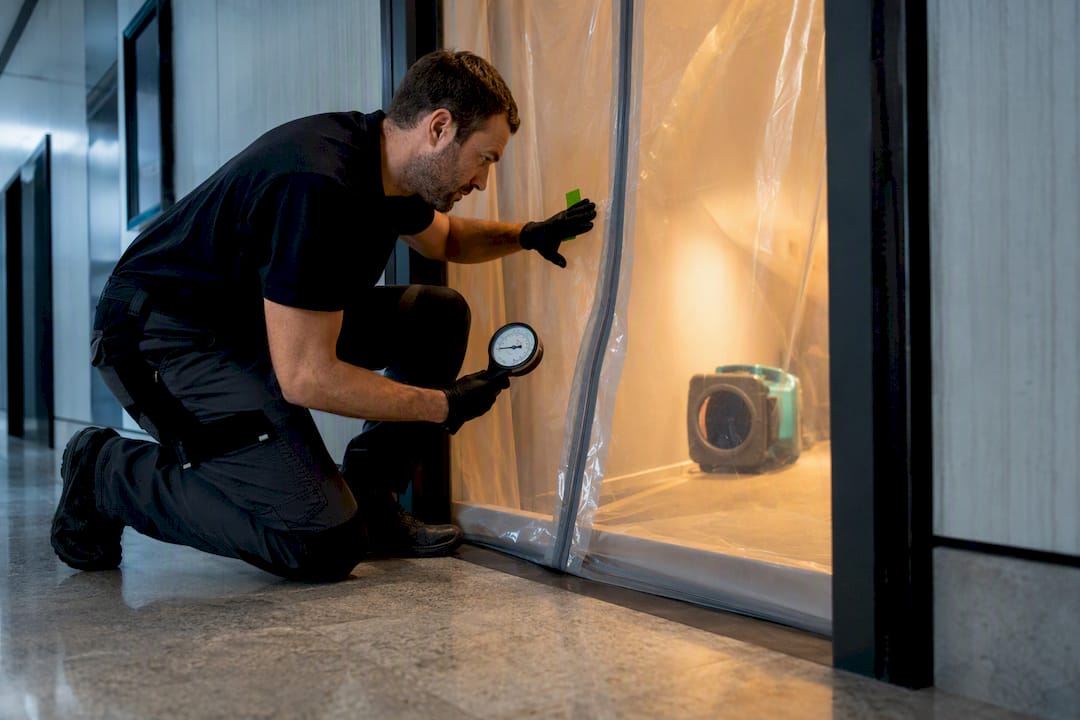
Negative air containment must pull air inward, never let it push out, holding at least −2.5 Pa relative to surrounding space while HEPA-filtered extraction cycles the enclosed air fast enough for safe re-entry. That number comes from CDC guidance on airborne isolation, and it only counts once you’ve measured it, logged it, and confirmed it with a smoke test or manometer reading. Containment protects the hallway outside, not the technician inside, so full respiratory PPE stays mandatory the entire time. Start measuring before anyone breaks a wall.
TL;DR:
- Achieving at least a negative pressure of −2.5 Pa is essential and must be verified with proper measurements before work begins.
- Building containment requires sealing all penetrations, isolating HVAC systems, and routing exhaust outside to prevent leakage and maintain pressure.
- Using a properly rated HEPA H13 or H14 filtration system and sizing the machine to room volume ensures effective particle removal and faster clearance times.
- Continuous pressure monitoring, logged and checked against alarm thresholds, is critical to detect leaks and maintain containment throughout the project.
- Certified abatement contractors provide necessary documentation, clearance testing, and proof of compliance, especially when regulated materials like asbestos are involved.
Table of Contents
- How do you set up negative air containment?
- Choosing the right negative air machine and filtration
- How do you verify negative pressure is actually holding?
- What containment does not protect against
- Commissioning, documentation, and safe re-entry
- When containment needs a certified contractor, not a DIY crew
- Containment done right, with the appropriate paperwork to prove it
- Sources
- FAQ
How do you set up negative air containment?
Building a working containment system is a sequence, not a single task. Skip a step and the pressure differential you’re chasing never materializes, no matter how good the machine is.
- Map the footprint first. Walk the space and decide where the “dirty” work zone ends and the “clean” corridor begins. Most jobs need at least one anteroom or a zippered double-door entry so nobody walks straight from contaminated air into a hallway.
- Build the physical barrier. Standard practice uses 6-mil poly sheeting for critical barriers (some crews go to 4-mil for lighter jobs, but 6-mil resists tears better around framing and door frames). Frame openings with furring strips or spring-loaded poles, tape every seam, and pay special attention to outlets, light fixtures, and any pipe or duct penetration, since these are where containment quietly fails.
- Isolate the HVAC system. Locate every supply and return register inside the work area and seal them with poly and tape, not just a cover. On larger jobs, shutting down the central air handler for that zone is safer than trusting a sealed register alone, because ductwork can still pull contaminated air into shared returns elsewhere in the building.
- Place the negative air machine and route the exhaust. Position the unit so intake air travels across the whole contaminated zone before reaching the filter (this improves capture and avoids dead air pockets). Route the exhaust hose to an unoccupied exterior point, never back into another occupied area, and label every duct and hose run so nobody at shift change reconnects the wrong line.
A quick pre-flight checklist before intrusive work starts:
- Anteroom or double-door entry installed and taped
- All penetrations, outlets, and fixtures sealed
- HVAC registers isolated or system shut down for the zone
- Machine placed, exhaust routed outside, ducts labelled
Choosing the right negative air machine and filtration
Room volume drives every other decision here. Multiply length by width by height to get cubic footage, then decide the air changes per hour (ACH) you need. Higher ACH shortens the time required to bring particle counts down to acceptable levels before re-entry, so a machine undersized for the room volume leaves you waiting far longer than planned, or worse, opening containment before it’s actually clean.
Filtration matters as much as airflow. A machine rated HEPA H13 or H14 captures at least 99.95% to 99.995% of particles at the 0.3-micron test size, which is why the EPA’s HEPA filter guidance treats certified HEPA as the baseline for any serious containment, not an upgrade.
Machine horsepower is where a lot of jobs go wrong. Lab testing found that consumer-grade fans could not generate meaningful negative pressure at all, while a 3.5-horsepower vacuum reached −3.0 Pa, comfortably past the CDC’s −2.5 Pa target. A box fan taped into a doorway is not a containment strategy.
A few practical notes on keeping filtration honest over the course of a job:
- Prefilters extend HEPA life; check them daily on dusty demolition work.
- Replace HEPA filters when static pressure climbs (not on a fixed calendar date alone).
- Seal every duct joint; a loose coupling behind a machine bypasses the filter entirely.
Pro Tip: Provision one extra machine per containment zone as a redundancy, not just a backup. Field crews routinely find they need more capacity than initial volume math suggests, because leakage scales with wall surface area, not room volume.
How do you verify negative pressure is actually holding?
Verification has two tiers, and skipping the second one is where a lot of containment fails quietly.
Start with a tissue or smoke test at every seam, doorway, and anteroom flap. Air should visibly pull inward. It’s a fast, useful gut check, but it tells you direction, not magnitude, so it can’t stand alone as your compliance record.
For that, you need a manometer or a continuous digital pressure sensor placed at chest height near the containment entrance, reading against the adjacent clean space. Log the number, don’t just glance at it. Continuous monitoring with an alarm threshold catches slow pressure drift long before a technician notices anything by feel, and automated pressure control has been shown to hold gradients more steadily than manual adjustment over long shifts, according to engineering research on HVAC pressure stability.
Common leak points to check first when a reading won’t hold:
- Window frames and old caulking lines
- Recessed light fixtures and electrical boxes
- Door sweeps on the anteroom’s outer flap
- HVAC register seals, especially at corners
Statistic Callout: In ambulance-module testing, a containment pod paired with HEPA-filtered extraction cut aerosol concentration by a large majority, greatly reducing aerosols compared with an unfiltered baseline, and sped up air clearing considerably. That gap between “sealed” and “sealed plus properly filtered” is the whole point of instrumented verification.
What containment does not protect against
Negative pressure earns its keep by keeping contaminants out of the hallway, the office next door, or the rest of a hospital ward. It does not earn a technician the right to skip a respirator.
Negative-pressure enclosures reduce outward migration of airborne particles and shorten air-clearance times, but they do not remove close-proximity exposure risk for anyone working inside the zone during active generation of contaminants. Full personal protective equipment stays mandatory regardless of how well the room holds pressure.
That’s the core finding from medical literature reviewing negative-pressure room use, and it applies just as directly to asbestos abatement or mould remediation as it does to a hospital isolation ward. A number on a pressure gauge says nothing about what’s floating six inches from someone’s face.
Operational habits that keep crews safe day to day:
- Log pressure readings on a fixed schedule, not just at shift start
- Stop work immediately on any alarm or sustained reading below target
- Rotate or maintain redundant machines so a filter clog never drops containment unnoticed
- Assign one trained operator per zone who owns the monitoring log
Full commissioning records for these checkpoints are available on request.
Commissioning, documentation, and safe re-entry
A containment system is only as good as the paper trail behind it. Regulators, insurers, and building owners all want the same thing: proof the numbers were real, not estimated.
- Record a baseline before intrusive work. Note ambient pressure, machine model and serial number, and filter condition at installation.
- Log continuously through the job. Pressure readings, ACH calculations, and particle-count baselines all belong in the same file, timestamped.
- Calculate clearance time from ACH. A higher ACH shortens the time needed to reach 99% or 99.9% particle removal after work stops; the exact figure depends on room volume and machine output, so calculate it per job rather than using a rule of thumb.
- Sign off and retain records. Keep filter-change dates, final clearance readings, and machine IDs on file, and hand a copy to the client or regulator before re-entry begins.
The testing and assessment side of a remediation project usually confirms this data with independent air sampling before anyone calls a space clear.
When containment needs a certified contractor, not a DIY crew
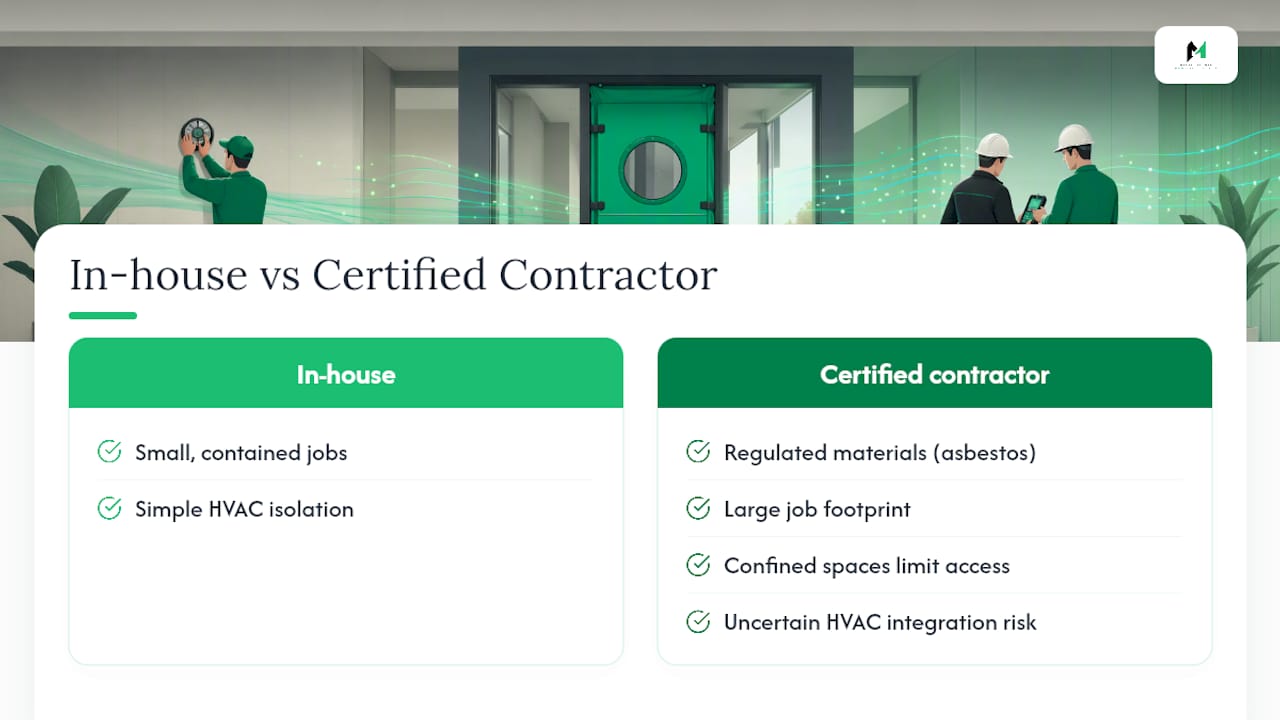
Handle it in-house for small, contained jobs with simple HVAC isolation. Call a certified contractor once regulated materials like asbestos are involved, the footprint is large, confined spaces limit access, or HVAC integration is uncertain enough that a sealing mistake could pull contaminants into shared ductwork.
Certified abatement firms bring formal commissioning paperwork, liability insurance, trained and certified personnel, and post-work air sampling that verifies clearance rather than assuming it. A complete commissioning package, covering baseline readings, continuous logs, and final clearance data for auditing, can be provided on request.
Containment done right, with the appropriate paperwork to prove it
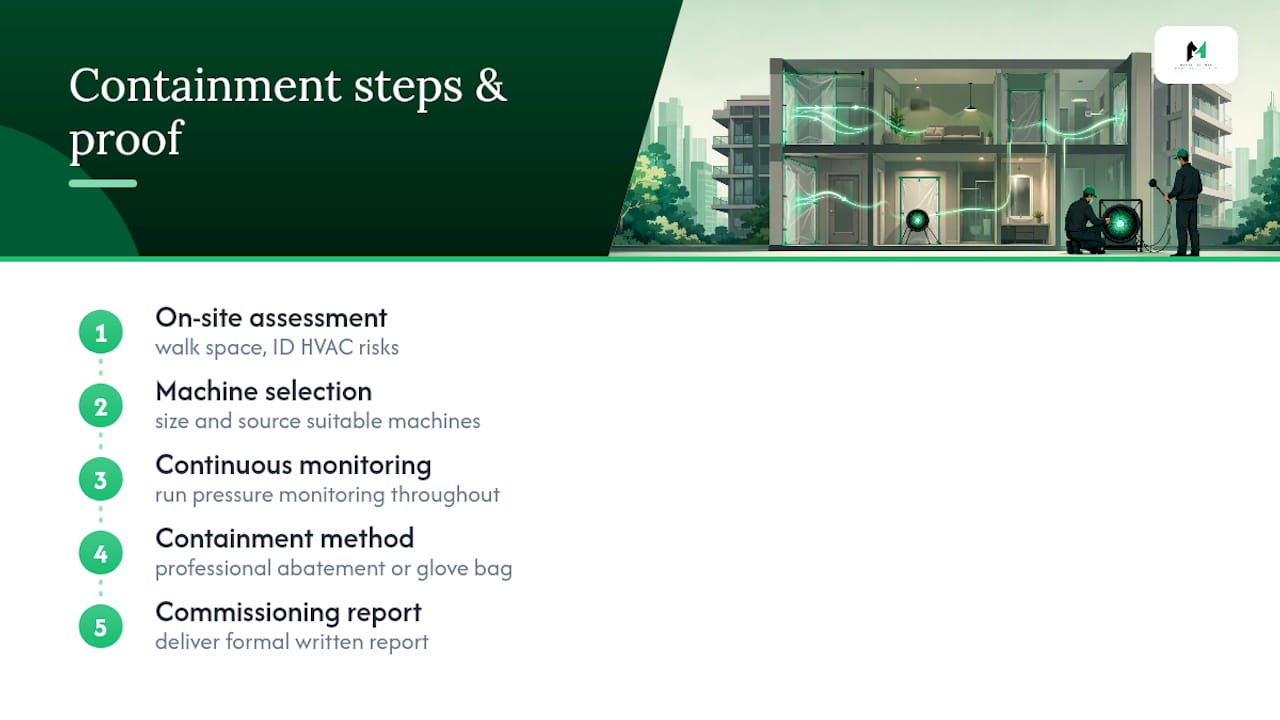
Getting the pressure differential right is only half the job. The other half is proving it, in writing, to a regulator or a building owner who wasn’t standing there watching the manometer. Containment setup includes sourcing and sizing suitable machines for the space, running continuous monitoring throughout the job, and delivering a formal commissioning report at the end rather than a verbal “it’s clear.”
That matters most on regulated jobs. If asbestos is anywhere near the scope, professional asbestos abatement and removal closes the gap between a contained space and a legally defensible one, backed by air sampling and documented clearance times instead of guesswork on when it’s safe to re-enter. For crews weighing a smaller job, glove bag techniques cover the cases where full negative-pressure containment is overkill.
Property managers uncertain about job classification can request an on-site assessment. The assessment includes walking the space, identifying HVAC integration risks, and providing a tailored commissioning checklist.
Sources
Technical claims above draw on CDC-aligned lab testing of portable containment, peer-reviewed review of negative-pressure room limits, ambulance-module aerosol testing, and EPA HEPA filtration guidance. For non-intrusive alternatives on sensitive sites, see Vista Drone Cleaning’s notes on disruptive-free building cleaning.
- Development and efficacy testing of a portable negative pressure enclosure for airborne infection containment
- What is a HEPA filter? — EPA
FAQ
What is negative air containment?
It’s a sealed work zone held at lower air pressure than the surrounding space, using HEPA-filtered extraction so airborne contaminants get pulled inward and filtered rather than escaping into adjacent areas.
How do you set up negative air containment?
Build a sealed poly barrier with an anteroom, isolate or seal HVAC registers in the zone, place a properly sized negative air machine with exterior exhaust routing, then verify the pressure differential with a manometer before starting intrusive work.
What’s an example of a negative-pressure enclosure working?
Lab testing of a portable enclosure paired with a 3.5-horsepower vacuum reached −3.0 Pa, beating the CDC’s −2.5 Pa target for airborne isolation, while consumer-grade fans tested in the same setup failed to generate meaningful negative pressure at all.
What is negative airflow and how does it work?
Negative airflow means air moves into a space faster than it moves out, created by an exhaust fan or HEPA-filtered machine pulling more air out than passively enters through gaps, which keeps contaminated air from drifting into cleaner areas nearby.