

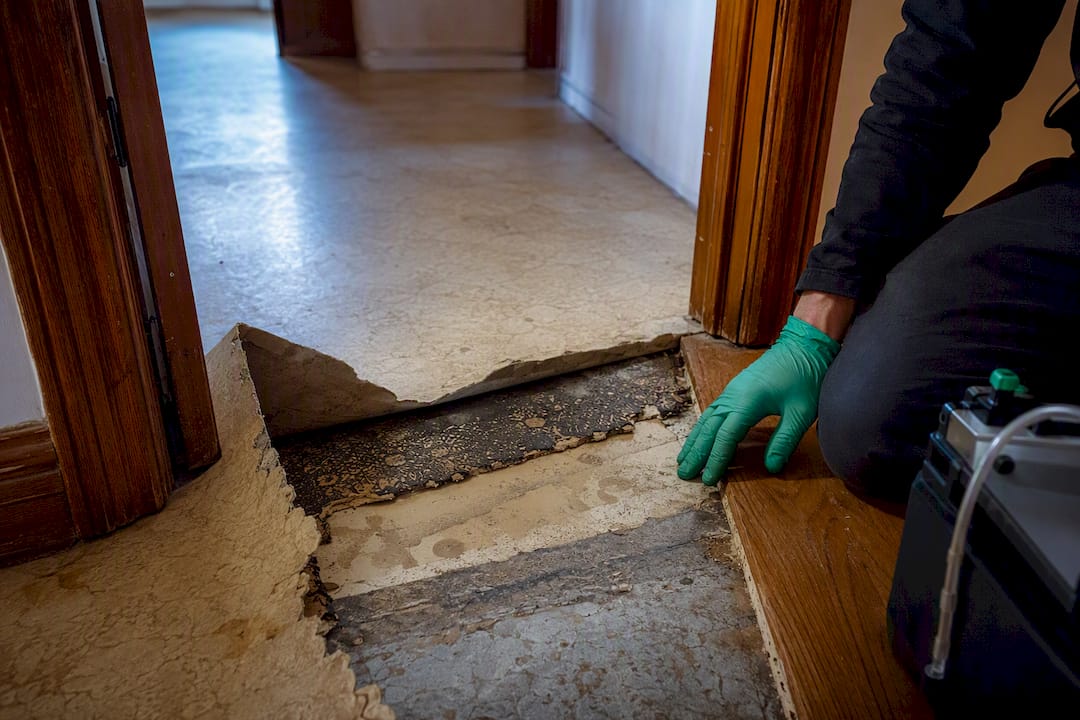
If your Ontario home was built before 1990, there’s a real chance it contains asbestos, and if it predates 1960, lead paint on interior surfaces is common. Both become dangerous mainly when disturbed. Before you sand a wall, pull up a floor tile, or open an attic hatch, stop and arrange a professional survey or lab sampling. Children and pregnant occupants are advised to avoid work zones until clearance testing confirms safety, as recommended by public health guidance.
TL;DR:
- Most homes built before 1990 likely contain asbestos in materials like insulation, pipe wrap, and floor tiles, and should be sampled before disturbance.
- Lead paint on interior surfaces is common in homes built before 1960, with exterior paint in homes from 1960 to 1990, and must be tested to prevent dust exposure during renovation.
- Other hazards include vermiculite insulation contaminated with asbestos, mercury switches, PCBs, mould, and off-gassing UFFI foam insulation, all requiring specialized assessment.
- A comprehensive survey with lab analysis and clearance testing is essential to identify materials, avoid legal liability, and prevent costly delays during renovation.
- Homeowners should disclose any hazards before bidding and hire certified professionals for asbestos, lead, or mould abatement to ensure safety and legal compliance.
Table of Contents
- Hazardous materials in older Ontario homes: where asbestos hides
- Lead paint in Ontario homes: renovation risks and exposure
- Other environmental hazards Ontario homeowners overlook
- How HAZMAT surveys and lab testing work before you renovate
- Ontario rules on disclosure, liability and hazardous waste disposal
- When to call certified abatement professionals
- Containment, PPE and getting the clearance to move back in
- What Ontario homeowners consistently get wrong about renovation hazards
- MSN Environmental: your next step after this guide
- Sources
- FAQ
Hazardous materials in older Ontario homes: where asbestos hides
Asbestos shows up in an astonishing range of building products used in homes constructed before 1990, and Canada didn’t fully ban its manufacture, import, sale, and use until December 30, 2018. That means even a house renovated as recently as the early 2000s could still have original asbestos-containing materials tucked behind drywall or under flooring.
Statistic to know: Health Canada defines a material as asbestos-containing when it holds 0.5% asbestos or more by dry weight, a threshold that catches far more products than most homeowners expect.
The most common locations in Ontario housing stock include:
- Loose grey or silver vermiculite insulation in attics
- White or grey pipe wrap and boiler insulation in basements
- 9×9 inch vinyl floor tiles and their black mastic adhesive
- Drywall joint compound and textured “popcorn” ceilings
- Cement roofing shingles, siding, and plaster
Intact asbestos is not an emergency. The danger comes from disturbed fibres becoming airborne and inhaled, and Health Canada is direct about avoiding disturbance and seeking professional advice rather than testing your luck with a utility knife. If a material looks like one of the items above and you’re not certain, treat it as asbestos until a lab says otherwise. Sampling for a single suspect material typically runs faster and cheaper than a full-home survey, but budgeting for either matters before you sign a contractor’s quote. Vermiculite insulation gets its own attention below, and if that’s what you’re staring at in your attic hatch, our guide to vermiculite insulation removal walks through the specifics.
Lead paint in Ontario homes: renovation risks and exposure
Lead paint follows a fairly predictable age pattern. Homes built before 1960 commonly have lead-based paint on interior surfaces, while homes built between 1960 and 1990 may have it on exteriors; anything built after 1990 is generally lead-free, according to Health Canada. Trim, baseboards, window sashes, and old kitchen cabinetry in a pre-1960 house are prime suspects.
The exposure problem isn’t the painted surface itself. It’s what happens when you sand, scrape, heat-strip, or demolish it. Those actions turn old paint into fine dust that settles on floors, gets tracked through the house, and is easily inhaled or ingested, particularly by small children who put their hands in their mouths.
Testing options range from quick to conclusive:
- XRF (X-ray fluorescence) screening gives an on-site reading in minutes
- Bulk paint chip sampling sent to an accredited lab for confirmation
- Dust wipe sampling after work to check clearance levels
Pro Tip: If your home falls in the 1960 to 1990 window, don’t assume the exterior is safe just because the interior tested clean. Exterior and interior paint jobs were often done years apart with different products.
Until you know for certain, isolate the work area, use wet sanding or wet scraping instead of dry methods, and use HEPA-filter vacuums for cleanup to reduce airborne dust during renovation. If you’re working on old window components specifically, our page on windows with lead paint covers what to do before you touch the sash.
Other environmental hazards Ontario homeowners overlook
Asbestos and lead get the headlines, but older homes carry a handful of other substances worth checking for before demolition starts.
- Vermiculite insulation: often contaminated with asbestos from the now-closed Libby, Montana mine; warrants sampling before attic work
- Urea-formaldehyde foam insulation (UFFI): installed heavily in the late 1970s, now brittle and prone to off-gassing if disturbed
- Mercury: found in older round or programmable thermostats and some light switches
- PCBs: turn up in light-ballast capacitors and some older caulking and window glazing compounds
- Mould: grows wherever moisture has sat undetected, from basement sill plates to bathroom subfloors
Mercury-containing thermostats and light switches are usually a straightforward homeowner swap; wrap and dispose of them at a household hazardous waste depot rather than the trash. PCBs, vermiculite, and any mould covering more than a small patch generally need professional testing or remediation, and our mould in basement guide explains when a stain is cosmetic versus structural. Walk your pre-renovation checklist room by room: attic, mechanical room, window frames, and any bathroom or basement with a history of dampness.
How HAZMAT surveys and lab testing work before you renovate
A designated-substances or HAZMAT survey is the single most useful step you can take before a demolition permit gets pulled, and it typically unfolds in a few stages:
- Visual walkthrough: a trained assessor identifies suspect materials by location and condition
- Bulk or air sampling: small physical samples or air pump readings are collected from suspect zones
- Lab analysis: an accredited laboratory confirms asbestos, lead, or other contaminant content
- Written report: results, locations, quantities, and recommended abatement steps get documented for your contractor and permit file
Inspection and sampling generally take a matter of days, with lab turnaround adding more time depending on how many samples were collected and the lab’s backlog. A proper survey report lists exactly which materials tested positive, where they’re located, and what abatement category applies, which lets a contractor price the job accurately instead of guessing and padding the quote to cover unknowns. Skipping this step is how homeowners end up with a mid-project stop-work order when a demolition crew hits something unexpected.
Why it matters financially: an early survey lets you shop multiple abatement quotes with real numbers rather than change orders, and our testing and inspection services page breaks down what a typical assessment covers. If your project also needs interior demolition afterward, understanding survey requirements first, as outlined in our designated substances survey guide, keeps your permit application clean.
Ontario rules on disclosure, liability and hazardous waste disposal
Ontario law puts real weight on hazard disclosure, and homeowners aren’t exempt from the consequences of ignoring it. The Occupational Health and Safety Act and Ontario Regulation 490/09 require employers and project owners to assess designated substances like lead and asbestos and put control programs in place before work begins.
That regulatory chain starts with you. If you know your home has asbestos pipe wrap or lead paint and you don’t tell your contractor, you’re the one exposed to liability if a worker gets sick or a stop-work order shuts the project down mid-renovation. Failing to disclose known hazards before bidding is one of the most common ways an Ontario renovation goes over budget and over schedule.
- Disclose any known or suspected hazardous materials to every contractor bidding on the job
- Confirm whether your municipality requires a permit before hazardous waste removal or disposal
- Ask your abatement contractor how waste manifests and disposal documentation will be handled
- Keep copies of survey reports and clearance certificates for future sale disclosure
Municipal hazardous-waste depot rules vary by region, and disposal logistics can add days to a project timeline if materials need special handling, so confirm local requirements before you finalize a renovation start date.
When to call certified abatement professionals
Not every discovery needs a call to a specialist, but several situations absolutely do:
- Lab-confirmed asbestos in friable (crumbly) condition rather than intact and stable
- Visible mould covering more than roughly a square metre or tied to a moisture source you can’t fix yourself
- Lead dust readings above clearance levels after sanding or demolition work
- Any renovation that will disturb vermiculite, pipe wrap, or floor tile adhesive
A general contractor isn’t automatically qualified to handle abatement, even a skilled one. Before hiring, verify the firm carries documented worker training, holds the correct licensed abatement category for the material involved, carries liability insurance, and uses an accredited lab for sample analysis rather than an in-house guess.
Pro Tip: Ask to see a sample clearance report from a past job before you sign anything. A legitimate abatement contractor will have one ready, complete with air-monitoring results and waste manifest numbers.
Expect a proper job to end with a written work plan, an air-monitoring plan if applicable, a final clearance report, waste disposal manifests, and an itemized invoice. Our step-by-step asbestos removal process guide outlines what that paperwork trail looks like from first call to final clearance.
Containment, PPE and getting the clearance to move back in
Professional containment keeps contamination from spreading past the work zone: sealed plastic barriers, negative air pressure machines pulling air out through HEPA filtration, and restricted access with a single decontamination entry point. HVAC systems get isolated or shut down entirely during active abatement so ductwork doesn’t circulate fibres or dust through the rest of the house.
Workers wear fitted respirators rated for the specific hazard along with disposable protective suits, and daily decontamination protocols keep contaminated materials from leaving the containment area on clothing or tools. On the household side, relocate children, pregnant occupants, and pets away from the work zone entirely, as public health guidance recommends, until the job is done.
Re-occupancy isn’t a judgment call. It requires post-abatement clearance testing, air sampling below the applicable threshold, and a written clearance report before anyone moves back into the space.
What Ontario homeowners consistently get wrong about renovation hazards
The biggest misconception I see in how homeowners approach older houses is treating hazardous materials as a binary: either your house has “the asbestos problem” or it doesn’t. That’s not how any of this works. A 1974 bungalow might have asbestos pipe wrap in the basement that’s been stable and undisturbed for fifty years, and lead paint on a single window trim that’s flaking onto a windowsill a toddler can reach. One is a low-priority monitoring item. The other is an active exposure risk today. Treating them the same, either by panicking over the stable pipe wrap or ignoring the flaking trim, gets homeowners in trouble in opposite directions.
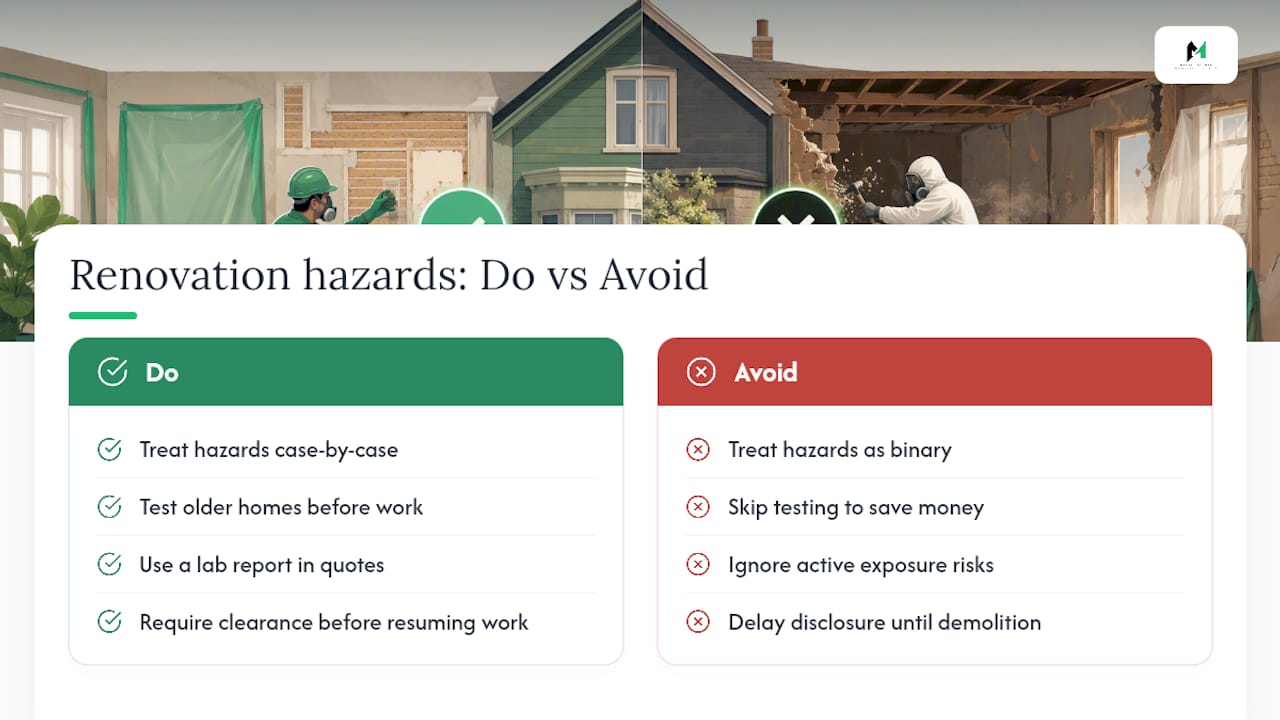
The second thing people underestimate is how much leverage a survey report gives them in contractor negotiations. Homeowners who skip testing and just ask for renovation quotes almost always get vague, padded pricing because contractors are quoting for the unknown. A homeowner who walks in with a lab-confirmed survey and a clearance requirement gets a tighter, more honest number. It’s counterintuitive, but paying for testing upfront usually saves money on the renovation itself.
Where the Ontario legal framework genuinely helps homeowners, even though it reads like a burden, is that it forces disclosure early rather than letting problems surface mid-demolition when change orders and stop-work delays cost real money. The law isn’t there to make your renovation harder. It’s there because the alternative, discovering asbestos after the drywall dust has already settled through your ductwork, is far worse than a week’s delay for sampling.
— Moacyr
MSN Environmental: your next step after this guide
Reading about asbestos thresholds and lead exposure pathways is useful, but at some point you need someone on-site with a sampling kit, not another article. Hazardous materials abatement companies offer HAZMAT surveys, lab-confirmed testing, and abatement services for asbestos, mould, and lead paint in Southwestern Ontario communities.
Technicians with documented certifications and accredited lab partnerships provide clearance reports that help if you sell the house or face a municipal inquiry later. That paperwork trail, from initial survey through final clearance testing, is exactly what protects you under Ontario’s disclosure rules. If you’ve already found something suspicious mid-renovation, our page on what to do after finding asbestos during a renovation walks through immediate steps. For projects further along, MSN Environmental’s asbestos removal services cover everything from a single-room sample to full-scale abatement, and it’s worth building safety planning into your project timeline the way construction safety analytics approaches now recommend for Canadian sites. Request a quote and get your survey scheduled before the demolition crew shows up.
Sources
FAQ
What years was asbestos used in homes in Ontario?
Asbestos was widely used in Canadian building products up until Canada’s full ban took effect on December 30, 2018, though the highest-risk period for residential use runs through homes built before 1990.
Would a house built in 1976 have asbestos in Canada?
Yes, a home built before 1990 commonly contains asbestos in vermiculite insulation, floor tiles, pipe wrap, or drywall joint compound, so any renovation should start with sampling rather than assumptions.
What are the five common hazardous materials found in existing buildings?
Older Ontario buildings most often turn up asbestos, lead paint, mercury (in older thermostats and switches), PCBs (in caulking and light ballasts), and mould from long-term moisture problems.
Will 30 minutes of asbestos exposure hurt you?
A brief, low-level exposure carries far less risk than prolonged or repeated exposure, but Health Canada’s guidance is to avoid disturbing suspect materials altogether rather than treat any exposure duration as automatically safe.
Do I need a professional survey before a small DIY renovation?
If your home was built before 1990 and the work will disturb drywall, flooring, insulation, or old paint, yes. Even a small project like removing a section of flooring can release fibres or dust that a quick sample test would have caught beforehand.