

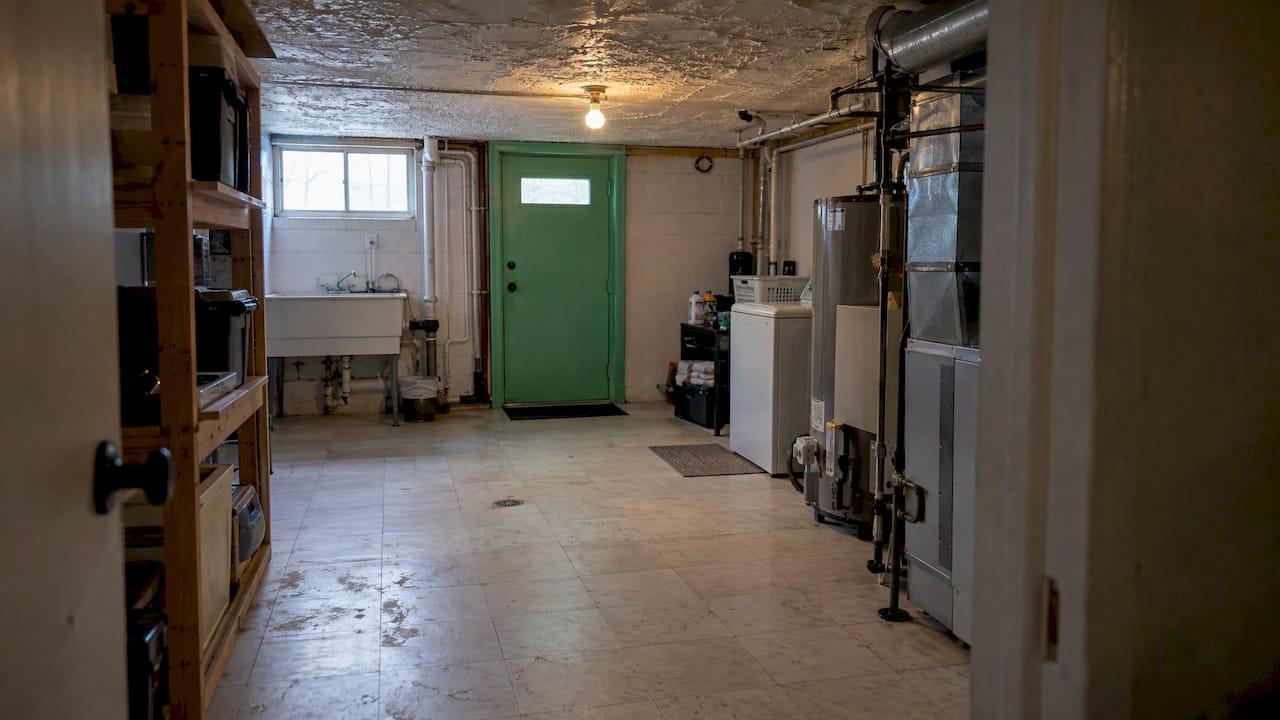
Asbestos mitigation means reducing the risk from asbestos-containing material in a building. In Canada the trade usually calls the removal side of it asbestos abatement. In Ontario, the right choice depends on the condition of the material and on whether you plan to disturb it. Sound, untouched material can often be managed in place. Material that is damaged, or that sits in the path of a renovation, should be tested and then dealt with by a trained crew. Homeowners are not permitted to do that work themselves if it could expose a worker.
This guide covers the three ways to mitigate asbestos, how Ontario classifies the work, what a compliant job looks like from first call to clearance, and the mistakes that cost owners the most.
TL;DR
- Asbestos that is intact and left alone is usually not the problem. Disturbing it during a renovation or letting it deteriorate is what releases fibres.
- Mitigation has three forms: removal, encapsulation (sealing) and enclosure (building a barrier). Only removal is permanent.
- Ontario’s O. Reg. 278/05 sorts work into Type 1, 2 and 3 operations, with the strictest controls and Ministry of Labour notice for Type 3.
- Test before you renovate. The owner is responsible for knowing which designated substances are in the building.
- Never sweep, vacuum or scrape suspected material. Stop, leave it, and call a certified professional.
Table of Contents
- What asbestos mitigation actually means
- Your three mitigation options
- How Ontario classifies asbestos work
- Can you do it yourself in Ontario?
- Test first: the survey that protects your budget
- What a professional mitigation job looks like
- Where owners go wrong
- What it costs and what affects the price
- Our perspective
- Asbestos removal and testing from MSN Environmental
- FAQ
- Sources
What asbestos mitigation actually means
The word “mitigation” is broader than “removal”. It covers any step that lowers the chance of fibres getting into the air you breathe: identifying the material, leaving it in good condition, sealing it, walling it off, or taking it out.
Asbestos was used mainly to insulate buildings and homes against cold weather before 1990, according to Health Canada. That is why the typical Ontario house built before the 1990s can hold it in places such as insulation, plaster, floor tiles and ceiling texture. You cannot identify it by looking. Only laboratory analysis of a sample confirms it.
Health Canada’s position is useful to keep in mind before you spend anything: asbestos in good condition that nobody disturbs poses little risk. The danger comes when materials are damaged, aged or worked on. Panic removal is not always the answer. Careless removal can be the moment of highest exposure.
Your three mitigation options
| Option | What it is | Best for | Limits |
|---|---|---|---|
| Leave and monitor | Material is identified, labelled in a management plan and inspected over time | Intact material you will not touch | Needs ongoing checks; must be disclosed and managed if you renovate |
| Encapsulation | Sealing the surface with a bonding agent | Stable material in low-traffic areas | Material stays in the building; the coating must be maintained |
| Enclosure | Separating the material from occupied space with a sealed barrier | Pipe wrap, ductwork, areas that are hard to reach | Material stays; future access still needs controls |
| Removal | Taking out the material under containment and disposing of it as waste | Damaged material, or anything in the path of renovation or demolition | Highest short-term disturbance, so it must be done properly |
The federal guidance on vermiculite insulation describes removal, encapsulation and enclosure as the available approaches, and it makes the same point we make to clients: containment methods need an ongoing management plan, while professional removal is the permanent fix.
When removal is the right call
Removal makes sense in three situations. The material is already crumbling, water damaged or friable. You are about to open walls, strip ceilings or gut a basement. Or you want the building free of the material before a sale, a change of use or a long-term renovation programme. If you are not sure which applies, a survey comes first, not a quote for removal.
When sealing or leaving it is reasonable
Floor tile that is intact under a newer floor, or textured ceilings in good shape that you do not plan to scrape, may not need to come out today. The condition of the material and your plans for the room decide this. A professional assessment tells you which side of the line you are on.
How Ontario classifies asbestos work
Ontario regulates this under O. Reg. 278/05, which applies to construction projects and to the repair, alteration and maintenance of buildings. It classifies operations that may expose a worker to asbestos as Type 1, Type 2 and Type 3.
- Type 1: low-risk work, typically with non-friable material and little dust.
- Type 2: medium-risk work with moderate dust potential.
- Type 3: high-risk work, including friable material such as spray-applied insulation.
The practical difference is in the controls. Type 3 work requires the constructor or employer to notify the nearest Ministry of Labour office, orally and in writing, before the operation begins. It also calls for full enclosures, negative air pressure and worker decontamination. For a closer read of those requirements, see our Type 3 asbestos abatement compliance guide and our roadmap to Ontario asbestos regulations.
The regulation also contains a threshold that surprises owners: material is treated as asbestos-containing at 0.5% content. Our page on the 0.5% rule for older Ontario homes explains how that plays out before a renovation.
Can you do it yourself in Ontario?
In short, no, not where the work could expose a worker. O. Reg. 278/05 prohibits homeowners from carrying out asbestos removal on construction projects or building repairs where the operation may expose a worker to asbestos. Health Canada and provincial authorities also advise against cutting, sanding or removing suspected material yourself, because those actions put fibres into the air of your home and your family’s lungs.
The regulation does allow handling material for the sole purpose of checking whether it is asbestos. Even then, taking a sample is a job for someone with the right protection and method. A poorly taken sample is itself a disturbance.
If you have already disturbed something, do not vacuum or sweep. Our guide on what to do in the first 90 seconds lays out the immediate steps, and what to do when asbestos turns up mid-renovation covers the stop-work decisions.
Test first: the survey that protects your budget
Before any renovation or demolition in an older building, someone has to find out what is in it. Under Ontario’s framework, the owner is responsible for determining which designated substances are present before construction begins, as Indoor Air Quality Canada notes in its summary of the owner’s duty. A Designated Substance Survey (DSS) is how owners meet that duty.
The cost of skipping it is predictable. A contractor opens a wall, finds suspect material, and work stops. Schedules slip, and the abatement gets bid in a hurry with no competition. A pre-bid survey lets every trade price the same scope. Health Canada’s own renovation advice is the same: have your home tested by a professional before you start.
Testing normally includes some combination of:
- Bulk sampling of suspect materials such as plaster, tile, insulation and ceiling texture, analyzed in a lab.
- Air sampling where fibres may already be airborne, or to verify a clean space after work. See our practical guide to asbestos air sampling.
- A project-specific pre-renovation or demolition survey that maps what will be touched.
We offer all of these through our testing, inspections and assessments service, and understanding asbestos testing explains what the results mean.
What a professional mitigation job looks like
The difference between a professional job and a rushed one is not the scraping. It is the controls around it. CCOHS describes the engineering controls used on asbestos work, including wetting, enclosures, local exhaust ventilation and HEPA-filtered equipment, all aimed at stopping fibres from migrating into clean areas.
A typical removal runs like this:
- Survey and scope. Confirm what the material is, how much there is and which Type of operation applies.
- Planning and notice. Write the work plan, arrange waste handling and, for Type 3, notify the Ministry of Labour before starting.
- Set-up. Seal off the work area, shut down and cover ventilation, and establish negative air pressure with HEPA-filtered machines.
- Removal. Wet the material, remove it in controlled pieces, and bag it in labelled waste containers.
- Cleaning. HEPA vacuuming and wet wiping of every surface in the enclosure.
- Clearance. Air testing to confirm the space is safe before the enclosure comes down and the room is reoccupied.
- Disposal and paperwork. Waste goes to an approved facility, and you receive documentation for your records.
We set out the full sequence in our step-by-step asbestos removal process. After clearance, general construction dust can still linger from the rebuild itself, so plan a final clean once trades have finished. Many owners also check their policies with a broker first, and home renovation insurance before work starts is worth sorting out before anyone opens a wall.
Where owners go wrong
- Ripping out first, testing later. Demolition spreads fibre through ducts and rooms before anyone knows it is there.
- Hiring on price alone. Ask what controls are included, who holds the certifications and whether liability insurance is in place. Our reasons to hire certified hazardous material professionals lists the questions.
- Confusing demolition with abatement. Gutting a room is not the same as removing asbestos from it. See interior demolition versus abatement.
- Forgetting vermiculite. Attic insulation of this type may contain tremolite asbestos, according to Health Canada’s findings, so do not disturb it before it is tested.
- Skipping clearance. Without verification, you are trusting your eyes.
What it costs and what affects the price
Prices vary with the type of material, the area, access, the Type of operation, containment needs and waste volume. We do not publish a fixed rate because a pre-1990 basement ceiling and an attic full of loose insulation are very different jobs. A site visit and test results are the honest basis for a quote. Our asbestos removal cost guide for Ontario walks through the factors, and our page on asbestos removal grants in Ontario covers what help may be available.
Our perspective
We get the same call every week: “I found asbestos, how fast can you get it out?” Our first answer is usually a question about what the material is, what condition it is in, and what you plan to do next. Sometimes the right move is a sealed, documented plan and nothing more. Sometimes it is a full Type 3 enclosure within days.
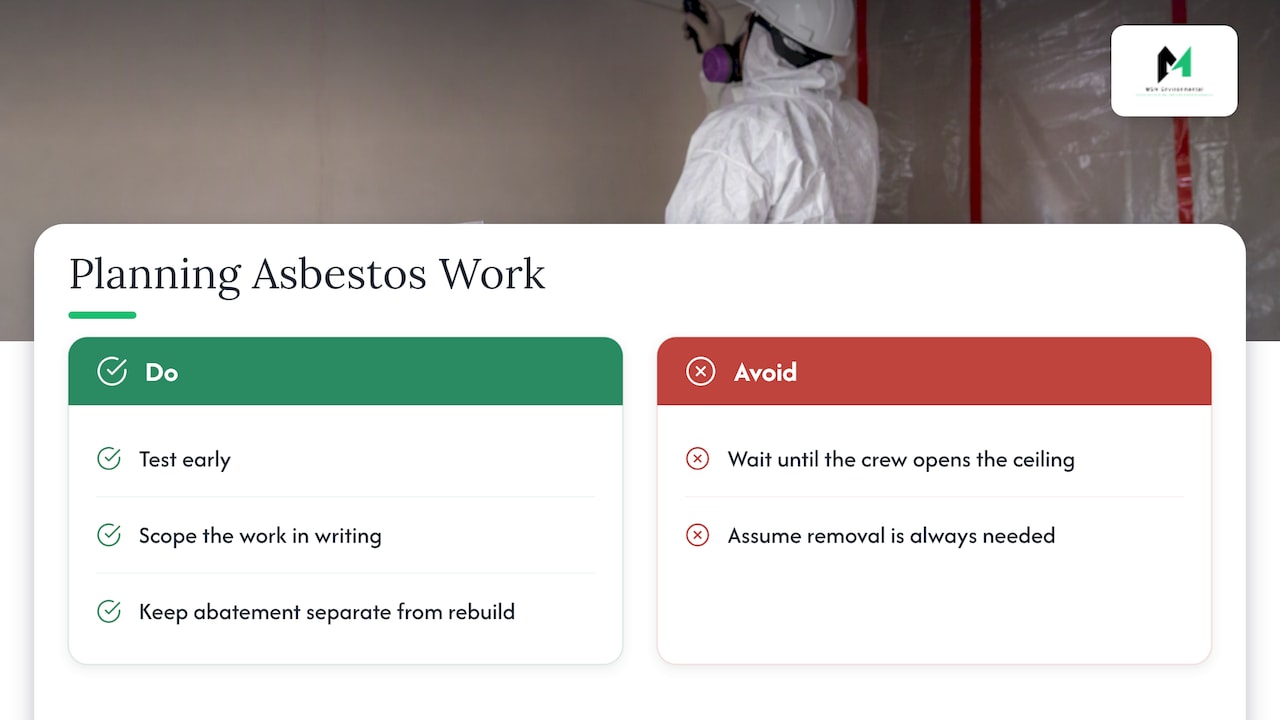
What we have learned on residential, commercial and industrial properties is that the costly jobs are rarely the ones with asbestos. They are the ones where nobody looked until the crew had already opened the ceiling. Test early, scope the work in writing, and keep abatement separate from the rebuild so each is priced and supervised on its own terms.
We hold ourselves to the standard we would want in our own homes: trained, certified technicians, proper equipment, personal oversight on site, full liability insurance, and a clean result that is verified rather than assumed.
— Moacyr
Asbestos removal and testing from MSN Environmental
If your survey points to removal, our asbestos removal services cover homes, commercial buildings and industrial sites across southwestern and central Ontario, including Kitchener, Waterloo, Cambridge, Guelph, Hamilton, London and Oakville. If you are still at the “is it asbestos?” stage, start with testing. In the Greater Toronto Area, see our Toronto asbestos remediation page. Tell us about the property and the planned work, and we will recommend the next step.
FAQ
Can asbestos be 100% removed?
It can be removed from a defined area, and clearance air testing confirms the space is safe to reoccupy. Encapsulation and enclosure do not remove it, so they require an ongoing management plan. Removal is the only permanent option.
Can I remove asbestos myself in Ontario?
Not where the work could expose a worker, because O. Reg. 278/05 prohibits it for homeowners on construction projects and building repairs. Beyond the legal point, DIY removal releases fibres into your living space. Hire a certified professional.
How do you mitigate asbestos?
You identify it with lab testing, then choose among leaving it in good condition, sealing it, enclosing it or removing it. The choice depends on the material’s condition and your renovation plans. A professional survey makes the decision straightforward.
How much does asbestos mitigation cost?
It depends on the material, the area, access and the Type of operation, so a fixed number would mislead you. Testing and a site assessment give a reliable quote. Our cost guide explains what drives the price in Ontario.
Sources
- O. Reg. 278/05, Ontario e-Laws
- O. Reg. 278/05 on CanLII
- Asbestos and your health, Health Canada
- Planning a renovation? Asbestos, Canada.ca
- Vermiculite insulation containing tremolite asbestos, Canada.ca
- Asbestos control measures, CCOHS
- Asbestos testing, Indoor Air Quality Canada
- Home renovation insurance before work starts