

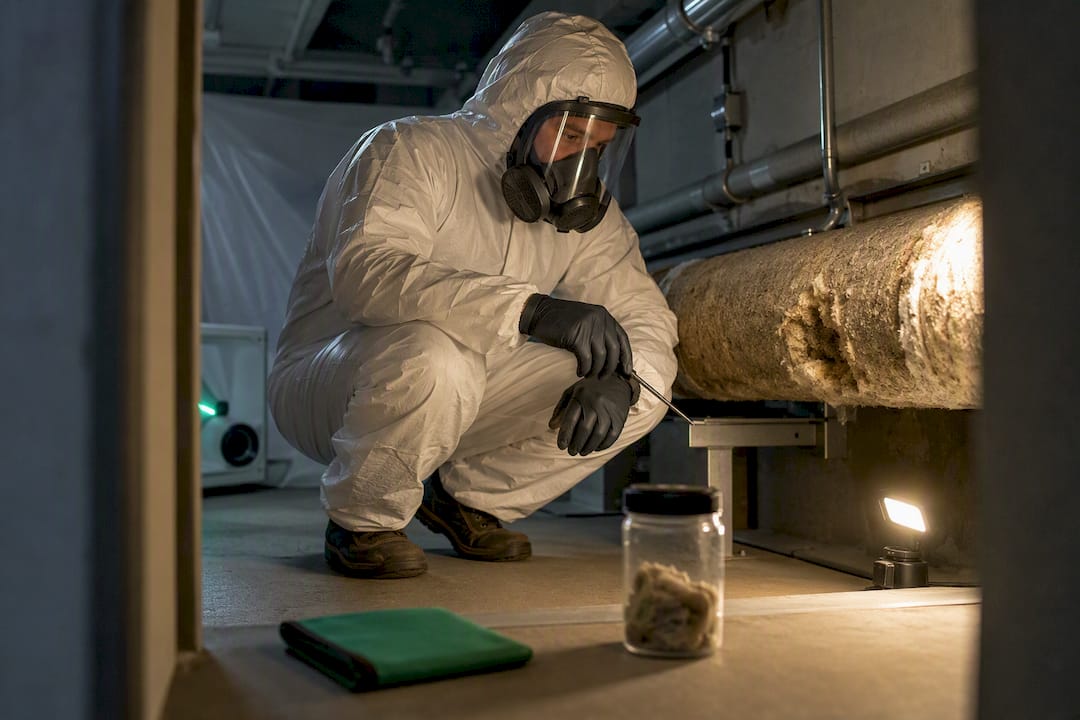
Stop whatever you’re doing immediately, keep everyone away from the area, and close doors behind you without walking through debris. Do not sweep, vacuum, or dust the area. Post a warning sign, call emergency services if anyone is injured or the release is large, and arrange a professional asbestos assessment before anyone goes back in.
TL;DR:
- Only trained, licensed professionals should handle high-hazard asbestos materials like pipe lagging or loose-fill insulation, especially after a disturbance.
- Do not attempt cleanup with vacuums or dusting tools, as these spread fibres and increase contamination risk until proper containment is established.
- Immediate isolation steps include shutting off equipment, sealing the area, and using plastic sheeting to prevent fibre migration before a licensed team arrives.
- Asbestos samples must be analyzed in a lab, with rush analysis available for emergencies; do not assume materials are safe without confirmation.
- Anyone exposed should remove contaminated clothing, wet wipe skin and hair, and seek medical advice if symptoms develop, but brief exposures generally pose low risk.
Table of Contents
- Asbestos emergency response: immediate actions to stop, protect and isolate
- Assess, sample and call a certified professional
- Decontaminating people who may have been exposed
- Containment measures while you wait for a licensed contractor
- When does licensed removal replace simple cleanup?
- Recordkeeping and reporting after an asbestos incident
- Why use a certified contractor for asbestos emergencies
- What the checklists get wrong
- Getting emergency help from MSN Environmental
- Sources
- FAQ
Asbestos emergency response: immediate actions to stop, protect and isolate
The first ninety seconds decide how bad this gets. Fibres released into the air don’t settle quickly, and additional foot traffic or airflow through the space pushes them further.
Here’s the order that actually matters:
- Switch off equipment where it stands. If a drill, saw, or excavator disturbed the material, kill the power without walking back through the debris field to retrieve tools.
- Get people out and close the doors. Move everyone to a clean area, shut interior doors, and if there’s mechanical ventilation serving that zone, shut it down too.
- Tape off the area and post a sign. A simple barrier and a handwritten “Do not enter, asbestos hazard” note buys time until proper signage arrives.
- Resist the urge to tidy up. No broom, no shop vac, no wet mop yet. Standard vacuums and dry sweeping don’t capture the fibres; they launch them into the air and spread contamination to rooms that were never affected.
- Call the fire department or other emergency responders first if anyone is hurt or the release covers a large area. WorkSafeBC’s guidance on handling asbestos is explicit on this: stop, isolate, and post a warning before doing anything else.
Pro Tip: Keep a roll of plastic sheeting and a few “hazard, do not enter” signs in your site office or utility closet. Reaching for something makeshift in the moment usually means someone improvises with a paper towel and a permanent marker, which nobody can read from ten feet away.
Assess, sample and call a certified professional
Until a lab confirms otherwise, treat the material as asbestos. That’s not caution for caution’s sake; it’s the only safe default when the visual clues (grey fibrous texture, older building materials, pipe insulation) point that way and you have no test result yet.
Bulk sampling and laboratory analysis can take some time, though rush turnaround is often available for active emergencies. A certified assessor takes small samples from the disturbed material and surrounding surfaces, then sends them for polarized light microscopy.
Certain materials are generally considered high hazard and require immediate professional handling without delay, including pipe lagging, loose-fill insulation, sprayed-on fireproofing or acoustic coatings, and any large or widespread releases.
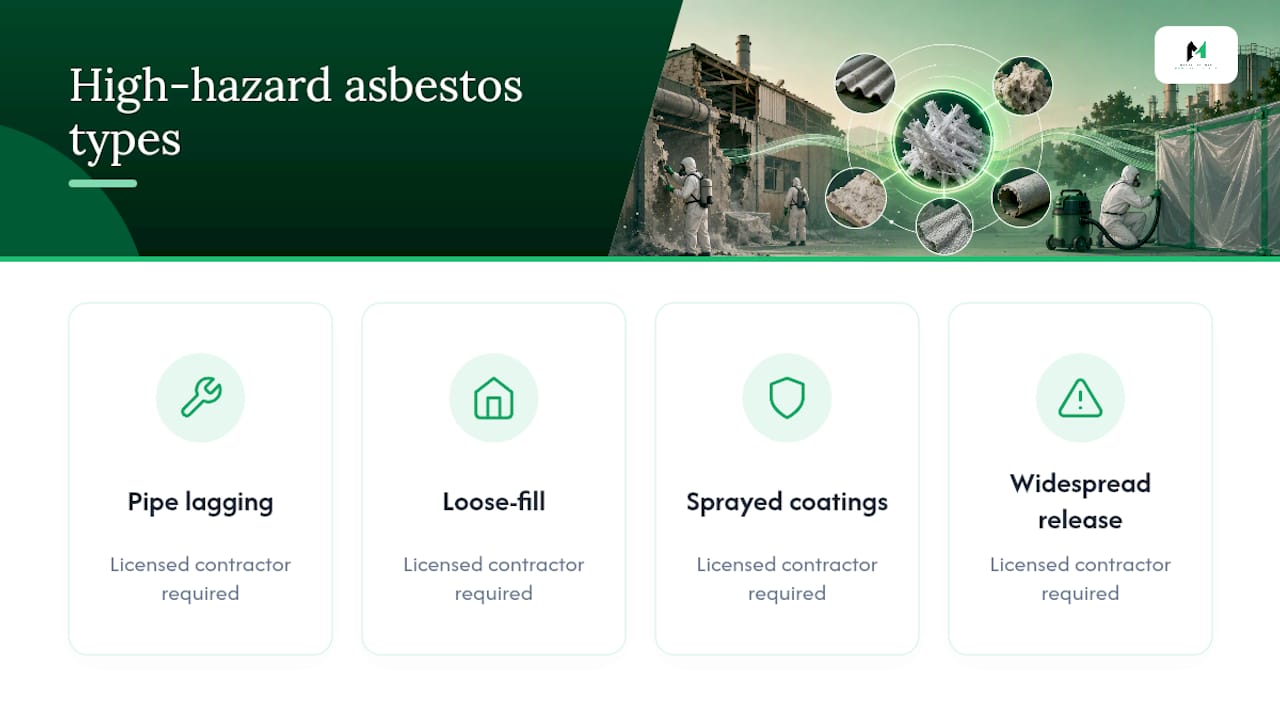
CCOHS’s asbestos guidance is clear that these high-hazard categories require a licensed contractor, full stop, regardless of how the material looks on the surface. When you’re vetting a contractor, ask for their licence number, proof of liability insurance, and a sample of a past clearance report before they set foot on site.
Decontaminating people who may have been exposed
Anyone standing near the disturbance when it happened needs basic decontamination before they touch anything else. This isn’t about panic. It’s about not carrying fibres into a car, a break room, or home.
- Remove outer clothing carefully, and don’t pull it over the head. Step out of it, or cut it off if it’s stuck.
- Bag and seal contaminated clothing immediately for hazardous waste disposal.
- Wet wipe exposed skin and hair rather than brushing or shaking anything off.
- Avoid rubbing or shaking clothing, which just redistributes fibres.
CCOHS notes that people who were briefly exposed and remain asymptomatic generally only need observation, not emergency medical treatment. Watch for shortness of breath, persistent coughing, or chest tightness in the hours after exposure, and have anyone showing those signs seen by a doctor the same day. A single brief exposure carries a very different risk profile than years of occupational exposure, and short exposures near a disturbance are not known to cause measurable harm on their own. That doesn’t mean skip the decontamination step. It means don’t let panic override the calm, methodical process.
Containment measures while you wait for a licensed contractor
Between your first isolation steps and the arrival of a licensed crew, there’s a window where a few low-tech moves make a real difference. HSE’s guidance on accidental disturbance incidents recommends keeping the area damp and covered rather than left dry and exposed to airflow.
- If it’s safe to do so, lightly dampen visible debris (never a high-pressure hose) and cover it with plastic sheeting.
- Set up one controlled entry point with shoe covers and disposable coveralls for anyone who must go back in.
- A basic dust mask or surgical mask does not protect against asbestos fibres. Only a fit-tested N95 or higher-rated respirator offers real protection, and only when properly fitted.
- PPE is your last line of defence, not your first. Isolation and engineering controls do the real work; masks and coveralls just protect the people who still have to be in the room.
That last point reflects the hierarchy of controls that WorkSafeBC applies to every asbestos job: eliminate or isolate the hazard first, then use engineering controls, and treat PPE as a backup, not a solution.
When does licensed removal replace simple cleanup?
Not every disturbance needs a full abatement crew in hazmat suits. A small, contained release of non-friable material sometimes gets resolved with careful cleaning and encapsulation. But the decision hinges on two things: what the material is, and how much of it got disturbed.
A licensed abatement job for anything beyond a minor, contained release typically includes:
- A sealed enclosure with negative air pressure to keep fibres from migrating to clean areas
- HEPA filtration running continuously through the work zone
- Waste double bagged, labelled, and tracked with a chain of custody through disposal
- Post-job air monitoring, with clearance testing confirming the space is safe before anyone moves back in
High-hazard materials like pipe lagging or loose-fill insulation almost always require this full process because they release fibres so readily once disturbed. Skipping the clearance air test and just eyeballing the room is how incidents get reopened weeks later when someone reports symptoms or a follow-up inspection finds elevated fibre counts.
Recordkeeping and reporting after an asbestos incident
Document the incident while it’s fresh. A minimal record includes the date and time, the exact location, who discovered it, a written description with photos, and the names of everyone who may have been in the area.
Notify your workplace health and safety authority, the building owner if you don’t own the property, and your insurer. For larger releases, local public health or emergency services may need a call too. Once the immediate response wraps up, update your building’s asbestos management plan and schedule a follow-up inspection or air sampling to confirm the fix held.
Why use a certified contractor for asbestos emergencies
A contractor’s value in an emergency isn’t the truck or the suits. It’s the paper trail and the equipment that make a space provably safe again.
MSN Environmental works across testing and inspections, containment, licensed removal, and post-remediation air monitoring, the same sequence a real incident actually needs from start to finish. When you’re evaluating any contractor for emergency work, look for:
- Trained, certified technicians with documented experience on comparable jobs
- Equipment that matches the job: HEPA vacuums, negative-air units, proper waste packaging
- Full liability insurance and a written scope of work before anything starts
- A clearance report you can hand to an insurer, a tenant, or a regulator without hesitation
A qualified crew that documents every step shortens the time a space sits closed and gives you something concrete to show if anyone asks what happened and how it was fixed.
What the checklists get wrong
Most asbestos guidance reads like a fire drill poster: stop, isolate, call someone. That part is right, and it matters, but it undersells how much judgement the middle steps actually require.
The real failure point isn’t the first sixty seconds. It’s the hour after, when someone decides the room “looks fine” and starts moving furniture back in before air clearance results come back. I’d argue the biggest gap in most emergency plans is the absence of a written decision tree for exactly that moment: who signs off on reoccupation, and based on what evidence.
Conventional advice also underplays decontamination for people, treating it as an afterthought behind property containment. It shouldn’t be. A worker who walks straight from a disturbed area to their car, still wearing contaminated clothes, has just created a second contamination site with no isolation at all.
If you take one thing from this, make it this: write your asbestos emergency response plan before you need it, not during the incident. A plan drafted under pressure always skips a step. The one drafted calmly, with named responsibilities and a contractor already on file, doesn’t.
— Moacyr
Getting emergency help from MSN Environmental
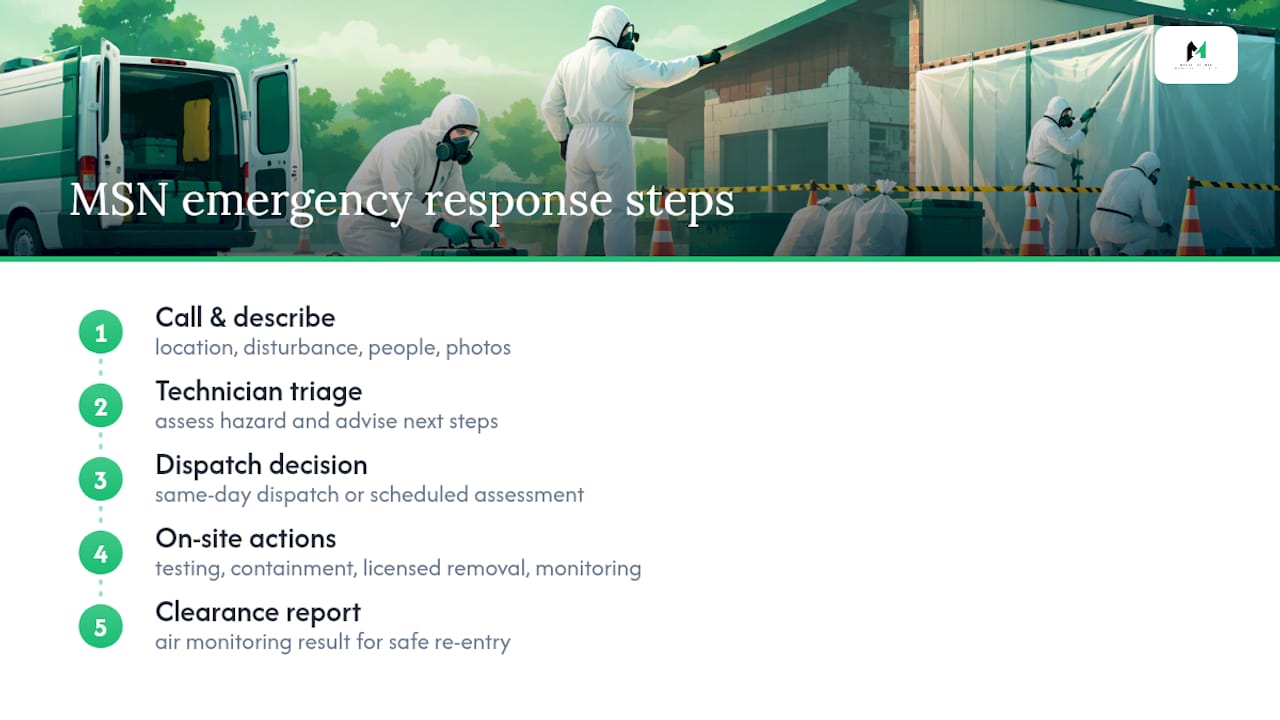
If you’re staring at a disturbed ceiling tile or a pile of broken insulation right now, the fastest useful thing you can do is call and describe exactly what you’re looking at. Tell the responder the location, what got disturbed and how (drilling, a collapsed section, a renovation cut), roughly how many people were nearby, and whether you have photos taken from a safe distance.
MSN Environmental handles the full arc of an asbestos emergency instead of just one piece of it. That’s the practical difference for a property manager juggling a live incident: one call covers testing and sampling, containment, licensed removal, and the air monitoring that gets you a clearance report at the end, rather than coordinating three separate vendors while a room sits taped off. Highly trained technicians and full liability insurance back every job, residential or commercial.
Large-scale releases and high-hazard materials like pipe lagging or loose-fill insulation genuinely need licensed abatement. There’s no shortcut around that. If your situation fits, contact a licensed abatement professional and describe what you’ve found. A technician can tell you within minutes whether this is a same-day dispatch or a scheduled assessment.
Sources
This article draws on regulatory guidance from WorkSafeBC, CCOHS, and the UK’s HSE, along with the US EPA. These bodies set the technical standards that licensed contractors follow, and they’re worth consulting directly for jurisdiction-specific requirements.
This article is general information, not a substitute for advice from a qualified doctor. Consult a qualified healthcare professional about your own circumstances before acting on anything here.
FAQ
Will 30 minutes of asbestos exposure hurt you?
A single brief exposure carries far lower risk than repeated or prolonged occupational exposure, and there’s no reliable evidence that thirty minutes alone causes measurable harm. That said, decontamination and observation still matter, since the goal is preventing any further inhalation, not just managing the exposure that already happened.
What is the 3-5-7 rule for asbestos sampling?
There’s no universally recognized “3-5-7 rule” in the guidance from WorkSafeBC, CCOHS, HSE, or the EPA. If you’ve seen it referenced elsewhere, treat it cautiously and ask your assessor directly about their specific sampling protocol and turnaround time instead.
How soon after asbestos exposure do you get sick?
Asbestos related disease typically develops over decades of exposure, not hours or days after a single incident. Watch for immediate symptoms like coughing or shortness of breath as a precaution, but the serious health risks associated with asbestos come from cumulative, long-term exposure rather than one accidental disturbance.
Do N95 masks protect against asbestos?
A properly fit-tested N95 respirator offers real protection against asbestos fibres, but a standard surgical or dust mask does not. Fit matters as much as the mask itself. A loose seal around the face lets fibres in regardless of the filter rating.
What should I do if I suspect asbestos during a renovation?
Stop work immediately, isolate the area, and arrange professional testing before continuing, since CCOHS guidance treats suspected material as asbestos until a lab confirms otherwise. MSN Environmental’s testing and inspection services can confirm what you’re dealing with before any more of the project moves forward.