

A small, accessible job can be finished in a day. A typical residential project runs about two to four weeks from inspection to final clearance, and a complex building can take longer. Most of that time is not spent removing material. It goes on testing, planning, notifying the Ministry, building containment and proving the air is clean afterwards. Below is what each stage usually takes, what is specific to Ontario, and what pushes a schedule out.
TL;DR
- Expect roughly two to four weeks from inspection to clearance for a typical home. The removal itself usually takes one to five working days.
- Testing and planning come first. Skipping them is the most common way to turn a two-week job into a stalled one.
- In Ontario, Type 3 work needs notice to the Ministry of Labour before it starts, so build that lead time into your renovation calendar.
- Failed clearance testing can add another 2 to 5 days. Surprises found mid-demolition can stop work entirely.
- Do not disturb suspected material while you wait. Hire a qualified contractor instead of removing it yourself.
Table of Contents
- The asbestos abatement timeline at a glance
- Stage 1: Inspection and sampling
- Stage 2: Project design, permits and notices
- Stage 3: Containment setup
- Stage 4: Active removal
- Stage 5: Final cleaning and clearance testing
- What commonly delays asbestos abatement
- Planning your renovation around abatement
- Our perspective on asbestos timelines
- Get a realistic schedule for your property
- FAQ
- Sources
The asbestos abatement timeline at a glance
The figures below are typical ranges, not promises. Your own schedule depends on the material, the amount, how accessible it is and whether people live in the building. Ranges for containment, removal and clearance come from published industry timelines. Testing and planning times are what we commonly see in practice.
| Stage | Typical duration | What happens |
|---|---|---|
| Inspection and sampling | A few hours on site, then lab turnaround | Suspect materials are identified and samples are analysed |
| Project design and notices | Several days to a couple of weeks | Scope, method, waste plan, Ministry notice where required |
| Containment setup | 4 hours to 2 days | Sealed work area, negative air, decontamination unit |
| Active removal | 1 day to several weeks | Wetting, careful removal, double bagging |
| Final cleaning and visual check | A few hours to a day | Surfaces cleaned, area inspected |
| Clearance air testing | 24 to 48 hours | Air samples taken once the enclosure is dry |
| Teardown and reoccupancy | 4 hours to 1 day | Barriers come down, area is released |
Add those up for a single room or a basement ceiling and you land close to the two-to-four-week window. A whole-house project with several materials, or a commercial floor, can stretch well beyond it.
Stage 1: Inspection and sampling
Nothing starts until you know what is there. A qualified person surveys the area, records where suspect material is, how much there is, its condition and how easy it is to reach, and takes representative samples. CSA guidance describes surveys in just these terms: location, extent, product type, accessibility, condition and samples.
The site visit is short. The wait is the lab. Samples are analysed off site, and results can take from a day or two to longer if you want them rushed or the lab is busy. If the building is old, the survey also covers other hazards you may meet during the same renovation.
In Ontario this step matters legally as well as practically. Owners and constructors need to know whether materials contain asbestos before they disturb them. Our guide to the 0.5% asbestos rule for older Ontario homes explains when testing is expected, and four situations where Canadians must test and get a written scope covers the trigger points.
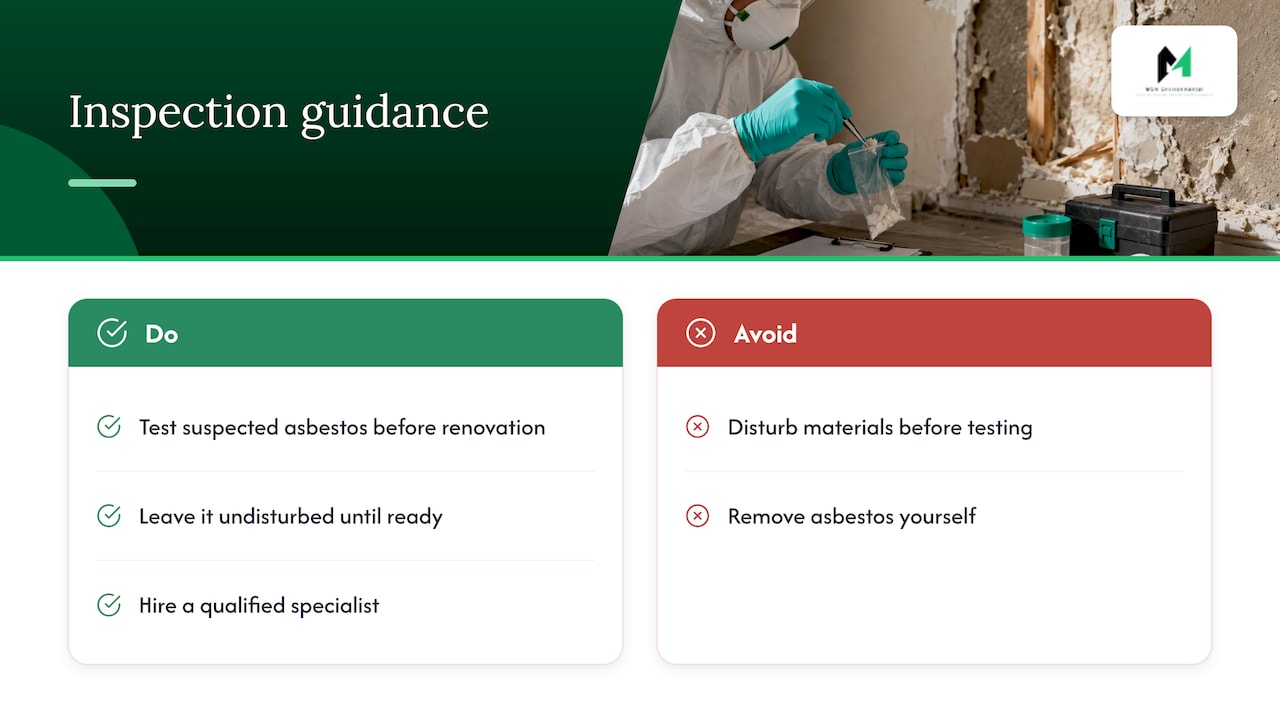
The Canadian Centre for Occupational Health and Safety advises testing suspected asbestos before renovation, leaving it undisturbed until proper procedures are in place, and hiring a qualified specialist instead of removing it yourself. That last point is a timeline point too. A cracked ceiling or a half-pulled floor changes the job from planned work into an emergency clean-up.
A pre-work inspection by a qualified professional is also what lets the rest of the schedule be fixed in advance. The same principle applies to other contamination, such as bird droppings and the health risks they bring: a trained eye identifies the problem before anyone starts cleaning.
Stage 2: Project design, permits and notices
Once the lab confirms asbestos, the contractor writes the plan: which method, what size of enclosure, how workers and waste will move in and out, and how the material will be disposed of. This is also where notifications happen, and it is the stage most homeowners do not know exists.
What Ontario requires
Under O. Reg. 278/05, constructors and employers must notify an inspector at the nearest Ministry of Labour office before beginning a Type 3 asbestos operation. The Ministry runs an online Notice of Asbestos Removal Work form, which covers Type 3 operations and certain Type 2 operations. Our Type 3 compliance guide explains which jobs fall into that category, and the Ontario regulations roadmap gives the wider picture for owners and contractors.
The notice is quick to file, but it must be filed before work begins, so the contractor needs the scope finalized first. Property managers who already track inspections and compliance tasks, for example with a landlord safety inspections checklist, should add asbestos notice lead time to the same calendar.
How other provinces differ
If you manage property in more than one province, do not assume Ontario’s timing applies elsewhere:
- Alberta employers must notify Alberta OHS 72 hours before work that may release fibres.
- Manitoba requires notice to the Director 5 to 10 days before work on a building containing asbestos that may release it.
- In British Columbia, asbestos work requires a Notice of Project with safe work procedures and a hazardous materials survey. WorkSafeBC says contractor licence applications generally take two to six weeks to process when complete.
For most Ontario homeowners, design and notice take a few days to a couple of weeks, depending mostly on how quickly the survey results arrive and when your contractor’s crew is free.
Stage 3: Containment setup
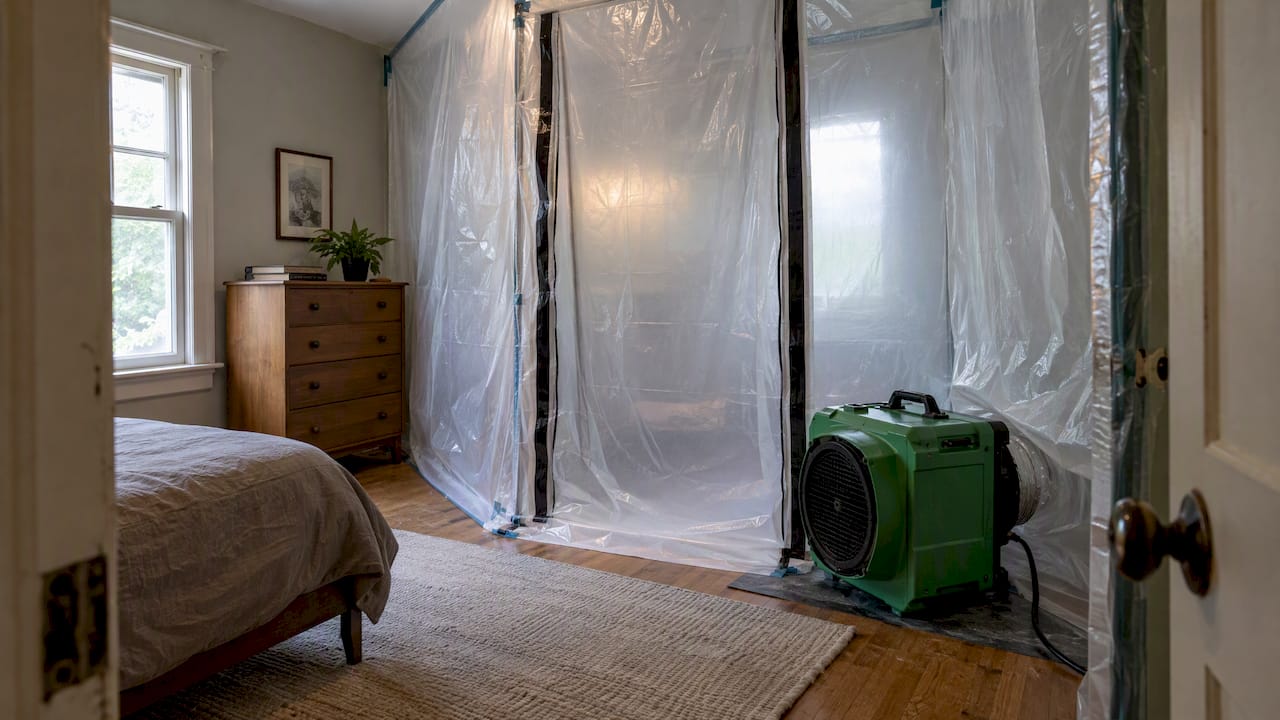
Containment is where an abatement job starts to look like one. The crew seals off the work area with poly sheeting, sets up negative air machines with HEPA filtration so air flows into the enclosure rather than out, and builds a decontamination unit where workers suit up and clean off before leaving.
Published timelines put this stage at 4 hours to 2 days. A single room with one door is at the short end. A basement with ductwork, or an area with irregular openings, takes longer to seal properly. Rushing it is false economy, because a leaky enclosure fails inspection and risks spreading fibres.
Stage 4: Active removal
This is the stage people picture, and for houses it is often the shortest. The residential removal phase typically lasts one to five working days. Larger or commercial projects can run to several weeks.
What drives the duration:
- Material type. Wet, friable material such as sprayed insulation needs different control than vinyl tile. Some products come off in sheets. Others, like mastic under flooring, are scraped, slow work. See our guides on asbestos drywall removal and asbestos mastic removal for how those two differ.
- Quantity and access. Square metres matter, but so do attics, crawl spaces and tight corners, which slow every step.
- Waste handling. Material is wetted, double bagged and moved out through the decontamination unit. Disposal has to go to a facility that accepts it, so haul-away is scheduled alongside removal. For example, one Manitoba landfill’s approval describes double-bagged asbestos going to a dedicated disposal area, and the same logic applies to Ontario sites.
- Occupancy. Working around people or tenants usually means smaller phases and longer total duration.
Our step-by-step guide to the asbestos removal process in Canada goes through the physical work in more detail.
Stage 5: Final cleaning and clearance testing
After the material is out, the crew cleans every surface inside the enclosure, and the area is checked visually. Then comes the part many owners forget to budget for: waiting for clearance air testing.
The federal technical guideline on exposure management says clearance air sampling must be done after surfaces are completely dry and forced air has been used to dislodge potential fibres. It describes a passing result as airborne fibre concentrations of 0.01 fibres per cubic centimetre or less. In Ontario, O. Reg. 278/05 says barriers, enclosure and decontamination facility cannot come down until required clearance testing is complete and passed. If the area fails, the cleaning steps are repeated and the test is run again.
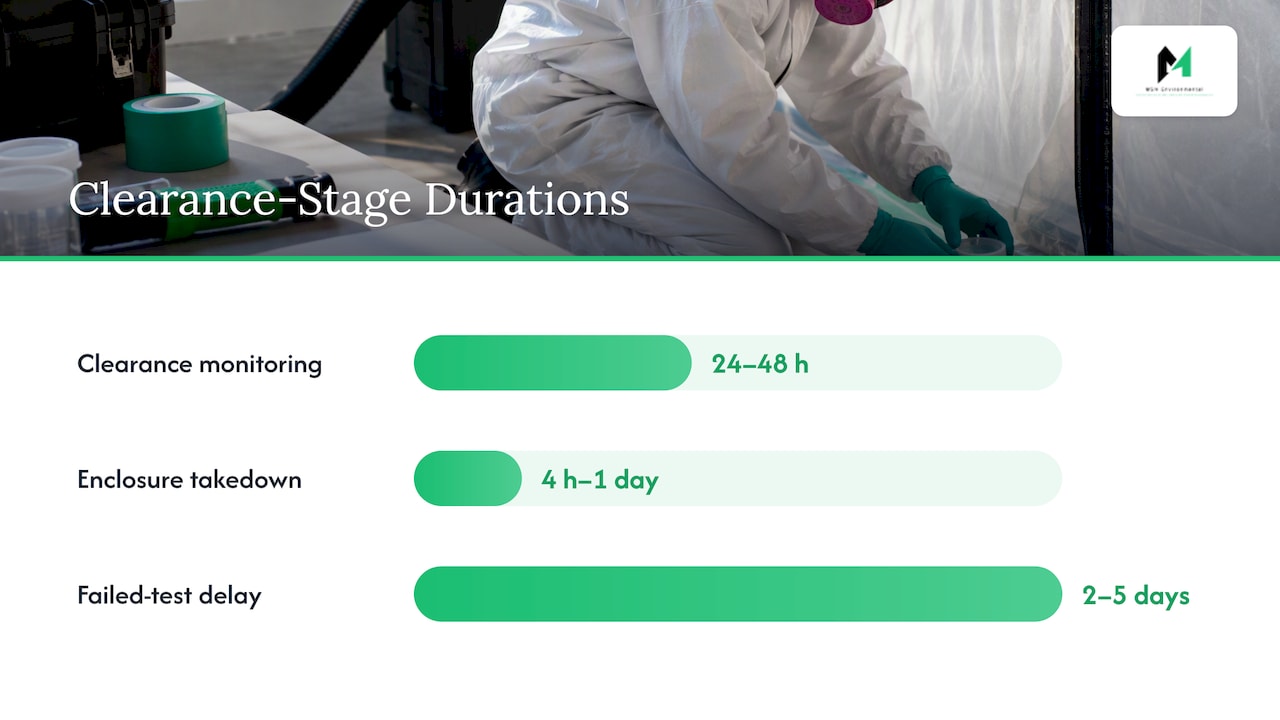
Typical clearance monitoring takes 24 to 48 hours, followed by 4 hours to a day to take down the enclosure. A failed test can add 2 to 5 days. Our asbestos air sampling guide explains what the test measures and how to read the report.
In British Columbia, a qualified person must certify that the worksite air is safe after removal. In general, nobody should move back in, or let trades back in, until that confirmation is in your hands.
What commonly delays asbestos abatement
Most overruns come from a short list of causes, and nearly all can be prevented.
- Demolition before testing. If more suspect material turns up once demolition has started, WorkSafeBC states that work must stop and certified, qualified workers must remove it before work resumes. The same logic applies in Ontario: a stop in the middle of a gut renovation costs more days than a survey would have.
- Late scope changes. If the renovation plan grows after the notice is filed or the enclosure is built, the plan has to be revised.
- Failed clearance. A leak in the enclosure or inadequate cleaning means re-cleaning and retesting.
- Lab and crew availability. Spring and early summer, when renovation season peaks, tend to be busier. Book early.
- Hidden materials. Old floor layers, drywall joint compound and mastic hide where you cannot see them. Thorough surveys catch more of them.
- Access problems. Stored belongings, locked units or occupied rooms slow down setup.
Planning your renovation around abatement
Work backwards from the date you want trades on site.
- Test before you design the renovation, not after demolition begins.
- Allow a week or two for lab results, scope and notice, then a further few days to two weeks for crew scheduling.
- Add the removal days, then at least two days for clearance and teardown.
- Keep a buffer of several days for a failed clearance test or a surprise.
- Tell other trades the abatement finish date is conditional on a passing air test, not on the last bag leaving the house.
This is why many homeowners find it simpler to have testing, abatement and any interior demolition handled by one contractor. The handoffs are where days get lost. If you are unsure whether you need demolition or abatement, our comparison of interior demolition vs abatement explains the difference.
Buying a home and worried about a closing timeline? The asbestos inspection guide for home buyers covers what can be done before closing.
Our perspective on asbestos timelines
The most common mistake we see is treating abatement as a single event. Owners ask how many days the removal takes, when the real question is how many days from the first phone call until the room is usable. The removal is often a small slice of that.
We would rather give you a schedule with honest ranges than a promise that falls apart. The things that most reliably shorten a project are not speed. They are a proper survey up front, a scope that does not change halfway, and a notice filed before the crew arrives. We run abatement under Ontario regulations, with trained technicians, full liability insurance and personal oversight of each job, and we plan the clearance test into the schedule from day one rather than treating it as an afterthought.
If you are deciding between two timelines, the shorter one is not better if it skips the test that tells you whether the air is safe.
— Moacyr
Get a realistic schedule for your property
We provide asbestos removal and asbestos and mould testing, sampling and surveys for homes, businesses and construction projects across Kitchener, Waterloo, Cambridge, Guelph, Hamilton, London and surrounding areas of Ontario. Tell us what you are planning and where, and we will walk you through the sequence, the notice requirements and a timeline specific to your property. You can start at msnenvironmental.com.
FAQ
How long does asbestos abatement take for a typical house?
Most residential projects take about two to four weeks from inspection to clearance. The removal itself usually takes one to five working days. The rest is testing, planning, notices, containment and clearance.
Can asbestos be removed in a day?
Sometimes, for a small and accessible amount of material, once testing is done. Containment setup, clearance testing and teardown still need to happen around it. Plan for the surrounding stages even when the removal itself is short.
When can I move back in or restart renovations?
Only after clearance air testing has passed and the enclosure has been taken down. Testing usually takes 24 to 48 hours after the area is clean and dry. If the test fails, the area is cleaned again and retested, which can add a few days.
Do I need to notify anyone before abatement starts in Ontario?
For Type 3 operations, the constructor or employer must notify the Ministry of Labour before work begins. Your contractor normally files this. Ask them to confirm it is done before your start date.
Can I speed things up by removing the material myself?
We do not recommend it. The CCOHS advises homeowners to hire a qualified specialist rather than remove suspected asbestos themselves. Disturbing it without containment can spread fibres through the house and create a larger, slower clean-up.
Sources
- How Long Does Asbestos Abatement Take? Real Timelines
- CSA Group: Asbestos Management in Canada
- CCOHS: Asbestos in the Home
- O. Reg. 278/05, Designated Substance: Asbestos (ontario.ca)
- O. Reg. 278/05 on CanLII
- Notice of Asbestos Removal Work form
- Alberta Asbestos Abatement Manual
- Manitoba new asbestos regulations
- WorkSafeBC: Submit a Notice of Project
- WorkSafeBC: Licensing and certification for asbestos abatement
- WorkSafeBC: Asbestos
- WorkSafeBC: Asbestos hazards in demolition, renovation and salvage
- Technical guideline to asbestos exposure management
- Eastview Landfill environmental approval document